
Home/Blog/Agent control planes are reshaping enterprise orchestration and governance
Agent control planes are reshaping enterprise orchestration and governance
October 28, 2026
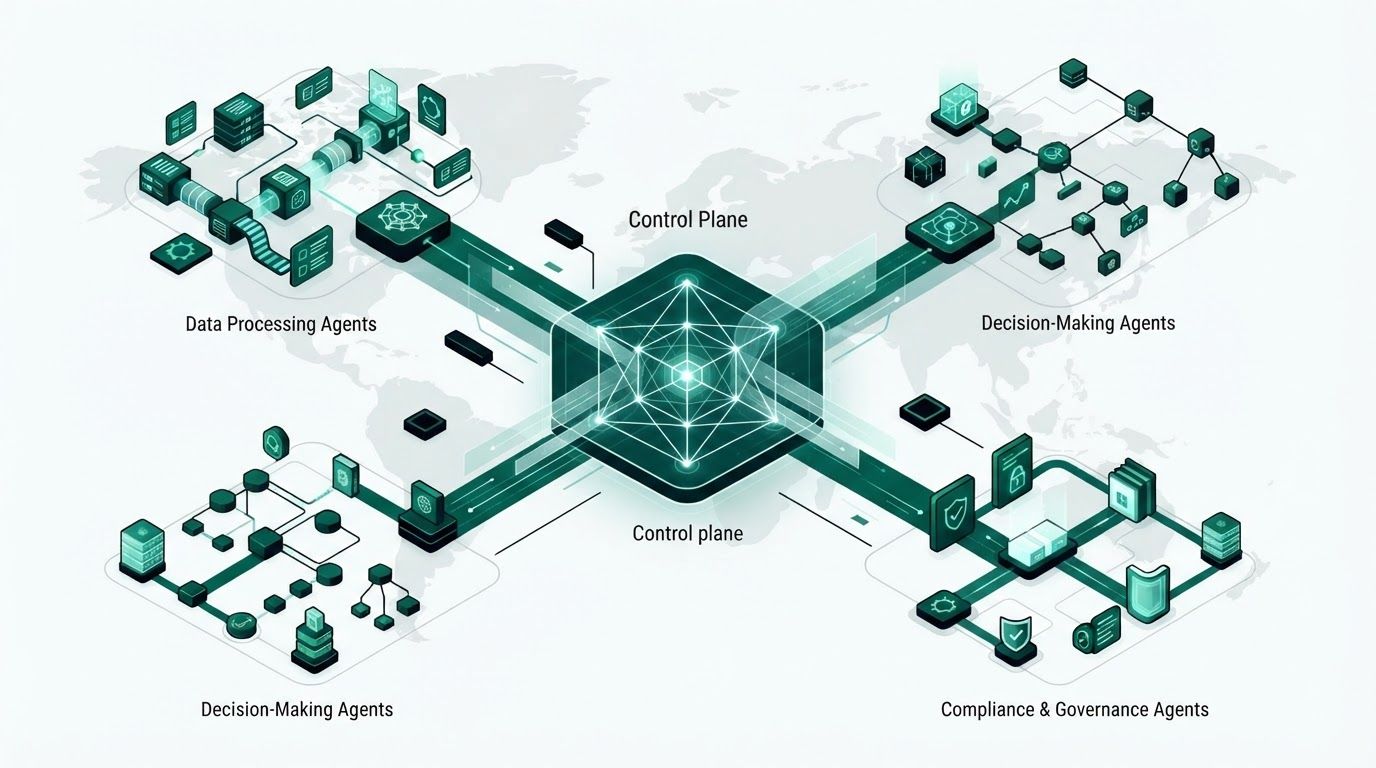
Enterprise teams can build capable AI agents quickly, but operating many of them safely is a different problem. Agent control planes are emerging as the shared layer for orchestrating agent work, applying policy, managing identity and access, collecting operational evidence, and keeping human owners accountable as agents connect to real business systems.
The shift matters because isolated agent applications do not provide an enterprise-wide answer to basic operational questions: Which agent acted, on whose authority, with access to which tools and data, under which policy, and with what result? Vendors including Google Cloud, IBM, Salesforce, WSO2, Boomi, Microsoft, HPE, and NVIDIA are now framing the control plane as production infrastructure rather than an optional administrative feature. For platform engineers and operations leaders, the practical task is to turn that narrative into an architecture that improves control without making useful workflows impossible to ship.
What agent control planes do in enterprise orchestration
Direct answer: An agent control plane is a shared management and governance layer that coordinates AI agents and their tool-backed workflows while centrally enforcing identity, permissions, policies, telemetry, auditability, and operational controls. It separates enterprise control decisions from individual agents’ reasoning and execution.
An agent may reason over a request, call a tool, hand work to a specialist agent, and return an outcome. The control plane should not be confused with the agent itself. It is the layer that establishes the conditions under which the agent can operate and records what happened while it did.
This distinction becomes essential in multi-agent workflows. A routing agent may identify the right specialist, a specialist may retrieve customer or operational data, and another agent may prepare an action in a business system. Without a shared layer, every team must independently implement authorization, secrets handling, policy checks, observability, approval gates, and logging. That produces inconsistent behavior and leaves governance fragmented across applications.
The control plane versus the execution plane
A useful design separates management and enforcement concerns from runtime execution. The execution plane is where an agent runs models, invokes tools, processes context, and completes workflow steps. The control plane defines and mediates the rules that govern that activity.
Identity:
establishes the identity of users, agents, services, and delegated processes.
Authorization:
determines what an agent may access or do, ideally with least-privilege permissions.
Policy:
applies organizational requirements, such as approved tools, data boundaries, action restrictions, and escalation rules.
Orchestration:
routes work, manages handoffs, coordinates workflow state, and supports deterministic paths where they are required.
Telemetry:
captures signals about requests, tool calls, outcomes, failures, and operational behavior.
Auditability:
preserves an understandable record of decisions and actions for operators, reviewers, and regulated processes.
Academic work in 2026 increasingly treats governance as a distinct runtime layer. This is a useful corrective to the idea that stronger prompts or a one-time permission setup can govern an agent throughout a complex workflow. Prompts influence behavior; they do not independently mediate authority. Static permissions can establish baseline access, but they do not by themselves provide context-sensitive runtime controls, replayable evidence, or centralized visibility.
Research on programmable control planes, including KedgeFlow, similarly emphasizes language-independent contracts, trusted controllers, and privileged gateways that can enforce authority independently of agent reasoning. The architectural implication is straightforward: do not depend on an agent to be the final arbiter of whether it is allowed to perform a privileged action.
Why agent control planes are reshaping enterprise governance
The enterprise problem has shifted from demonstrating that one assistant or agent can complete a task to managing a portfolio of agents that use different models, frameworks, deployments, and business tools. Agent sprawl is not simply a discovery issue. It creates incompatible access patterns, duplicated connections, uneven logging, unclear ownership, and policies that vary according to which team built an agent first.
WSO2 describes its generally available Agent Manager as an open control plane for governing agents across frameworks, models, and deployments, specifically addressing enterprise sprawl and sovereignty needs. That positioning illustrates a broad market change: organizations need a management boundary that spans more than a single agent framework or model provider.
IBM makes the same case from an operations perspective. Its watsonx Orchestrate Agentic Control Plane is positioned as a centralized experience for operating, governing, and scaling AI agents across the enterprise, with end-to-end visibility and enforcement. IBM’s October 12, 2026 guidance describes the control plane as a shared management layer that makes work visible, governed, and consistent across the enterprise.
Those claims align with a real governance tension. Decentralized teams need freedom to build specialist workflows close to their business domain. Central platform and security teams need consistent identity, policy, and evidence. A control plane is the architectural mechanism intended to make both possible: local agent development within enterprise-wide boundaries.
Trust is the constraint on scale
Boomi highlights the gap between adoption and confidence. In a Forrester Consulting paper commissioned by Boomi, 86% of leaders said their organizations had moved beyond AI agent pilots, while only 34% said they trust the actions their agentic systems take. The finding does not prove that one specific architecture solves trust, but it explains why governance, observability, and cost controls are moving closer to the center of agent platform decisions.
Trustworthy operation is not achieved by claiming an agent is autonomous. It comes from setting appropriate boundaries, exposing enough evidence to investigate behavior, restricting authority to what is required, and requiring human review where the consequence of error is high. A control plane gives those practices a shared home instead of leaving them scattered through prompts, application code, cloud settings, and individual tool integrations.
Enterprise orchestration needs shared context and controlled handoffs
Orchestration is often described as routing work between agents. In production, it is more demanding than selection alone. The system needs to preserve the right context during a handoff, avoid passing unnecessary sensitive information, maintain a clear chain of authority, and ensure the receiving agent is allowed to use the requested tools.
For a specialist-agent workspace, that means the router should not simply choose the agent with the most plausible name. It should make a decision based on the task, the caller’s permissions, the available approved tools, data boundaries, workflow state, and the risk level of the requested outcome. The handoff should convey task-specific context and provenance, not indiscriminately copy an entire conversation or internal data record to every downstream agent.
Classify the request.
Identify the intended business outcome, risk level, and whether the work is informational, operational, or action-taking.
Resolve the acting identity.
Determine who initiated the task and what authority, if any, is delegated to the agent workflow.
Select an eligible agent.
Route only to agents approved for the domain, deployment boundary, model use, and tool access required.
Constrain the context package.
Pass the minimum context necessary for the next step and retain provenance for material inputs.
Mediate tool calls.
Check each sensitive or consequential tool call against current policy before it reaches the target system.
Record the outcome.
Capture the workflow path, decisions, tool activity, approvals, exceptions, and final result in useful operational telemetry.
Salesforce’s expanded Agent Fabric emphasizes deterministic orchestration and LLM governance in a multi-vendor AI environment. Deterministic orchestration is important because some stages should not be left to probabilistic interpretation. For example, a workflow may require an approved specialist for a regulated process, a mandatory approval before changing a record, or a fixed sequence of validations before a transaction is submitted.
That does not mean every workflow must be rigid. Probabilistic agent reasoning remains valuable for understanding requests, generating plans, interpreting documents, and handling exceptions. The pragmatic pattern is to use flexible reasoning where judgment is useful and deterministic controls where authority, compliance, data access, or irreversible actions are involved.
Governance architecture: identity, policy, telemetry, and audit
Across vendor announcements and research, the recurring governance themes are identity, policy, telemetry, auditability, and least privilege. These are not a checklist to add after agents are deployed. They are architectural dependencies for reliable multi-agent operation.
Identity must persist across delegation
Every important action should be attributable. In agent systems, that may require preserving several related identities: the initiating user, the owning application or team, the orchestrating agent, the specialist agent, and the service identity used to reach a tool. Losing that chain during a handoff creates both a security problem and an operational problem. Reviewers can no longer answer whose authority enabled a particular action.
BCG describes the Enterprise AI Control Plane as a way to unify identity, policy, visibility, and governance, centered on questions such as who the agent is, what it can access, and how it is governed across the enterprise. Those questions should be answerable before production rollout, not reconstructed only after an incident.
Policy should be enforceable at runtime
Runtime policy decides whether an action is permitted in the current context. A policy may account for the agent identity, user delegation, target system, data classification, environment, action type, workflow stage, and whether an approval has been granted. The point is not to encode every decision in a single policy engine; it is to prevent privileged business actions from relying only on the agent’s interpretation of instructions.
VeriWeave Govern proposes evidence-gated deterministic runtime governance as an independent control plane for enterprise execution. Its emphasis on auditable, replayable controls reflects a practical need: if a workflow triggers a high-impact event, the organization needs to know what evidence was evaluated, which gate allowed or denied the action, and whether the control behavior can be examined after the fact.
Telemetry must support operations, not only debugging
Logs that contain raw model outputs but omit workflow identity, tool decisions, policy outcomes, and approvals are rarely sufficient for enterprise operations. Useful telemetry links a request to the agents involved, the tools considered and invoked, the policy decisions applied, and the outcome returned.
This does not require indiscriminate collection of content. Telemetry design must respect privacy, retention, and data-minimization requirements. The key is to retain operationally meaningful evidence while handling sensitive content according to policy.
Use consistent identifiers for workflows, agents, requests, tool calls, and approvals.
Capture allow, deny, and exception decisions rather than only successful calls.
Record policy versions and relevant configuration context for consequential actions.
Define ownership and escalation paths for failures, anomalous behavior, and policy conflicts.
Design retention and access controls for audit data as carefully as for production business data.
How to implement an agent control plane without centralizing every workflow
The goal is not to force all agent development into one monolithic application. It is to provide reusable control capabilities that teams can consume while keeping their domain workflows and specialist agents independently deployable. The strongest initial implementation focuses on a narrow set of shared controls that solve immediate production risks.
Start with an inventory and authority map
Before choosing a platform, identify the agents that already exist or are planned. For each one, document its owner, business purpose, deployment location, model dependencies, connected tools, data categories, inbound callers, outbound actions, and required human approval points. This creates the baseline needed to reason about risk and overlap.
Then map authority rather than merely features. An agent that summarizes a document has a different authority profile from an agent that creates a support case, changes a record, sends a customer communication, or submits a transaction. The control plane should reflect those differences in its access model and escalation design.
Build a minimal shared control path
A practical first release can establish a common path for identity, agent registration, tool access, policy mediation, and event collection. Avoid waiting for a universal abstraction that supports every possible agent framework or workflow. A smaller, enforceable path for the highest-value or highest-risk workflows is more useful than a broad catalog with no consistent controls.
Register approved agents and assign a clear technical and business owner.
Connect agent identities to existing enterprise identity and access structures.
Broker or gateway access to sensitive tools and business systems rather than distributing broad credentials to every agent.
Apply least-privilege scopes that match the actual task and environment.
Add approval gates for actions whose consequences exceed the agent’s authorized autonomy.
Send normalized execution and policy events to the organization’s operational monitoring and security processes.
Microsoft’s governance guidance offers a useful integration principle: agent security should align with existing enterprise control-plane components rather than becoming a parallel security universe. Microsoft points to Azure RBAC, Content Safety in Foundry Control Plane, Defender for Cloud AI threat protection, and Sentinel as parts of that stack. The broader lesson applies even outside Azure: build on established identity, security operations, and monitoring practices wherever possible.
Use progressive autonomy
Not every agent needs the same operating model. Begin with read-only or recommendation-oriented workflows where the impact of a mistake is easier to contain. As evidence of reliable behavior accumulates, expand autonomy for narrowly defined actions with clearly bounded permissions. High-consequence decisions may remain human-approved indefinitely, and that is a sound operating choice rather than a failure of automation.
Real-world enterprise use cases in regulated workloads emphasize shared control over models, tools, workflows, and sandboxes, with scoped permissions, guardrails, audit controls, and human oversight. An effective rollout treats human review as an explicit workflow capability, not an emergency workaround added after an agent behaves unexpectedly.
Choosing a control-plane approach across cloud and agent ecosystems
There is no single control-plane product category with identical boundaries. Some offerings emphasize integrated model, agent, DevOps, orchestration, and security capabilities. Others focus on cross-framework governance, integration connectivity, open management, or alignment with a specific cloud ecosystem. Teams should evaluate the operating model they need, not just the breadth of a vendor’s feature list.
Google Cloud describes Gemini Enterprise Agent Platform as a single control plane for agent development, orchestration, and governance. Google says it evolves Vertex AI by combining model selection, model building, agent building, DevOps, orchestration, and security into one governed stack. In a late-October 2026 post, Google also described pairing Agent Compute Engine with expanded governance across cloud for protected, high-density agents.
That integrated approach can reduce integration effort for teams committed to a cloud platform. The trade-off is that enterprise environments may still need to govern agents and tools beyond that platform. Cross-cloud and multi-vendor requirements should be tested at the level of identity federation, policy consistency, telemetry export, deployment boundaries, and tool connectivity,not assumed from a general claim of openness or governance.
IBM emphasizes centralized operation, governance, scale, visibility, and enforcement. Salesforce positions its Enterprise AI Harness as a trusted foundation that lets agents reason, plan, take action, and operate under enterprise controls without requiring organizations to build and manage those capabilities separately for every agent. Boomi emphasizes secure connectivity to business systems, governance of agent activity, and control of runaway AI costs. WSO2 emphasizes an open control plane across frameworks, models, and deployments. These are different entry points into the same underlying problem.
Questions to ask before selecting a platform
Can the platform represent user, agent, service, and delegated identities throughout a multi-agent workflow?
Can policies be evaluated at runtime before sensitive tool calls and actions occur?
Does it support the models, agent frameworks, deployment environments, and business-system connectors that the organization actually uses?
Can teams apply deterministic orchestration where process requirements demand it while still using model-driven reasoning where appropriate?
Can operational events, security signals, and audit records integrate with existing monitoring and incident-response processes?
Does the platform support data-residency, sovereignty, private-cloud, or deployment constraints relevant to the organization?
How are costs observed and bounded across agent execution, model usage, tools, and workflow retries?
What remains portable if a model, framework, or hosting environment changes?
HPE and NVIDIA frame private-cloud and sovereignty capabilities as production infrastructure for secure, governed agentic AI, including consistent governance over agent execution. For organizations with strict deployment requirements, this reinforces the need to make location, isolation, and operational sovereignty first-class evaluation criteria rather than late-stage procurement conditions.
The limits of agent control planes and the trade-offs to manage
A control plane can improve consistency and visibility, but it cannot make an unsafe workflow safe merely by sitting in front of it. Poorly defined business rules, excessive permissions, low-quality tool integrations, unreliable data, and vague ownership remain risks. Governance infrastructure needs sound process design behind it.
Centralization also has costs. A control plane can become a bottleneck if every team needs manual review for routine changes, if policy authoring is opaque, or if a central group cannot support the rate of agent development. The remedy is not to eliminate shared controls. It is to create self-service guardrails, well-defined policy templates, delegated administration within boundaries, and clear paths for exceptions.
There is also a tension between portability and depth. A highly integrated stack may deliver a more cohesive implementation for its native environment. A framework-agnostic layer may support a broader estate but require more integration work and careful definition of common contracts. The right choice depends on where enterprise complexity actually lives: model and cloud diversity, business-system integration, compliance boundaries, developer experience, or operational ownership.
Finally, a control plane does not remove the need to evaluate models and agents. Content safety, tool-use testing, prompt-injection resilience, workflow validation, and incident response still matter. Governance should be treated as a runtime discipline that complements engineering quality and security practices, not as a substitute for them.
Operating model changes for platform, product, and operations teams
Agent control planes are reshaping organizational responsibilities as much as technical architecture. Platform teams increasingly provide the reusable identity, routing, policy, tool-gateway, and observability capabilities. Product and domain teams own the business outcomes, workflow definitions, acceptance criteria, and user experience. Security, compliance, and operations teams define guardrails, review evidence, and participate in exception and incident processes.
This division works only when ownership is explicit. Every production agent should have a named owner, a documented purpose, an authority boundary, a supported lifecycle, and a path to disable or constrain it when necessary. Shared infrastructure can make governance consistent, but it cannot decide which business owner accepts accountability for a specific automated outcome.
Industry narratives increasingly compare agent control planes to Kubernetes for microservices. The comparison is useful only to a point. Both represent a move from managing isolated workloads to operating a shared platform with standardized controls. But agents introduce additional concerns around reasoning, delegated authority, model behavior, context, and tool use. Enterprise teams should borrow the operational discipline of platform engineering without assuming that agent governance is identical to container orchestration.
The most durable operating model treats agents as managed enterprise workloads with their own runtime characteristics. Teams need release practices, change management proportionate to risk, evaluation before promotion, production telemetry, cost awareness, owner accountability, and incident playbooks. A control plane supplies much of the connective tissue for that model.
Practical takeaways for scaling governed agent workflows
Agent control planes are becoming a category because enterprise agent systems need a shared answer to identity, permissions, orchestration, telemetry, and policy. Google Cloud, IBM, Salesforce, WSO2, Boomi, Microsoft, HPE, NVIDIA, and industry researchers approach the problem from different directions, but the core pattern is consistent: isolated agent applications are insufficient for production-scale governance.
Start with the workflows where agents already touch important tools, data, or decisions. Establish durable identities, least-privilege access, runtime policy checks, controlled handoffs, meaningful telemetry, and human oversight for consequential actions. From there, expand autonomy based on demonstrated operational evidence,not on the assumption that a capable model will govern itself.