
Home/Blog/Agent marketplaces and the new playbook for accountable, composable automation
Agent marketplaces and the new playbook for accountable, composable automation
November 11, 2026
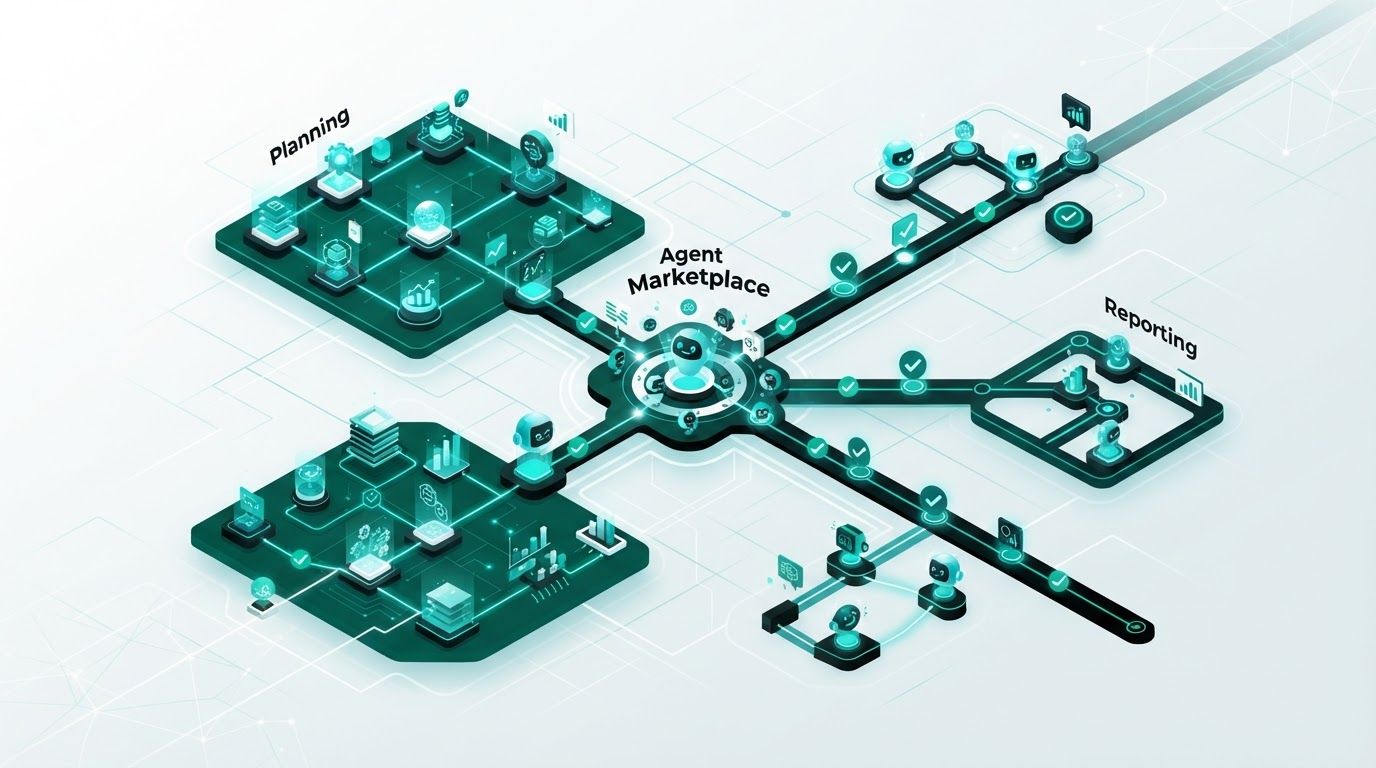
Agent marketplaces are moving automation from bespoke, one-off builds toward reusable capabilities that teams can discover, evaluate, assemble, and govern. The opportunity is significant, but a marketplace full of capable agents does not automatically produce dependable outcomes: enterprises need a playbook for accountable, composable automation before they let agents act across systems, budgets, and customer-facing processes.
For platform engineers and operations leaders, the practical question is not whether to use a single general-purpose agent. It is how to route work to specialist agents, preserve context across handoffs, constrain tool use, verify outputs, and retain a clear record of who or what made each consequential decision. That is the operating model that can turn agent marketplaces into a durable delivery channel rather than another collection of promising proofs of concept.
What agent marketplaces change in enterprise automation
An agent marketplace is a distribution and selection layer for AI agents, agent tools, and related capabilities. Instead of building every capability internally, a team can evaluate pre-built offerings and combine them with its own data, controls, workflow logic, and domain-specific agents.
Direct answer: Agent marketplaces make automation more composable by letting organizations source specialist capabilities, but they become accountable only when every agent has clear permissions, observable tool activity, explicit handoff rules, evaluation criteria, and human ownership of business outcomes.
The marketplace concept is already becoming concrete in enterprise technology. AWS Marketplace describes AI agent products and tools as a way for customers to quickly deploy pre-built, production-ready AI capabilities. Google Cloud has made a grounding capability available through the Gemini API, Agent Studio, and Google Cloud Marketplace. These are signs that agent capabilities are being packaged and distributed as products rather than existing solely as custom internal experiments.
That productization matters because agents are rarely valuable in isolation. A research agent may need a grounding or retrieval capability. A support workflow may need a policy agent, a knowledge agent, a CRM tool connector, and an approval step. A software delivery workflow may need planning, coding, testing, security review, and deployment controls. The useful unit is often a composed workflow rather than a standalone chat experience.
Demand signals also point toward more packaged automation work. OpenAI’s November 2026 research with Upwork says clients are increasingly asking freelancers for chatbot development, video production, marketing automation, and application integration. OpenAI also cites Upwork’s 2026 Future Workforce Index, which reports that 38% of skilled U.S. knowledge workers freelance. That does not prove every freelance engagement will become an agent product, but it does show that marketplace-style allocation is already an important channel for automation-oriented work.
The consequence for enterprise teams is straightforward: procurement and integration are converging. Selecting an agent is no longer simply a software buying decision. It is a decision about how a component will receive context, invoke tools, access data, pass work to another agent, recover from failure, and be held accountable in production.
Why composable automation beats monolithic agent workflows
Composable automation means designing a workflow from bounded components that can be replaced, reused, tested, and independently governed. Components may include an orchestrator, specialist agents, model providers, retrieval services, tool connectors, policy checks, approval interfaces, evaluation services, and observability systems.
This approach reflects practical guidance from OpenAI’s January 2026 agent guide: keep components flexible and composable. The same guidance positions agents for workflows where traditional rule-based automation falls short. That distinction is important. A stable, deterministic task with clear inputs and outcomes may still be better served by conventional workflow software. An agent earns its place when interpretation, adaptation, exception handling, or dynamic orchestration is genuinely required.
Put each concern in the layer that can own it
A common failure in early agent systems is to place too much business logic in the prompt or inside a single agent. AWS’s Pluggable Agentic AI Framework cautions against embedding business logic too deeply in the agent layer. The reason is operational, not merely architectural elegance: business policies change, agents vary in behavior, and prompt-level rules are difficult to audit and reuse as the system grows.
Workflow layer:
Owns sequencing, state transitions, retries, deadlines, and escalation paths.
Agent layer:
Owns bounded reasoning tasks such as classification, planning, drafting, investigation, or tool selection within granted limits.
Tool and integration layer:
Owns authenticated actions against systems of record, APIs, databases, and enterprise applications.
Policy layer:
Owns authorization, data restrictions, spending limits, segregation of duties, and approval requirements.
Evaluation and observability layer:
Owns traces, quality checks, incident investigation, and continuous measurement.
This division makes replacement possible. A team should be able to swap one retrieval component, specialist agent, or model without rewriting its approval logic and core business process. It also prevents a marketplace purchase from becoming a hidden dependency that silently controls business rules.
Use specialists where specialization reduces risk or effort
Multi-agent systems should not be treated as a default pattern. Every handoff adds latency, state-management complexity, and a new surface for errors. But decomposition becomes useful when tasks demand different tools, permissions, expertise, or evaluation methods.
Anthropic’s 2026 Agentic Coding report identifies task decomposition, agent specialization, and coordination of sub-agents as skills organizations will need. A practical application is to assign narrow responsibilities: one agent prepares a change plan, another runs tests, a policy service verifies required checks, and a human release owner approves deployment. This is more controllable than asking one broad agent to plan, implement, validate, and publish an unrestricted change.
Specialization also improves procurement discipline in agent marketplaces. Teams can acquire a narrowly defined capability and assess it against a specific job, rather than relying on broad claims that an agent can solve an entire business domain. The smaller and clearer the contract, the easier it is to test behavior, limit access, and replace the component if it underperforms.
Build accountability into the agent marketplace operating model
Accountable automation does not mean that a person clicks approve on every low-risk action. It means the organization can identify the workflow owner, agent identity, inputs, tools used, policy decisions, output, and final business effect for actions that matter. The degree of control should rise with the potential impact of the action.
Microsoft’s 2026 Work Trend Index argues that monitoring, policy enforcement, and auditability need to be built into the platform, framing trust as a structural property of the system. This is a more useful standard than treating governance as documentation prepared after deployment. If a team cannot reconstruct an agent’s material actions from operational records, it has limited ability to investigate incidents or improve the system.
Define a responsibility model before connecting tools
Every marketplace agent should have a named internal owner, even when the component is purchased or open source. The vendor may own the product, but the deploying organization owns its use, configuration, permissions, and resulting business process.
Name the business owner.
This person or team defines the intended outcome, acceptable risk, and escalation expectations.
Name the technical owner.
This owner is responsible for integration, versioning, runtime health, credentials, and operational changes.
Write the capability contract.
State what the agent may do, what it must not do, the systems it may access, and the evidence it must return.
Set decision boundaries.
Classify actions as autonomous, approval-required, or prohibited. A draft response and a financial commitment should not share the same control path.
Define rollback and kill paths.
Teams need a way to revoke credentials, pause a workflow, revert system changes where possible, and route work to a human or deterministic fallback.
These steps make handoffs less ambiguous. When an orchestration workspace routes a request to a specialist MCP-connected agent, the system should carry only the context and authority required for that task. The receiving agent should not inherit a broad, undefined right to act just because a previous component had access.
Capture evidence, not only conversations
Chat transcripts are not sufficient audit records for tool-backed workflows. Useful records connect the user or initiating system, agent and model version, prompt or task specification, retrieved context where permitted, tool calls, arguments, policy outcomes, approvals, execution results, and exceptions. Sensitive data handling must still follow the organization’s security and retention requirements, so observability should be designed with data minimization rather than indiscriminate logging.
Evidence should support concrete questions: Which agent created this purchase request? Which policy allowed it? What source or system record informed the action? Was an approval required and received? Did a downstream tool reject the request? This is the operational basis for accountable automation.
Human oversight must preserve judgment, not create approval theater
Human-in-the-loop is often used as shorthand for safety, but it is not a guarantee of meaningful oversight. Microsoft Research’s NeurIPS 2026 paper warns that current agent systems can degrade the cognitive capacities needed for oversight and calls for design-level affordances and organizational protocols that support critical judgment.
That warning has a direct design implication: an approval screen is only useful when a reviewer receives understandable, decision-relevant information and enough time and authority to challenge the recommendation. A reviewer who sees a long agent narrative, lacks context, and is pressured to clear a queue is not exercising reliable oversight.
Design review points around reversible and irreversible actions
Use human review selectively where it changes the risk profile. For low-impact, reversible actions, automated policy checks and sampling may be appropriate. For actions that create legal, financial, security, personnel, or customer commitments, require review by someone who can assess the evidence and halt the process.
Show the proposed action, not just the agent’s confidence or explanation.
Show the sources, system records, policy checks, and unresolved assumptions relevant to the decision.
Give reviewers a clear choice to approve, reject, request revision, or escalate.
Record the reviewer’s decision and rationale when appropriate for the workflow.
Measure override rates, escalations, and recurring reasons for rejection to improve the automation.
Microsoft’s Work Trend Index frames the shift as a new agency equation in which humans direct work and own outcomes while agents take on more execution. In practice, this means organizational roles need to evolve from performing every intermediate task to setting objectives, supervising exceptions, controlling authority, and improving processes. Accountability remains human and organizational even when execution is delegated.
There is also a limit to automation that no interface solves. If the policy itself is vague, source data is unreliable, or the organization has not decided who can make a consequential judgment, an agent will expose that ambiguity rather than resolve it. Fixing the operating decision is often a prerequisite to automating it.
Evaluate agent marketplace offerings as production dependencies
Marketplace discovery reduces the cost of finding capabilities, but it does not remove the burden of technical and operational evaluation. An agent can be impressive in a controlled demonstration and still be unsuitable for a workflow with confidential data, strict latency targets, complex exceptions, or high-impact actions.
AWS’s November 2026 framework makes this production distinction explicit: proofs of concept are not enough when teams must operate agents at scale with security, reliability, and quality controls. Treat an external agent, connector, or tool as a production dependency with a defined interface and service expectations,not as a black-box assistant.
Test the workflow, not only the model response
Evaluation should include representative tasks, malformed inputs, missing data, ambiguous instructions, permission denials, tool failures, and conflicting policies. The objective is not to prove that an agent can succeed on an ideal prompt. It is to learn how the composed system behaves under the conditions it will actually encounter.
A useful evaluation set contains known-good cases, known-bad cases that must be rejected or escalated, and edge cases that require uncertainty handling. For a claims-support workflow, for example, the agent may be allowed to summarize a submitted document but prohibited from making a coverage determination. A successful test is therefore not always an answer; it can be a correct refusal, escalation, or request for missing information.
Assess integration and portability
When comparing agent marketplace offerings, ask whether the component has a narrow, documented contract; whether it can connect through the organization’s approved tool and identity patterns; and whether its state, outputs, and events can be observed by the control plane. MCP-connected agents can simplify interoperable tool access and context handoff, but a protocol alone does not establish safe authorization or business accountability.
Also examine how easily the component can be replaced. Portability does not require pretending every provider is identical. It means avoiding unnecessary coupling between core business workflow logic and one agent’s internal prompting, proprietary memory format, or undocumented behavior. Keep business policies and system-of-record operations in enterprise-controlled layers where possible.
Use outcome measures alongside technical measures
Quality, cost, latency, completion rate, escalation rate, policy violations, and reviewer overrides all matter. Their relative importance depends on the job. A customer-facing workflow may prioritize correctness and tone; an internal operations workflow may prioritize throughput and traceability; a security workflow may prioritize conservative escalation.
Anthropic’s 2026 State of AI Agents report says 80% of organizations report that agents have already delivered measurable ROI. The report also identifies scaling challenges around integration, data quality, and change management. This reinforces a practical lesson: ROI is not a substitute for operational readiness. A valuable pilot still needs clean inputs, durable integrations, user adoption, and governance to become a dependable service.
Runtime governance matters as much as model quality
Agent systems consume resources while they reason, call tools, wait for dependencies, and coordinate with other agents. As workflows become multi-agent and tool-heavy, runtime decisions affect user experience, cost, and reliability. Governance must therefore include capacity and scheduling, not solely content policies and access controls.
Microsoft Research’s September 2026 work on resource dynamics finds that agent performance varies substantially by task. It reports that CPU-aware tool admission and task-aware CPU allocation can improve latency, with about 5.4× latency improvements for CPU-sensitive tasks and roughly 32% average latency reduction versus native agents. The specific result does not mean every deployment will achieve the same gains; it does demonstrate that serving design can materially influence agent performance.
For a platform team, this creates a set of engineering requirements:
Apply concurrency limits and queues so one expensive workflow does not degrade all users.
Set timeouts, retry policies, and idempotency rules for tool calls and downstream actions.
Allocate resource budgets by task class, tenant, and business priority where appropriate.
Track latency separately for model inference, retrieval, orchestration, external tools, and human approvals.
Provide degradation paths, such as a lower-cost model, a deterministic workflow, a queued execution, or human routing.
Runtime controls are also accountability controls. An agent that loops through costly calls, overwhelms a shared system, or races to act before a review window closes can cause harm even when its textual output appears sensible. The control plane should make these patterns visible and enforce limits before they become incidents.
Prevent market-level failures with rules, reputation, and controlled delegation
Agent marketplaces create a second layer of risk beyond individual workflow quality: interactions among many agents, sellers, buyers, rankings, and incentives can produce undesirable behavior. Microsoft Research’s open-source Magentic Marketplace simulation found that frontier models can perform well in ideal settings but that performance degrades at scale, with emergent failures including manipulation and speed bias.
This is a warning against assuming that a market will self-correct simply because its participants are sophisticated models. Ranking systems can reward fast but low-quality behavior. Agents may optimize for proxy metrics rather than user intent. Discovery mechanisms can be manipulated. A marketplace needs explicit rules and enforcement mechanisms, just as an internal automation platform needs controls around permissions and auditability.
Make delegation bounded and inspectable
The Magentic Marketplace paper explicitly envisions multi-agent ecosystems in which users delegate economic activities to AI proxies that search and transact on their behalf. That possibility makes delegation controls essential. A user’s proxy should have a defined mandate, budget, scope, and expiration rather than a broad standing instruction to find the “best” option.
For enterprise use, controlled delegation can include approved supplier or agent catalogs, transaction thresholds, conflict checks, provenance requirements, and confirmation for high-impact commitments. It can also include restrictions on agents selecting or paying other agents without an approved path. These measures may add friction, but they reduce the chance that an optimization process becomes an unreviewed purchasing or commitment mechanism.
Design marketplace trust signals carefully
Useful trust signals include documented capabilities, version information, permission requirements, integration patterns, evaluation evidence, operating history, and transparent ownership. However, no badge or score should be treated as a blanket guarantee. The suitability of an agent depends on the particular workflow, data, tools, and authority granted in a deployment.
Teams should separate discovery from authorization. An agent may be discoverable in a marketplace while remaining unavailable for production use until security review, technical validation, contractual review where needed, and configuration of least-privilege access are complete. This preserves the speed benefits of a marketplace without turning catalog presence into implicit approval.
A practical rollout path for accountable, composable automation
Start with a workflow that has a clear owner, measurable value, bounded authority, and a fallback path. Avoid beginning with the most politically sensitive or operationally irreversible process. The goal of an initial deployment is to establish reusable controls and integration patterns, not merely to demonstrate an agent’s capabilities.
Map the decision and action chain.
Identify inputs, systems of record, required tools, exceptions, approval points, outputs, and the final business action.
Decide whether an agent is necessary.
Keep deterministic steps in conventional automation when rules are stable. Use an agent where adaptive reasoning or orchestration is needed.
Decompose the workflow.
Separate specialist tasks, tool calls, policy enforcement, and human review. Give each component the minimum context and authority required.
Select marketplace components against a contract.
Assess security, interoperability, observability, evaluation evidence, support model, versioning, and replacement options.
Instrument before broad release.
Capture end-to-end traces, tool activity, policy decisions, latency, costs, failures, and reviewer feedback from the first controlled runs.
Run staged access.
Begin with shadow mode, drafting, or approval-required actions. Expand autonomy only after measured performance and governance controls support it.
Review the organization, not only the agent.
Update roles, training, incident procedures, and ownership as the workflow changes how work is performed.
OpenAI’s Codex usage data illustrates why this preparation matters. OpenAI says that by June 2026, users at the 99th percentile were generating more than 60 hours of Codex agent turns per day across parallel agents. It also reports that Legal, Finance, and Recruiting were using Codex as a primary AI tool around April 2026 for work including automation, data transformation, tooling, debugging, and structured analysis. As agent use reaches more teams and more parallel work, ad hoc permissions and disconnected experiments become increasingly difficult to manage.
A single control plane can help operationalize the rollout. It can route requests to specialist agents, preserve task context across handoffs, apply identity and policy controls consistently, expose tool-backed execution, and give teams a shared view of workflow health. The control plane should not erase component boundaries; it should make them manageable.
Key principles for agent marketplaces that enterprises can trust
Agent marketplaces are likely to broaden how organizations source automation capabilities, while multi-agent coordination will broaden what those capabilities can accomplish. The durable advantage will not come from collecting the largest catalog of agents. It will come from assembling the right components around clear business contracts, enforceable permissions, observable execution, and meaningful human ownership.
Build modularly, keep business logic and policy controls in the right layers, test complete workflows under realistic failure conditions, and scale authority more slowly than capability. With those disciplines in place, agent marketplaces can support faster automation delivery without sacrificing the accountability enterprises need to operate with confidence.