
Home/Blog/Balancing autonomy and safety: choosing a governance layer for enterprise orchestration
Balancing autonomy and safety: choosing a governance layer for enterprise orchestration
November 20, 2026
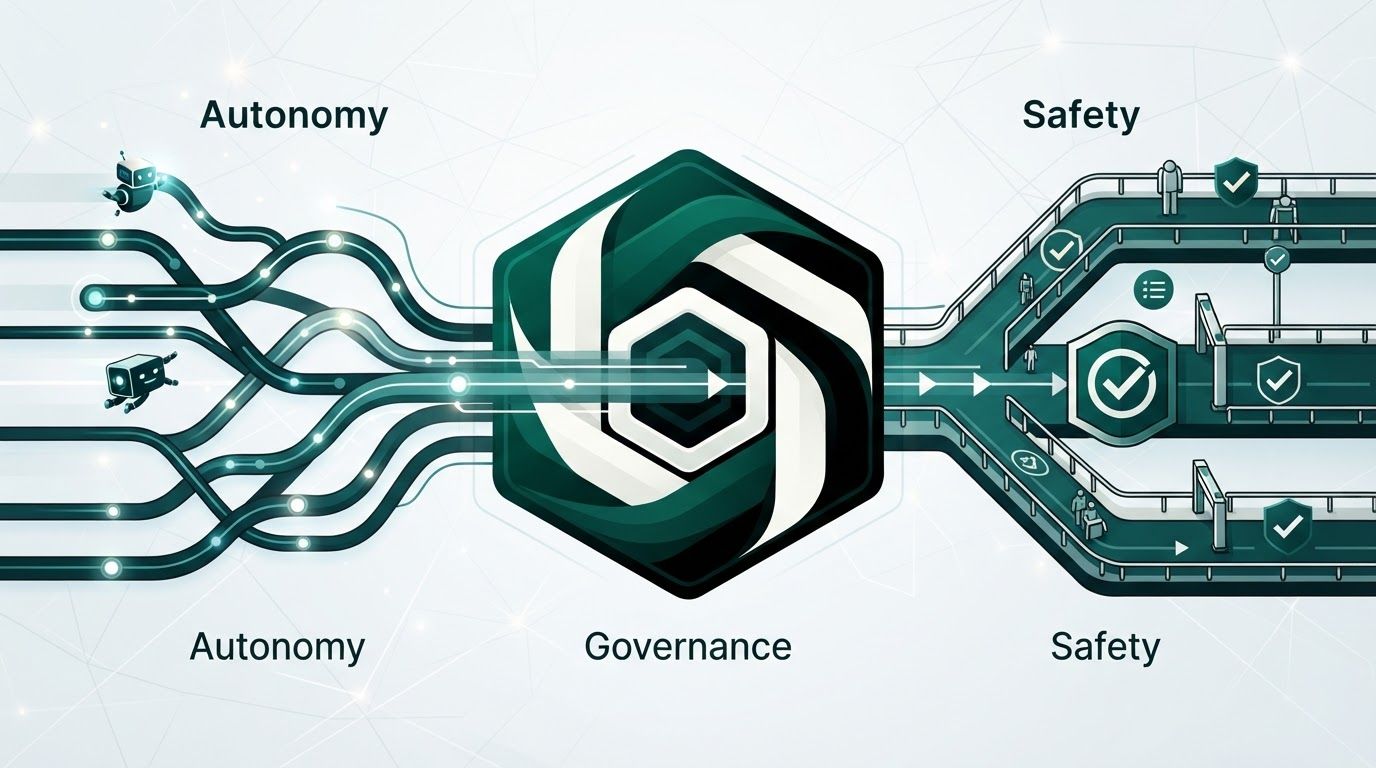
Enterprise orchestration fails when it treats autonomy and safety as opposing objectives rather than design variables. The right enterprise orchestration governance layer lets specialist agents act quickly within explicit boundaries while preserving the approvals, permissions, traceability, and operational control that high-stakes work requires.
The practical question is not whether to centralize every decision or let every team build independently. It is where to place control: at the workflow, tool, identity, policy, runtime, and human-approval levels,and where a lightweight integration is more appropriate than full multi-agent orchestration.
What an enterprise orchestration governance layer should do
Direct answer: Choose a governance layer that centralizes policy enforcement, identity and permissions, observability, approval gates, and lifecycle controls, while allowing specialist agents and business teams to operate autonomously within those guardrails. Use handoffs when ownership should move to a specialist; use agents as tools when a manager must retain control of the outcome.
Enterprise orchestration is often introduced as a routing problem: receive a request, select an agent, invoke tools, and return a result. That is necessary, but it is not sufficient for a production environment. Once agents can access enterprise systems, use tools, retain state, and perform long-running tasks, orchestration becomes a governance hub.
A useful governance layer coordinates autonomous agents and human-in-the-loop work without forcing all business logic into one central agent. AWS Prescriptive Guidance describes this kind of orchestration layer as sitting alongside semantic and intelligence layers, helping make capabilities enterprise-wide rather than isolated in separate teams or applications.
In practice, the layer should make five questions answerable for every consequential action:
Who initiated it?
The system should connect a request to an authenticated user, service, or delegated agent identity.
What is the agent allowed to do?
Permissions, scoped credentials, and policies must define the allowed tool actions and data access.
Why did the system choose this path?
A reviewable workflow specification, routing decision, and relevant context should make the behavior understandable.
What happened?
Teams need logs, traces, tool-call records, outcomes, and operational signals for monitoring and investigation.
What happens when risk rises?
The workflow needs a defined escalation path, such as a human approval, a policy denial, or transfer to a more constrained process.
This is not an argument for a universal control plane that dictates every prompt or workflow detail. It is an argument for common controls where common controls matter. Business units can still own their specialist agents, domain knowledge, and operating goals, provided the platform enforces the standards that protect shared systems and users.
Match the governance model to the autonomy you are granting
The amount of governance should follow the authority an agent receives. An agent that summarizes a document from a user-provided file presents a different risk profile from one that can change production configuration, access customer records, or initiate remediation across a security environment.
Recent guidance converges on bounded autonomy: central governance sets standards, and business units operate independently within those guardrails. This avoids two common failures. A fully decentralized model can create agent sprawl, inconsistent permissions, and unclear accountability. A fully centralized model can make every workflow change slow, forcing teams to work around the platform rather than through it.
Define autonomy as a set of permissions, not a vague capability
“Autonomous” should never be the only description of an agent. For governance purposes, translate autonomy into specific authority: what data it may read, which tools it may invoke, which actions it may propose, which actions it may execute, what spending or impact limits apply, and when it must obtain approval.
These boundaries can vary by environment. For example, an operations agent may be able to inspect production telemetry and draft a remediation plan, but require approval before applying a configuration change. In a lower-risk development environment, that same class of workflow may be permitted to execute a preapproved change automatically.
Use a practical autonomy ladder
Assist:
The agent retrieves, summarizes, drafts, or recommends. A human remains the decision-maker and executor.
Propose:
The agent constructs a plan or tool-call sequence that is reviewed before execution.
Execute within a narrow policy:
The agent can take approved, reversible, and well-scoped actions with logging and defined limits.
Coordinate bounded specialists:
A workflow delegates to agents that each have tightly scoped responsibilities and permissions.
Run long-horizon work:
The system maintains state across extended tasks, with monitoring, checkpoints, escalation, and identity boundaries.
The ladder is not a maturity score. A team does not need to reach the final level for every use case. The correct level is the lowest one that reliably delivers the operational outcome. This is especially important because long-running autonomy creates a need for durable state management and stronger controls around tool use, permissions, and intervention.
OpenAI’s guidance for high-volume, high-stakes workflows positions managed enterprise agent platforms around policies and permissions, system connections, testing, production monitoring, and human involvement when necessary. Those capabilities are the operating conditions for autonomy, not optional administrative features added after an agent proves useful.
Choose handoffs or agents as tools based on decision ownership
One of the most consequential design choices in a multi-agent system is whether a manager delegates ownership of the interaction or retains it. OpenAI’s orchestration guidance frames handoffs and agents-as-tools as a governance choice, not merely an implementation preference.
Use handoffs when the specialist should own the next stage
A handoff transfers control to a specialist. This fits a request that has clearly crossed a domain boundary, such as moving from a general support triage agent to a billing-resolution agent, or from an initial security investigation agent to a remediation specialist.
The benefit is genuine specialization. The receiving agent can own its part of the interaction, apply its domain instructions, and use tools suited to that responsibility. The governance requirement is equally clear: the handoff contract must define what context transfers, what permissions the specialist receives, what it may do, and how it returns or escalates the work.
Use agents as tools when the manager must remain accountable
With agents as tools, the manager invokes a specialist for analysis or a bounded subtask but remains responsible for the final answer or action. This pattern is often better for workflows that need one policy-aware coordinator to reconcile competing inputs, apply a final approval rule, or maintain a unified user experience.
Consider an operations workflow that consults an incident classifier, a dependency analysis agent, and a change-risk agent. The manager may call each as a tool, collect structured outputs, validate policy conditions, and then either request approval or initiate a narrowly authorized action. The manager stays in control of the outcome even though specialists contribute expertise.
Prefer handoffs
when ownership should move, the specialist needs direct control of the next interaction, and the routing boundary is clear.
Prefer agents as tools
when a coordinator must enforce an end-to-end policy, combine results, or remain accountable for the response.
Avoid ambiguous hybrids
where multiple agents appear to own the same decision but no component has a defined final authority.
Neither pattern removes the need for policy enforcement. A handoff should not silently grant broader access than the originating context permits. Likewise, an agent used as a tool should not become an unreviewed path around the manager’s controls. Identity propagation, scoped permissions, and traceable delegation are central design requirements in both cases.
Build policy enforcement below the interface, not inside every prompt
A thin user interface is a useful enterprise pattern. The presentation layer should present the conversation or task experience and pass requests to an orchestration layer below it; it should not become the primary place where access decisions and safety controls live.
This separation matters because users can reach enterprise capabilities through more than one interface: chat, an internal portal, an API, an automated workflow, or another agent. If governance exists only in a particular front end or in a collection of agent prompts, controls become inconsistent and hard to audit.
Separate responsibilities across layers
A robust design assigns different responsibilities to different layers. The exact technology choices can vary, but the separation should remain explicit.
Presentation layer:
Captures user intent, displays status, and communicates requests and results. It should avoid independently making authorization decisions.
Orchestration layer:
Routes work, manages context, coordinates specialists, tracks workflow state, and invokes the required governance checks.
Policy and identity layer:
Evaluates who may perform which actions, under what conditions, with what approval requirements.
Tool and integration layer:
Connects agents to enterprise systems through constrained, authenticated interfaces such as MCP-connected services and other managed integrations.
Observability and evaluation layer:
Records traces and outcomes, supports testing, exposes failures, and supplies feedback for improvement.
Defense in depth is important because no single instruction, classifier, or approval mechanism is sufficient for every failure mode. AWS guidance on pluggable agentic AI frameworks recommends input guardrails together with identity and policy controls. Input protections can screen or shape requests, while policy enforcement determines whether a particular tool call is actually permitted.
The distinction is critical. A guardrail may flag an unsafe request, but a policy engine can prevent an unsafe tool call before execution. OpenAI’s Cogent Security case study describes Agent Policies that define permitted changes and approvals, with a TRACE engine checking tool calls against policy before they execute. For consequential workflows, enforcement at the action boundary is more dependable than relying on instructions alone.
Document policy alongside code. A reviewer should be able to see not only how a workflow is composed but also what it is allowed to do, what approvals it needs, and what conditions block execution. That practice supports safer promotion from prototype to production and reduces the chance that an informal operating assumption disappears during implementation.
Use stateful orchestration for long-running work, with explicit checkpoints
State is not merely a convenience for preserving chat history. In enterprise workflows, state may include the work plan, completed and pending actions, tool results, delegated responsibilities, approval status, user and agent identity boundaries, and the evidence supporting an action.
Stateless APIs can support useful agent experiences, but they place the burden of rebuilding this orchestration layer on the team. OpenAI’s February 2026 Bedrock runtime announcement describes a stateful runtime as carrying memory and history, tool and workflow state, and identity and permission boundaries. That is increasingly relevant when tasks extend beyond a single request-response cycle.
Decide what state is necessary,and what should not persist
Persist only the state required to safely resume, audit, or coordinate work. A long-running procurement, security, support, or operations workflow may need a durable record of its plan, approvals, and tool activity. It does not follow that every piece of conversational context should be retained indefinitely or made available to every downstream specialist.
State design should include data classification, retention expectations, access scope, and the conditions under which a workflow can resume. It should also identify what invalidates prior state. A revoked permission, changed system configuration, expired approval, or new risk signal may require the workflow to re-evaluate rather than continue from an old plan.
Put human intervention at meaningful control points
Human-in-the-loop does not mean asking for approval after every tool call. Excessive approvals create fatigue and encourage bypass behavior. Instead, place intervention at points where a decision changes risk, expands scope, causes an external effect, or cannot be readily reversed.
Review a proposed plan before a workflow moves from analysis into action.
Require approval when the workflow crosses a data, system, or financial boundary.
Pause before irreversible or high-impact changes.
Escalate when the agent encounters a policy conflict, missing information, or low-confidence result.
Require verification before declaring a remediation or business process complete.
This approach supports the operational promise of long-running autonomy without confusing duration with permission. OpenAI’s discussion of enterprise defense links sustained tasks to outcomes spanning investigation through verified remediation. The governing system must therefore preserve not only the task state, but also the evidence, authority, and checkpoints that make sustained execution defensible.
Prevent agent sprawl by choosing the lightest viable architecture
Not every enterprise problem needs a manager agent, a group of subagents, persistent workflow state, and a broad governance program. AWS guidance warns that defaulting to full agent orchestration where an MCP server would suffice adds governance over and consumes tokens unnecessarily.
The decision should start with the operational need, not with an assumed agent topology. An MCP-connected specialist capability may be enough when a user or application needs a constrained, well-defined tool integration. A more elaborate orchestrator is justified when the system must coordinate multiple capabilities, make routing decisions, manage state, enforce cross-cutting policies, or support complex approvals.
Questions that reveal the right level of complexity
Does the task require multi-step planning, or is it a single well-scoped operation?
Does it need more than one specialist, and are their responsibilities genuinely distinct?
Must the workflow retain state across sessions, interruptions, or approval cycles?
Does it access systems with different permission models or risk profiles?
Is there a clear need for a manager to arbitrate, or can a deterministic workflow handle the sequence?
Can the required capability be exposed as a narrow tool with a clear input and output contract?
Answering these questions honestly often produces a simpler design. Simplicity is a governance advantage: fewer delegation paths, fewer credentials, fewer policy intersections, and a smaller audit surface. It also reduces the temptation to create one giant agent that accumulates tools, context, and authority over time.
OpenAI’s governance cookbook specifically advises against one massive agent and recommends layered defenses. A system of narrow specialists can be easier to test and constrain, but only if it has explicit ownership boundaries. Splitting a giant agent into several agents without defining contracts, permissions, and decision rights simply distributes the same risk across more components.
A useful alternative for predictable processes is a deterministic workflow with agentic steps only where judgment or unstructured interpretation is required. That approach can preserve repeatability while still benefiting from specialist reasoning. It also makes the line between workflow logic and model-driven behavior easier to test.
Make workflow specifications reviewable before execution
Specification-driven workflow composition offers a practical way to improve traceability. AWS architecture guidance recommends separating intent, composition, and processing layers so that workflow specifications provide a clear, reviewable description of behavior before invocation.
This separation is particularly valuable when product, operations, security, and platform teams all participate in a workflow. A business owner can describe the intended outcome, a platform team can validate the composition and policy constraints, and a runtime can process the approved workflow without requiring every stakeholder to inspect low-level implementation details.
What a reviewable workflow specification should communicate
The specification does not need to expose every internal prompt or implementation detail. It should, however, make the material behavior visible to reviewers:
the user or system intent being addressed;
the specialist agents, tools, or services that may be invoked;
the permitted data sources and identity context;
the expected sequence, routing rules, and stop conditions;
approval gates and escalation paths;
the policies evaluated before sensitive tool calls; and
the evidence and telemetry required to verify the result.
Reviewability supports change management. If a team adds a new tool, broadens a delegation scope, or changes a remediation path, the effect can be assessed as a workflow change rather than discovered later in production traces. This is especially useful for promotion paths from prototype to production, where experimental flexibility should give way to named owners, tests, monitoring, and governance checkpoints.
Keep model choice, orchestration framework, and deployment target as separable decisions where possible. DXC’s enterprise reference architecture argues that this independence helps avoid re-platforming when one layer evolves. From a governance perspective, separation also reduces lock-in of control logic: policy intent and workflow requirements should not disappear inside a single model provider, runtime, or interface implementation.
Operate the governance layer with testing, observability, and feedback
Governance is not complete when a policy is written or a tool permission is configured. Enterprise leaders are being advised to combine orchestration with measurement and feedback loops to build and scale products safely and efficiently. The operating model needs evidence that controls work in real workflows, not only in design documents.
Test the workflow and the controls together
Traditional application tests remain necessary, but agentic systems also need tests for routing, tool selection, policy denials, delegation boundaries, approval behavior, state recovery, and human escalation. A workflow that produces an acceptable final answer while attempting a prohibited tool call has still exposed a governance issue.
Test cases should include routine paths and adverse conditions: ambiguous requests, missing permissions, conflicting instructions, unavailable tools, stale state, denied approvals, and attempts to exceed a specialist’s scope. The aim is not to prove that a model will never behave unexpectedly. It is to verify that the surrounding system prevents unexpected behavior from becoming an unauthorized action.
Observe outcomes, not just model responses
Production monitoring should connect a user request to routing decisions, agent calls, tool calls, policy evaluations, approvals, and business outcomes. This enables platform teams to investigate failures and gives domain owners the evidence needed to improve workflows.
Useful operational questions include:
Which tools are most often denied by policy, and is the cause an unsafe request, an overly broad workflow, or a poorly designed permission?
Where do workflows pause for human review, and are those gates catching meaningful risks?
Which handoffs lead to completion, rework, or escalation?
Are specialists being called for work that could be handled by a constrained service or deterministic step?
Can teams verify the final operational result, rather than merely confirm that the agent claimed success?
Use this evidence to refine policies, workflow specifications, tool contracts, evaluations, and user experience. A high denial rate is not automatically a problem; it may show that enforcement is working. But recurring denials are a signal to inspect whether intent capture, role definitions, agent boundaries, or approval design need adjustment.
Run the governance layer inside the organization’s existing security posture where possible. OpenAI’s Bedrock runtime announcement emphasizes operation inside the customer’s AWS environment to align with existing security posture, tooling integrations, and governance rules. The larger principle applies across platforms: enterprise controls are strongest when agent runtime decisions connect to established identity, monitoring, and security practices instead of creating a parallel, opaque control system.
Choose a governance layer using a phased adoption path
The best architecture is rarely selected in one procurement or platform decision. Start with a bounded workflow, establish controls that match its actual authority, and expand only when testing and operating evidence support broader autonomy.
Inventory the proposed agent action.
Identify the user, data, tools, target systems, external effects, and reversibility of the workflow.
Set the minimum autonomy level.
Decide whether the workflow should assist, propose, execute a narrow action, or coordinate specialists. Do not grant broader authority for convenience.
Choose the coordination pattern.
Use a handoff when ownership belongs with a specialist; use agents as tools when a manager must retain final control.
Define enforceable boundaries.
Establish identity propagation, tool permissions, policy checks, approval gates, and stop conditions before enabling production actions.
Specify the workflow.
Make intent, composition, processing path, and expected evidence reviewable before invocation.
Test adverse paths.
Validate denials, failed tools, stale state, blocked approvals, and escalation behavior in addition to successful completion.
Instrument and review.
Monitor traces and outcomes, then use feedback to simplify, tighten, or safely expand the workflow.
This phased path supports both platform standardization and domain-team velocity. The central platform can supply reusable identity integration, policy enforcement, observability, evaluation, and deployment controls. Business teams can then compose specialist workflows around their domain needs without repeatedly rebuilding the safety-critical foundation.
There is no universal point at which an organization needs a full governance hub. As with cloud account governance, the value of an orchestration layer grows as the number of capabilities, teams, identities, environments, and operational dependencies grows. The decision should be based on the complexity and consequences of coordinated work, not on the appeal of a more elaborate agent architecture.
Balancing autonomy and safety means making authority explicit, keeping specialists bounded, and enforcing controls where actions actually occur. A capable enterprise orchestration governance layer does not suppress innovation; it gives teams a reliable way to ship useful agents without turning every new workflow into an unmanaged security, compliance, or operations exception.
Start with the smallest workflow that needs coordination, connect it to existing identity and policy controls, and make every consequential tool call traceable and reviewable. As workloads become longer-running and more autonomous, expand the governance layer deliberately,with clear ownership, measurable outcomes, and human intervention at the points where it truly matters.