
Home/Blog/Bridging stateless tool servers for secure, auditable model workflows
Bridging stateless tool servers for secure, auditable model workflows
November 15, 2026
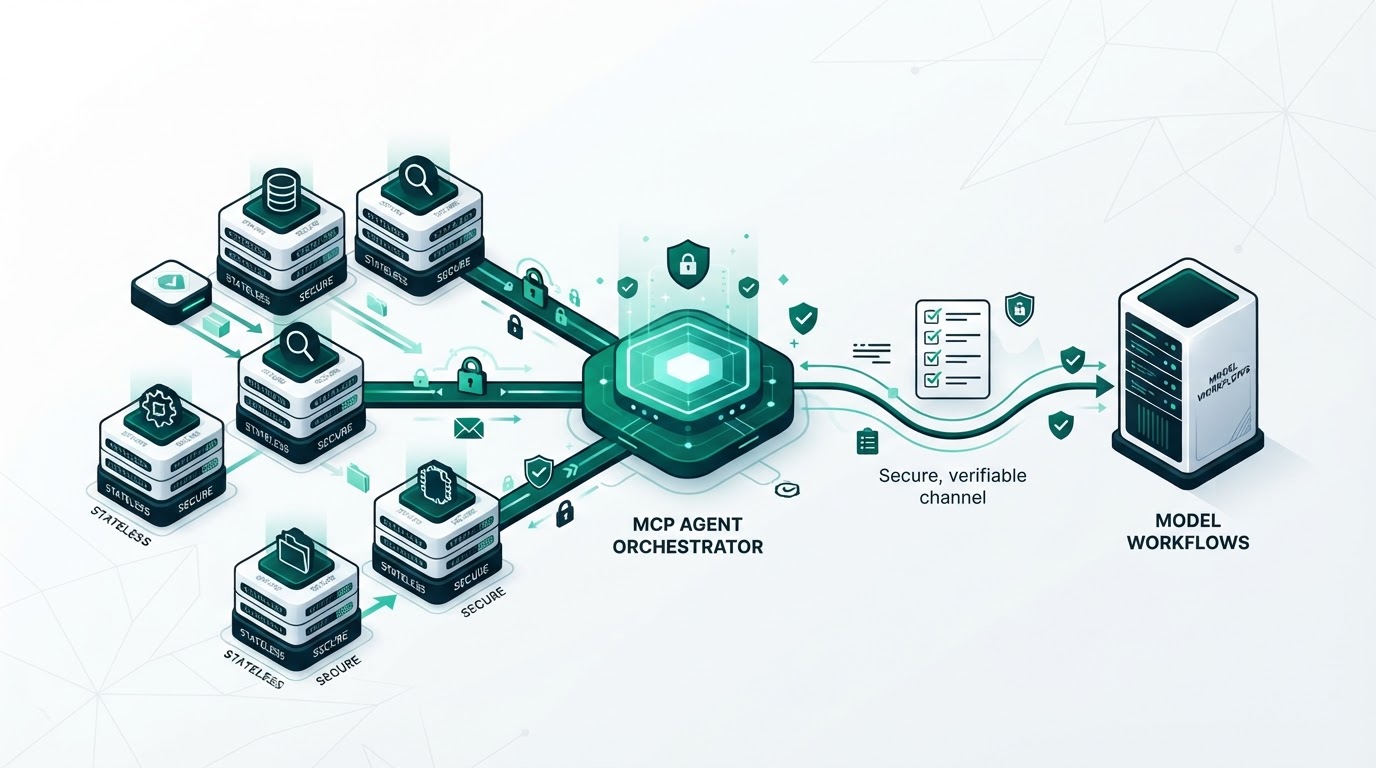
Stateless MCP servers simplify deployment and make it practical to put consistent routing, authorization, and observability controls in front of AI tools. But stateless transport alone does not create a secure, recoverable agent workflow: teams still need a durable workflow layer that owns approvals, identity, state, and audit evidence.
For platform engineers building multi-agent systems, the useful pattern is to bridge stateless tool servers through a policy-aware gateway and orchestrate them from a control plane that persists workflow context. This separates fast, scalable tool invocation from the longer-lived decisions that enterprise workflows require.
What stateless MCP servers solve,and what they do not
The 2026-07-28 Model Context Protocol specification introduced a stateless protocol core. Its design includes er-based routing, cacheable list results, authorization hardening, and a formal extension framework, allowing MCP servers to run on standard scalable infrastructure without maintaining persistent connections or server-side protocol sessions.
In practical terms, a stateless MCP server can treat each inbound request as an independently authenticated and authorized operation. The server does not need to retain a prior initialization exchange to understand the request. The MCP Go SDK describes this model without the initialize and notifications/initialized handshake; protocol version and client capabilities travel with each request in _meta.
Direct answer: Bridge
stateless MCP servers
with a gateway that authenticates and authorizes each request from trusted server-side policy, then connect that gateway to a durable workflow runtime that records identity, approvals, state transitions, tool results, and traces.
This is valuable because a tool server is often best kept narrow. A server that exposes a ticketing action, retrieves a record, runs a deployment check, or calls an internal service should not also become the system of record for a complex agent process. Keeping the server stateless reduces its operational burden while letting it scale behind conventional HTTP infrastructure.
What it does not solve is equally important. Stateless transport does not retain the business context needed to resume a paused workflow, establish whether a person approved a specific high-impact action, reconstruct a failed run, or manage a long-running operation. OpenAI’s 2026 discussion of Bedrock runtime architecture makes a similar distinction: stateless APIs can fit a simple one-prompt, one-answer prototype, while real workflows need approvals, system state, prior-action context, and trusted guardrails.
Stateless tool layer:
receives a request, validates it, executes a bounded capability, and returns a response.
Gateway layer:
routes by ers, applies authentication and authorization controls, and emits enforcement telemetry.
Durable workflow layer:
preserves workflow state, approval records, identity and permission context, recovery information, and an auditable event history.
The boundary is architectural, not merely conceptual. If workflow state is hidden in model prompts, browser memory, or an individual tool server process, recovery and investigation become fragile. The AgentR research paper identifies this broader failure mode in stateless prompt-response wrappers and session-bounded systems, noting that interruption and failure can make those applications hard to recover, audit, and reproduce.
Why er-based routing changes the gateway design
Stateless MCP servers become easier to bridge because the newer protocol moves method and tool names into the Mcp-Method and Mcp-Name HTTP ers. A gateway can use these ers to make routing and authorization decisions without parsing request bodies.
That matters for a shared tool plane. Rather than sending all traffic to one generic proxy path and discovering the intended tool after processing, the gateway has explicit protocol-level routing information early in request handling. It can select an upstream server, apply tool-specific policy, attach trace context, and produce a decision log around the request.
Use ers for dispatch, not as proof of permission
Header visibility improves enforcement placement, but it does not make a client request trustworthy by itself. A caller can claim a method name or request a tool; the gateway still needs to authenticate the caller and decide whether that caller, for that workflow, has the relevant capability. The policy decision must be based on validated identity, server-side grants, and organizational policy.
A sound routing decision can combine several inputs:
The validated workload, user, or service principal behind the request.
The target MCP server and requested method or tool name.
The workflow run, tenant or organization scope, and environment.
A server-side grant or approval for consequential actions.
Operational conditions, such as an allowlisted downstream destination or a required change window.
This lets the gateway enforce a narrow least-privilege path. For example, a research agent may be permitted to call a read-only inventory tool under one organization scope, while a deployment agent may require a distinct principal and an explicit approval grant before invoking a production-changing tool. The model’s text output should not be the authority that broadens either permission.
Cache carefully where the protocol allows it
The stateless specification’s cacheable list results can reduce unnecessary repeated discovery requests. This is useful for information such as a tool list when the deployment can safely manage freshness. It is not a reason to cache authorization outcomes beyond the limits of the organization’s policy, identity lifetime, or approval state.
Tool discovery, authorization, and execution are different concerns. Caching a list response can be efficient; treating a previously observed tool list as enduring proof that a principal may invoke a tool is not. Keep the gateway’s policy evaluation tied to the current request and validated context.
Build a secure bridge for stateless MCP servers
A bridge should be small enough to reason about and explicit enough to audit. Its job is not to infer intent from free-form model text. Its job is to accept a protocol request, establish who is acting, determine the permitted scope, route the request to the correct MCP server, and record the result.
Register each MCP server and tool contract.
Maintain an inventory of approved servers, their ownership, environment, endpoints, expected tools, and permitted organization scopes. This inventory supports routing and gives operations teams a clear review surface.
Authenticate the caller at the edge.
Validate the token or credential intended for the MCP server or gateway. MCP security guidance specifically says servers must not accept tokens that were not explicitly issued for that MCP server.
Bind a principal to the request.
Associate the request with a validated human, workload, or delegated service identity. Preserve the identity chain when an orchestrator acts on behalf of a user, rather than replacing it with an opaque shared agent identity.
Resolve policy from trusted state.
Evaluate the requested method and tool against server-side role, scope, environment, and approval data. Do not allow a model-generated claim, a client hint, or a tool annotation to substitute for policy.
Route using MCP ers.
Use
Mcp-Method
and
Mcp-Name
to choose an approved upstream and the applicable policy path. Reject unregistered destinations or mismatched routing metadata.
Invoke with constrained credentials.
Send only the downstream authorization required for that particular call. Avoid giving a general-purpose agent credential to every tool server.
Capture a decision record and trace linkage.
Record the policy result, scope, approver or grant reference when applicable, target server, tool, outcome, and trace identifiers.
The value of this sequence is that it makes authorization deterministic at the boundary where the action is executed. An orchestration workspace may hand context from one specialist agent to another, but the gateway should independently enforce whether the next tool call is permitted. Context handoff helps work proceed; it should not itself confer access.
Keep the tool server’s responsibility bounded
The tool server should validate the request it receives and enforce its own relevant controls as well. A gateway is not a reason to weaken the server. Defense in depth is particularly important when servers may be untrusted or agents may be compromised; a 2026 GitHub deck on agentic workflows describes a defense-in-depth architecture for precisely those conditions.
At the same time, avoid duplicating an entire workflow engine inside every connector. A server that has to reconstruct multi-step approvals, persist workflow checkpoints, and coordinate unrelated agents becomes harder to operate and less reusable. Keep action-specific validation close to the action, while placing cross-tool process control in the durable orchestrator.
Do not use tool annotations as an authorization system
MCP tool annotations communicate useful behavior: whether a tool is described as read-only, destructive, idempotent, or network-reaching. Those attributes can improve agent planning, UI presentation, and review workflows. They are not security guarantees.
MCP guidance is explicit that clients must treat annotations as untrusted unless they come from a trusted server. More broadly, security materials warn against relying on client-supplied hints or runtime assumptions. A label such as “read-only” is not sufficient evidence that an operation cannot change state, and a label such as “safe” is not a valid basis for bypassing approval.
Use annotations as inputs to a cautious experience, not as final authority:
Show an annotation in the operator interface to explain expected tool behavior.
Use it to request additional review when behavior is potentially destructive or network-reaching.
Verify high-impact permissions with server-side policy and the registered tool contract.
Log annotation values as context, while logging the actual enforced policy separately.
This distinction prevents a subtle class of failures. A model can be influenced by misleading tool descriptions, a client can relay inaccurate metadata, or a server can drift from its intended contract. If the runtime treats metadata as authority, a descriptive field becomes a permission boundary without the controls normally required of one.
Recent research on MCP-style runtimes frames the alternative as explicit, testable invariants: metadata non-authority, grant-backed approval, principal binding, scoped capability invocation, deny-path audit, and explicit protocol state. Whether a team adopts those exact terms or not, they make a strong design review checklist. Each security property should be verifiable in implementation and tests, not merely assumed because an agent was instructed to behave safely.
Put durable workflow state above the stateless tool layer
The most reliable architecture combines a stateless core with durable workflow control. The tool plane stays request-oriented; the workflow plane persists what must survive retries, pauses, handoffs, and investigation.
OpenAI’s runtime discussion identifies the types of context complex agents need: memory and history, tool and workflow state, environment use, and identity and permission boundaries. These requirements do not argue against stateless MCP servers. They explain why tool transport should not be mistaken for a complete agent runtime.
State that belongs in the workflow system
A durable orchestration layer should own records that have meaning beyond one HTTP request. The exact data model varies by organization, but the following categories are usually separate from a stateless MCP server:
Workflow identity:
run identifier, organization scope, initiating principal, delegated agent identities, and environment.
Execution state:
current step, completed actions, pending dependencies, retry conditions, and durable checkpoints.
Approval state:
what action was proposed, the scope and conditions of a grant, who approved it, and whether that grant remains valid.
Evidence:
inputs needed for review, tool outputs or references to retained outputs, policy decisions, and trace correlations.
Recovery data:
enough structured state to resume safely or produce a clear terminal failure when resumption is not appropriate.
For a multi-agent workflow, this layer also makes handoffs concrete. Instead of passing only natural-language summaries between agents, the orchestrator can pass a structured task state that includes allowed capabilities, organization scope, relevant prior results, and the decision that led to the handoff. The receiving agent can use that context to work efficiently, while the gateway still checks every actual tool invocation.
Model approval as a grant, not a chat message
A human approval embedded only in conversation history is difficult to verify later and easy to apply too broadly. Treat approval as a durable, scoped grant connected to a defined action or action class, a principal, an organization or environment, and the conditions under which it is valid.
Then require the gateway to check that grant when the action is requested. This approach aligns with the research invariant of grant-backed approval and reduces the risk that a broad statement such as “go a” is interpreted as permission for unrelated future work. It also produces an audit record that can be inspected without replaying a model conversation.
Make traces and audit records useful for investigations
Observability is not just a reliability feature in an agentic tool environment. It is how teams answer who initiated an action, which agent proposed it, what policy allowed it, which server performed it, and what happened downstream.
The 2026 MCP release-candidate material standardized trace propagation so a tool call can appear as one span tree in an OpenTelemetry-compatible backend across the host, client SDK, MCP server, and downstream calls. The C# SDK further states that W3C trace context propagates through _meta in JSON-RPC messages, allowing the client call and server handling to appear as parent-child spans regardless of transport or session mode.
This makes statelessness compatible with strong request-scoped observability. The absence of a persistent session does not mean requests must be disconnected from their workflow. The orchestration runtime can create or continue a trace; the bridge can propagate the trace context; and each tool server can attach its execution spans.
Separate tracing from the audit record
A trace is excellent for following latency, dependencies, and execution paths. It should be complemented by a durable audit record for authorization and governance. Traces may sample, retain data differently, or optimize for debugging rather than compliance review.
An investigation-ready record should be designed deliberately. OpenAI’s cyber action-plan language emphasizes need-to-know access, anomaly detection, auditability, privileged-access governance, and investigation-ready telemetry across critical surfaces. For an MCP bridge, useful fields include:
Workflow and request identifiers, plus trace and span identifiers.
Authenticated principal, delegation chain, and organization scope.
Target MCP server, method, tool name, and policy version or decision reference.
Approval or grant reference for actions that require it.
Allow, deny, error, timeout, and retry outcomes.
References to protected inputs and outputs, with access controls appropriate to their sensitivity.
Record denied requests as well as successful ones. The proposed invariant of deny-path audit is operationally important: a denial can reveal a compromised agent, an incorrect integration, a missing grant, or an attempted cross-scope operation. If teams only record successful tool calls, they lose part of the security story.
Auditability also needs organization scope. A 2026 paper on regulated cybersecurity workflows argues for a runtime substrate that enforces organization-level scope across retrieval, tools, memory, findings, reports, and audit while remaining model-agnostic and locally deployable. That is a useful requirement for general enterprise agent systems, not only cybersecurity workflows. Scope must remain consistent wherever information or authority crosses a boundary.
Handle long-running work without reintroducing hidden sessions
Stateless request handling is a strong default for many tools, but some operations take longer than a single request-response interaction. The 2026 MCP specification materials address this by introducing Tasks as one of the first official extensions for reliable long-running agents. The extension complements, rather than replaces, the stateless core.
The architectural mistake is to respond to long-running work by quietly storing critical workflow state in a single server’s memory or by keeping an opaque connection open indefinitely. That can make scaling, recovery, and audit harder. Instead, represent asynchronous work explicitly and persist its lifecycle in the workflow layer.
A workflow requests an allowed operation through the bridge.
The MCP server starts or references a task and returns a durable task identity or result appropriate to the extension and tool contract.
The workflow runtime records the task relationship, authority scope, and expected next action.
Later status checks or callbacks are correlated to the same workflow and evaluated under the required policy.
The runtime decides whether to continue, seek approval, retry, compensate, or close the workflow based on
durable state
.
This design preserves the simplicity of a stateless server while giving operations teams a coherent view of work that spans minutes, hours, or multiple specialist agents. It also gives a recovery process somewhere reliable to start after a deployment interruption or downstream outage.
Not every tool should use a long-running task model. A lookup or a short validation may remain a straightforward stateless call. The key is to classify work by its operational lifecycle rather than forcing every interaction into either an open-ended conversation or a one-shot request.
Choose the right stateless mode and migration path
SDK support shows that stateless operation is becoming a first-class deployment pattern. The C# SDK exposes HttpServerSessionMode.Stateless, which selects no sessions and creates a fresh server context for each HTTP request; its session configuration is therefore invoked on every request. The Ruby transport documentation offers an explicit stateless: true option on StreamableHTTPTransport and describes it as suitable for simple tool servers that do not need server-initiated requests.
These details have implementation consequences. With a fresh context per request, servers cannot rely on in-memory session setup being present from a prior call. Authentication, tenant resolution, trace linkage, request validation, and authorization must be available on every request. This is a feature when it leads teams toward explicit inputs and deterministic enforcement.
When stateless servers are a strong fit
Bounded lookups, retrieval, validation, and action calls with clear request inputs.
Horizontally scaled tools where persistent connection management adds little value.
Shared tool platforms that need gateway-based routing and authorization.
Integrations where workflow state already belongs in an orchestration system.
When to add a durable service or extension
Work that must survive interruptions, wait for human review, or resume later.
Operations with a lifecycle that needs visible status, cancellation, retry, or compensation.
Cross-agent processes requiring durable handoff state and reliable reconstruction.
Processes with regulated or organization-scoped evidence requirements.
Migration does not have to be all at once. The SDK beta material says that clients speaking 2026-07-28 can fall back to the older initialize handshake when connecting to servers on 2025-11-25 or earlier. That interoperability supports phased adoption: introduce a gateway and durable audit model, migrate suitable servers to stateless handling, and retain compatibility where older servers remain necessary.
Compatibility is not a reason to retain insecure assumptions. During a mixed deployment, apply the same core rules to both paths: validate intended tokens, bind requests to principals, enforce server-side scope, and maintain trace and audit correlation. The transport and handshake may differ; the trust model should remain explicit.
Operational checks for a secure, auditable tool plane
Before treating a stateless MCP deployment as production-ready, review the full route from agent planning to downstream effect. A secure bridge is not only a proxy configuration; it is an operating model shared by platform, security, and application teams.
Can every request be tied to an authenticated principal and organization scope?
Does policy use trusted server-side grants instead of model text, client hints, or annotations?
Are server and tool registrations reviewed, owned, and restricted by environment?
Can the gateway route from MCP ers without allowing arbitrary upstream destinations?
Are least-privilege downstream credentials used for each tool invocation?
Do workflow records preserve approvals, state changes, handoffs, retries, and recovery decisions?
Do traces link the host,
orchestration layer
, gateway, MCP server, and downstream call?
Are both allow and deny decisions auditable, with access to records limited on a need-to-know basis?
Are long-running operations represented through durable workflow state or supported extensions rather than hidden server memory?
Teams should also test adverse paths. Try an expired or wrong-audience token, a tool request outside the organization scope, an unapproved consequential action, a misleading annotation, a failed downstream call, and a workflow restart after interruption. The result should be understandable enforcement behavior and a record that makes the outcome explainable.
That testing focus is more valuable than relying on a generic claim that an agent is safe. The relevant question is whether the system preserves the required invariants when the model is wrong, an integration is misconfigured, a server is untrusted, or a credential is used in the wrong context.
Stateless MCP servers provide a practical foundation for scalable tool connectivity: each request can be routed on explicit ers, authorized at a gateway, and traced across the tool path. Their simplicity is most effective when it is paired with strict token validation, principal binding, scoped invocation, and policy that does not trust descriptive metadata as authority.
For multi-agent enterprise workflows, keep durable context above the tool layer. Let the orchestration control plane own approvals, workflow state, recovery, organization scope, and audit evidence; let stateless servers execute bounded capabilities; and use traces plus decision records to connect the two. This stateless-core-plus-durable-workflow pattern gives teams a clearer path to scalable operations without sacrificing security or accountability.