
Home/Blog/Building observability and governance into collaborative agent pipelines
Building observability and governance into collaborative agent pipelines
November 4, 2026
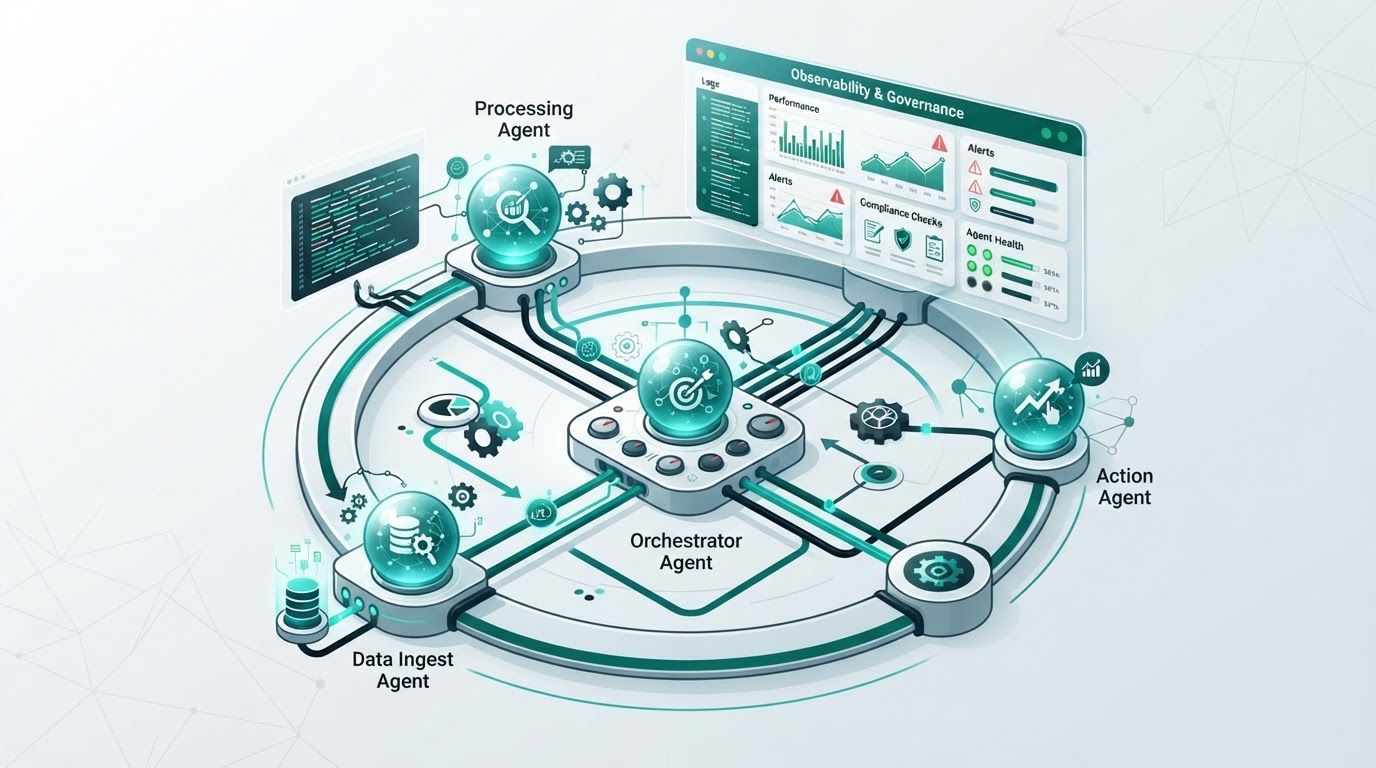
Collaborative agent pipelines become difficult to operate the moment work crosses agent, model, tool, and data boundaries. Building observability and governance into collaborative agent pipelines gives teams a practical way to understand what happened, constrain what can happen, and intervene before an unsafe or costly workflow causes wider impact.
This is not a logging project added after agents reach production. It is an operating design: every agent needs an identity, every consequential action needs a policy decision and audit record, and every handoff needs traceable context. For platform engineers and operations teams, those controls make specialist agents usable as a coordinated system rather than a collection of opaque automations.
Why observability and governance in collaborative agent pipelines must be designed together
A conventional service pipeline often has predictable inputs, a bounded set of dependencies, and code paths that can be tested in advance. Collaborative agents introduce less deterministic behavior. An orchestrator may choose a specialist, a specialist may select a tool, and the tool result may change the next plan or handoff.
That flexibility is valuable, but it changes the control problem. Teams must be able to reconstruct a workflow across model calls, tool invocations, agent hops, approvals, and external side effects. They must also decide which requests should be allowed, denied, escalated, or stopped while the workflow is running.
Governance should answer four operational questions: who the agent is, what it can do, what it did, and what it should never touch.
Google Cloud frames agent governance around those questions, and they are a useful design test for any orchestration stack. If a team cannot answer them for each agent and each run, it has limited ability to investigate an incident, prove a control worked, or safely expand the agent’s scope.
The pressure is already clear at the infrastructure level. In Google Cloud’s 2026 State of AI infrastructure report, 79% of technology leaders named security, governance, or operations as their biggest challenge to scaling inference. The issue is not only model quality. It is whether an organization can operate autonomous, tool-using systems with reliable controls.
Direct answer: the minimum control plane for multi-agent workflows
To build governed, observable multi-agent workflows, give each agent a unique identity; enforce default-deny, least-privilege access at every agent and tool boundary; trace model calls, tool calls, and handoffs with standardized telemetry; retain agent-attributed audit records; and define real-time escalation and credential-revocation paths for anomalous behavior.
This baseline separates useful coordination from uncontrolled agent sprawl. It also creates a foundation for later controls such as semantic policy checks, model-routing rules, budgets, and organization-wide reporting.
Identity:
establish which agent is requesting access.
Authorization:
decide which data, tools, and actions that identity may use.
Observability:
capture the full execution path and performance signals.
Auditability:
retain attributable records of actions and policy outcomes.
Response:
detect unusual behavior and contain it quickly.
Start with agent identity and least-privilege permissions
Do not treat a collaborative agent as a user interface feature or as an anonymous background job. Treat it as a workload with its own identity, permissions, and accountability. Google Cloud describes agent identity in workforce-like terms: each agent receives a cryptographically attested identity, least-privilege permissions, and auditing tied to that identity.
That model is particularly important when an orchestration workspace routes work to specialist MCP-connected agents. A research agent, a database agent, a support agent, and a deployment agent should not inherit one broad capability set merely because they participate in the same user workflow. Shared context does not require shared authority.
Define authority by agent role
Begin by listing the roles in a pipeline and the actions each role must perform. Include the orchestrator rather than assuming it is harmless. The orchestrator can often select tools, delegate tasks, or pass sensitive context, so it needs explicit constraints too.
Assign a stable identity to every orchestrator and specialist agent.
Map each identity to only the models, MCP servers, APIs, datasets, and environments required for its role.
Issue short-lived or tightly scoped credentials where the underlying platform supports them.
Separate read, write, execute, and administrative permissions rather than relying on a single broad grant.
Require an approval or a differently privileged execution path for high-impact actions.
Default-deny is the useful starting condition. Google Cloud emphasizes the need to secure non-deterministic interactions across agents, tools, models, skills, and data while maintaining least privilege across distributed runtimes. In practice, that means an unfamiliar agent-to-tool relationship is blocked until a policy explicitly permits it.
Keep human identity separate from agent identity
A user may initiate a workflow, but that does not mean every later action should appear as if the user performed it. Google says Gemini agent activity is written as agent-attributed audit data, not person-attributed activity. That distinction preserves accountability when an agent chooses, sequences, or retries actions on its own.
Good records can preserve both relationships: the initiating user or service, the agent that performed the action, the agent that delegated it, and the target system. This makes it possible to answer whether an action was authorized by a user request, allowed by an agent’s role, and performed by the correct workload identity.
Instrument the complete agent execution path with OpenTelemetry
Logs alone rarely explain a collaborative run. A failure may begin with a routing decision, emerge in a model response, become visible in a tool call, and affect a downstream agent after multiple handoffs. Distributed traces connect those events into an execution narrative.
OpenTelemetry is becoming a standard for this problem. Google Cloud says its agent observability provides OTel-compliant metrics, logs, and distributed traces using agentic semantic conventions, with telemetry for every model call, tool invocation, and agent hop. That breadth is essential for debugging and auditing multi-agent workflows.
What a useful trace should capture
Use a workflow or run identifier as the top-level correlation key, then propagate trace context through orchestration, agent delegation, model inference, MCP tool calls, retries, and callbacks. A trace should reveal both the path taken and the control decisions that shaped it.
Workflow ID, parent workflow, initiating principal, and runtime environment.
Agent identity, role, version, and the reason for a handoff where available.
Model provider or route, model identifier, request outcome, latency, and token-related measurements where supported.
Tool or MCP server identity, requested operation, authorization result, duration, retry behavior, and side-effect status.
Policy evaluation result, applicable rule or policy version, and approval state.
Error class, cancellation reason, fallback path, and final workflow outcome.
The aim is not to capture every raw prompt or tool payload indiscriminately. Those fields can contain confidential data, customer information, credentials, or internal reasoning artifacts that should not become broadly accessible telemetry. Build a data-handling policy for observability itself: minimize sensitive collection, redact or tokenize protected values, enforce access controls, and set retention rules that match operational and compliance needs.
Traditional orchestration signals still matter. Google Cloud release notes mention DAG callback success and failure counters in Orchestration Pipelines, illustrating how pipeline monitoring is extending into agentic orchestration. Track run success, failure, latency, retries, stalled handoffs, and callback outcomes alongside agent-specific signals. A workflow that completes is not necessarily one that acted appropriately, but a workflow that cannot be measured is hard to improve or govern.
Put policy enforcement at agent, tool, and network boundaries
Identity says who is making a request. Policy enforcement decides whether that request is acceptable in its current context. In a multi-agent system, enforcement should not depend on one check at the initial chat or API boundary because a later delegation can create a materially different risk.
Google describes Agent Gateway as an AI network firewall and control plane for traffic between clients, agents, and external systems, enforcing policies in real time. Its stated Agent Sandbox model places each Gemini agent inside its own network boundary, with traffic in, out, and between agents passing through Agent Gateway under organization policy. Whether a team uses that specific platform or another architecture, the design principle is valuable: control the paths where agents communicate and act.
Layer policies rather than relying on one broad rule
A durable policy model has several layers. Each layer should make a focused decision and emit its result to the trace and audit trail.
Ingress policies:
validate caller identity, tenant context, request class, and input constraints.
Delegation policies:
limit which agents can call each other and which context fields can cross the handoff.
Tool policies:
constrain the operations, resources, methods, and parameters a given agent may invoke.
Data policies:
determine which sources may be queried, returned, stored, or sent to another runtime.
Egress policies:
restrict external destinations, outbound requests, and data transfer paths.
Execution policies:
require approval, a change window, or additional verification for sensitive actions.
Semantic governance adds a needed layer beyond fixed allowlists. Google Cloud documentation describes semantic governance policies as an extra security layer that helps ensure agent actions match user intent and organizational constraints. This matters when a request may be syntactically valid but inappropriate in context, such as a request to use an approved database tool for an unapproved purpose.
Semantic controls should complement deterministic authorization, not replace it. A policy that depends on interpretation can be helpful for intent alignment and risk classification, but it should not be the only barrier protecting production systems or sensitive data. Deterministic identity, scope, network, and API controls remain the hard boundary.
Make audit trails useful for investigations and operations
An audit trail is more than a record that a workflow ran. It should establish a defensible chain from request to decision to action. When an incident occurs, security, platform, and application teams should not have to manually join disconnected application logs, cloud audit records, and tool histories before they can determine what happened.
Record consequential actions in an immutable or appropriately protected audit system, while linking them to observability traces. The trace helps engineers understand timing, dependencies, and failures. The audit record supports accountability: which agent acted, under which authority, against which target, with what outcome.
Audit the decisions, not only the side effects
A database write, ticket update, message send, or deployment trigger needs an audit entry. So do the decisions that explain why it was allowed. Capture the delegated authority, applied policy, relevant approval, and any exception or override.
This is especially important for agent handoffs. If a coordinator passes a task to a specialist, retain the delegation event, the permitted scope, and the context classification. That allows reviewers to distinguish an expected transfer from an unauthorized expansion of responsibility.
Useful audit questions include:
Which agent identity performed the action, and which principal initiated the workflow?
What resource, tool operation, or external system did the agent target?
Which policy decision allowed, blocked, or escalated the request?
What context and permissions were delegated at each handoff?
Did the action complete, fail, retry, or produce a partial side effect?
Was a human approval required, requested, granted, or bypassed through an authorized exception?
Do not confuse extensive audit data with good governance. An audit trail that cannot be searched by agent identity, workflow ID, target resource, policy result, or time window will slow response when it matters. Design retrieval workflows before an incident: establish owners, access paths, investigation queries, and evidence-retention requirements.
Monitor behavior in real time and define containment before an incident
Post-incident analysis is necessary, but it is not enough for agents that can query databases, read email, or trigger API calls. Google characterizes agents as “ultimate insiders” because of this broad potential access. The operational goal is to identify anomalous behavior while a workflow can still be stopped or contained.
Google explicitly calls for real-time monitoring of logs to detect unusual activity early. Google Cloud’s 2026 AI risk reporting, which includes Mandiant guidance, likewise emphasizes embedding guardrails into the software pipeline, monitoring agent behavior in real time, and neutralizing compromised workflows before lateral impact occurs.
Define behavioral signals that matter to your environment
Start with rules that have clear operational meaning rather than trying to classify every unusual model output. Examples include a new tool relationship, access to an unfamiliar data domain, an unusual burst of delegated work, repeated authorization denials, unexpected cross-environment requests, or tool calls that exceed a workflow’s normal sequence.
Signals need context to avoid producing unmanageable alerts. Compare an agent’s behavior with its declared role, the current workflow type, the tenant or environment, its approved tools, and the active change window. A deployment agent calling a deployment API may be normal; a documentation agent attempting the same action deserves immediate scrutiny.
Create a containment runbook
Teams should decide in advance what automated controls can do and which cases require human review. The response should be proportionate to the risk and reversibility of the action.
Pause the current agent run or block the specific tool and egress path.
Preserve trace and audit evidence, including policy decisions and the active identity bindings.
Notify the workflow owner and the appropriate security or operations responder.
Assess whether the behavior is an expected change, a configuration error, a compromised credential, or a policy gap.
Resume with a documented exception, revise the policy, or revoke the identity and credentials.
High-fidelity signals can justify stronger action. The AI risk report recommends pre-authorized responders be able to revoke agent service identities and OAuth tokens when guardrails are bypassed. Emergency revocation is disruptive, so it requires careful ownership and testing, but it is more credible when the organization has already defined the authority, evidence threshold, and recovery path.
Use routing and cost controls as governance mechanisms
Governance is often discussed only as security, but model selection and spending are also control-plane concerns. An agent pipeline may make many inference calls across planning, specialization, retries, evaluation, and summarization. Without attribution, teams cannot tell which workflow, tenant, agent, or model route is creating cost.
Google says upcoming Agent Gateway capabilities will support token management, spend attribution, budget guardrails, and a single source of truth for token metrics. It also describes model-routing policies as a way to send user and agent requests to the appropriate model for performance and cost control.
For a platform team, the practical move is to define routing policy alongside access policy. A low-risk extraction task may use a different approved model route than a task involving sensitive internal context or a high-impact decision. A workflow nearing a budget threshold may need a smaller model, a lower-cost route, a pause, or an explicit approval,not an invisible continuation.
Set budgets at the organization, team, workflow, and agent levels where the platform allows it.
Attribute token and model usage to the same workflow and agent identifiers used in traces and audits.
Use routing rules that reflect task requirements, data constraints, latency needs, and approved providers.
Alert on unexpected usage patterns, repeated fallback behavior, and rapid retry loops.
Review whether costly steps actually improve task outcomes before standardizing them.
Cost guardrails have limits. A budget does not make an unsafe action safe, and a low-cost model is not automatically appropriate for a lower-risk task. Still, clear routing and usage policies prevent cost from becoming another invisible side effect of autonomous coordination.
Build governance into the delivery lifecycle, not just the production runtime
The safest time to discover that an agent cannot be observed, constrained, or audited is before it receives production access. OpenAI’s deployment guidance says governance and data foundations should be in place before scaling agents, and its engineering guidance recommends building guardrails first and expanding responsibility iteratively.
That approach fits collaborative systems well. Begin with a narrow task, a small tool set, and a clearly defined failure boundary. Validate observability, policies, handoffs, and recovery behavior before adding more agents or granting access to more consequential systems.
A practical release sequence
Define the workflow contract.
Document the intended task, permitted agents, tools, data classes, side effects, and stop conditions.
Implement telemetry first.
Confirm that a test run produces connected traces, usable logs, metrics, policy events, and agent-attributed audit records.
Test denials and failures.
Verify that an unapproved tool call, malformed handoff, unavailable dependency, and expired credential produce safe, observable outcomes.
Evaluate behavior before release.
Datadog describes LLM observability as useful for debugging agent operations before production release, and Google Cloud highlighted its ADK integration for evaluating responses and validating changes quickly.
Release with narrow authority.
Use limited environments, controlled datasets, lower-impact actions, and approval gates where needed.
Expand iteratively.
Add tools, agents, data access, or autonomy only after reviewing evidence from real runs and revising the controls.
Versioning is critical. Treat prompts, agent instructions, tool schemas, policy bundles, model routes, and orchestration definitions as deployable artifacts. An investigation is much more reliable when a team can determine exactly which agent configuration and policy version governed a past run.
Shared agents can improve workflows over time, as OpenAI notes in its approach to team-use workspace agents. But shared improvement should not mean uncontrolled changes. Establish owners for each agent, a review path for capability expansion, and tests that confirm a change does not broaden access or remove telemetry.
Scale the operating model across runtimes without losing control
Enterprise pipelines rarely live in one isolated runtime. Teams may run agents in cloud services, cross-cloud environments, local devices, SaaS tools, and internal networks. Google Cloud says it is extending agent governance across cloud, multicloud, and managed endpoints, reflecting the need for policies that travel with the agent interaction rather than stopping at one infrastructure boundary.
Centralization does not have to mean one monolithic execution engine. It means central standards for identity, policy, telemetry, audit fields, and incident response, while specialist teams retain freedom to build agents appropriate to their domains. Looker’s agentic workflows, for example, are designed with a centralized workflow management interface to balance flexibility and enterprise control.
Use a common control-plane contract across runtimes: consistent identities, standardized trace propagation, a shared event vocabulary, policy decision records, and an inventory of approved agents and tools. Google’s Agent Registry concept points to the importance of knowing what agents exist, who owns them, what they are allowed to do, and where they run.
This also reduces shadow AI and agent sprawl. Google warns that weak governance can lead to shadow AI, data exfiltration, and agent actions that are difficult to track and audit. An accessible approved path,where teams can register an agent, attach identity, connect telemetry, and request scoped capabilities,usually works better than relying on prohibition alone.
Useful takeaways for governed agent orchestration
Collaborative agents should be governed like workforce identities, not treated as scripts with a chat interface. Give every agent a distinct identity, default-deny permissions, observable handoffs, agent-attributed audit records, and policy enforcement close to the tool and network boundaries where real consequences occur.
Then operate the pipeline as a living system: monitor it in real time, test containment and credential revocation, attribute usage and cost, and expand autonomy only after controls work in narrower scopes. That discipline gives platform, product, and operations teams a clearer path to ship specialist agent workflows without sacrificing accountability or operational visibility.