
Home/Blog/Building resilient broker layers for stateless model tool integrations
Building resilient broker layers for stateless model tool integrations
October 4, 2026
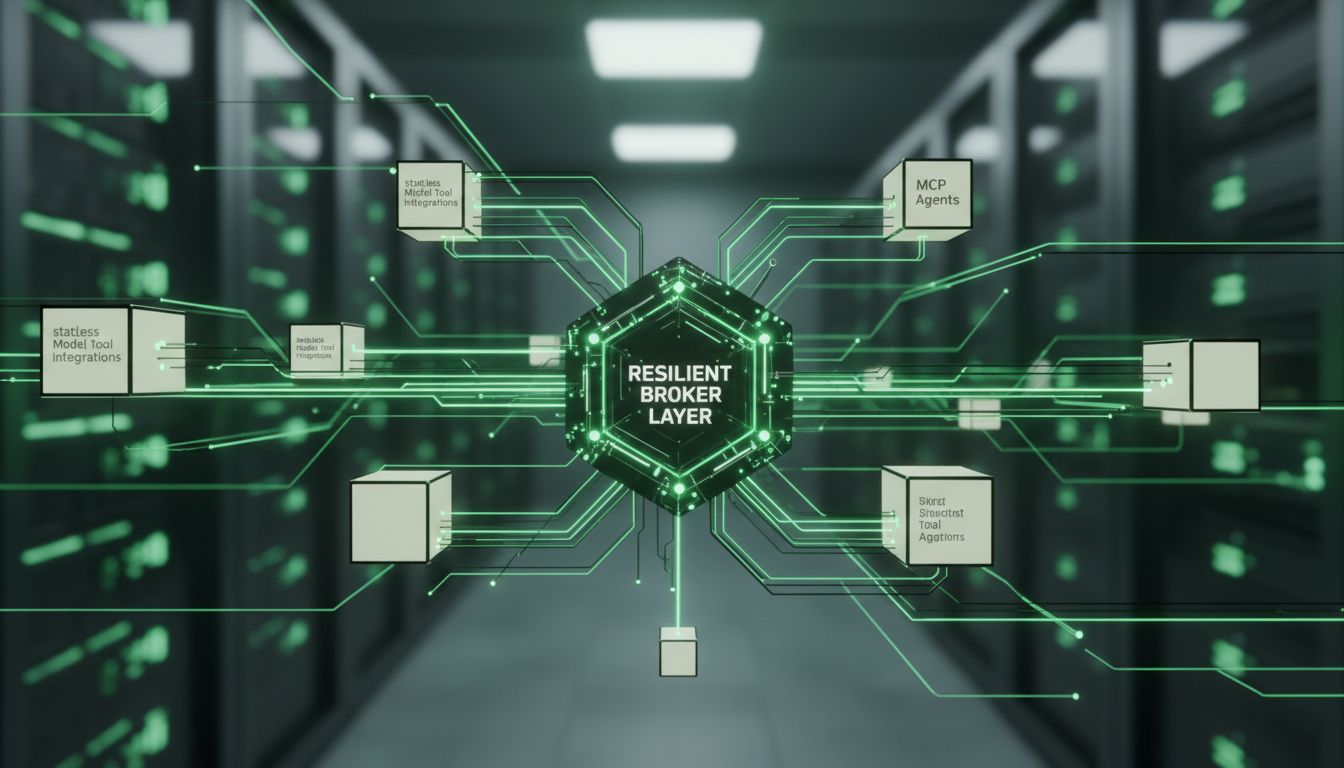
Stateless model tool integrations are easy to prototype and difficult to operate safely at scale. A resilient broker layer gives agents a controlled path to discover, authorize, invoke, observe, and recover from tool calls without binding every model or agent directly to every downstream system.
The central design decision is straightforward: keep agents and MCP servers as stateless as practical, while making the broker responsible for the durable operational concerns that stateless requests do not solve on their own. That includes identity, policy, context continuity, routing, retries, audit evidence, and isolation when an individual tool degrades.
What a resilient broker layer does for stateless tool integrations
A broker layer is an intermediary between an agent runtime and the APIs, services, MCP servers, data systems, or enterprise applications the agent can use. It is not merely a proxy. In a production design, it is the control point that turns a model-selected tool call into an authorized, observable, bounded, and versioned operational action.
Direct answer: Build a resilient broker layer as a centralized tool gateway with a shared registry, protocol adapters, runtime identity brokering, policy enforcement, routing, observability, and fallback controls. Keep tool invocation contracts explicit, isolate complex execution behind dedicated services, and avoid placing credentials or governance logic inside individual agents.
This matters because a stateless request does not inherently retain the information needed to make safe decisions across a workflow. The application may need to reconstruct conversation state, attach the caller’s authorization context, determine which tool version is valid, enforce data policy, and correlate the call with previous actions. OpenAI notes that stateless APIs require an application to build the supporting orchestration layer for agents. The broker is a practical place to concentrate much of that supporting layer.
AWS now describes a tools gateway as a centralized broker for tool discovery, security, versioning, routing, and invocation. That framing is especially useful for enterprise agent systems: direct agent-to-tool connectivity might work for a narrow prototype, but it distributes operational responsibility across every agent, tool owner, and integration path.
For stateless agent systems, the broker should own control and continuity concerns; tools should own their business operation; agents should decide what to request within the boundaries the broker enforces.
This separation makes the system easier to reason about. The agent is responsible for selecting an action based on the task and available contract. The broker verifies whether the action is permitted and determines how to execute it. The downstream tool performs a focused operation and returns a structured result. No component needs to become a hidden, all-purpose owner of orchestration, permissions, and business execution.
Why direct agent-to-tool calls fail as integrations multiply
The issue with direct calls is not that they are always wrong. For a single internal tool, a short-lived experiment, or a tightly scoped workflow, direct connectivity can reduce initial implementation work. The problem is the multiplication effect: every new agent-to-tool pairing creates another place to manage contracts, credentials, policies, network paths, failure handling, and telemetry.
Without a shared registry and standard protocol, integration sprawl becomes an operational problem rather than a code organization problem. AWS recommends a single authoritative catalog and protocol-based interoperability instead of hardcoded integrations because each new tool otherwise adds burden and failure risk.
Where integration sprawl becomes visible
Tool discovery becomes inconsistent.
Different agents may expose different versions, descriptions, or schemas for the same business capability.
Authorization becomes fragmented.
Each agent must independently decide how to obtain and apply user or workload permissions.
Secrets spread into application paths.
Tool-specific credentials can end up in agent configurations, environment variables, or code that should not hold them.
Failure behavior diverges.
One integration retries aggressively, another returns an opaque error, and a third silently falls back to stale behavior.
Audit reconstruction becomes expensive.
Operators have to join logs from agent runtimes, client applications, tool services, and identity systems after an incident.
Change management slows down.
A tool schema or endpoint change requires tracing every embedded dependency rather than updating a governed integration surface.
Stateless APIs intensify these gaps. When each request stands alone, the system needs an explicit method to restore the relevant workflow context and security context. It also needs a consistent correlation identifier that follows a request from the user-facing application through the agent runtime, broker, and downstream service.
A broker does not eliminate all complexity. It relocates shared complexity to a layer that can be designed, tested, observed, and governed once. That is a favorable trade when many specialist agents share access to a growing set of tools.
The alternative is not necessarily a single giant gateway. A platform can use federated domain brokers, provided they implement common contracts and report to a shared registry and audit model. The important distinction is between deliberate, standardized delegation and uncontrolled point-to-point integration.
Design the tool registry and contracts before adding routing logic
Reliable routing starts with a reliable description of what may be routed. A shared tool registry should be the authoritative catalog for tools available to the platform. It gives agent builders, operators, and policy systems a common record of a tool’s purpose, owner, protocol, version, required scopes, schema, data classification, operational limits, and lifecycle status.
Protocol-based interoperability is important here. MCP compatibility is increasingly relevant for tool brokers, and AWS Marketplace guidance notes that APIs, Lambda functions, and existing services can be converted into MCP-compatible tools. A protocol boundary does not make every integration identical, but it prevents every consumer from needing a bespoke client integration.
Define contracts that a model and an operator can both use
Tool descriptions should be written for two readers: the model deciding whether a tool fits the task, and the engineer diagnosing a production outcome. Descriptions need a precise purpose, known constraints, and clear parameter semantics. Vague names such as process_request produce ambiguity; a bounded capability such as create_purchase_order_draft communicates intent and risk.
OpenAI’s tooling guidance recommends explicit return contracts through output_schema and documentation of error behavior. This is valuable beyond any one provider. A broker needs structured outputs to apply policy, route outcomes, render useful results to agents, and distinguish business rejection from transport failure.
Describe the input boundary.
Define required and optional fields, accepted formats, sensitive fields, and validation rules.
Describe the result boundary.
Specify the success payload, stable identifiers, partial-result behavior, and machine-readable status.
Describe error behavior.
State whether an error is retryable, whether the request may have been applied, and what safe next action exists.
Version deliberately.
Preserve compatible contracts where possible and make version selection visible in the registry rather than implicit in agent prompts.
Attach ownership.
Every production tool needs an accountable service owner and a defined deprecation path.
Do not overload a single tool with unrelated actions simply to reduce the number of entries in the registry. Broad tools make least-privilege authorization harder and give the model too much room to select a risky operation. Smaller, purpose-built operations are easier to authorize, test, observe, and retire.
There is also a practical context-window consideration. If an application has many functions or large schemas, OpenAI recommends pairing function calling with tool search so that only tools actually needed are loaded. A broker can support this pattern by filtering registry results based on the workflow, user permissions, domain, and current task rather than exposing the entire enterprise catalog to every agent.
Build a secure tool gateway with identity and policy at the service layer
Security belongs in the broker because individual agents are not a dependable enforcement boundary. Agents can vary by model, prompt, deployment, owner, and implementation maturity. A central gateway can apply the same authentication, authorization, inspection, and audit rules no matter which agent initiated a request.
AWS’s Agentic AI Lens recommends that tool invocations be authenticated, authorized to least privilege, and fully auditable at the service layer rather than per agent. This design reduces the chance that an agent implementation accidentally becomes the only protection around a sensitive operational tool.
Broker identity rather than distributing credentials
A secure credential broker retrieves credentials at runtime without exposing them to AI applications, according to AWS security guidance. In practical terms, the agent should communicate its workload identity and the relevant end-user or service context to the broker. The broker then obtains or exchanges the minimum credential required for the specific downstream call.
This is stronger than embedding a shared API key in each agent configuration. It supports revocation, scoped access, rotation, and attribution. It also reduces the blast radius if an agent runtime, prompt configuration, or development environment is compromised.
Authenticate the calling application or agent workload.
Carry user or service delegation context where the business operation requires it.
Authorize the requested tool and operation against least-privilege policies.
Retrieve or mint downstream credentials only at invocation time.
Prevent credentials from appearing in tool descriptions, model context, or ordinary application logs.
Record the identity decision and granted scope in the audit trail.
Make policy enforcement independent of agent code
Policy must govern more than permission to call a tool. It may need to inspect tool arguments, classify data, enforce allowed destinations, prevent unsafe operations, or require an approval step. Google Cloud’s Agent Gateway update describes runtime enforcement that can inspect LLM inference requests and MCP tool calls and apply data loss prevention policies without code changes. The architectural lesson is that policy is most effective when it is externalized from every agent implementation.
A policy engine should have enough context to make a meaningful decision: caller identity, delegated user identity where applicable, tool name and version, requested operation, arguments or their classifications, environment, destination, and workflow state. It should return a clear allow, deny, transform, or escalate outcome. A denial should be structured so an agent can choose a safe alternative rather than repeatedly retrying a prohibited action.
Centralized connectivity also supports this boundary. Recent AWS architecture guidance for regulated environments uses inspection layers, DMZ-style routing, and centralized third-party connectivity patterns to control traffic before it reaches integration points. The exact network topology will vary, but the design objective remains the same: do not let every agent establish unrestricted routes to every external system.
Preserve workflow continuity without making every component stateful
Stateless does not mean context-free. It means durable state is not assumed to reside inside every request handler or tool server. A resilient broker needs a defined continuity strategy so that tool calls can be connected to the correct conversation, workflow, approval state, identity context, and prior result without relying on in-memory agent state.
OpenAI’s function-calling documentation describes tool calling as a multi-step conversation between an application and a model. Its current guidance also supports continuing stored or stateless requests with conversation state. The broker therefore needs to understand its place in a larger interaction loop even if the broker itself remains horizontally scalable and stateless between requests.
Use references, not hidden session assumptions
A sound pattern is to pass stable references with each call: a workflow identifier, correlation identifier, idempotency key, caller identity reference, policy context reference, and a pointer to any authorized conversation or state record. The broker retrieves only the information needed to evaluate and execute the operation.
This differs from retaining a mutable session inside a gateway instance. A request can land on any healthy broker instance because the authoritative state is externalized to an appropriate workflow, conversation, identity, or audit store. That approach supports scaling and makes failover less dependent on a particular process.
Decide where the agent loop belongs
There are several valid ownership models for the loop that interprets model output, invokes tools, feeds results back, and continues until completion. An application can own it, a platform orchestration runtime can own it, or a managed provider runtime can own part of it. OpenAI states that the Agents API can run the agent loop and that Programmatic Tool Calling runs in an OpenAI-managed agent harness, reducing how much orchestration the application must own.
Managed orchestration can reduce implementation effort, but it does not remove the need for enterprise control around downstream tools. Teams should still determine where authorization, credential brokering, outbound connectivity, audit retention, and policy enforcement occur. In many architectures, the managed runtime drives the loop while a customer-controlled broker remains the governed boundary for internal and third-party operations.
For multi-agent workflows, context handoff should be explicit. A specialist agent should receive the task-relevant state and permitted tool set, not an uncontrolled copy of every prior message, credential, or internal result. The broker and orchestration workspace can jointly enforce that narrower handoff.
Engineer failure isolation, fallbacks, and idempotent recovery
A broker becomes resilient not when it promises that every tool will always work, but when a tool failure stays contained and produces a safe, understandable outcome. AWS warns that without a shared registry and common fallback behavior, each new tool failure can risk broader agent outages. The broker is the appropriate place to make failure handling consistent.
Start by distinguishing failure classes. A schema validation error should not be retried. A policy denial should not be retried. A temporary downstream timeout may be retryable, but only when the operation is safe to repeat or protected by an idempotency mechanism. A completed operation with a lost response requires reconciliation, not blind resubmission.
Use bounded behavior for each downstream dependency
Timeouts:
Set explicit deadlines that reflect the operation, user experience, and downstream service expectation.
Retries:
Retry only transient failures and only with bounded attempts, backoff, and idempotency protection.
Concurrency controls:
Limit simultaneous requests to a degraded dependency so one tool cannot exhaust broker capacity.
Circuit breaking:
Stop sending ordinary traffic to a dependency that is repeatedly failing, then allow controlled recovery checks.
Fallbacks:
Return a known safe alternative, deferred-workflow state, or human escalation path when the business process permits it.
Isolation:
Keep separate execution pools, routes, or service boundaries for tools with distinct risk and performance profiles.
Fallback should never mean inventing an answer when a tool was required to establish a fact or execute a transaction. A safe fallback may be to state that the action is unavailable, create a review task, use an approved read-only source, or defer a non-urgent operation. The broker should expose which path occurred so the agent and user experience do not mistake degraded behavior for a successful tool result.
Idempotency deserves special attention for stateless invocation. If a network interruption occurs after a tool receives a request, the broker may not know whether the operation completed. An idempotency key tied to the intended business action lets the downstream service recognize a safe replay. If the service cannot support idempotency, the broker should favor status lookup or reconciliation over automatic retry for side-effecting operations.
Stateless architecture also helps limit resource exhaustion. AWS WAF and Shield documentation describes stateless SYN-proxy mitigation as a way to absorb large floods without state exhaustion. A tool broker is not a network SYN proxy, but the resilience principle transfers: avoid tying broad system capacity to per-request in-memory state when a dependency or traffic burst can create pressure.
Separate lightweight MCP access from heavy tool execution
Stateless MCP servers are an accepted architectural pattern for lightweight tool access. AWS certification guidance explicitly mentions Lambda functions for implementing stateless MCP servers, while contrasting them with ECS-based MCP servers for more complex tools. This supports a useful design split: use a lightweight stateless protocol edge where it fits, and move sustained, complex, or specialized execution to an appropriate backend service.
The broker should not become the place where all business logic runs. Its primary role is mediation and control. Heavy document processing, long-running jobs, complex transformations, persistent connections, or domain-specific computation may need a dedicated execution service with its own scaling profile and operational ownership.
A practical layered architecture
Agent and client layer:
A user-facing application or orchestration workspace routes work to specialist agents and handles the interaction experience.
Broker or gateway layer:
The gateway discovers approved tools, validates contracts, evaluates policy, brokers identity, routes calls, and emits telemetry.
Protocol adapter layer:
Adapters translate MCP or other agent-facing protocols to the downstream interface required by the target system.
Execution layer:
Stateless functions serve lightweight operations; containerized or dedicated services handle complex, long-running, or high-control workloads.
Control-plane services:
Registry, identity, memory or state references, policy, and audit services provide shared governance.
This layered model aligns with AWS Bedrock AgentCore’s separate build-layer components such as Gateway, Identity, Memory, Policy, and Registry. It also aligns with recent AWS partner architecture describing a protocol gateway that supports MCP and A2A on the client side while translating to runtime, gateway, and tool backends.
The trade-off is added architecture and operational ownership. A small team with one low-risk integration may not need every layer on day one. However, teams should avoid treating an early direct integration as the permanent platform pattern. Establishing a registry, stable contracts, central identity, and common telemetry early prevents a costly migration when specialist agents and tools proliferate.
Operate resilient broker layers with end-to-end observability
A stateless path is only debuggable if every component emits connected evidence. AWS recommends a single audit trail linking the gateway, agent runtime, and downstream tools, together with distributed tracing across agent boundaries. That means logs alone are not enough: operators need shared identifiers, trace propagation, structured events, and a way to understand the policy and routing decisions that shaped an invocation.
At minimum, trace a request from its user or upstream workflow through model tool selection, registry resolution, authorization, credential brokering, policy evaluation, transport, downstream execution, result transformation, and response delivery. Avoid recording sensitive arguments or outputs indiscriminately. Observability data must follow the same data-handling rules as the workflow it describes.
Record decisions, not just errors
The most difficult production question is often not “Did the tool return an error?” It is “Why was this tool selected, allowed, routed to this version, and presented with these arguments?” A useful audit event captures the decision chain without unnecessarily exposing sensitive content.
Correlation and trace identifiers linking the agent, broker, and tool path.
Caller workload identity and delegated principal reference when applicable.
Selected tool, contract version, registry source, and destination class.
Policy decision, applicable rule reference, and whether data controls transformed or blocked the request.
Routing target, attempt count, latency, timeout state, and fallback or circuit-breaker outcome.
Structured result status, including whether the operation completed, was denied, deferred, or requires reconciliation.
Use this data to improve the platform, not only to respond to incidents. Repeated schema validation failures can indicate a poor tool description or agent instruction. Frequent policy denials may reveal an over-broad tool exposure model. Timeouts concentrated in one integration can justify a different execution boundary or a tighter concurrency limit.
Operational review should include the registry as well as runtime telemetry. Remove obsolete tools, verify owners, review scopes, identify duplicate capabilities, and test the actual behavior of fallback paths. A registry that is technically centralized but operationally stale creates a different form of risk: agents may discover interfaces that are no longer appropriate to use.
Adopt the broker incrementally without rebuilding every tool
A resilient broker layer does not require rewriting every existing API or service. Existing APIs, Lambda functions, and services can be exposed as MCP-compatible tools where appropriate, while adapters preserve the existing downstream interface. The migration objective is to centralize the control plane first, then improve individual tool contracts and execution boundaries over time.
Start with the highest-value control points
Inventory current integrations.
Identify which agents call which tools, how credentials are handled, where contracts live, and which operations create side effects.
Create an authoritative registry.
Register a small set of high-value tools with owners, schemas, versions, scopes, and lifecycle status.
Place a gateway in front of sensitive operations.
Prioritize systems involving customer data, financial actions, external connectivity, or irreversible changes.
Introduce runtime identity brokering.
Remove static downstream credentials from agent applications where feasible.
Standardize structured outputs and errors.
Add explicit schemas, status categories, and idempotency expectations to the most-used tools.
Add tracing and audit correlation.
Ensure an operator can follow a request across agent, broker, and tool boundaries.
Test failure paths.
Validate timeout, denial, unavailable-tool, partial-completion, and recovery behavior before relying on automation.
Do not begin by exposing every internal API to agents. Start with narrow capabilities that have clear business value, defined ownership, and a manageable authorization model. Use tool search and contextual filtering to keep the model-facing catalog lean, especially where schemas are large or the full enterprise inventory would create selection ambiguity.
The most successful operating model is usually shared: a central platform team owns the broker foundations, security integrations, registry standards, and telemetry conventions; domain teams own their tool behavior and contracts; product and operations teams define the approval, escalation, and user-experience requirements around consequential actions. That division supports specialist agents without forcing every team to become an identity, networking, and observability expert.
A resilient broker layer is the practical foundation for stateless model tool integrations: centralize discovery and governance, broker identity at runtime, make contracts explicit, isolate failures, and trace every consequential call. The result is not a claim that agent workflows are risk-free; it is a system where risk, ownership, and recovery behavior are visible and intentionally controlled.
As the tool catalog grows, treat the broker as a product with clear interfaces and operational standards rather than as a thin routing utility. That approach lets teams add MCP-connected agents and tool-backed workflows from a shared control plane while preserving the security, reliability, and governance expected of enterprise integrations.