
Home/Blog/Coordinating autonomous AI collaborators for resilient enterprise orchestration
Coordinating autonomous AI collaborators for resilient enterprise orchestration
September 15, 2026
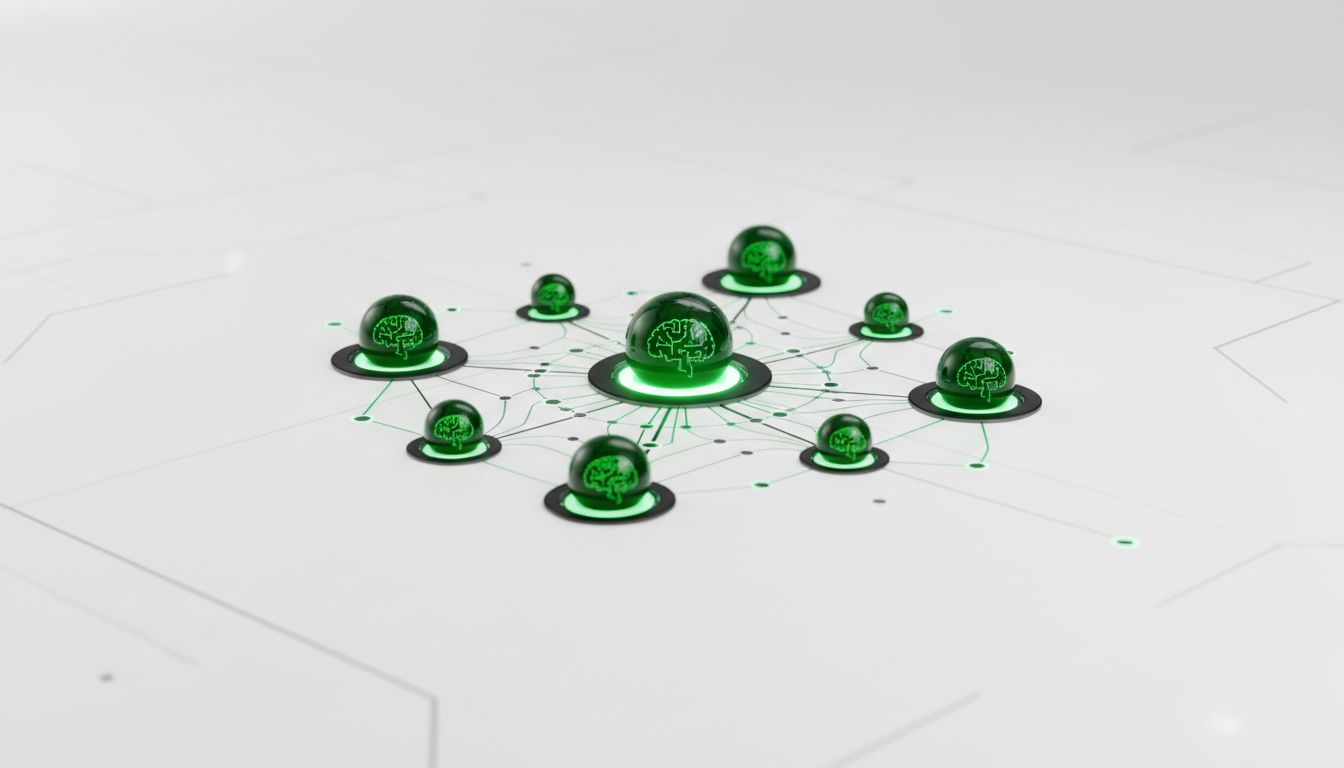
Coordinating autonomous AI collaborators for resilient enterprise orchestration is no longer primarily a prompt-design exercise. Enterprise teams are increasingly connecting specialist agents to business systems, data sources, code environments, and one another. The operational challenge is to let those collaborators make useful progress while preserving context, enforcing permissions, recovering from failure, and giving people a credible way to understand what happened.
A capable model is necessary, but it is not the orchestration layer. Production workflows span multiple steps, multiple tools, and often multiple owners. An AI agent orchestration workspace that routes work to MCP-connected specialists, transfers the right context, and executes tool-backed workflows from one control plane can turn isolated agent demos into a governed operating system for execution. Resilience comes from the architecture around the agents: explicit goals, durable state, bounded autonomy, observable handoffs, and safe recovery paths.
Why resilient enterprise orchestration needs coordinated collaborators
Enterprise work rarely arrives as a single, self-contained request. A procurement exception may require policy retrieval, supplier-data validation, risk review, approval routing, and an update to a system of record. An incident response may need telemetry analysis, runbook lookup, change-impact assessment, a controlled remediation action, and a status report. Assigning every step to one generalist agent creates an oversized trust boundary and makes failures harder to isolate.
Specialist AI collaborators provide a more realistic design. One agent can focus on retrieval, another can inspect structured data, another can propose an action, and a coordinator can decide whether the evidence is sufficient to continue. This is not simply parallelism for its own sake. It is decomposition: each agent gets a constrained goal, an appropriate tool set, a defined input contract, and a known escalation route.
Durable work is the normal enterprise workload
A 2026 open-access article on enterprise agentic architectures describes workflows that commonly need six to twenty tool interactions with persistent intermediate state. That profile differs substantially from a short chat exchange. It requires a system to preserve artifacts, correlate tool results, survive delays, and resume without asking an agent to reconstruct the entire task from an unreliable summary.
The same article argues that benchmarks often under-represent enterprise orchestration because they reward short reasoning traces rather than persistent, multi-step operations. Platform teams should therefore evaluate orchestration on production-relevant behavior: can a workflow pause safely, can it retry a failed connector, can it retain evidence, and can an operator reconstruct the chain of decisions?
Specialization:
route work to agents with limited, purpose-built capabilities.
Coordination:
pass structured context and artifacts rather than ambiguous narrative alone.
Durability:
retain state across long-running work, interruptions, and context windows.
Control:
apply policies and approval gates where an action changes a real system.
Observability:
record goals, handoffs, tool calls, outputs, and recovery events.
OpenAI’s enterprise guidance explicitly includes “or even other agents” as tools. That framing matters because it treats multi-agent orchestration as a supported design pattern, not a workaround in which agents communicate through unstructured chat. A collaborator can be invoked as a bounded capability, with defined inputs and outputs, just as a workflow invokes a database query or a ticketing API.
Design the control plane before expanding agent autonomy
A resilient system separates the control plane from the execution plane. The execution plane is where agents call tools, inspect files, use enterprise services, and generate candidate outputs. The control plane determines who may initiate work, which agent is eligible, what context can travel, which policy applies, when approval is required, and how the run is observed or stopped.
Without this separation, routing logic, access decisions, and recovery behavior become scattered across individual prompts and tool wrappers. That creates inconsistent behavior and makes a change to governance expensive. With a central orchestration workspace, teams can make the route and the guardrails visible without forcing every specialist agent to understand the entire enterprise workflow.
Establish a clear contract for every collaborator
Each autonomous collaborator should have a narrow operational contract. The contract is more useful than a broad description such as “help with finance” or “handle incidents.” It defines what the agent is allowed to decide, which systems it may access, what evidence it must return, and when it must decline or escalate.
State the delegated goal.
Define the outcome, deadline or event condition, quality threshold, and explicit non-goals.
Scope the authority.
Separate read access, recommendation authority, and write or execution authority.
Define inputs and outputs.
Prefer schemas for task packets, findings, confidence signals, artifacts, and status updates.
Constrain tools.
Grant only the connectors, MCP servers, filesystem areas, or computer environments needed for the assignment.
Specify escalation.
Identify conditions that require a human owner, a policy agent, or a compensating workflow.
Make completion testable.
A handoff should include evidence that a downstream collaborator can validate.
Microsoft’s 2026 research note argues that agents should receive delegated goals and report progress against them. Its related point is practical: the ceiling on human-AI collaboration is not capability but clarity of goals. In an enterprise setting, clarity is also a resilience feature. A workflow cannot safely recover if no component can distinguish a completed task from a plausible-looking but incomplete response.
Resilient orchestration does not mean giving every agent more freedom. It means granting enough bounded authority for work to continue safely when conditions change.
A control plane should also make human responsibility explicit. Human review is not synonymous with manually approving every step. It can mean setting policy, reviewing high-impact transitions, handling ambiguous exceptions, and examining a trace after an automated recovery. The appropriate intervention point depends on business impact, reversibility, data sensitivity, and the maturity of the underlying tools.
Use durable sessions and persistent state as resilience primitives
Long-running workflows need more than a conversation history. They need durable state: the task identity, current stage, prior tool results, generated files, pending approvals, retry history, and the references required to continue. If a process must wait for an external event or a human decision, its useful context should be recoverable without relying on an agent’s transient memory.
OpenAI launched the Agents API in public beta on September 10, 2026, positioning it as a managed harness for long-running, multi-step agents with durable sessions, context management, tool coordination, and subagent support. OpenAI says the API is designed to keep agents running “for days,” with environments for files, code execution, and intermediate results, explicitly targeting production reliability and recovery.
OpenAI’s API reference documents managed agent sessions and streaming events, which confirms first-class persistent orchestration primitives in the platform. Its product material also reports automatic compaction of older context as sessions approach limits, helping agents continue across multiple context windows without custom compaction logic. Context compaction is helpful, but it should not be confused with a complete system of record: high-value facts, approvals, and externally meaningful artifacts still need explicit durable storage.
What should persist outside the model context
Workflow and parent-child run identifiers.
The delegated goal, policy version, and authorization context.
Structured outputs from tools, including timestamps and source references where available.
Artifacts such as files, generated plans, code diffs, and proposed transactions.
Checkpoint state, idempotency keys, retry counters, and terminal status.
Approval decisions, exception reasons, and operator interventions.
OpenAI’s earlier 2026 Agents SDK update added configurable memory, sandbox-aware orchestration, filesystem tools, and durable execution. Separately, OpenAI’s Responses API computer-environment material describes orchestration alongside a shell tool, hosted container, reusable skills, and compaction for long-running workflows with durable artifacts. These are meaningful building blocks, especially for teams that otherwise would write substantial glue code for state handling and execution environments.
One customer statement captures the operational distinction. Nash.ai says the Agents API provides “the durable session and orchestration layer” needed for agents “operating continuously in production,” including context, recovery, and multi-step execution. The broader lesson is vendor-neutral: resilience improves when a workflow can resume from a known checkpoint rather than restarting an expensive or sensitive sequence from scratch.
Coordinate through events, artifacts, and explicit handoffs
Static task graphs are useful for predictable processes, but enterprise operations are frequently event-driven. A supplier record changes, an alert crosses a threshold, a customer uploads a document, a service returns an error, or an approval arrives late. The orchestration layer should be able to accept these events, correlate them to active runs, and decide whether to continue, pause, branch, or compensate.
A June 2026 paper on autonomous event-driven multi-agent orchestration for enterprise AI focuses on event-driven design at scale. Its companion alphaXiv/arXiv record explicitly targets enterprise AI at scale. The direction is significant: a resilient workflow should react to meaningful enterprise events rather than only advance through a fixed, precomputed sequence.
Make the handoff package inspectable
Agent-to-agent collaboration fails when the next agent receives a prose summary with missing assumptions, omitted evidence, or unclear action status. Instead, handoffs should combine a human-readable explanation with a structured package. The recipient should know what was requested, what was attempted, what changed, what remains uncertain, and which action is allowed next.
A practical handoff package includes the goal, relevant policy constraints, a compact facts list, references to durable artifacts, tool outcomes, a status classification, and an escalation indicator. The coordinator can attach only the minimum context needed by the receiving specialist, reducing both unnecessary exposure and confusion. An MCP-connected routing layer is particularly useful here because it can present specialists as governed capabilities instead of requiring every agent to maintain bespoke integrations.
OpenAI’s product language emphasizes parallel tool calling, chaining operations, and filtering results in code. These capabilities support a common enterprise pattern: collect independent evidence in parallel, validate or reconcile it, then send only the relevant result to the next decision point. Parallel execution can reduce waiting, but it must not create an uncontrolled race between conflicting actions.
Choose the coordination pattern to fit the risk
Supervisor and specialists:
a coordinator delegates bounded tasks and validates returns. This works well when a workflow needs centralized policy enforcement.
Event-triggered collaboration:
agents react to trusted events and update a shared, durable workflow state. This fits operational environments with changing conditions.
Proposal and approval:
agents produce plans or transactions, while a policy check or human approver authorizes execution. This is appropriate for consequential writes.
Parallel investigation with reconciliation:
multiple agents gather evidence, then a designated resolver addresses discrepancies before action.
The mistake is not choosing one pattern over another. The mistake is allowing agents to discover an informal coordination protocol at runtime for work that has compliance, security, or financial consequences. Controlled emergence requires deliberate interfaces and a coordinator that can observe the overall state.
Contain cascading failures with trust boundaries and recovery design
More collaborators create more paths for progress, but also more dependency edges. An incorrect classification can trigger an unnecessary lookup; an ambiguous lookup can lead to a flawed recommendation; a flawed recommendation can be written into a downstream system. The resulting failure may look like several independent agent errors even though it began with one invalid assumption.
A May 2026 SSRN paper, Multi-Agent Orchestration: Coordination, Trust, and Cascading Failures, warns that enterprise adoption has outpaced security, safety, and governance literature. Its focus on cascading failures is a useful engineering reminder: trust boundaries and fault containment are not optional governance paperwork. They are core availability and safety controls when autonomous collaborators depend on one another.
Build for graceful degradation
Graceful degradation means the workflow can provide a safe, useful result when one component is unavailable or uncertain. It does not mean silently proceeding after a critical check fails. For example, an agent can draft an incident update when a telemetry connector is degraded, but it should label the update as incomplete and avoid recommending a production change that requires missing evidence.
Classify actions by reversibility.
Read-only retrieval, draft generation, queued changes, and immediate external writes should not share the same threshold.
Use idempotent execution where possible.
A retry must not create duplicate tickets, payments, account changes, or deployments.
Set timeouts and retry policies per dependency.
A temporary connector error differs from a policy denial or a malformed input.
Validate before crossing a boundary.
Check schemas, authorization, business rules, and required evidence before handing off or writing data.
Preserve a compensation path.
Where a completed action can be reversed, define who or what performs the reversal and how it is logged.
Fail closed on high-impact uncertainty.
Escalate rather than allow a low-confidence output to trigger a consequential action.
The March 2026 AAAI paper ResMAS: Resilience Optimization in LLM-based Multi-agent Systems reports a framework with strong generalization to new tasks and models for building resilient multi-agent systems. While research findings do not replace production controls, they reinforce the idea that resilience should be engineered at the system level rather than assumed from the quality of an individual model.
There are already domain examples of autonomous orchestration in demanding settings. A March 2026 paper on conflict-aware multi-agent AI for Open RAN describes “fully autonomous, zero-touch rApp orchestration.” Telecom control systems make the trade-off concrete: autonomous coordination can be valuable, but conflict awareness and carefully constrained action are central to safe operation.
Govern identity, permissions, and semantic interoperability
In a multi-agent environment, “the agent” is not a single identity. A user initiates a workflow; a coordinator routes it; specialist agents invoke tools; tools access data or perform actions. Enterprise governance must preserve this chain of delegation. Otherwise, audit logs cannot answer the essential questions: who requested the work, which policy permitted it, which collaborator acted, and what system changed?
A June 2026 arXiv paper, The Internet of Agentic AI: Communication, Coordination, and Collective Intelligence at Scale, identifies semantic interoperability, secure identity, incentive-compatible coordination, resource-aware orchestration, and governance as core challenges. It argues that scalable agent ecosystems need controlled emergence and secure coordination. That is a practical warning against treating interoperability as merely a transport problem.
Apply least privilege to agents and tools
Tool access should be scoped to the job, environment, and duration. A research agent may need read access to approved knowledge sources but no ability to change records. A remediation agent may be able to prepare a change in a sandbox while production execution requires a separate authority and an approval event. Sandboxed execution and filesystem controls should be part of the architecture, not afterthoughts added after an agent has already accumulated broad credentials.
Semantic controls matter as much as access controls. Two agents may use the same word,such as “approved,” “customer,” or “closed”,to mean different things across systems. Define canonical schemas for key workflow objects and preserve provenance for facts used in decisions. When a downstream agent cannot interpret an upstream result unambiguously, it should request clarification or route the item to a resolver instead of guessing.
Use separate identities for users, coordinators, agents, and tool invocations.
Propagate authorization context with each handoff rather than relying on ambient credentials.
Log the policy decision and tool scope associated with consequential actions.
Limit cross-agent context to purpose-relevant information.
Require structured validation at integration boundaries.
These controls support trustworthiness in a way that model assertions alone cannot. They also make operational investigations faster: teams can isolate whether a failure came from routing, stale context, a tool permission, a schema mismatch, a policy rule, or the agent’s interpretation of evidence.
Operate multi-agent workflows as observable enterprise systems
An orchestration system needs traces, not just transcripts. A transcript may show the text exchanged by agents, but an operational trace connects that text to run identifiers, tool calls, artifacts, state transitions, policy decisions, retries, and outcomes. This allows platform engineers to diagnose a broken path and allows product or operations teams to verify whether the workflow delivered the intended business result.
Streaming events, documented in OpenAI’s managed agent session materials, are relevant because long-running workflows need progress signals while work is underway. A control plane can surface active stage, pending dependency, waiting approval, failed tool call, or terminal state without asking an agent to narrate progress after the fact. For operators, this is the difference between observing an execution system and waiting on an opaque chat session.
Measure behavior that indicates resilience
Do not reduce evaluation to whether an agent produced a fluent final answer. Track whether the workflow completed its delegated goal within policy, whether it used approved tools, whether it recovered safely, and whether its outputs were accepted by downstream systems or reviewers. Quality measures should be specific to the workflow and should distinguish successful automation from successful escalation.
Completion and abandonment by workflow stage.
Tool error categories, retry outcomes, and fallback usage.
Handoff rejection, schema-validation failure, and unresolved-conflict rates.
Approval frequency, override reasons, and post-execution corrections.
Time spent waiting for external events or human decisions.
Resource use by agent, tool, and workflow path, with attention to avoidable loops.
OpenAI reported on May 6, 2026 that frontier firms are better at adopting tools that help workers “delegate multi-step tasks,” “apply company context,” and handle more complex research. Its enterprise signals page says that, as of June 2026, agentic AI use accounted for 64% of combined Codex and ChatGPT output tokens among enterprise customers. These signals point to rapid adoption, but they do not make governance automatic. As deployment expands, the discipline of tracing, evaluation, and controlled rollout becomes more,not less,important.
Start with replayable workflows and staged permissions. Run representative cases, inject tool failures, test context-limit behavior, and review the resulting trace with the people who own the process. Production readiness is demonstrated when the system handles expected exceptions, not when it performs one ideal path in a controlled demo.
Build a practical adoption path for enterprise teams
The market direction supports investment in orchestration, but implementation should remain deliberate. IBM announced a major expansion of watsonx Orchestrate for multi-agent orchestration on May 5, 2026, pairing it with real-time data and intelligent operations capabilities. IBM’s framing of real-time data as a foundation for agentic systems is well aligned with operational reality: stale context weakens coordination, while timely signals enable adaptive control loops.
Google’s 2026 Gemini documentation describes autonomous agents as enabling resilient multi-step planning and tool orchestration workflows for complex enterprise workflows and large-scale data pipelines. Its documentation also says the managed-agent default uses Gemini 3.8 Flash. Alongside OpenAI’s managed session capabilities, these offerings show that orchestration is becoming a managed platform concern. Teams should still assess integration, policy, data handling, observability, and operational fit rather than assuming any managed abstraction resolves those concerns by itself.
A phased implementation approach
Select a bounded workflow.
Choose meaningful work with clear inputs, a measurable outcome, and an acceptable fallback. Avoid beginning with an unbounded, cross-functional process.
Map decisions and dependencies.
Identify systems, tools, data classes, owners, approvals, failure modes, and expected events before assigning agents.
Introduce specialists deliberately.
Start with a coordinator plus a small number of narrowly scoped collaborators. Add parallelism only after handoffs are reliable.
Persist state and artifacts.
Ensure a run can resume after delay, interruption, or context compaction, and preserve the evidence required for audit.
Instrument and test failure.
Simulate unavailable tools, conflicting evidence, expired authorization, duplicate events, and stalled approvals.
Expand authority gradually.
Move from recommendations to reversible actions and then, where justified, to higher-impact execution with stronger controls.
OpenAI’s Agent Builder materials say orchestration tooling can collapse “months of complex orchestration” into “just a couple of hours.” The operational value of such tooling is real when it reduces repetitive integration work. However, a faster build does not eliminate the need to validate business logic, access boundaries, and recovery behavior. The reusable platform should accelerate safe patterns, not make unsafe autonomy easier to deploy.
Industry reporting also reflects an operating-model shift. A Berkeley report on the governing agentic enterprise describes movement beyond manual routing to “collaborative multi-agent teams,” and cites logistics and insurance examples involving real-time disruption response and autonomous claims processing. Oracle’s 2026 cloud-infrastructure trends report says multi-agent orchestration will handle complex workflows and predicts that 33% of enterprise apps will include agentic AI in 2026 and 2027. These are directional views, not a substitute for an organization’s own readiness assessment, but they reinforce why teams should establish orchestration standards now.
Make resilience an architectural requirement, not a feature request
Coordinating autonomous AI collaborators for resilient enterprise orchestration requires a shift in evaluation. The important question is not whether a collection of agents can complete a happy-path task. It is whether the overall system can keep work moving, pause safely, retain the right state, explain its decisions, and recover appropriately when data, tools, people, or agents fail.
The strongest enterprise designs combine a central control plane, goal-based delegation, specialist MCP-connected capabilities, durable sessions and artifacts, event-aware coordination, strict trust boundaries, and operational telemetry. They make autonomy proportional to risk and treat escalation as a successful outcome when the system lacks sufficient authority or evidence. That is how teams can turn multi-agent capability into dependable execution rather than fragile automation.