
Home/Blog/Cost-aware dispatch: building confidence-gated orchestrators for specialist models
Cost-aware dispatch: building confidence-gated orchestrators for specialist models
November 16, 2026
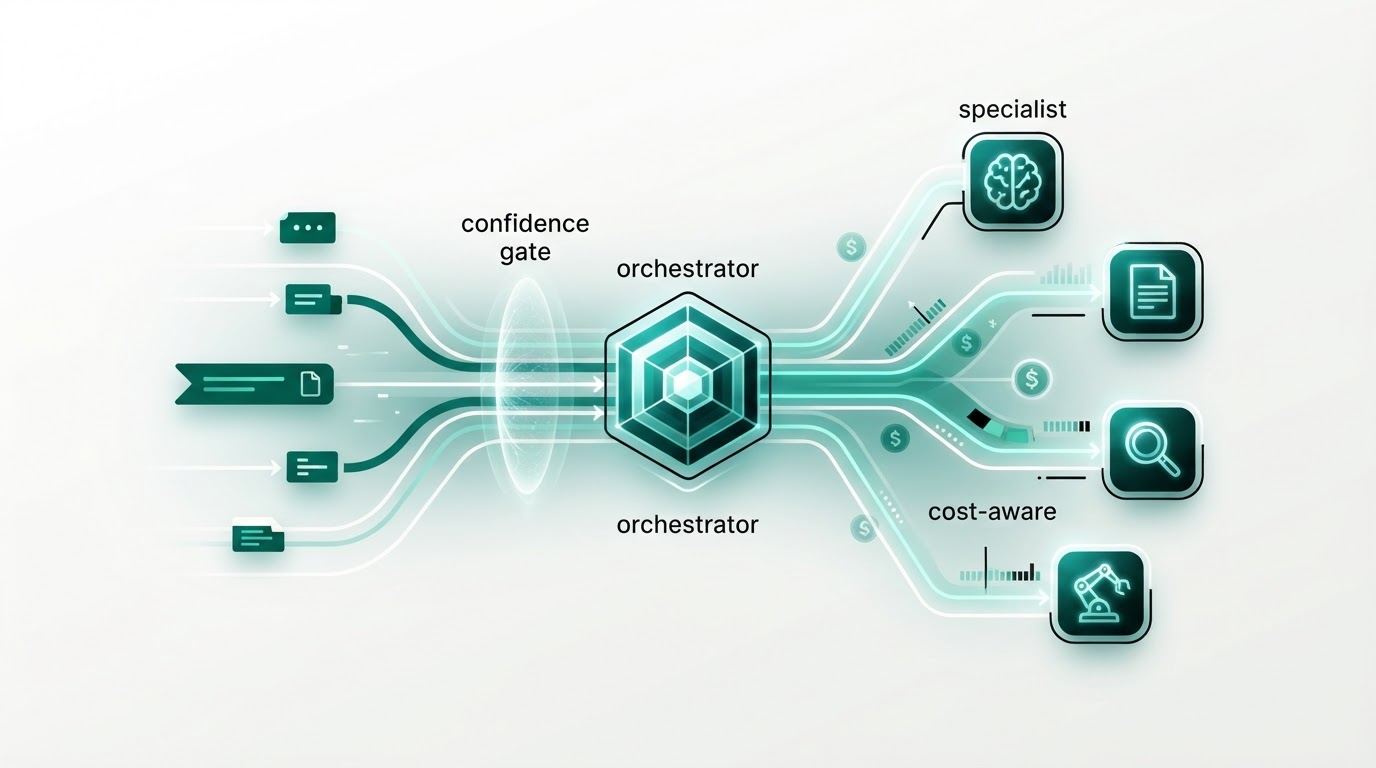
Cost-aware dispatch is the practical way to stop sending every AI request to the most expensive capable model while protecting outcomes that genuinely need more reasoning, tools, or specialist expertise. The core design is a confidence-gated orchestrator: it estimates whether a lower-cost route is likely to meet the task’s quality bar, dispatches with a policy that reflects cost and risk, and escalates uncertain cases rather than treating every request alike.
For platform teams operating specialist agents, this is not merely a model-selection feature. It is a control-plane capability that connects intent detection, model and agent capabilities, MCP tools, budget rules, capacity, conversation state, and observable quality outcomes. Done well, it makes multi-agent workflows more economical without making them unpredictable; done poorly, it creates cheap but fragile routes that silently damage user trust.
What cost-aware dispatch means for specialist model orchestration
Direct answer: Cost-aware dispatch selects the lowest-cost model, specialist agent, or workflow that is predicted to satisfy a defined quality and risk requirement. A confidence gate accepts that lower-cost route when its calibrated confidence clears a threshold and escalates, defers, or requests clarification when it does not.
The important distinction is between a router that predicts a label and an orchestrator that makes an operational decision. A classifier may conclude that a prompt appears to be a coding request. An orchestrator must decide whether a lightweight coding model is sufficient, whether a repository-aware agent needs tool access, whether a security specialist should review the request, and whether the organization can afford the route under current budget and capacity conditions.
That decision has a cost-quality objective. Quality can mean task correctness, groundedness, adherence to policy, successful tool execution, or user acceptance. Cost can include input and output tokens, tool calls, latency-sensitive retries, model pricing, and the indirect cost of sending work through several agents. A useful policy therefore asks a constrained question: what is the least expensive available route that has enough evidence to meet the service objective for this request?
Recent research increasingly treats smart routing as precisely this kind of optimization problem. A 2026 paper derives an optimal threshold-policy structure and separates calibration from discrimination. Under that paper’s stated pricing and traffic assumptions, a calibrated router can reduce blended inference cost by roughly an order of magnitude compared with always using a frontier model. The result should not be read as a universal savings promise; it does show why threshold selection and probability calibration matter as much as identifying the apparently best route.
Confidence is useful only when it corresponds to real-world success rates. A score of 0.8 should be operationally interpretable, not simply a ranking signal that happens to put likely successes above likely failures.
In an agent workspace, a route may be a single model call, a specialist MCP-connected agent, an ordered handoff, or a tool-backed workflow. Cost-aware dispatch should support all of these. Restricting the decision to “small model versus large model” misses the economic benefit of choosing a narrower specialist that can resolve a well-scoped task with fewer steps and less context.
Why confidence-gated orchestration is different from simple routing
Simple routing chooses an expert based on predicted fit. Confidence-gated orchestration adds an explicit decision about uncertainty. Rather than forcing every request into a route, it identifies the cases where available evidence is inadequate and applies a safer action.
That action does not always have to be escalation to the most powerful model. Depending on the task and operating policy, the orchestrator can request missing information, run a low-cost verifier, choose an ensemble, defer a high-impact action for review, or invoke a specialized agent with stronger grounding tools. This expands routing from a static model picker into an adaptive workflow controller.
Separate discrimination from calibration
Discrimination answers whether the router ranks good routes above bad ones. Calibration answers whether its confidence values match observed outcomes. A router can discriminate well but still be unsafe to threshold: if its predicted 90% confidence routes succeed only 70% of the time, its acceptance boundary is misleading.
This is particularly important for specialist agents. A broad intent classifier may correctly recognize that a prompt is about finance, but it may overestimate the ability of a general financial assistant to handle a request requiring internal policy retrieval, spreadsheet tools, or approvals. Confidence should be calibrated against the complete route outcome, including tool-use success and the final workflow result, not just intent-label accuracy.
Define the abstention and escalation paths before training the router
A confidence score becomes useful only when it changes behavior. Establish the possible actions and their obligations up front:
Accept:
dispatch directly to the selected low-cost model or specialist when expected quality clears the threshold.
Escalate:
send the request to a more capable model, a more deeply grounded agent, or a workflow with additional verification.
Clarify:
ask the user for a missing parameter, scope, or authoritative source when ambiguity is the central problem.
Verify:
let an economical route draft an answer, then apply a validator or specialist review where the risk policy requires it.
Decline or hand off:
stop automated execution when authorization, safety, data access, or policy conditions are not met.
Confidence-aware gating has shown stability benefits in multi-agent orchestration research. A 2026 Scientific Reports study reports routing accuracy of 0.77 for confidence-aware gating versus 0.65 for a learned baseline. In that study, switching fell from 0.44 to 0.11 and bounce fell from 0.09 to 0.01. These figures concern that study’s setup rather than every deployment, but the pattern is operationally meaningful: a router should avoid thrashing between agents and avoid returning work to a previous agent without progress.
Stable routing improves more than cost control. It makes workflow traces easier to understand, reduces repeated context transfer, and allows teams to investigate whether an escalation was justified. Those properties are essential when a single user request passes through multiple MCP-enabled tools and specialist agents.
Build the route policy around quality, cost, risk, and capacity
Many routing prototypes optimize a single offline score, such as which model produced the preferred answer for each prompt. Production dispatch has more constraints. A route that is accurate but unavailable, over budget, too slow for the interaction, or disallowed for the data classification is not a viable choice.
A practical policy needs explicit inputs rather than hidden preferences. At minimum, represent the request, candidate routes, quality requirements, risk tier, cost estimates, capacity state, and session context. The output should be both a chosen action and the evidence that led to it.
Model the candidate routes, not only the models
A candidate route should be a versioned operational unit. For example, “general model A” is too vague. A route might instead be “support-triage-agent v3 with CRM retrieval, one tool retry, and model A,” or “contract-review-agent v2 with approved clause retrieval and model B.” These units expose the actual cost, dependencies, permissions, and evaluation target.
For each route, capture fields such as the following:
Supported task families, data classifications, languages, and tool requirements.
Expected quality signals, including calibrated route-success confidence and known failure modes.
Expected token usage, tool calls, latency, and pricing assumptions.
Hard eligibility rules, including identity, authorization, region, and policy constraints.
Current capacity, rate limits, queue state, and fallback availability.
Escalation target, maximum retry count, and trace identifiers for auditability.
Cost estimates should be predictive, not merely retrospective. The 2026 IEEE paper CostRoute formalizes pre-dispatch routing with an Output Length Prior, a Query Cost Signature, and a Cost-Quality Efficiency score. It also presents an uncertainty-aware variant that penalizes high-variance providers. This matters because the cost of a route is often not known from the input length alone: likely output size, tool loops, and provider variance can change its realized expense.
Use hard constraints before optimization
First exclude routes that cannot serve the request. A request requiring a particular internal system should not be sent to an agent without that MCP connection. A route barred from handling a data class should never enter the cost comparison. A high-impact action that requires approval should not be made eligible simply because a router is confident.
Then optimize among eligible routes. Conceptually, the orchestrator can choose the route with the lowest expected cost that clears a quality threshold, respects a risk threshold, and fits capacity. Teams do not need to expose a mathematically complex objective to every operator, but they should make the policy’s priorities explicit and testable.
Capacity deserves first-class treatment. The 2026 ACM AIES paper Robust Batch-Level Query Routing for Large Language Models under Cost and Capacity Constraints proposes joint assignment across a batch while respecting both cost and capacity limits. Its premise is directly relevant to production systems: per-query routing can fail to capture heterogeneous serving conditions. A locally optimal route may consume scarce specialist capacity needed for a more critical request arriving moments later.
Design confidence gates that can be measured and tuned
A confidence gate should not rely on a single opaque score whenever the workflow has multiple ways to fail. Instead, combine observable signals into a policy that is calibrated against the outcome that matters. The selected signal set will vary by workload, but the gate should be understandable enough for engineering and operations teams to diagnose.
Useful signals commonly include request intent and complexity, similarity to evaluated examples, required tool availability, retrieved-context quality, expected output length, prior route performance, model self-assessment where appropriate, and signals from inexpensive verifiers. For multi-turn interactions, conversation history is also part of the decision context.
The 2026 paper MTRouter: Cost-Aware Multi-Turn LLM Routing with History,Model targets this point directly: model selection for a turn can depend on conversation history as well as the current query. A customer who has supplied account details across several messages, or an engineer debugging a failure after several tool calls, cannot be routed reliably from the final sentence alone.
Choose thresholds by consequences, not intuition
A threshold is a business and engineering choice. Lowering it accepts more low-cost routes, which can reduce spend but increase the chance of missed quality requirements. Raising it escalates more work, which can protect quality but erode the economic advantage of routing.
Specify route-level success.
Define what counts as success for each workflow: a correct answer, a completed tool task, a policy-compliant draft, or a human-approved result.
Segment the workload.
Analyze threshold behavior by task family, language, customer tier, risk level, input length, and tool availability. A single global threshold can hide poor performance in important segments.
Calibrate on held-out and recent data.
Compare predicted confidence ranges with actual success rates, then revisit calibration as prompts, models, tools, and traffic change.
Assign different thresholds to different consequences.
A low-risk knowledge request may accept a lower confidence than an action that modifies records or produces regulated content.
Evaluate the complete cascade.
Measure final quality and total cost after escalations, retries, and verification, rather than scoring the first route in isolation.
Risk-aware calibration is an active direction in this field. The ICML 2026 paper RACER: Risk-Aware Calibrated Efficient Routing for Large Language Models explicitly addresses the cost-performance trade-off and emphasizes calibrated efficient routing. That framing is useful because a generic accuracy metric can obscure asymmetric costs: a weak response to a casual query is different from a weak response that triggers an irreversible business action.
When calibration data is sparse, err toward explicit abstention policies and narrower deployment scopes. Confidence cannot repair missing ground truth, unobserved tool failures, or an evaluation set that does not reflect production traffic. A route should earn broader autonomy through measured outcomes, not through an appealing score.
Implement a route-then-escalate workflow for specialist agents
For many teams, the most practical starting architecture is a cascade: route likely straightforward requests to economical specialists and escalate only the uncertain, complex, or high-risk remainder. This avoids the false choice between an inexpensive default that fails too often and a frontier default that handles every request at premium cost.
The 2026 work Cluster, Route, Escalate presents clustering plus routing to assign queries to the most cost-effective model, escalating low-confidence cases to a stronger model. The larger principle applies to agent systems as well: group recurring work where meaningful, make a first decision with a constrained economical option, and preserve a clearly defined path to a stronger route.
A control-plane sequence for an incoming request
Normalize the request.
Capture the prompt, tenant and user policy context, channel, data classification, session state, available tools, and trace ID. Do not force every agent to reconstruct this context independently.
Apply eligibility filters.
Remove routes that lack required permissions, tools, regional availability, or policy approval.
Estimate route outcomes.
Produce predicted success confidence, expected cost, expected latency, and uncertainty for each remaining candidate route.
Select under constraints.
Choose the least-cost route that meets the quality, risk, latency, and capacity policy. If none qualifies, choose the defined escalation or handoff action.
Execute with bounded autonomy.
Limit retries, tool-call count, and spending for the route. Record all tool actions and context handoffs.
Assess completion.
Use task-specific checks, verifier results, tool outcomes, and user feedback where available. Decide whether to return, repair, or escalate.
Learn from the trace.
Store the routing features, prediction, decision, realized cost, outcome, and reason codes for analysis and recalibration.
In this architecture, escalation needs context handoff, not a restart. Pass the original user goal, relevant conversation history, retrieved evidence, tool outputs, attempted actions, failure reasons, and remaining budget. The stronger specialist should know what the lower-cost route already established and why it was insufficient. Repeating work loses much of the cascade’s cost benefit and can frustrate users.
Bounded autonomy also matters. A route may have high confidence for drafting a response but lower confidence for executing an external side effect. Separate those decisions. An agent can prepare a change request, while a more controlled workflow validates it and obtains approval before the change is applied.
Use batch, prompt, and multi-turn signals without overfitting the router
Request-level dispatch is useful, but it is not the entire operating picture. The best policy can vary with workload composition, available capacity, prompt characteristics, and what has already happened in the conversation. Treat these as distinct extensions, each with its own evaluation plan.
Batch-aware dispatch protects scarce resources
When requests arrive in queues or predictable bursts, allocate routes across a batch rather than greedily handling one request at a time. A system may reserve a limited high-capability model or a specialist tool workflow for requests with the strongest need, while assigning routine work to qualified lower-cost routes. This is the setting studied by the 2026 ACM AIES work on robust batch-level routing under explicit cost and capacity constraints.
Batch optimization should not cause unacceptable waits for interactive users. Use it where queueing is natural, such as document processing, support backlogs, evaluation jobs, or scheduled operations. For real-time flows, capacity state can still inform a per-request policy without delaying the decision for a batch.
Prompt-adaptive policies can include ensembles
Prompt-adaptive routing recognizes that no model or specialist is uniformly best across every request. The 2026 paper Ensemble Routing for Prompt-Adaptive Cost-Aware LLM Inference introduces PISA for single-model routing and PISA-E for ensemble routing, illustrating a move toward prompt-conditioned dispatch policies. An ensemble may be worthwhile when independent checks materially improve the outcome, but it should be treated as a route with its own cost and latency budget, not as a default safety blanket.
Likewise, contrastive routing research is moving toward selection of the cheapest accurate expert rather than raw accuracy alone. The NeurIPS 2025 paper Cost-Aware Contrastive Routing for LLMs trains a contrastive encoder to favor the least costly accurate expert within a fixed set. This aligns with the production objective, provided the expert set, task labels, and evaluation outcomes reflect real operational needs.
Do not assume the router’s top pick is the whole answer
Dispatch and aggregation are separate design decisions. A 2026 sparse Mixture-of-Experts paper argues for decoupling expert dispatch and aggregation; in its audited examples, router Top1 identified the best selected expert in only 12.5% and 16.7% of cases on WikiText and C4, respectively. The reported figures are from those audits, but they are a useful warning against equating top-1 router selection with final-system quality.
For orchestration teams, this means some tasks need a second stage: a reviewer, a verifier, structured aggregation, or a user-visible uncertainty statement. Adding that stage only where it is valuable is a stronger design than paying for multi-agent deliberation on every request.
Observe the economics and quality of every dispatch decision
Cost-aware dispatch cannot be governed from aggregate token spend alone. Teams need to understand which routes are being selected, why they were selected, whether confidence was justified, how often they escalated, and what final outcomes they produced. This is where an orchestration workspace becomes a system of record rather than a collection of ad hoc prompts.
Record a structured event for each decision. Keep sensitive content under the organization’s data-handling policy, but retain enough metadata to reconstruct the route and investigate issues. Version the router, route definitions, prompts, tools, model settings, calibration artifacts, and policy configuration so that performance changes are attributable.
Metrics that reveal whether the policy is working
Realized cost per completed task:
include all calls, tool actions, retries, verifier steps, and escalations, not only the first model call.
Route acceptance and escalation rate:
track how often confidence gates accept low-cost routes and how often they invoke stronger alternatives.
Calibration error by segment:
compare predicted confidence with observed success across task types, tenants, risk classes, and conversation lengths.
Task success and failure taxonomy:
distinguish incorrect content, unavailable tools, bad retrieval, policy denials, capacity failures, and user abandonment.
Switching and bounce:
measure unnecessary agent changes and returns to prior routes, which are indicators of orchestration instability.
Latency distribution:
assess end-to-end completion time, including queue time and escalations, because a cheap route that repeatedly retries is not operationally cheap.
Capacity pressure:
monitor saturation, rate-limit events, and how often capacity rules alter the preferred route.
Evaluate against meaningful baselines. Always using the strongest model is a quality-oriented baseline; always using the cheapest eligible route is a cost-oriented baseline; a fixed rules policy can be an interpretability baseline. The question is not whether routing beats an unrealistic ideal. It is whether the confidence-gated policy improves the organization’s chosen balance of quality, cost, latency, and risk over a credible alternative.
Recent research supports the premise that confidence-aware multi-agent strategies can deliver meaningful efficiency improvements while maintaining quality in evaluated benchmarks. For example, Orchestrating Intelligence: Confidence-Aware Routing for Efficient Multi-Agent Collaboration across Multi-Scale Models reports 17.05% and 78.47% lower average inference cost than multi-agent baselines on four benchmarks while maintaining or improving accuracy. Those benchmark results should guide hypotheses and evaluation design, not substitute for measurement on an organization’s own agents, tools, traffic, and service requirements.
Common failure modes in cost-aware dispatch and how to avoid them
The most expensive routing failures are often policy failures rather than modeling failures. Teams can reduce them by making routing decisions explicit, reversible, and measurable.
Optimizing token price instead of total workflow cost.
A low-price model that triggers tool errors, long outputs, retries, or human rework may cost more than a stronger first route. Estimate and measure the full route cost.
Using uncalibrated confidence as permission to automate.
Ranking routes is not enough. Calibrate confidence to route-level outcomes and create conservative policies for sparse or shifting data.
Escalating without transferring state.
If the receiving agent repeats retrieval and tool work, the cascade becomes slower and more expensive. Pass structured context and attempted-action history.
Mixing hard rules with soft preferences.
Compliance, authorization, and data restrictions are eligibility constraints, not terms to trade against cost or model preference.
Training on easy historical traffic.
A router trained primarily on routine requests can appear excellent while failing on tail cases. Maintain representative evaluations and inspect slices where escalation is most consequential.
Ignoring drift.
New models, updated prompts, changing tool behavior, and altered traffic patterns can invalidate calibration. Re-evaluate after meaningful route or workload changes.
Overusing ensembles and reviewers.
Extra agents can improve reliability, but indiscriminate redundancy undermines the cost objective. Gate verification based on risk and uncertainty.
Allowing capacity to be an afterthought.
A routing policy that selects a saturated specialist creates queues and fallbacks that were absent from offline evaluation. Include live capacity in dispatch decisions.
A 2026 survey, Doing More with Less, frames routing across LLM systems as a resource-optimization problem and notes that experts can be trained end-to-end with the gating function. That is a useful long-term possibility, but many enterprise teams do not need to begin there. A transparent policy layer, reliable telemetry, calibrated route evaluation, and clear escalation paths can deliver a robust foundation before pursuing end-to-end optimization.
Start with a narrow, trustworthy confidence-gated orchestrator
Begin with one workflow that has clear completion criteria, enough repeated traffic to evaluate, multiple viable routes, and a defined escalation destination. Instrument its cost and outcomes before attempting broad autonomous routing. A narrow deployment makes it possible to validate whether confidence predicts success, whether savings survive retries and escalations, and whether users experience smoother rather than more fragmented service.
Cost-aware dispatch works when it treats low-cost routes as earned defaults, not universal defaults. Build route definitions around real specialist capabilities, enforce hard policy and capacity constraints, calibrate confidence against final outcomes, and preserve context when the system must escalate. That gives platform teams a defensible way to scale specialist AI workflows while keeping both spend and operational risk visible.