
Home/Blog/Evaluating orchestration layers for autonomous systems: observability, governance and scale
Evaluating orchestration layers for autonomous systems: observability, governance and scale
August 5, 2026
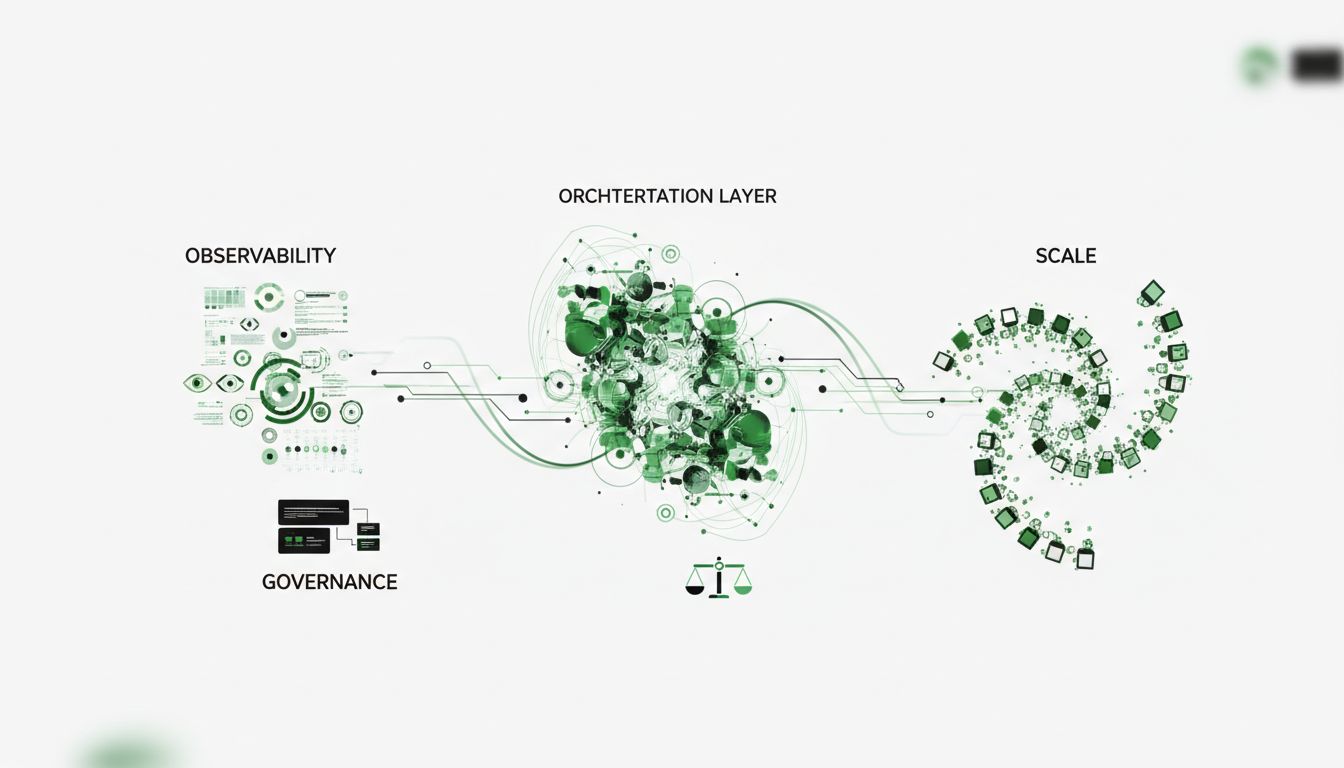
Enterprise teams evaluating orchestration layers for autonomous systems are no longer choosing a simple workflow tool. They are choosing the control surface that will coordinate specialist agents, mediate access to tools and data, preserve context across handoffs, and make runtime behavior visible enough to operate safely in production. As multi-agent architectures move from experimentation into core business processes, orchestration becomes less about chaining steps and more about governing a living system.
That shift is changing the evaluation criteria. Recent industry guidance and research increasingly frame orchestration as a control plane problem that spans observability, governance, and scale. For platform engineers and product teams, the question is not only whether an agent can complete a task, but whether the orchestration layer can explain what happened, enforce policy at runtime, and support heterogeneous agents and frameworks without collapsing under operational complexity.
Why orchestration layers are now evaluated as control planes
In early implementations, teams often treated orchestration as equivalent to workflow execution: route a request, call a model, invoke a tool, and return an answer. That framing breaks down quickly in autonomous systems. Once multiple agents can delegate, access external systems, and trigger state-changing actions, the orchestration layer takes on responsibilities that look much closer to a distributed control plane than a basic workflow engine.
Recent enterprise messaging reflects that reality. Multi-agent orchestration is increasingly described as a layer that coordinates identity, policy mediation, telemetry, and execution across agents. That matters because the operational risk in autonomous systems rarely sits in one prompt or one model call. It emerges from interactions between agents, tools, permissions, retries, handoffs, and environmental changes over time.
For buyers and builders, this means an orchestration layer should be evaluated on how well it standardizes these runtime concerns. Can it route users to specialist agents consistently? Can it carry context across handoffs without losing accountability? Can it apply organization-wide controls across Azure-native and open-standard workloads? If the answer is no, the platform may automate tasks, but it will struggle to support enterprise-grade autonomous systems.
Observability must be AI-native, not limited to logs and traces
Observability for autonomous systems has expanded beyond traditional logs, metrics, and traces. Those signals still matter, but they are no longer sufficient on their own. Microsoft’s guidance now treats observability as AI-native, meaning teams need visibility into evaluation outcomes, policy decisions, tool usage, model behavior patterns, and governance-relevant events if they want to troubleshoot and improve agents at scale.
This changes how teams should assess an orchestration layer. A strong platform should not only emit telemetry about latency and errors; it should capture the sequence of agent decisions, handoffs, plan revisions, tool invocations, and human approvals. It should also support evaluation signals such as task quality, source quality, completeness, failure modes, and confidence indicators. Without those layers, post-incident analysis becomes guesswork.
There is also a practical operational angle. Microsoft’s 2026 Azure Monitor messaging points toward faster access to telemetry and AI-assisted issue surfacing for agent troubleshooting at scale. That is useful only if the orchestration layer produces rich enough runtime data to begin with. In other words, observability is not a bolt-on dashboard feature; it is a design property of the orchestration runtime.
Policy-aware telemetry is becoming a baseline requirement
One of the clearest shifts in enterprise AI operations is the rise of policy-aware telemetry. Organizations increasingly need traces that show not just what an agent did, but what policies were in effect, which controls were applied, what approvals were required, and whether runtime behavior stayed within allowed boundaries. Microsoft Learn explicitly ties observability for autonomous systems to OTel-aligned telemetry for governance and administrative visibility.
For engineering teams, that has concrete implications. Telemetry should preserve enough context to answer questions like: Which identity executed this tool call? Which policy blocked or modified the action? Which handoff introduced the error? Which data source influenced the final recommendation? These are governance and incident-response questions, but they are also core debugging questions in a multi-agent environment.
When comparing orchestration layers, look for standardized control surfaces and export paths rather than proprietary black boxes. If telemetry is difficult to correlate across agents, tools, and environments, teams end up with fragmented visibility and delayed root-cause analysis. Policy-aware observability is most valuable when it integrates directly into the orchestration fabric instead of being reconstructed after the fact.
Governance is moving into the runtime itself
Governance used to be discussed as a separate review process layered around deployment. That model is increasingly inadequate for autonomous systems that make ongoing decisions in production. Microsoft’s 2026 governance materials emphasize built-in governance for agent orchestration, with security, observability, and discoverability treated as first-class pillars. The implication is straightforward: governance must be enforced where actions are coordinated, not merely documented elsewhere.
An orchestration layer should therefore be assessed on runtime governance capabilities. Can it enforce role-based and tool-level permissions? Can it require approval for sensitive actions? Can it record provenance and maintain audit trails across agent-to-agent handoffs? Can it expose discoverability and inventory so teams know which agents exist, what they can access, and where they are being used? These are not secondary enterprise add-ons. They are essential operating requirements.
This convergence of operational control with security and compliance is visible in broader platform messaging as well. A single place to observe, govern, manage, and secure agents is becoming the target state. For teams shipping specialist agents into enterprise workflows, that means governance should feel like a native property of the orchestration layer, not an integration project stitched together from separate tools.
Evaluation has to go beyond task success
A recurring lesson in 2026 research is that task completion is an incomplete metric for autonomous systems. An agent may finish a workflow and still create safety, accountability, or compliance problems. Evidence-synthesis work on agentic systems argues that evaluation, governance, orchestration, and assurance need to be considered together because completion metrics alone miss the risks introduced when systems act on the world.
This is especially relevant when comparing orchestration layers. If a platform only reports that a task succeeded, teams cannot tell whether success required policy bypasses, poor evidence quality, unnecessary tool usage, excessive retries, or risky state changes. More mature evaluation frameworks now emphasize dimensions such as observability, decidability, timeliness, and attestability for state-changing actions. Those criteria align much more closely with real production needs than a binary success rate.
Practically, the orchestration layer should support structured evaluation loops. That includes replay, trace inspection, benchmark runs, quality scoring, and policy outcome analysis. It should make it possible to ask not only “Did the agent complete the task?” but also “Did it complete the task in a reliable, explainable, and governable way?” For enterprise autonomous systems, that is the more important question.
Verification and replanning improve reliability at the orchestration layer
Another important development is the use of runtime verification inside multi-agent orchestration. A recent plan-execute-verify-replan framework reported better answer completeness and source quality than a single-agent baseline, reinforcing a practical point: reliability improvements often come from orchestration logic, not only from selecting a stronger model. In other words, the layer coordinating agents can materially improve output quality.
That insight should shape evaluation criteria. Teams should ask whether the orchestration layer supports verification checkpoints, branch-level validation, source checks, retries with policy constraints, and controlled replanning when assumptions fail. If orchestration is limited to naive chaining, the system may remain brittle even when individual agents are capable. Runtime quality mechanisms need to be native enough to operate continuously, not only in offline tests.
This also connects back to observability. Verification only helps if teams can inspect where plans diverged, why a replan occurred, and whether the fallback path respected policy. An orchestration platform that combines execution, verification, telemetry, and governance provides a stronger foundation for trustworthy autonomy than a workflow runner that simply dispatches calls and hopes the model gets it right.
Scale depends on standardized control surfaces across frameworks
As organizations move beyond pilots, heterogeneity becomes unavoidable. Different teams adopt different models, agent frameworks, tool stacks, and hosting patterns. Scale therefore pushes teams toward standardized control surfaces rather than framework-specific operations. Microsoft’s Build 2026 materials describe a portable Agent Control Specification and portable tracing and evaluation patterns intended to apply controls without forcing everyone into one runtime stack.
For platform engineers, this is one of the most important aspects of orchestration layer selection. The winning platform is rarely the one that assumes all agents are built the same way. It is the one that can observe, govern, and secure heterogeneous workloads through consistent interfaces. That includes standardized metadata, portable traces, common policy hooks, and interoperable evaluation signals that travel across specialist agents and external systems.
This matters because fragmentation becomes a scale-breaker long before raw request volume does. When every framework needs different telemetry, different approval logic, and different governance tooling, operating costs rise faster than agent value. A portable control model helps organizations keep architectural flexibility while still maintaining one operational posture for enterprise autonomous systems.
Event-driven scale requires feedback loops, not just throughput
Enterprise adoption is also moving toward event-driven orchestration, where agents respond to changing business events, trigger downstream actions, and collaborate in near real time. Recent research positions this as a coordination problem centered on orchestration logic and governance. In practice, that means scale is not just about handling more requests per second. It is about maintaining control as concurrency, state transitions, and cross-system dependencies increase.
Microsoft Learn’s 2026 adoption patterns call out multi-agent orchestration, real-time telemetry, and learning infrastructure as scale-breakers, while emphasizing that ethics and safety need to be built into the architecture. OpenAI’s deployment guidance similarly highlights orchestration, measurement, and feedback loops as core ingredients for scaling AI systems. The pattern is consistent: scale depends on closed-loop operations, not only execution capacity.
When evaluating an orchestration layer, teams should look for event handling, backpressure controls, runtime alerts, evaluation pipelines, and mechanisms for continuous improvement. The goal is not simply to run autonomous systems at larger volume, but to keep them measurable and governable as they adapt. A platform that supports feedback loops can turn production behavior into a source of learning instead of a source of recurring surprises.
How to compare orchestration layers in practice
A pragmatic evaluation framework starts with three pillars: observability, governance, and scale. Under observability, assess whether the platform captures agent-native telemetry, evaluation signals, and policy context in addition to standard traces. Under governance, assess whether controls are embedded in runtime execution through identity, approvals, provenance, auditability, and discoverability. Under scale, assess whether the system can apply those controls consistently across heterogeneous agents, frameworks, and event-driven workflows.
It is also worth testing for failure analysis rather than only happy-path demos. Ask the vendor or internal platform team to show a cross-agent trace for a failed task, identify the policy that intervened, replay the execution, and explain why the system took a particular action. Then ask how the same controls would apply to agents built in a different framework. These exercises reveal whether the orchestration layer is truly a control plane or merely a task router with better marketing.
Finally, tie the evaluation back to operational outcomes. Recent enterprise messaging increasingly links observability to ROI through governance, management, security, and FinOps. That is a useful lens. A capable orchestration layer should reduce time to troubleshoot, reduce the cost of fragmented controls, improve the quality of agent outcomes, and make expansion safer across teams. In enterprise autonomous systems, those properties are what turn experimentation into repeatable production value.
The market is moving quickly, but the direction is becoming clearer. Orchestration layers for autonomous systems are being judged less by how elegantly they sequence steps and more by how effectively they create a unified operational control plane. Observability, governance, and scale are no longer separate evaluation tracks; they are interdependent requirements for making specialist agents usable in real organizations.
For teams building or adopting autonomous systems, the most durable approach is to choose an orchestration layer that can route work, preserve context, enforce policy, and expose AI-native telemetry across diverse agents and tools. That combination is what makes enterprise autonomy manageable. In practice, the best orchestration layer is the one that helps you observe, govern, and scale without giving up flexibility.