
Home/Blog/From ad-hoc apis to managed connectors: unlocking trust and scale in ai integrations
From ad-hoc apis to managed connectors: unlocking trust and scale in ai integrations
August 22, 2026
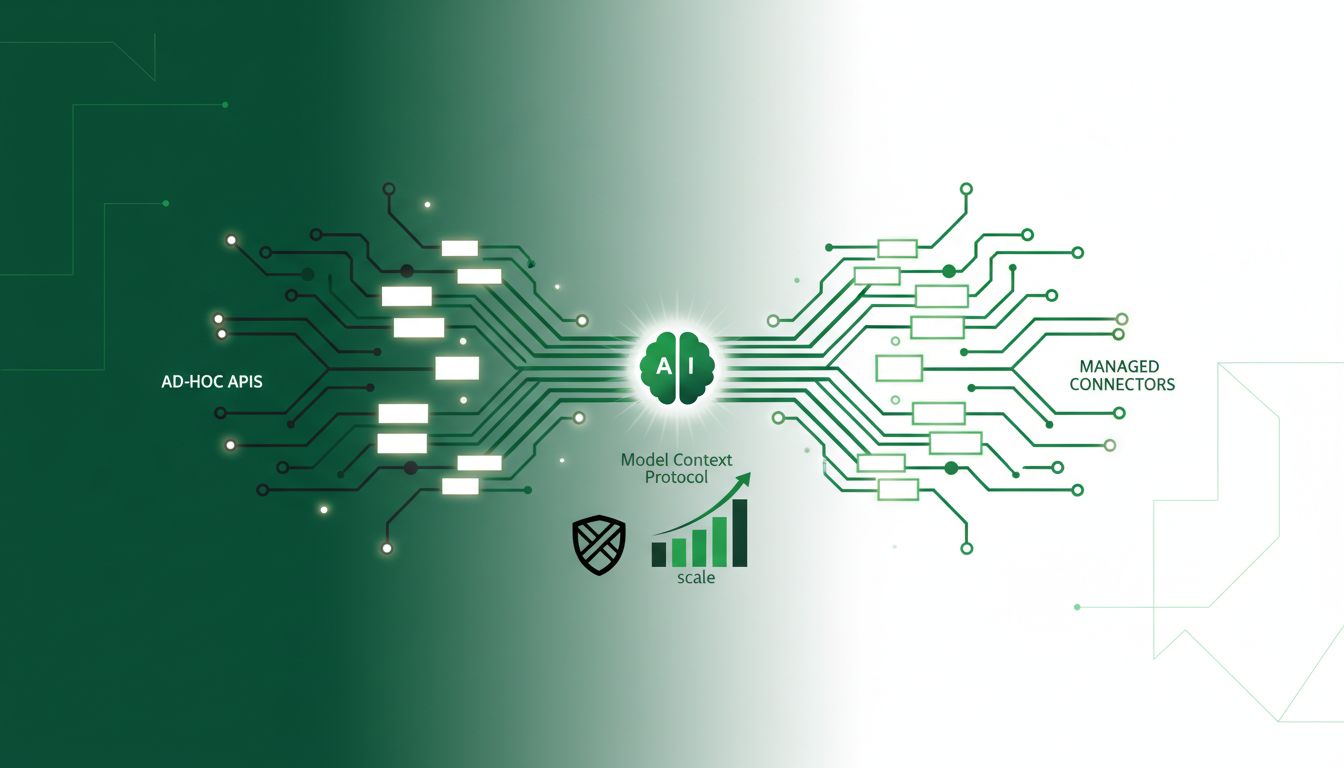
Enterprise AI has moved past the novelty stage. The new constraint is not whether models can reason, summarize, or classify well enough. The harder problem is whether organizations can connect those models to real systems, real data, and real workflows without losing control, security, or uptime.
That is why the conversation is shifting from ad-hoc APIs to managed connectors. In practice, this means moving away from one-off scripts, brittle auth handoffs, and custom glue code toward governed integration layers that can be reviewed, observed, and scaled across teams. For platform engineers and AI builders, this is the difference between a demo that works once and an operating model that can support enterprise rollout.
Why trust, not model quality, is now the bottleneck
Recent research keeps pointing to the same conclusion: enterprise AI is hitting a trust-and-governance wall, not a model-quality wall. KPMG’s June 2026 research found that organizations treating trust and AI governance as operational capabilities outperform peers, based on a survey of more than 1,750 senior transformation leaders across 20 countries. That is a strong signal that governance is no longer a compliance afterthought; it is a performance multiplier.
This matters because production AI systems do not fail only on accuracy. They fail when access is unclear, data is stale, identities are over-permissioned, or workflows cannot be audited. In other words, the control plane matters as much as the model plane. If an AI agent can call tools but cannot do so within policy, trust erodes quickly.
The market is reflecting this reality across sectors. TM Forum reports that trust and assurance are moving to the forefront as CSPs try to deploy AI at scale, while Rasa found that 60% of leaders rank black-box issues or compliance as their top challenge. That is a useful reminder for teams shipping specialist agents: explainability is important, but operational confidence is what gets systems approved for use.
Why ad-hoc APIs break down at enterprise scale
Ad-hoc API integrations are often the fastest way to prove value. A team connects a ticketing system, a CRM, a data warehouse, and a workflow engine, and suddenly an agent can execute work end to end. But every new integration adds authentication complexity, rate-limit handling, schema mapping, observability work, and failure recovery.
That accumulation becomes a maintenance tax. Paragon’s 2026 State of Agentic Integrations Report notes that buyers increasingly ask how integration data is captured, stored, and isolated, and that keeping integrations alive through auth changes, API drift, and volume spikes grows with every connector added. What looks like a productivity shortcut can quickly become a distributed systems problem.
Enterprise readiness depends on integration maturity. CData’s 2026 State of AI Data Connectivity report, based on more than 200 data and AI leaders, concludes that data integration maturity drives whether AI initiatives scale or stall. That is why platform teams are rethinking the integration layer itself rather than just adding more custom endpoints.
Managed connectors turn integration into a governed capability
Managed connectors change the operating model. Instead of every team hand-rolling access patterns and lifecycle logic, the organization standardizes connection management, policy enforcement, and review. In Microsoft’s federated connectors overview, connectors are “managed and governed by admins” in Microsoft 365, and partners can submit remote MCP servers for review before they are added to the gallery.
That administrative boundary is important. It means connectors are no longer informal escape hatches built by individual developers, but enterprise assets with ownership and controls. Anthropic is productizing a similar pattern through remote MCP: its help center says pre-built web connectors are available in Claude on Pro, Max, Team, and Enterprise plans, including Zapier.
Anthropic also extends the same logic into regulated environments. The Claude Help Center says the MCP framework registers, authenticates, and executes Anthropic-provided connectors entirely within the Claude for Government authorized boundary. For teams operating in sensitive environments, that is the difference between “connected” and “approved.”
The connector layer is becoming a real platform surface
The Model Context Protocol ecosystem is no longer just a developer curiosity. A 2026 arXiv paper reports more than 10,000 active MCP servers and 97 million monthly SDK downloads as of early 2026. Even with that growth, the paper also notes that reliable agent tool integration still needs infrastructure beyond the spec itself.
That point matters for engineering teams. A protocol can standardize how tools are discovered and called, but it does not automatically solve identity delegation, secret management, retries, policy enforcement, or data isolation. Those are platform concerns, which is why managed connector systems are becoming the real enterprise layer around MCP.
Vendors are increasingly formalizing this connector surface in product. Microsoft is governing connectors in the Microsoft 365 admin center, while Anthropic is offering remote MCP-based connectors as part of its product experience. The signal is clear: the market is converging on a connector layer that behaves more like infrastructure and less like an app-specific integration hack.
Hybrid API plus MCP is the practical enterprise path
Not every integration should become an MCP connector, and not every API should remain directly exposed to agents. Gartner’s January 2026 research on enabling agentic AI via API-based integration points to a hybrid MCP-API strategy with delegated identity for secure enterprise scale. That framing matches what many platform teams are already discovering in practice.
In a hybrid model, core systems remain API-first, while the agent layer accesses them through managed, policy-aware connectors. This lets organizations keep legacy and modern services on the same integration footing without forcing a full rewrite. It also reduces the pressure to expose every backend directly to autonomous workflows.
For builders, the design principle is simple: use APIs for source-of-truth operations and MCP-style connectors for governed orchestration. That division of responsibility helps preserve clear ownership, minimizes accidental coupling, and allows security teams to reason about access paths more effectively. It is also a more realistic path for enterprises that already have a large API estate.
Security and governance are now part of the scaling architecture
Security-first integration is not a separate discipline from AI scaling; it is the scaling architecture. Deloitte’s 2026 API governance and agentic AI paper argues that enterprise readiness depends on API implementation, data consistency, real-time access, and secure, scalable automation within a zero-trust security framework. In other words, the connector layer must be designed as infrastructure with policy built in.
Security researchers are reinforcing that direction. A June 2026 arXiv paper on security-first API pipeline development reports case-study improvements including 30% fewer security incidents and 40% fewer post-release vulnerabilities when security-first and zero-trust practices are applied. Those are the kinds of outcomes that matter when AI workflows start touching customer data, internal systems, and operational actions.
The practical takeaway is that governance needs to be embedded in the integration lifecycle: registration, review, permissioning, execution, logging, and revocation. Managed connectors make that possible by centralizing control points that ad-hoc integrations often scatter across codebases and teams.
What production teams should optimize for next
Leadership sentiment suggests adoption is moving faster than operational readiness. Deloitte’s 2026 AI report says worker access to AI rose by 50% in 2025, and the share of companies with at least 40% of projects in production is expected to double in six months. At the same time, UST’s 2026 enterprise AI study found that 86% of leaders feel ready to scale enterprise-wide, yet 44% are blocked by data quality.
That gap is where integration strategy becomes decisive. Salesforce’s 2026 Connectivity Report says 49% of organizations cite cross-application data governance as a top integration issue, and 94% of IT leaders say AI agent success will require more API-driven architecture. The message is not that teams need more integrations; they need better-managed ones.
For platform and product teams, the right target state is a control plane that can route users to specialist agents, hand off context, and run tool-backed workflows from a single governed layer. That means standardizing how connectors are approved, how identity is delegated, how data is isolated, and how failures are observed before a connector ever reaches production.
Conclusion: scale comes from governance, not just connectivity
The market is converging on a clear lesson: connectors reduce custom glue, but governance decides whether they scale. KPMG, Salesforce, Microsoft, Anthropic, Gartner, Deloitte, CData, Paragon, and others are all pointing in the same direction. Enterprise AI succeeds when integration is treated as a managed capability, not a side effect of shipping agents.
For teams building AI orchestration platforms, this is an opportunity to create durable trust. Replace brittle point-to-point integrations with managed connectors, align them to zero-trust controls, and use hybrid API plus MCP patterns where they fit. That is how organizations unlock both confidence and scale in AI integrations, without turning every new workflow into a bespoke engineering project.