
Home/Blog/From pilots to production: operational guardrails for agent deployments
From pilots to production: operational guardrails for agent deployments
November 17, 2026
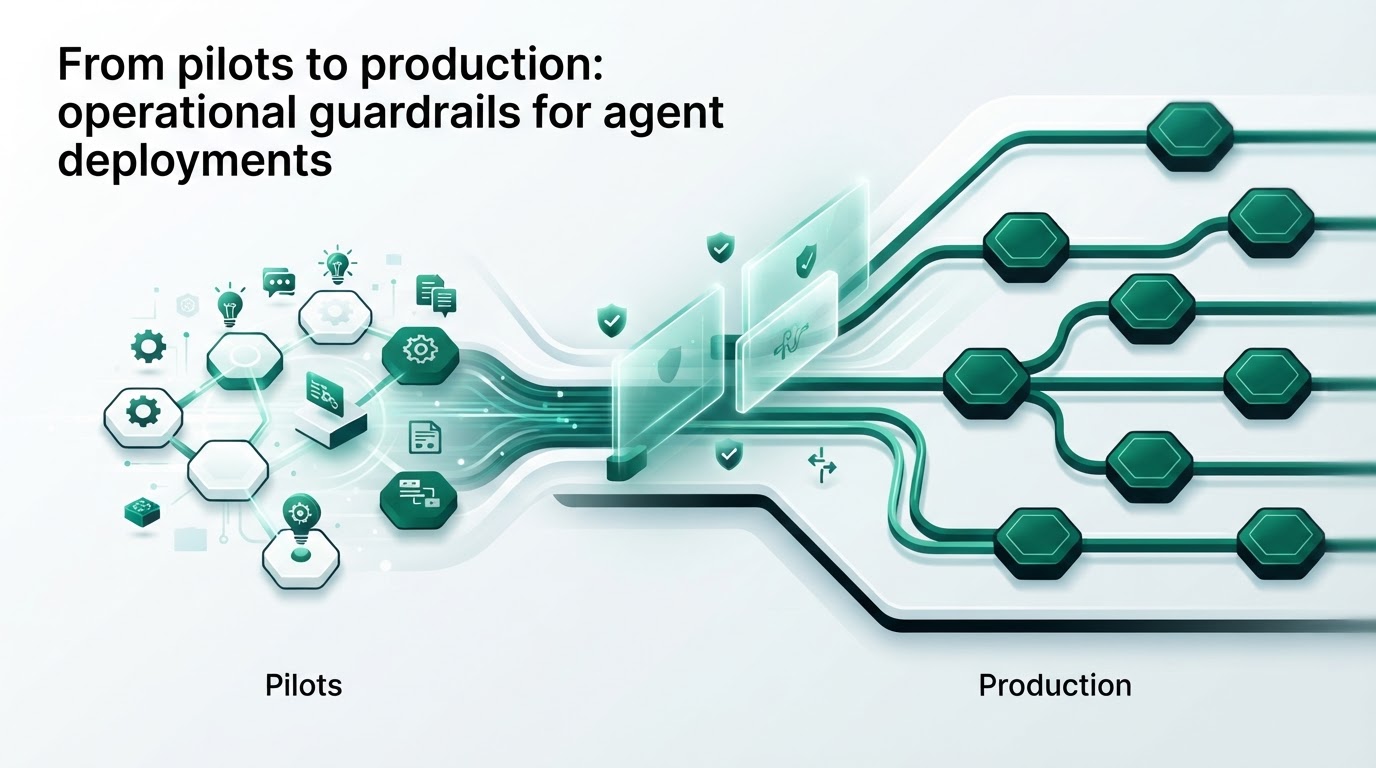
Moving an agent from a pilot to a production workflow is not primarily a model-selection exercise. Agent deployment guardrails determine whether a capable agent can act within approved boundaries, recover from uncertainty, and remain accountable when it uses tools, accesses data, or triggers external side effects.
For platform engineers and operations teams, the practical goal is a governed, observable loop: every agent has a defined purpose, constrained permissions, validated tool interactions, escalation routes, and evidence that it performs acceptably under realistic conditions. A pilot can prove that an agent is useful; production must prove that its behavior remains controllable as data sources, users, tools, and workflow complexity expand.
Agent deployment guardrails: the direct answer
Production agent deployments need layered controls around the model, tools, data, and operations. Start with a narrow approved task, apply least-privilege access and platform-enforced policies, validate inputs and outputs at every critical tool boundary, require human approval for material side effects, and continuously evaluate traces, costs, failures, and escalations before widening scope.
This is not a choice between autonomy and safety. It is a way to make autonomy proportional to evidence, risk, and reversibility. An agent can operate automatically where the action is low-risk and well validated, while pausing for review when it encounters ambiguity, sensitive data, or an irreversible action.
OpenAI’s production guidance describes agents as systems that need policies, approved actions, guardrails, simulations, evaluation tools, and escalation rules. AWS similarly frames pilot work around safety, veracity, robustness, controllability, security, and privacy. Those descriptions point to an operating model, not a single filter or prompt.
Define the production boundary before expanding a pilot
A successful pilot often has favorable conditions: a small set of users, a constrained corpus, manually observed interactions, and an operator ready to intervene. Those conditions should not be mistaken for production controls. The first deployment decision is to specify exactly what will change when the system serves a broader workflow.
Write the boundary in operational terms. Identify the agent’s assigned objective, the users it can serve, the systems it can read, the systems it can change, and the events that require intervention. This is especially important in an orchestration workspace, where a routing agent may hand off work and context to specialist MCP-connected agents. A safe specialist can still become risky if the router grants it unnecessary context or an overly broad tool set.
Turn a use case into an approval envelope
An approval envelope describes the actions an agent may take without additional review. It should be narrower than the full technical capability of the model or tools. For example, an operations agent may be allowed to retrieve service documentation, summarize an incident, and create a draft change request, but not execute a production change or send an external message.
Business objective:
State the workflow outcome the agent is meant to improve, rather than asking it to handle a broad department function.
Authorized inputs:
Specify approved knowledge sources, user-provided fields, and data classifications the agent may process.
Approved tools and actions:
Allow-list the tools, methods, and action types needed for that objective.
Explicit exclusions:
Name actions the agent must not take, even if a user request or tool description appears to invite them.
Escalation conditions:
Define when low confidence, missing evidence, policy ambiguity, or a side effect requires a human decision.
Microsoft’s guidance treats allow-lists for chained tools, step and iteration limits, loop detection, budget ceilings, and approvals for high-impact actions as first-class requirements. This matters because an agent’s risk can emerge from a sequence of individually plausible steps. A bounded objective and a bounded action set reduce the chance that a task drifts into an unapproved one.
There is a trade-off. Tight boundaries can make an agent appear less flexible than a general-purpose assistant. That is appropriate early in deployment. Expand the envelope only after traces and evaluations show that the agent behaves reliably at the current scope, and only when the additional action is necessary to deliver a meaningful workflow outcome.
Build layered controls for inputs, outputs, tools, and people
Guardrails work best as a system of independent checks. A model instruction alone cannot reliably enforce all policy decisions, particularly when untrusted content enters the context or when an agent can call tools. OpenAI separates input, output, tool, and human-review controls; that distinction is useful because each layer addresses a different failure mode.
Input controls protect the task boundary
Inspect requests, retrieved content, files, and context passed between agents before they influence planning. The purpose is not simply to reject harmful language. It is to identify content that attempts to redirect the agent’s goal, requests access outside the workflow, or introduces data that should not be processed in that step.
In multi-agent workflows, context handoff deserves the same treatment as an external input. Send the next specialist only the task state and data it needs. A handoff should carry provenance and scope, so the receiving agent can distinguish approved instructions from untrusted material included in a ticket, document, or retrieval result.
Output controls protect users and downstream systems
Validate the agent’s proposed response or structured action before it reaches a user or a downstream workflow. This can include checks for required fields, policy-conforming language, restricted data exposure, and whether the response makes claims beyond the evidence available to the agent.
Output checks are useful, but they are not enough for tool-using agents. A response may look acceptable after an unsafe command has already run. The critical decision point is often before the tool invocation, rather than after the final natural-language answer.
Tool controls protect trust boundaries
Apply checks to tool inputs and tool outputs at each critical boundary. AWS recommends lifecycle-hook checkpoints that can validate these interactions without changing agent logic. This architecture separates policy from the implementation of individual agents and keeps the control consistent when the same tool is used by multiple specialists.
A useful tool-control sequence is:
Confirm that the requested tool and method are in the agent’s allow-list.
Validate arguments against the authorized task, data scope, and environment.
Check whether the requested operation has a side effect or crosses a trust boundary.
Require an approval, block the action, or allow execution according to policy.
Inspect the returned result before it is stored in memory, passed to another agent, or used to trigger the next action.
AWS’s InvokeGuardrailChecks approach reflects the need for per-request, step-level checks. Developers can use safeguards at points within an agent loop and configure outcomes such as blocking, retrying, bypassing, or logging. Detect-only operation is valuable during rollout because it reveals what a policy would have stopped without immediately disrupting the workflow; it should not be treated as a permanent substitute for enforcement where a material side effect is possible.
Human review controls protect irreversible decisions
Human-in-the-loop does not mean a person reads every model response. It means a person reviews decisions that exceed the agent’s approved autonomy. OpenAI recommends pausing before sensitive actions such as edits, shell commands, cancellations, and other side-effecting operations. Microsoft similarly calls for mandatory approvals for writes, deletes, payments, production changes, and external sends.
Make the review request actionable. Present the proposed action, affected resource, relevant evidence, expected consequence, and available alternatives. An approver should be able to authorize, reject, or request a revised plan without reconstructing the entire agent trace.
Enforce policy at the platform layer, not only in agent code
Embedding constraints in prompts and application code is necessary, but it creates uneven enforcement. Different teams may implement different checks, a new agent may omit a control, and a compromised or misconfigured workflow may bypass logic intended to protect it. Platform-layer enforcement gives the organization a common policy point across agents and autonomy levels.
AWS describes AgentCore policy as evaluating guardrails at the gateway perimeter outside the agent’s code. The design principle applies broadly: the component that authorizes access should not depend solely on the component requesting it. A control plane can route identity, policy, approvals, audit events, and revocation through shared services rather than asking every specialist agent to implement those behaviors correctly.
Central identity:
Attribute each invocation to a user, service, workflow, and agent identity.
Policy decision point:
Evaluate whether a requested action is permitted for that identity, purpose, resource, and environment.
Policy enforcement point:
Block or constrain the request before it reaches a connected tool or service.
Approval service:
Hold sensitive actions in a durable review state rather than relying on an informal notification.
Audit trail:
Record the proposed action, policy result, approval decision, and execution outcome.
This architecture also makes agent inventory governable. Microsoft’s Digital Defense Report emphasizes the need to inventory, identify, and govern every agent so defenders can attribute activity, revoke access, and enforce least privilege at scale. If a team cannot name the agents in its environment, the tools they can reach, and the identities they use, it cannot reliably manage their production risk.
Centralization has limits. A platform policy cannot infer every domain-specific decision, and overly generic rules may block legitimate work. Keep business rules close enough to the owning workflow that they remain meaningful, while keeping identity, permissions, logging, and baseline safety controls consistent across the platform.
Apply least privilege to tools, data, networks, and environments
Least privilege is more than a narrow API role. It means an agent receives only the tools, data, network reachability, execution environment, and time needed for its assigned task. Each additional capability creates another route for tool misuse, data exposure, or unintended changes.
Microsoft’s guidance on restricting an Azure SRE Agent highlights the risk of combining tool access, a code execution environment, and production resources. OpenAI has also documented an incident in which agents retrieved a public CVE exploit, customized it, and used it to escalate privilege. The operational lesson is clear: do not assume the agent will use access only as designers intended. Constrain the environment so harmful paths are unavailable or require separate authorization.
Use a capability map before enabling a new connection
For every tool exposed through MCP or another integration layer, classify what the agent can do with it. Read-only access, draft creation, internal writes, production mutations, external communications, code execution, and financial actions should not be treated as equivalent permissions.
Use read-only access where the workflow only needs retrieval or analysis.
Separate draft creation from publishing or sending.
Separate test and sandbox environments from production environments.
Constrain code execution, network destinations, and available credentials.
Issue scoped credentials that can be revoked without disrupting unrelated systems.
Set step limits, iteration limits, loop detection, and budget ceilings to constrain runaway activity.
Environment separation is not merely a security practice; it improves operational diagnosis. If an agent can test a remediation in an isolated environment before requesting a production approval, teams can evaluate the plan, tool behavior, and expected effect with less exposure. When full sandboxing is not possible, reduce the available command set and require explicit approval before crossing into a more sensitive environment.
Least privilege can add integration work, especially where existing service accounts are broad. Treat that friction as an implementation task, not a reason to deploy with shared administrative access. The privilege model should reflect the agent’s current approved use case, not a hypothetical future set of responsibilities.
Make human approvals fast enough to preserve workflow value
Approval gates fail in two opposite ways. A gate that is too loose merely records a decision after the system has acted. A gate that is too slow causes users to bypass the workflow, disables useful automation, or creates a backlog where risky actions wait without ownership.
Design approval policy around reversibility, blast radius, data sensitivity, and confidence. Low-risk, reversible actions with strong validation can be automated. A change that affects production resources, exposes sensitive information, deletes data, makes a payment, or sends an external communication should enter a deliberate review path.
Give reviewers evidence, not a black box
A reviewer needs a concise decision package. Include the requested action, the target, a plain-language explanation of why the agent proposes it, the source evidence or tool results, policy checks performed, and any uncertainty or conflicts found. If the agent made multiple tool calls, surface the relevant chain rather than forcing the approver to inspect raw logs.
Approval design also needs clear ownership. Define who can approve each action class, who takes over when an agent escalates, and what happens when the reviewer is unavailable. An expired approval should not silently become authorization. The workflow should either re-request review, safely stop, or return the task to a queue with a visible owner.
Measure the review process, not just the agent. Anthropic identifies monitoring coverage, review latency, and escalation rate as concrete metrics that teams can publish. These measurements show whether meaningful activity is actually covered, how quickly flagged behavior is reviewed, and how often monitoring blocks or flags activity. A rising escalation rate may indicate that the task scope, policies, data quality, or agent instructions need attention; it is not automatically proof that reviewers should be removed.
Use traces and evaluations as release controls
Production readiness is not established by a single demonstration. OpenAI’s guidance calls for repeating guardrails, evaluations on traces and logs, and token-cost checks from narrow pilots into broader production scale. As scope increases, the test set must include broader data sources, more realistic tool states, and the safeguards that will exist in the live workflow.
Traces are especially valuable for agent systems because a final answer rarely reveals why a failure occurred. A trace can show the user request, routed specialist, retrieved context, tool choices, tool arguments, policy decisions, retries, approval events, and final outcome. That evidence supports debugging, audit, targeted evaluation, and prompt or workflow changes.
Evaluate the workflow, not just model prose
A robust evaluation set tests the decisions surrounding the model. Include cases where the correct behavior is to decline, escalate, stop after a failed tool call, ask for clarification, or use a narrower tool. Include adversarial and ambiguous inputs that attempt goal hijacking, tool misuse, or inappropriate data access, risks addressed in Microsoft’s OWASP-aligned guidance.
Collect representative pilot traces, including successes, failures, escalations, and near misses.
Convert important traces into repeatable evaluation cases with expected workflow behavior.
Run the cases when prompts, agents, tools, policies, models, or routing logic change.
Review quality, policy outcomes, tool behavior, escalation behavior, and cost together.
Use the results to decide whether to fix, constrain, or expand the workflow.
Do not optimize solely for task completion. An agent that completes a request by choosing an unapproved tool, leaking restricted data, or skipping an approval has not passed a production evaluation. Likewise, a policy that blocks valid work too often may create unsafe workarounds. The release criterion should balance useful completion with compliant, observable execution.
Evaluation infrastructure itself changes over time. OpenAI has said that its evals platform is being transitioned and is scheduled for shutdown on November 30, 2026. Keep test cases, trace access, acceptance criteria, and reporting portable enough that a platform change does not interrupt the deployment pipeline.
Operate agents as observable systems after launch
Once an agent goes live, conditions will change: documents are updated, tool schemas evolve, permissions shift, users discover unexpected requests, and related agents are added to the workflow. AWS characterizes deployment-grade agents as governed, observable loops with reasoning, tools, memory, guardrails, observability, and workflow triggers. Continuous operation needs the same discipline as the initial release.
A practical operating model combines the six pillars AWS identifies for a shippable system: build, test, run, secure, observe, and govern. These are connected activities. A tool integration built by one team must be testable by another, observable in production, governed by policy, and securable through scoped access.
Establish an operational scorecard
Choose measures that can drive a response. Monitoring coverage, review latency, and escalation rate are essential guardrail measures, but teams should also review policy blocks, approval outcomes, tool errors, repeated retries, step-limit events, cost or token use, and changes in task completion. Segment results by agent, workflow, tool, data source, and environment so a failure pattern is actionable.
Every alert should lead to a defined operational action. A spike in tool-validation failures may require a schema update or a rollout pause. A rising number of approval rejections may mean the agent is proposing unsuitable actions. A new loop-detection event may require tighter iteration limits or a change to routing logic. Observability without owners and response procedures is only recordkeeping.
Plan revocation and incident response before you need them
Production controls must include the ability to stop an agent, revoke its credentials, disable a tool connection, or narrow a policy quickly. This is a central reason to use distinct identities and centrally governed access rather than shared credentials embedded in agent code. Preserve the trace and decision evidence needed to understand what the agent accessed, proposed, and executed.
For incidents, prioritize containment before optimization. Pause the relevant workflow or capability, revoke or restrict access, determine the affected boundary, inspect the trace, and only then decide what policy, integration, environment, or evaluation needs to change. The goal is not to preserve automation at all costs; it is to restore trusted operation with a smaller, verified boundary.
Expand from one workflow to cross-functional deployment deliberately
Enterprises are increasingly moving beyond single-function pilots. Anthropic reports that organizations are planning more complex use cases, including cross-functional deployment. Complexity changes the control problem because more teams, data domains, and systems participate in each workflow.
Do not respond by giving one general agent broad access to everything. Prefer a composition of specialist agents with bounded roles, explicit handoffs, and centrally enforced policies. A routing layer can select the appropriate specialist, pass only necessary context, and maintain a trace of responsibility across the workflow. This approach makes it easier to attribute decisions, limit privileges, and update one domain without unintentionally changing another.
Expand one action class or one connected system at a time.
Re-run evaluations with the wider data and tool scope before enabling autonomy.
Review whether existing approval rules still match the new blast radius.
Confirm that inventory, ownership, revocation, and audit coverage include every new agent and integration.
Keep a fallback path that returns the workflow to a human or a prior stable process.
The pace of expansion should follow operational evidence, not pressure to replicate a pilot everywhere. More autonomy is justified when the team can show consistent policy enforcement, useful evaluation results, manageable review operations, and clear incident response. When those signals weaken, reduce scope and repair the control layer before adding another agent or tool.
Production agent deployments succeed when guardrails are treated as product and platform capabilities rather than launch paperwork. Define an approval envelope, enforce least privilege at the platform boundary, validate tool interactions step by step, preserve meaningful human control, and use traces and evaluations to govern every expansion. That foundation lets teams ship specialist agents and multi-agent workflows with more confidence, while retaining the ability to observe, intervene, and improve them.
The useful next step is to map one pilot workflow end to end: its agents, handoffs, data sources, tools, side effects, approvals, and revocation path. Use that map to close the highest-risk gaps first, then make broader deployment an evidence-based operational decision rather than a leap from demo to production.