
Home/Blog/Governing cross-service tool calls for reliable model-driven workflows
Governing cross-service tool calls for reliable model-driven workflows
October 25, 2026
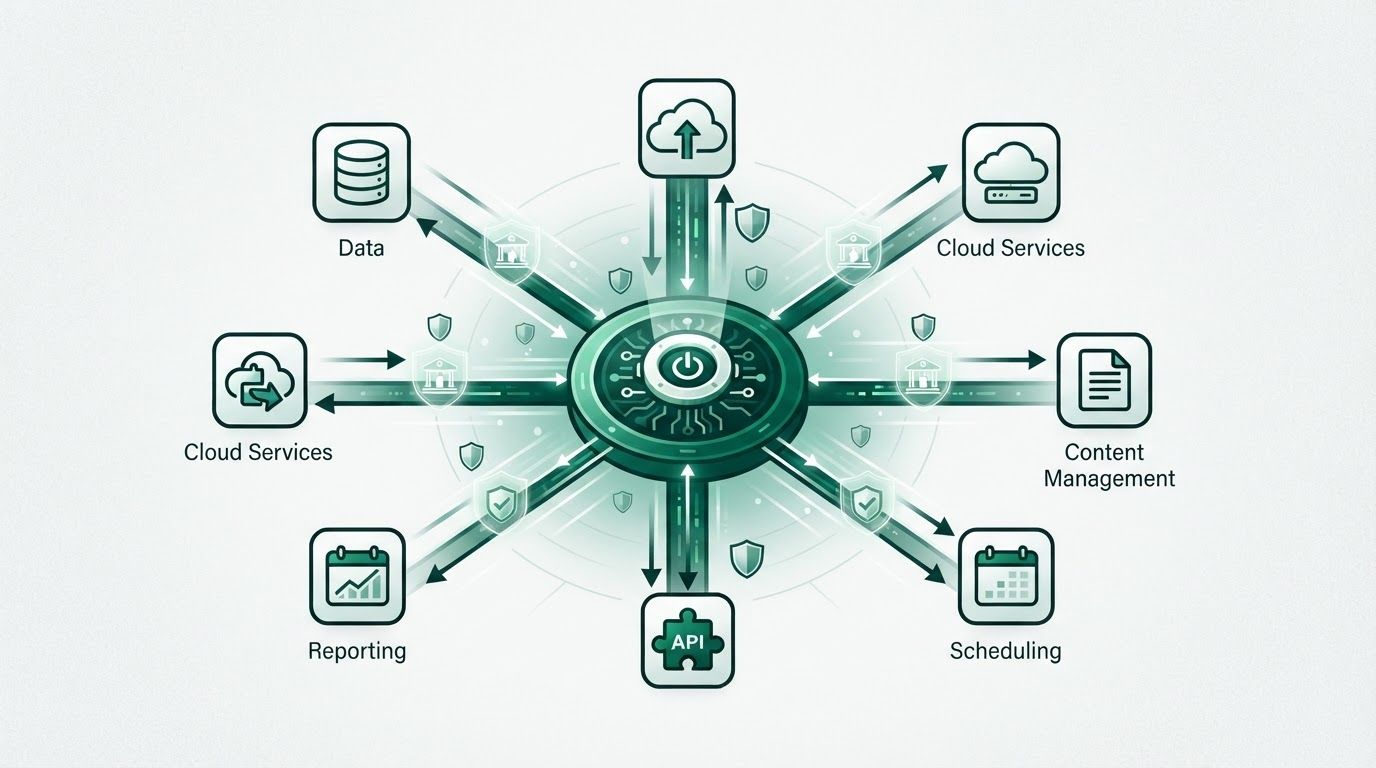
Cross-service tool calls fail in ways that a single-agent demo rarely exposes: a model can choose the wrong route, repeat a side effect after a timeout, pass stale context to a specialist, or produce a polished answer from incomplete results. Cross-service tool governance is the discipline of making those decisions observable, bounded, recoverable, and owned by the application rather than left to an unconstrained model loop.
For platform engineers and teams deploying MCP-connected specialists, the objective is not to remove model judgment. It is to put model judgment inside a controlled workflow: define which tools are available at each stage, keep sensitive logic and approvals on the server, process service results deterministically, and recover from uncertainty without blindly replaying actions.
What cross-service tool governance means in model-driven workflows
In a model-driven workflow, an agent differs from ordinary software automation because the model decides which tool to use and when. That flexibility is useful when requests are ambiguous or require interpretation, but it also creates a governance problem. A tool call is not merely a function invocation; it may read customer data, create a ticket, change a record, invoke a specialist agent, or initiate work in another service.
Cross-service tool governance provides the operating rules around those decisions. It separates the workflow control plane from the systems that actually execute work. The control plane coordinates stages, context, handoffs, guardrails, observability, and recovery. Execution happens in the application runtime, external services, and, where appropriate, isolated sandbox compute.
Direct answer: Govern cross-service tool calls by assigning tools to explicit workflow stages, keeping credentials and approval decisions in a trusted server runtime, giving one orchestrator responsibility for the outcome, recording every call and state transition, and using idempotent, state-aware recovery instead of automatic replays after uncertain failures.
This distinction is aligned with OpenAI’s current agent materials. Its building-agents guidance frames orchestration as handling multiple steps, tool use, agent handoffs, guardrails, and context. Its Agents API positions session management, orchestration, context compaction, and recovery as platform-level responsibilities, while the application supplies tools and the execution environment.
That division is practical. A model can help decide how to investigate a support request, for example, but it should not independently own the secret used to access a billing system, the policy that decides whether a refund needs approval, or the logic that determines whether a timed-out request actually completed.
Establish a control plane before connecting more tools
A reliable multi-service workflow needs a clear owner for coordination. Without one, every agent and connector becomes a potential decision-maker, and it becomes difficult to answer basic operational questions: Which step authorized this call? What information was sent? Did the action complete? Who can approve a retry?
A useful architecture has three distinct responsibility zones.
Orchestration control plane:
owns workflow state, stage transitions, handoffs, context selection, guardrails, trace records, and recovery decisions.
Trusted application runtime:
owns deployment, secrets, tool implementations, approval decisions, the harness, and the agent loop. OpenAI’s Agents SDK documentation places these responsibilities on the server.
Execution environments:
perform the permitted work. External APIs execute service operations, while sandbox compute can handle shell and filesystem work under appropriate isolation.
OpenAI’s migration guidance similarly distinguishes the trusted application runtime, which owns secrets, the harness, agent loop, and tools, from sandbox compute used for shell and filesystem work. This is more than an infrastructure preference. It limits credential exposure and makes it possible to apply different controls to durable business actions and ephemeral computation.
Make responsibility explicit at every boundary
Every cross-service call should have an accountable workflow owner, even if several specialist agents contribute. In many cases, that owner is a manager agent operated by server-side code. OpenAI’s orchestration guidance recommends agent.asTool when a main agent should remain responsible for the final answer while invoking specialists as helpers.
This manager-plus-specialist pattern is usually easier to govern than unconstrained peer-to-peer collaboration. The manager can decide which specialist is eligible for the current stage, reduce specialist outputs to the relevant facts, and ensure that one component remains answerable for the final response. Specialists can remain narrow: retrieve account status, analyze a document, prepare a deployment plan, or assess a policy condition.
A handoff can still be the right design when ownership genuinely needs to move. The important point is that a handoff is a controlled state transition, not an informal instruction embedded in a prompt. Record the source owner, destination owner, allowed context, reason, and return condition.
Use stage-based routing to constrain tool choice and sequencing
The most effective way to reduce accidental tool use is to avoid presenting every tool at every moment. OpenAI’s Programmatic Tool Calling guide recommends assigning each route to a specific workflow stage when the model can call a function directly or from a program. Applied to cross-service workflows, this turns a broad tool catalog into a sequence of constrained decisions.
Consider an enterprise request to resolve a suspected billing discrepancy. A governed workflow might move through explicit stages rather than let an agent freely alternate among CRM, billing, support, and notification tools.
Intake and classification:
validate the request, identify the account reference, and determine whether the request is read-only or may require a change.
Evidence collection:
permit read-only calls to the approved customer, invoice, and payment sources. Do not expose refund or notification tools yet.
Assessment:
combine verified evidence in code and have the model explain the discrepancy or identify missing information.
Decision and approval:
apply policy in the trusted server runtime. If an action needs approval, create an approval request rather than allowing the model to bypass the gate.
Execution:
expose the limited action tool only after the decision is authorized, with a scoped operation identifier.
Confirmation and communication:
verify the final service state, then compose and send a customer-facing update if that communication is allowed.
The value of stages is not only safety. They improve diagnosis. If a workflow returns a poor answer, operators can determine whether the failure was in classification, data retrieval, result normalization, policy evaluation, execution, or response generation. That is much more actionable than a single transcript containing a mixed sequence of model messages and tool calls.
Prefer eligibility rules to prompt-only restrictions
Prompts can explain that a refund tool should be used only after verification, but the runtime should enforce it. At each stage, construct the active tool set from the workflow state and authorization outcome. A tool implementation should also validate its own request: required identifiers, caller identity, authorization scope, stage, schema, and an operation or idempotency key where the action can have a side effect.
This produces defense in depth. The model receives fewer choices; the orchestrator permits only valid transitions; and the tool rejects requests that do not meet its contract. Prompt instructions remain useful for reasoning quality, but they are not the only control.
Design tool contracts for deterministic execution and review
A tool name and natural-language description are not a sufficient contract for a production workflow. Cross-service reliability depends on the details around the invocation: input validation, authorization, output shape, error taxonomy, latency expectations, retry eligibility, and the distinction between read operations and state-changing operations.
Start by treating each tool as an interface with an explicit operational contract. The model may select a tool, but the tool boundary should be governed by code.
Input contract:
define typed fields, required identifiers, allowed values, and limits on free-form content.
Authorization contract:
derive access from trusted identity and policy evaluation, not from model-provided assertions about what a user may do.
Effect classification:
label the operation as read-only, reversible, irreversible, or externally visible. This classification informs approval and recovery behavior.
Output contract:
return structured status, normalized results, provenance needed for review, and a safe error category. Avoid relying on prose alone for downstream decisions.
Recovery contract:
state whether retries are safe, what idempotency mechanism exists, how completion can be checked, and which failures require human review.
Do not ask a model to infer operational status from a loosely formatted response when the service can return structured fields. A billing API can report an operation reference and status. A ticketing service can return a created ticket identifier. A specialist agent can return a structured recommendation with evidence references and confidence constraints defined by the application. Code can then validate and combine those results before they re-enter the model context.
Parallelize independent reads, not ungoverned actions
OpenAI states that programmatic tool calling can run calls in parallel, chain related operations, and filter or combine results in code. Its Agents API launch materials likewise describe parallel tools and code that keeps only relevant context. This is a strong pattern when several independent sources are needed to answer one question.
For instance, an orchestrator can concurrently retrieve order state, account entitlements, and incident status, then normalize the three responses into one evidence object. The model receives the facts it needs rather than three raw, verbose payloads. This can reduce context bloat and avoids asking the model to perform deterministic joins, filtering, or conflict detection that application code can perform more reliably.
Parallelism has limits. Calls that depend on a previous result must remain ordered. State-changing calls should not be parallelized simply to reduce latency when their combined effect could be ambiguous, conflict-prone, or hard to compensate. The dependency graph, rather than a general preference for speed, should determine concurrency.
Keep context, memory, and handoffs under state governance
Cross-service workflows often fail because the right tool is called with the wrong context. An agent may have an old account identifier, omit a previous approval decision, or carry a specialist’s internal reasoning into a customer-facing response. Context management is therefore a reliability concern, not just a token-management concern.
OpenAI’s agent materials emphasize memory and compaction as part of production reliability. The Agents API places session management and context compaction among platform-level responsibilities, and the build-agents track recommends shared memory keyed by conversation_id for agent-as-tool and multi-agent collaboration. These patterns support a durable, scoped state model rather than ad hoc copying of entire transcripts between services.
Separate working context from durable workflow state
Working context is the limited information supplied to a model for the current decision: the current stage, task objective, relevant evidence, approved constraints, and the next allowed actions. Durable workflow state is the server-owned record needed to operate and audit the process over time: conversation ID, workflow ID, actor identity, service operation IDs, approval records, stage history, retry state, and final outcome.
Do not treat a model transcript as the system of record. It is useful diagnostic material, but it is not a dependable substitute for structured state. A restart, compaction event, failover, or handoff should be able to reconstruct what matters from the trusted workflow record.
Context compaction should be intentional. Preserve validated facts, decisions, open questions, and references to source records. Drop duplicated tool payloads, superseded hypotheses, and irrelevant conversational detail. When a specialist returns a large result, have the control plane select or summarize the permitted evidence before passing it to the manager agent. This follows the programmatic tool-calling pattern of filtering or combining results in code.
Scope what a specialist can see and do
A specialist should receive the least context necessary for its assigned task and only the capabilities required to complete that task. A document-analysis agent may need a sanitized document reference and extraction instructions, not customer-wide billing history or notification credentials. A support-drafting agent may need verified case facts, not permission to alter the account.
This approach improves both safety and answer quality. Narrow inputs reduce opportunities for a specialist to act on irrelevant instructions or stale details, while narrow tools make its behavior easier to test. If the manager needs additional information, it can initiate another governed stage rather than granting broad, persistent access.
Build recovery around uncertainty, idempotency, and verification
Timeouts and provider errors are normal operating conditions, but they do not all mean the same thing. A failed read can often be retried. A timeout during a state-changing call may mean the downstream service completed the action even though your orchestrator did not receive confirmation. Treating both cases as “try again” is how duplicate tickets, duplicate notifications, and repeated business actions occur.
OpenAI’s guidance on failover across model providers recommends defining error and response-time limits by provider, model, region, and workflow. It also warns against blindly replaying or assuming that a partial response can continue on another route. The same principle applies to cross-service tools: partial output or uncertain tool action must trigger explicit recovery logic rather than a naïve retry loop.
Classify the failure before selecting a response
Known non-execution:
validation rejected the request before an external effect, or a service clearly reported that no operation began. Retry may be appropriate if the underlying condition is transient.
Known completion:
the service returns a durable operation identifier and final status. Persist it and continue to verification or the next stage.
Unknown completion:
a timeout, broken connection, or partial response leaves the outcome unclear. Query status using the operation or idempotency key; do not issue the action again until completion is resolved.
Model or route failure:
the model response is unavailable, incomplete, or exceeds the configured limit. Resume only from persisted workflow state, and decide whether an alternative provider, model, or region is eligible for that specific workflow.
Idempotency is central for actions with side effects. Generate an operation key in the trusted runtime, persist it before execution, and reuse it when checking or safely retrying the same intended action. If a downstream system does not offer idempotency semantics, design an application-level reconciliation step or require review for uncertain outcomes. There is no universal retry policy that can make an ambiguous external effect safe.
Failover also needs workflow-specific boundaries. A read-only summarization stage may tolerate a provider switch after a response-time limit. An action-planning stage may need the same structured state and model instructions to preserve behavior. An in-progress state-changing tool call should normally be reconciled with the tool’s service before any route change is allowed. Provider, model, region, and workflow are meaningful dimensions because they affect both failure handling and acceptable risk.
Make approvals and sensitive operations server-owned
Approval is a business control, not a conversational flourish. A model can identify that approval may be required and prepare the information a reviewer needs, but the trusted server runtime should determine whether approval is mandatory, verify the approver, record the decision, and unlock the specific authorized operation.
OpenAI’s Agents SDK documentation is clear that the server owns tool implementations, state storage, and approval decisions while the SDK runs the agent loop. This supports a clean separation: agents can recommend, explain, and request; server-side policy and human or system approvers authorize.
For a sensitive change, keep the approval artifact structured. It should identify the requested effect, target, reason, relevant evidence, workflow and operation identifiers, requesting principal, approver, decision, and expiry or scope where applicable. When approval is granted, bind it to the approved action rather than treating it as a broad permission that a model can reuse for a different action later in the conversation.
Different actions warrant different controls. A read-only lookup may proceed automatically. A reversible internal update may require policy checks. An irreversible or externally visible action may require explicit approval and post-execution verification. The correct boundary depends on the service and business process, but the classification should be designed into the workflow rather than improvised by the model.
Operate cross-service workflows with traces, tests, and lifecycle discipline
Governance only works if teams can inspect it in production. Capture a trace for each workflow that connects model decisions to stage changes, agent handoffs, tool calls, authorization outcomes, service operation IDs, retries, and final results. Avoid logging secrets or more sensitive payload data than operations need, but retain enough correlated metadata to reconstruct what happened.
The trace should answer practical questions without relying on memory: which tool was available at a stage, why it was selected, what policy result applied, which external operation was created, what context was passed to a specialist, and whether the outcome was confirmed or remains unresolved. A shared conversation_id can coordinate collaboration, while a workflow or run identifier can distinguish individual executions and retries.
Test the workflow as a state machine
Tool governance is testable when stages and contracts are explicit. Test expected paths, but also test the cases that expose weak control boundaries.
Attempt a tool call before its eligible stage and verify that the runtime rejects it.
Return incomplete or conflicting results from two read services and verify deterministic normalization and escalation behavior.
Simulate a timeout after a side-effecting request is sent and verify reconciliation rather than duplicate execution.
Verify that a specialist cannot access tools or context outside its assigned task.
Verify that an expired, missing, or mismatched approval cannot unlock an action.
Test context compaction and session restoration to ensure essential state survives while irrelevant payloads do not accumulate.
Also manage platform lifecycle deliberately. OpenAI’s Agent Builder documentation says the product is deprecated and scheduled to shut down on November 30, 2026. Teams using workflow-building products should inventory dependencies and plan migration to supported paths such as the Agents SDK or ChatKit where appropriate. Governance architecture should outlast any one visual builder: preserve portable tool contracts, server-owned policy, structured state, and observable stage definitions.
OpenAI’s newer SDK direction, including configurable memory, sandbox-aware orchestration, filesystem tools, and standardized integrations, points toward increasingly structured runtime controls. That can reduce integration friction, but it does not eliminate the need for application-specific governance. Your organization still defines who may act, what counts as completion, what must be approved, and how uncertainty is resolved.
Choose the smallest orchestration design that can enforce the needed controls
Not every workflow needs a large multi-agent topology. A single orchestrating agent with a small, stage-limited tool set is often easier to secure and operate than several agents that can freely delegate to each other. Add specialists when a task benefits from distinct capabilities, different context scopes, or separate tool permissions,not merely because multi-agent design is available.
There are valid alternatives. Deterministic code is the better choice when the process is fully specified and does not require model judgment. A model can still assist at bounded points, such as classifying intake or drafting an explanation from validated data. Conversely, a manager-and-specialist design is useful when interpretation or domain-specific reasoning is needed, provided the manager remains accountable and specialists operate as controlled helpers.
The practical decision is based on risk and variability. Use code for deterministic joins, filtering, policy checks, state transitions, and side-effect execution. Use the model for interpretation, prioritization within an allowed set, explanation, and bounded planning. Use human approval where policy or consequence requires it. This division gives teams the flexibility of agents without making language-model output the sole authority for operational actions.
Reliable model-driven workflows are built from clear boundaries: a control plane that owns orchestration, a trusted runtime that owns secrets and approvals, explicit stages that limit available tools, structured state that survives handoffs, and recovery that treats uncertain actions as reconciliation problems. Start with one workflow, map every tool effect and failure mode, then enforce those rules in code before expanding the agent network.
As services, models, and agent frameworks evolve, keep the durable governance primitives stable: accountable ownership, least-privilege capabilities, deterministic post-processing, auditable state, idempotent execution, and verified completion. Those principles let an orchestration workspace route work to MCP-connected specialists while preserving the operational control enterprises need to ship dependable workflows.