
Home/Blog/Graph-based vs conversation-based runtimes: when to choose structured pipelines over chat-driven coordination
Graph-based vs conversation-based runtimes: when to choose structured pipelines over chat-driven coordination
August 5, 2026
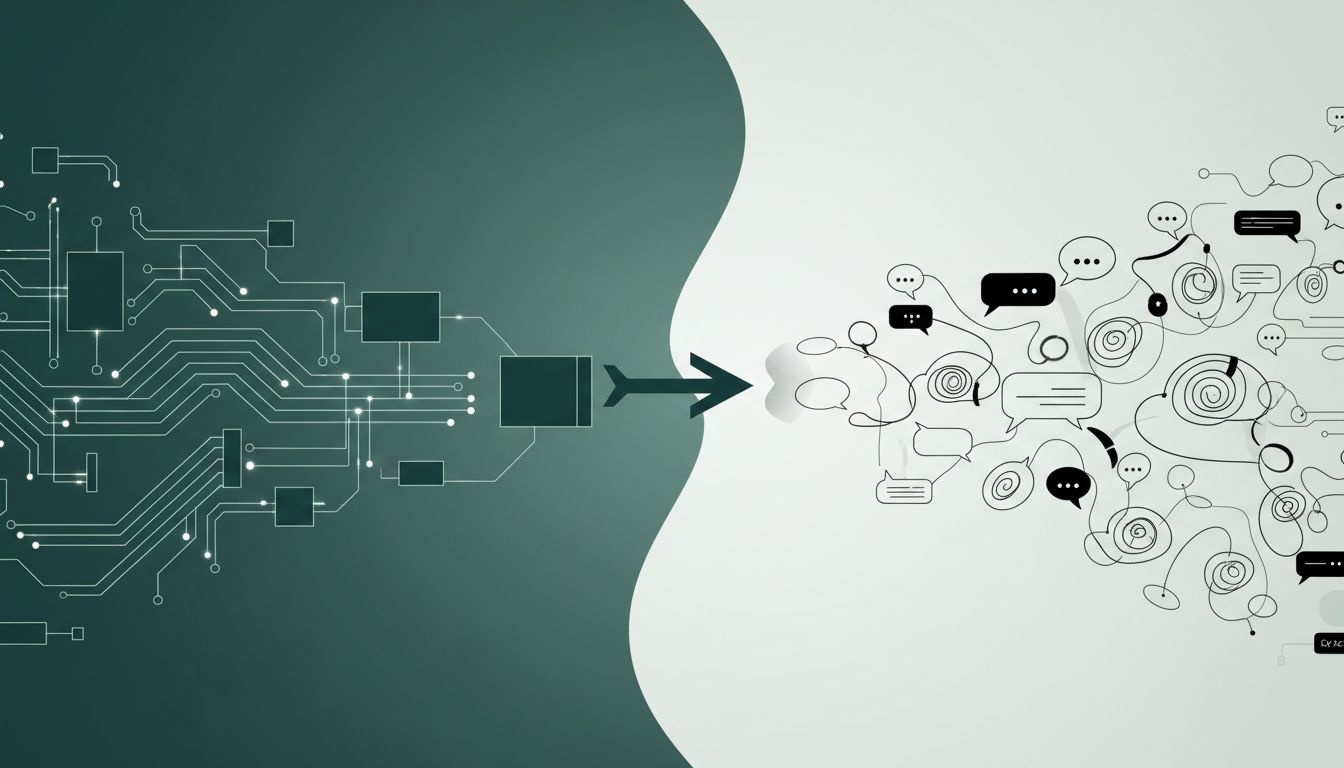
As enterprise teams move from simple chatbots to tool-using agents, orchestration becomes a systems design decision rather than just a prompt design exercise. One of the most important choices is whether to coordinate work through a graph-based runtime or through conversation-based handoffs between agents. Both models can produce capable multi-agent behavior, but they optimize for very different operating conditions.
For platform engineers and product teams shipping specialist agents, the question is not which model is more advanced in the abstract. The practical question is which runtime gives you the right balance of control, adaptability, auditability, and execution resilience for the job at hand. In most cases, the cleanest rule is simple: choose graphs for workflows, choose chat for deliberation.
What graph-based and conversation-based runtimes actually are
A graph-based runtime organizes work as explicit nodes, edges, state transitions, and checkpoints. In this model, each step in the workflow is defined in advance, even if some branches are conditional. The runtime is responsible for moving execution forward, preserving state, handling retries, and making the path through the system inspectable.
This is the direction strongly associated with platforms such as LangGraph, which positions itself as a low-level orchestration framework and runtime for building, managing, and deploying long-running, stateful agents. Its emphasis on durable execution, persistence, streaming, and human-in-the-loop controls reflects a production mindset: workflows may take time, require recovery, and need state continuity across many steps.
Conversation-based coordination works differently. Instead of predefining a full execution graph, agents interact through messages, and one agent can hand off to another as the situation evolves. OpenAI’s Agents SDK documentation explicitly highlights this code-first model as a way to use familiar programming constructs without needing to pre-define the entire graph upfront, with handoffs preserving the latest conversation state.
Why structured pipelines fit production workflow automation
Structured pipelines are the better default when the job must run predictably and repeatedly. If a workflow includes routing logic, approvals, enrichment steps, external API calls, validation, and final actions, a graph-based runtime makes these responsibilities concrete. Each step is bounded, observable, and easier to test before it reaches production.
This aligns with CrewAI’s guidance around Flows, which are recommended for decision workflows and API orchestration because they provide predictable, auditable decision paths with precise control. That is exactly what enterprise teams usually need for operational processes such as ticket triage, KYC review, incident classification, quote generation, or procurement routing.
Structured pipelines are also especially useful when teams want explicit task boundaries. CrewAI’s enterprise documentation emphasizes a task-centric model where the agent is an attribute of the task, reinforcing a “one card per step” approach. That design helps operations teams understand what happened, where it happened, and which component was responsible.
When chat-driven coordination is the better tool
Conversation-based coordination is useful when the interaction itself is part of the solution. Some tasks benefit from specialists debating options, refining hypotheses, or passing partial ideas back and forth until the best path emerges. In those cases, trying to force the work into a rigid graph too early can reduce effectiveness.
CrewAI makes this distinction clearly by recommending Crews for open-ended research and content generation, and more broadly for autonomous problem-solving, creative collaboration, or exploratory tasks. These are not jobs where every transition is known in advance. They require adaptation, initiative, and occasional changes in direction.
Microsoft’s guidance on group chat orchestration points to the same pattern. Group chat is designed to model a collaborative conversation among agents, with a manager deciding which agent responds next and whether to request human input. That makes it well suited to meeting-like workflows, debates, and collaborative problem-solving sessions where conversation is the coordination mechanism.
Durability, state, and recovery favor graph-based runtimes
Once workflows become long-running, graph-based runtimes gain a major advantage. Business processes do not always complete in a single session. They may wait on human approval, hit rate limits, span multiple tools, or need to survive container restarts and infrastructure failures. In these cases, state management stops being a convenience and becomes a core runtime requirement.
LangGraph’s positioning around long-running, stateful agents reflects this reality. Durable execution and persistence are not just implementation details; they are foundational for any workflow that must continue reliably over time. If an agent chain has to resume after interruption, a structured runtime with explicit state and checkpoints is far easier to operate than a loosely coordinated conversational loop.
OpenAI’s more recent agent runtime direction reinforces the same need. Its 2026 Agents SDK evolution adds snapshotting and rehydration so an agent can restore state in a fresh container and continue from the last checkpoint after failure or expiry. That is a strong sign that checkpointing and recovery are becoming standard expectations for serious agent workflows, and graph-based runtime patterns map naturally to those needs.
Auditability, compliance, and deterministic control
Many enterprise workflows are less about intelligence in the abstract and more about controlled execution under constraints. Teams need to know why a branch was taken, which tools were called, what inputs were used, and how a final action was authorized. If the system supports regulated or customer-facing processes, this requirement becomes non-negotiable.
Structured flows are preferable here because they make decision paths explicit. CrewAI’s documentation is unusually direct on this point, recommending Flows when precise control and auditable decision paths matter. The same applies wherever conditional logic, loops, and dynamic state management must be executed reliably and consistently rather than improvised through free-form turns.
Conversation-based coordination can still log transcripts, but a transcript is not the same thing as a deterministic process model. A long back-and-forth may explain what agents discussed, yet still leave ambiguity about why one option was selected over another. For audit-heavy environments, explicit state transitions are easier to inspect, replay, and govern.
The performance cost of too much conversation
Chat-driven coordination can become expensive in more ways than one. Longer conversations increase token usage, create more surface area for drift, and make it harder to isolate the moment where execution went off course. They can also burden analytical workflows that would be better served by concise state updates and direct tool execution.
Recent Microsoft research in ConDABench highlights a practical concern here by evaluating model performance against conversation length. While conversation is valuable in collaborative settings, extended interactive loops can become a liability in data analysis and similarly structured tasks. More turns do not automatically produce better outcomes.
That matters in production because many teams initially overuse chat as a coordination pattern simply because it is intuitive. But if a workflow mostly consists of conditional logic, extraction, validation, and tool calls, wrapping everything in conversation can introduce noise instead of useful reasoning. A graph-based runtime often reduces both cost and operational ambiguity.
Vendor direction increasingly separates workflows from deliberation
Across the ecosystem, vendor guidance is converging on a practical split between structured orchestration and dynamic collaboration. OpenAI’s own materials contrast graph-style workflows composed of nodes and conditional edges with the more flexible orchestration model in the Agents SDK. The distinction is not accidental; it reflects two different categories of work.
OpenAI is also positioning agents as workflow tools rather than just chat interfaces. Its platform materials describe agents that can operate independently for minutes or hours, orchestrating tool calls and iterating toward solutions, whereas chatbot interactions are often short and self-contained. The deprecation of the Assistants API in favor of the Responses API and Agents SDK further signals a move toward newer, more structured agent primitives.
Microsoft’s stack shows a similar direction. Group chat orchestration remains useful for collaboration, but orchestration features are still marked experimental and under active development. For production-grade automation, that is an important signal: collaborative chat patterns are valuable, but structured execution remains the safer default when reliability is the priority.
A practical decision framework for choosing between the two
Start with graph-based runtime design when the work is repeatable, tool-heavy, stateful, or operationally sensitive. If you need checkpoints, retries, human approval gates, conditional branches, loops, or postmortem-friendly traces, structured pipelines are usually the right answer. They are particularly effective when multiple specialist agents must contribute within clear task boundaries under a shared control plane.
Choose conversation-based coordination when the task is inherently exploratory and you cannot productively define the full flow up front. Research, planning, brainstorming, negotiation, collaborative diagnosis, and content ideation are strong candidates. In these situations, agent handoffs and group-style deliberation create useful flexibility because the next best step genuinely depends on what emerges during the exchange.
In practice, many mature systems combine both. A graph-based runtime can own the durable workflow, while specific nodes invoke short-lived conversational subroutines for exploration or expert debate. That hybrid model often gives enterprises the best of both worlds: strict process control where it matters, and adaptive agent collaboration where it adds real value.
The core lesson is that orchestration style should match the shape of the work. A graph-based runtime is not better because it is more structured, and conversation-based coordination is not better because it feels more agentic. Each is a runtime strategy optimized for different failure modes, operating assumptions, and business requirements.
For most enterprise teams building specialist AI systems, the safest heuristic remains straightforward: use structured pipelines for workflows and use chat-driven coordination for deliberation. If the outcome must be durable, auditable, and recoverable, reach for graphs first. If the value comes from collaborative reasoning and adaptation, let conversation drive the handoff.