
Home/Blog/How MCP's stateless shift is reshaping model orchestration
How MCP's stateless shift is reshaping model orchestration
August 31, 2026
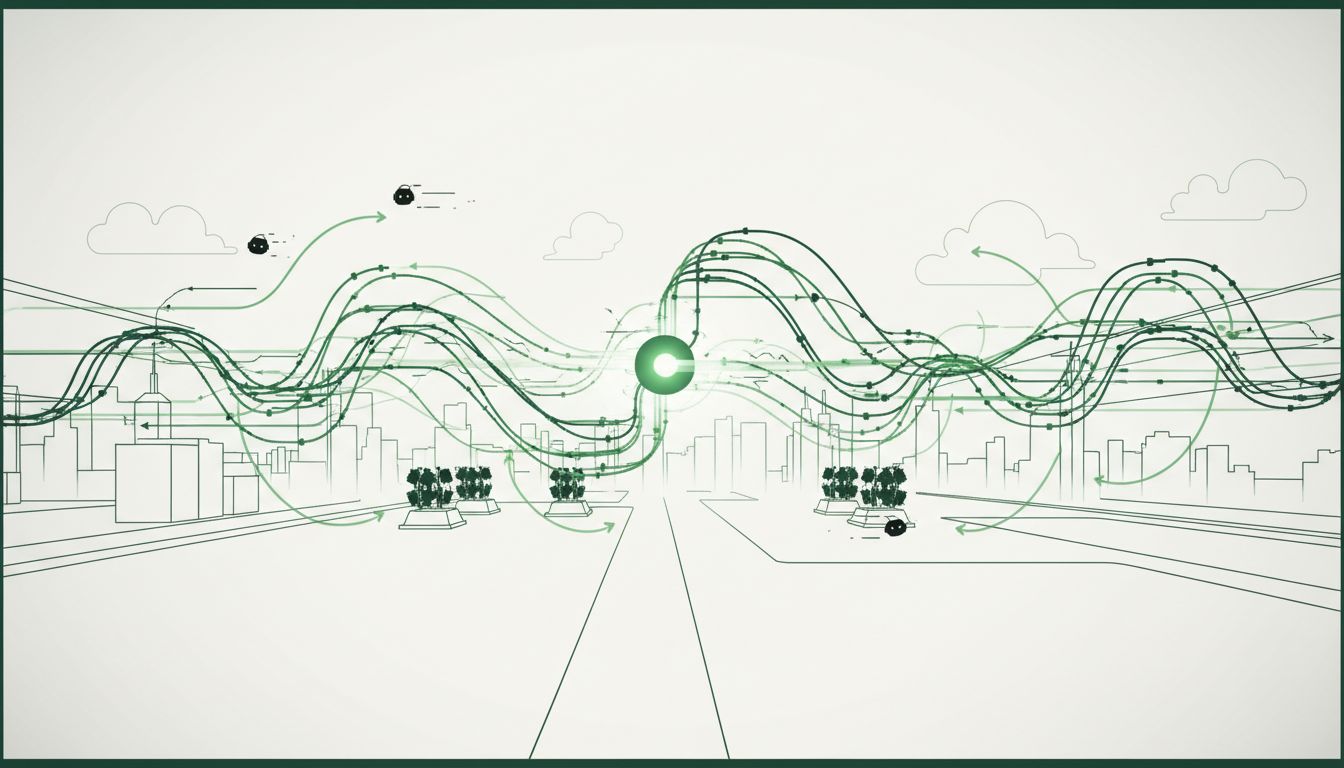
Model orchestration is often discussed as a question of prompts, agent roles, tool selection, or memory. In production, however, the transport model underneath those decisions has an outsized effect on reliability, scale, governance, and cost. MCP’s 2026-07-28 specification marks an important architectural change: its protocol core is transforming from a bidirectional stateful protocol into a request/response stateless protocol. That change does not make agent systems stateless. It changes where state belongs. Instead of making a transport connection the durable center of an interaction, teams can keep workflow, tool, user, and recovery state in the applications and orchestration layers designed to manage it.
For platform engineers and teams building specialist-agent workflows, this is a practical shift rather than a semantic one. A model orchestration workspace still needs to route work to the right MCP-connected agent, hand off relevant context, invoke tools, enforce policy, and make multi-step work observable. What changes is the operational substrate. When a request can reach any healthy server instance behind an ordinary round-robin load balancer, orchestration no longer has to inherit sticky-session constraints from the protocol transport. MCP increasingly looks less like a session bus and more like a standardized, policy-friendly control-plane interface for connecting models, agents, tools, and workflow services.
From connection ownership to request ownership
The line change in the 2026-07-28 MCP specification is explicit: the protocol is moving from a bidirectional stateful design to a request/response stateless protocol. In the new model, requests are not intrinsically bound to a particular server process because of an established protocol session. The specification describes the operational consequence clearly: any request can land on any instance behind a plain round-robin load balancer. For teams that have operated distributed services, that is familiar infrastructure behavior. For teams that previously had to treat an MCP connection as an object with location affinity, it is a significant simplification.
Older session-oriented designs tend to make connection placement a first-class operational concern. If an agent client initializes against one instance, later calls may need to return to that same instance because protocol state lives there. Load balancers must recognize and preserve that affinity. Deployments need careful draining behavior. A process restart can invalidate active work unless connection state is migrated or recovered. These issues are manageable, but they are incidental complexity when the substantive business requirement is to run a tool call or coordinate a model task, not to preserve a particular transport relationship.
Stateless request handling changes the unit of ownership. The relevant question becomes: which service should handle this request, given its declared method, tool name, authorization context, tenant, and workload characteristics? That is a routing question that a gateway and an orchestration control plane can answer repeatedly and consistently. It also means capacity can be added without deciding which existing sessions to move. Instances can remain comparatively interchangeable at the transport layer. The result is not automatic resilience,application state still requires deliberate design,but it removes session affinity as a default dependency of the MCP protocol path.
The handshake and session no longer define the core lifecycle
The release candidate language is direct: “the handshake and session are gone” from the protocol core. This deserves careful interpretation. It does not mean that applications stop identifying callers, negotiating capabilities where needed, tracking workflow progress, or preserving a user’s task context. It means those concerns no longer require a universal, long-lived protocol session as the organizing mechanism for normal transport behavior. The core lifecycle is instead oriented around independent requests and responses.
This distinction matters because transport sessions and application sessions solve different problems. A transport session answers questions such as which socket or stream is open, which backend accepted initialization, and where protocol-local state is stored. An application session may answer which user is working on a task, which approval is pending, which agent has produced an intermediate artifact, or which compensation action should run after a failed tool step. Treating both types of state as one thing often hides important design choices. The stateless shift makes the boundary more visible: stateful applications can remain stateful while the wire protocol is not.
For orchestration systems, that separation is useful. A control plane can store durable workflow records outside individual MCP server processes. It can associate a run ID with a sequence of agent handoffs, tool invocations, human approvals, and outputs. It can resume work using explicit application data rather than depending on the survival of a transport session. This aligns with the release candidate framing of “stateless protocol, stateful applications.” The phrase captures the core engineering posture: keep state where it can be observed, governed, replicated, and recovered, while making transport instances easier to replace and scale.
Header-driven routing makes MCP more legible to gateways
In the 2026-07-28 specification, method and tool names travel in the Mcp-Method and Mcp-Name HTTP ers. That is a consequential detail for platform design. A gateway can identify what a request intends to do before relying on hidden connection state. It can route a tool invocation to an appropriate service pool, apply method-specific controls, and collect metrics with a stable request-level view. The request becomes more self-describing to the infrastructure that sits between a caller and an MCP server.
For a multi-agent environment, er-driven routing enables a more deliberate dispatch model. An orchestration workspace may choose a specialist agent based on task type, then use ordinary Layer 7 routing to direct relevant MCP traffic to the matching tool domain or server fleet. A read-oriented catalog operation might use one route and cache policy; a sensitive write-capable tool might use another route with stronger authorization checks and audit requirements. The routing decision no longer has to be subordinated to the backend selected during an earlier handshake.
Headers do not eliminate the need for careful policy design. A gateway must treat routing metadata as input to validate, not as a substitute for authorization. Teams should verify that a caller is permitted to invoke the declared method and tool, enforce tenant and environment boundaries, and ensure that the backend performs its own appropriate checks. Still, exposed request metadata is operationally valuable. It supports consistent middleware behavior, clearer logging, and policy enforcement close to the edge. In an enterprise setting, that makes MCP easier to integrate with existing API gateways, observability systems, and security controls.
Cacheability becomes an orchestration primitive
The stateless design also elevates cache behavior from an implementation afterthought to a meaningful orchestration primitive. The specification says that list responses carry cache hints and deterministic order. In practical terms, this supports caching of tool catalogs and helps keep prompt caches stable across reconnects. A tool catalog is not merely descriptive metadata in an agent system. It affects planning, tool selection, prompt construction, policy evaluation, and user-facing capability discovery. Re-fetching and reshaping it unnecessarily can add latency and create avoidable inconsistency.
Deterministic ordering is especially relevant where tool definitions are injected into model context. If a catalog changes order despite being logically identical, prompt representations can change as well. Stable representations make it easier for clients and orchestration layers to reason about reuse and cache validity. This does not guarantee lower model cost or faster responses in every implementation; those outcomes depend on the model provider, client, and surrounding architecture. It does provide a protocol-level basis for treating capability discovery as cacheable, predictable data rather than as a transient property of one live session.
Teams should still design cache invalidation and policy boundaries explicitly. Cache a catalog only within an appropriate scope: for example, a tenant, environment, credential context, or policy version may affect which tools are visible. Avoid assuming that a globally cached list is valid for every user. The useful pattern is to make catalog snapshots explicit in orchestration records, track the source and validity conditions of those snapshots, and refresh according to the provided hints and local governance rules. Done well, caching reduces repetitive coordination work while preserving a clear explanation of which capabilities were available when an agent made a decision.
MRTR separates interactive workflows from permanently open streams
One concern with a simplistic reading of stateless request/response systems is that agent workflows sometimes need server-to-client interaction. A server may need to request sampling or elicitation as part of work. The 2026-07-28 specification addresses this with Multi Round-Trip Requests, or MRTR, for server-to-client requests such as sampling and elicitation. The stated goal is to remove the need for constantly open bidirectional streams while retaining a structured way to complete interactions that require more than one exchange.
That approach is important for orchestration because not every multi-step task requires a permanently held connection. A planning agent may invoke a tool, the tool-side service may need a model completion or additional input, and the workflow may then continue. With MRTR, the interaction can be represented as a sequence of explicit request/response turns rather than as a single stream whose continued availability becomes part of application correctness. This fits naturally with durable workflow techniques, where each step has an identifier, a payload contract, timeout behavior, retry policy, and observable status.
MRTR does not remove the need to reason about timeouts, duplicate delivery, idempotency, or approval boundaries. In fact, making these interactions explicit can reveal those requirements more clearly. An orchestration layer should correlate every round trip with a durable workflow record, constrain which agents or tools may request downstream model work, and preserve the information needed to resume safely after an interruption. The benefit is architectural, not magical: interactive behavior can remain available without forcing every server and every intermediary to maintain an always-open bidirectional protocol stream.
Horizontal scaling becomes a default deployment posture
The operational benefit most directly associated with the stateless shift is horizontal scaling without session affinity. The C# SDK documentation describes the HTTP transport as stateless by default, says it does not assign Mcp-Session-Id, and notes that this simplifies deployment by enabling horizontal scaling without session affinity. Its documentation also says compliant clients use MCP-Protocol-Version on each request and that stateless mode avoids in-memory transport session tracking. These are concrete signals that the model is not only theoretical; SDK guidance is being aligned around request-level operation.
For platform teams, a stateless default reduces several common deployment burdens. A service can be placed behind conventional load balancing. Autoscaling can add instances without needing new connections to be pinned intentionally. Rolling deployments and incident recovery become less dependent on preserving transport-local session data. Middleware can be applied consistently at the request boundary. None of this means an MCP server has no state at all. A server may still read shared configuration, access a database, queue work, or participate in a durable process. The key is that it need not retain protocol session state in memory simply to serve the next valid request.
Capacity planning should therefore distinguish transport concurrency from workflow concurrency. A request may be short-lived while the business operation it initiates is long-running. An orchestration platform should measure queue depth, downstream tool saturation, model limits, tenant quotas, and durable workflow backlogs rather than infer system health from the count of open MCP sessions. This is a more useful operating model for agent systems, where the work may fan out across several specialist agents and tools. Stateless transport makes the edge elastic; the orchestration layer must still manage the actual work lifecycle responsibly.
SDK migration shows a practical, not purely theoretical, transition
The MCP transport evolution did not arrive without context. The 2025-06-18 transport specification still described a standard client-server transport model that preceded the 2026 stateless redesign, while already negotiating protocol version through HTTP ers. Earlier design work in SEP-2575 identified that MCP was “not stateless by default” and proposed a fundamental stateless-first refactor, including protocol version in an HTTP er. The roadmap likewise noted that Streamable HTTP was production-ready, but large-scale usage had exposed gaps around horizontal scaling, stateless operation, and middleware patterns.
By late 2025, the future-of-transports discussion reported that many SDKs already offered a stateless option and set an agenda to finalize transport SEPs in early 2026 for the next release. Recent SDK materials show the migration becoming more concrete. The TypeScript SDK migration guide says its v2 HTTP entry serves 2026-07-28 per request and, by default, also serves legacy traffic per request through the established stateless idiom. That kind of compatibility posture matters because production ecosystems rarely shift all clients, gateways, and servers at once.
Migration should be treated as a controlled platform program, not a flag flip. Inventory existing servers and clients, identify where sticky routing or transport-local memory exists, and document which workflows truly require durable application state. Test new request-level routing through the same gateways and authorization layers used in production. The Ruby SDK documentation offers a useful warning about terminology: it exposes stateless: true while explicitly distinguishing that option from the MCP 2026-07-28 “sessionless modern lifecycle.” Teams should verify the exact SDK semantics and protocol version they are deploying rather than assuming similarly named options mean the same thing.
State moves upward into workflow and context architecture
When protocol state recedes, application state becomes more visible and more important. That is precisely where a model orchestration system adds value. It can retain the context required for a run without tying that context to a particular MCP server instance. It can record the task objective, agent assignments, tool inputs and outputs, approval decisions, policy outcomes, correlation identifiers, and retry state. It can selectively hand off the relevant context to the next specialist rather than relying on a transport connection to imply continuity.
This design is aligned with the broader agentic software trend. Anthropic’s 2026 agentic coding report describes organizations harnessing multiple agents with reasoning across separate context windows and says engineering value is shifting toward system architecture design and agent coordination. Whether a team uses coding agents, operations agents, research agents, or internal business automation, the implication is similar: the important state is increasingly distributed across models, tools, workflow records, and bounded context windows. A persistent socket is not a sufficient system of record for that kind of work.
Enterprise infrastructure messaging reflects the same separation. Accenture’s 2026 AI agents material describes infrastructure based on MCP for “stateful, resilient AI communication” with resumability and redelivery. That language is compatible with a stateless protocol core, not contradictory to it. Resumability and redelivery are generally stronger when they are owned by systems designed for durable coordination rather than by a best-effort in-memory transport session. The practical principle is to place state at the level where it must survive: use a workflow store for workflow progress, a governed memory system for retained context, and a tool-specific source of truth for business data.
Security and governance become easier to place at the request boundary
The 2026 specification change is also a security and governance story. It adds authorization hardening, issuer validation, and a move away from Dynamic Client Registration toward client metadata documents. Combined with self-describing ers and request-level protocol versioning, these changes make the MCP path more compatible with centralized enforcement. A gateway can evaluate an incoming request with a clearer understanding of its declared operation, identity context, client metadata, and destination before passing it to the service that performs the work.
For enterprise agent orchestration, policy should not be reduced to whether a connection was successfully established. Each action deserves evaluation. A tool that retrieves a public knowledge-base entry may need different controls from one that changes a production record, sends a message, accesses customer data, or requests model sampling. Stateless transport encourages a request-oriented enforcement model: authenticate the caller, validate issuer and client information, authorize the method and tool, apply rate and budget controls, redact or classify data where appropriate, and emit an audit event linked to the orchestration run.
Trustworthiness still depends on disciplined implementation. Header fields must be validated at trusted boundaries; backends should not blindly trust forwarded claims. Sensitive tools need clear scopes and least-privilege credentials. Idempotency should be designed for write operations because retries can occur in distributed systems. Logs should support investigation without becoming a new repository of sensitive prompts or tool payloads. The stateless architecture helps place controls in standard middleware and gateways, but it does not eliminate the need for defense in depth. Its value is that governance can be more uniform across a fleet rather than being entangled with connection-specific behavior.
What this means for an MCP orchestration control plane
The net effect is that MCP is becoming a better control-plane interface for model orchestration rather than a session bus. In a control-plane pattern, the orchestration workspace decides how work is routed, which specialist agent should act, which MCP tool server is eligible, what context can be handed off, and what policies apply. MCP provides a standardized way to invoke and describe capabilities, while the orchestration layer owns cross-agent coordination and business-level continuity. The stateless core is well suited to this division because it makes individual MCP calls easier to route through conventional infrastructure.
A pragmatic implementation starts with explicit identifiers and boundaries. Give every user task and workflow run a durable correlation ID. Record the selected agent, the tools it may use, the relevant policy version, and the minimal context required for the next action. Treat MCP calls as request-scoped activities that can be retried only when the operation is safe to retry. Keep long-running state outside the MCP transport, and use queues, workflow engines, or durable stores when the task needs delayed completion, approval, redelivery, or compensation. This approach preserves the flexibility of agent handoffs without asking a single live session to carry the full burden of correctness.
Operationally, teams should test the architecture the way it will actually run: behind Layer 7 routing, with instances added and removed, with caches cold and warm, with authorization failures, and with downstream tools degraded. Measure request-level latency and errors, but also inspect run-level outcomes: did the correct agent receive the correct context, did policy block prohibited actions, did a failed tool call recover safely, and can an operator explain why a decision was made? MCP maintainers have emphasized the scale of the ecosystem, noting close to half-a-billion downloads a month across Tier 1 SDKs and more than 1 billion total downloads for the TypeScript and Python SDKs. At that level of adoption, boring, interoperable operational patterns are a material advantage.
MCP’s stateless shift does not reduce model orchestration to HTTP routing. Agent systems remain stateful, probabilistic, and operationally demanding. They still need careful context management, tool contracts, evaluation, observability, reliability engineering, and human control for consequential actions. What the shift does is remove a layer of unnecessary coupling: a workflow no longer needs to be organized around the survival and location of a protocol session. That gives platform teams more freedom to build resilient control planes around the state that actually matters.
The most useful design response is to embrace the separation intentionally. Keep the MCP transport request-oriented, horizontally scalable, and gateway-governed. Keep business state, agent coordination, resumability, and context handoffs in explicit application-layer services. Use er-driven routing and cache hints to make the infrastructure more efficient, and use MRTR where multi-round interaction is needed without maintaining permanently open streams. For organizations routing work among specialist MCP-connected agents, that architecture offers a clearer path to scale: simple transport mechanics underneath, durable orchestration above, and policy enforcement throughout.