
Home/Blog/How model routers are reshaping distributed inference for cost, latency and compliance
How model routers are reshaping distributed inference for cost, latency and compliance
October 26, 2026
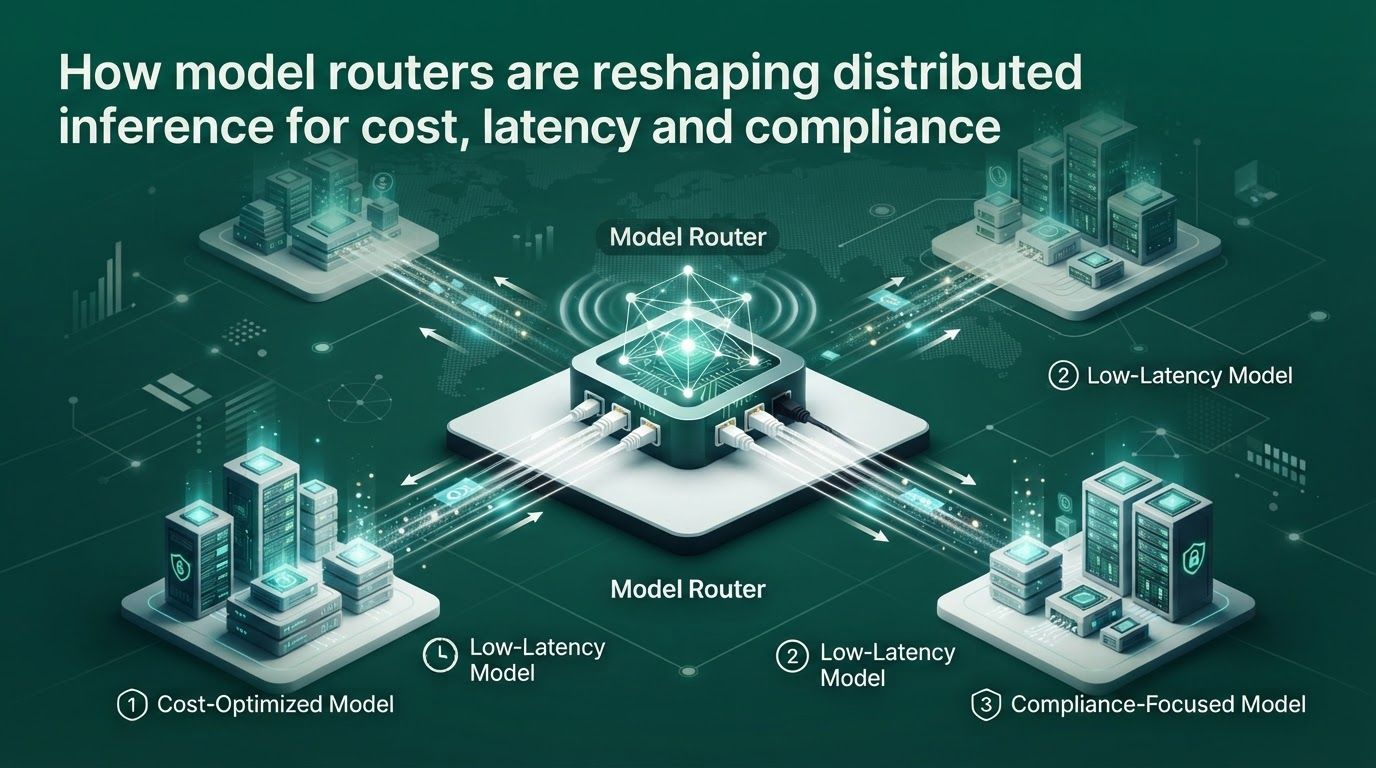
Distributed inference becomes expensive and unpredictable when every request goes to the same large model or the nearest available endpoint. Model routers address that problem by selecting the cheapest acceptable model and the best execution location for each request, using signals such as task complexity, prompt sensitivity, geography, cache state, queue depth, and service health.
For platform teams operating specialist agents, the value is not simply lower model spend. A router can preserve context across agent handoffs, keep regulated data within an approved boundary, avoid overloaded replicas, and send straightforward work to smaller or open-weight models while reserving premium capacity for tasks that need it. The result is a distributed inference control plane where cost, latency, quality, reliability, and compliance are explicit policy choices rather than accidental outcomes of a default endpoint.
How model routers reshape distributed inference
Direct answer: A model router is a policy and decision layer that evaluates each AI request, then directs it to an approved model, region, endpoint, or inference replica that can meet defined quality, cost, latency, reliability, and compliance requirements. In distributed inference, effective routing also considers live conditions such as queueing, prompt-prefix reuse, model-state locality, and available capacity.
Traditional deployment logic often treats model selection and infrastructure placement as separate decisions. A team picks a model, deploys it to one or more endpoints, and then relies on basic load balancing to distribute traffic. That approach is workable for stable, homogeneous workloads, but it leaves substantial value on the table when requests differ sharply in complexity, risk, input length, or urgency.
Model routers unite those decisions. Instead of asking only, “Which replica is free?” a router asks a sequence of operational questions: Which model is likely to produce an acceptable result? Where is an eligible copy of that model? Can an existing cache or prompt prefix be reused? Is the requested region permissible for this data? Will queueing at that destination erase the benefit of a faster model?
The routing decision has several layers
Task and quality routing:
classify the request and select a model tier or specialist that is expected to meet the required quality threshold.
Policy routing:
enforce tenant, data-classification, residency, provider, tool-access, and model-approval rules before inference begins.
Placement routing:
choose the region, availability zone, private endpoint, edge location, or cluster where an eligible model should run.
Serving-aware scheduling:
select a replica based on queue state, batch formation, cache affinity, prompt length, and the different needs of prefill and decode phases.
Resilience routing:
move traffic when a region, provider, model deployment, or capacity pool cannot satisfy the service objective.
This broader view matters because inference performance is not determined by model capability alone. A May 2026 paper on latency-aware LLM query routing notes that round-robin and join-the-shortest-queue policies fail to account for model accuracy and inference cost. It also emphasizes that latency depends on prompt length, prefill and decode workload, and the batching and scheduling behavior of the serving framework.
That is why distributed inference is increasingly a location problem as well as a model problem. Equinix argued in September 2026 that enterprises face cost, performance, and compliance risk based on where inference runs, and identified metro-local architecture, private connectivity, and open-weight model tiering as levers for optimizing distributed workloads. A useful router therefore needs visibility beyond a catalog of model names: it needs awareness of the network, the deployment topology, and current serving conditions.
Route for cost without treating every task as equal
The most familiar model-routing use case is cost control. Premium models may be appropriate for difficult reasoning, high-stakes generation, or complex coding tasks, but they are not automatically the best economic choice for classification, extraction, summaries, routine support responses, or constrained tool calls. A router can direct those lower-risk tasks to a smaller or less costly eligible model and escalate when confidence, policy, or evaluation results require it.
There is concrete evidence that this trade-off can be material, but it must be read as a benchmark result rather than a universal guarantee. AWS Cloud Financial Management reported in late October 2026 that, in one coding-agent benchmark, routing was 44.7% cheaper for 4.8% lower mean quality. That finding illustrates the core commercial question: whether the quality reduction is acceptable for the workload and the route selected.
Define an acceptable-quality floor first
Cost routing should not mean “always use the smallest model.” It should mean “use the lowest-cost route that meets the task’s acceptance criteria.” Those criteria differ across workflows. An internal research assistant may tolerate a lower-confidence draft that is reviewed by a person, while an automated compliance action may require a stricter model, constrained tools, and a mandatory review path.
Segment requests by business consequence, complexity, modality, and expected output format.
Set a quality floor for each segment using representative evaluation data, not a generic benchmark alone.
Assign approved candidate models and define escalation triggers such as low classifier confidence, failed validation, or unavailable tools.
Record route choice, model result, retry behavior, cost proxy, and quality outcome so the policy can be tuned.
Managed platforms are making this behavior more accessible. AWS said in August 2026 that Amazon Bedrock Intelligent Prompt Routing offers a single serverless endpoint that routes requests among foundation models to optimize response quality and cost. In April 2026, AWS also announced SageMaker AI inference recommendations that let customers indicate whether to optimize for cost, minimize latency, or maximize throughput.
Those capabilities reduce the burden of manually maintaining every deployment choice, but they do not remove the need for workload-specific governance. A platform team still needs to decide which models are allowed for which tenants, what quality loss is tolerable, and when an agent must escalate rather than silently produce a weaker answer. Small-model router research makes that limit clear: an April 2026 benchmark found that SLM-based routing could satisfy cost and latency prerequisites, while a 6.8 percentage-point accuracy gap remained a significant barrier to production viability.
Latency-aware model routing starts with queue, cache, and inference phase
Latency optimization is often misunderstood as a simple nearest-region problem. Physical distance matters, especially for interactive agent experiences, but a nearby endpoint with a long queue or cold cache can be slower than a slightly more distant endpoint with reusable state and available capacity. Model routers must therefore reason about both network path and serving path.
Prompt-prefix reuse is one of the clearest examples. AWS said its September 2026 benchmark found that prefix-aware routing on Amazon SageMaker Inference reduced latency by placing requests on endpoints able to reuse prompt prefixes, while characterizing routing cost as negligible. For agent systems, this can matter whenever many requests share a system prompt, knowledge preamble, tool schema, tenant policy, or conversation prefix.
Why cache locality changes the placement decision
Large language model serving has state. The key-value cache created during prefill can be valuable for subsequent requests, but it only helps when traffic reaches the place where that state is available. Sending a follow-up request to an arbitrary replica may discard that advantage and trigger redundant work.
OpenAI’s August 2026 Jalapeño hardware results reinforce the broader principle of phase-aware placement. OpenAI reported 1.7 to 3.6 times lower end-to-end latency than comparison systems and described how model state such as KV cache can be explicitly placed and kept local while the system activates appropriate compute, memory, and networking for each inference phase. The lesson for routing architecture is not that every team must reproduce that system; it is that routers should understand whether a request benefits from existing state and whether prefill and decode have different resource demands.
New, short requests:
prioritize an eligible endpoint with low queue delay and good network proximity.
Long-context requests:
consider prefill capacity, prompt length, and whether the route can reuse a shared prefix.
Multi-turn conversations:
favor session or cache affinity when it improves response time and cost.
Streaming workloads:
measure time to first token separately from total completion time, because users experience them differently.
Agent chains:
account for the time spent handing context to specialist agents and calling tools, not just raw model generation.
Cluster-level scheduling evidence points in the same direction. Red Hat said in May 2026 that llm-d routed requests across a distributed cluster with visibility into each node, queue, and cache. It reported 2x the users on the same hardware and 99% better latency under load. These are reported results for that system and workload, not a forecast for every deployment, but they demonstrate why generic infrastructure load balancing is insufficient for inference traffic.
Tail latency deserves special attention. A route that lowers average latency but occasionally sends long prompts into an overloaded or cold-serving path can still make an interactive product feel unreliable. Route evaluation should therefore examine queue time, time to first token, end-to-end time, retries, and P95 or P99 behavior by request class. A single mean-latency metric hides too much operational risk.
Compliance-aware routing makes geography and data sensitivity enforceable
For regulated or enterprise workloads, the best route is often constrained before performance optimization begins. A request carrying sensitive customer information, protected records, contractual data, or a tenant-specific residency requirement cannot simply be sent to the globally cheapest model endpoint. The router must first calculate an eligible set based on policy, then optimize among those permitted destinations.
Compliance-aware routing is becoming a distinct design category rather than an afterthought. A June 2026 paper on ComplianceGate proposed classifier-gated, multi-tier routing that evaluates query complexity and data sensitivity before inference and directs work to an appropriate model in an appropriate geography. The paper reported a 39% median latency reduction and 33.52% cost savings. Those research results are not a substitute for an organization’s legal, security, or audit requirements, but they show that governance constraints and efficiency objectives can be designed together.
Build eligibility before optimization
A defensible control flow is to reject prohibited routes first, then rank the remaining options. This is safer than choosing an attractive endpoint and attempting to add compliance checks afterward.
Classify the request:
identify tenant, data category, jurisdictional requirement, retention rule, and whether external tools or providers are permitted.
Construct the eligible route set:
filter models, regions, private connections, and deployments that do not meet the request’s policy requirements.
Optimize inside that set:
rank allowed routes by predicted quality, expected queueing, cache reuse, cost, health, and latency.
Log the decision:
retain the policy version, eligible candidates, selected destination, and reason codes needed for operational review.
Escalate exceptions:
if no compliant route can meet the service objective, fail safely, queue the task, request approval, or use a defined degraded mode.
Infrastructure vendors are increasingly describing routers in governance terms. Akamai’s 2026 AI grid material includes security guardrails and governance capabilities in routing orchestration, framing latency, cost, and compliance as connected enterprise trade-offs. IBM Research similarly wrote in July 2026 that production model routers must simultaneously balance cost, latency, model specialization, reliability, and compliance.
This is especially relevant for an orchestration workspace that hands context among MCP-connected specialist agents. Context handoff can itself create a policy boundary: an agent may be allowed to receive a sanitized task summary but not raw source records, or a tool-capable agent may be allowed in one jurisdiction but not another. Treat model routing, agent routing, context transformation, and tool authorization as related control-plane decisions. Otherwise, a compliant model selection can be undermined by an uncontrolled context transfer.
Use regional and multi-provider routes for resilience, not just failover
Distributed inference architectures need a plan for demand spikes, endpoint degradation, regional incidents, and capacity shortfalls. Static active-passive failover provides one level of protection, but adaptive routing can do more: it can steer normal traffic according to real-time availability, latency, and demand while retaining policy boundaries.
AWS’s June 2026 Bedrock resilience guidance describes dynamic routing across Regions based on real-time capacity, with requests automatically sent to an optimal destination region based on availability, latency, and demand. Its implementation guidance also states that cross-region inference carries no additional routing or data-transfer charge for using cross-region inference. That changes the economic calculation for organizations using that specific capability, although normal model usage, regional eligibility, and the provider’s applicable service terms still matter.
Separate resilience policy from quality policy
A resilient router should not indiscriminately substitute any available model when a preferred endpoint fails. A fallback route needs its own evaluation and approval. The degraded path may use the same model in another region, a compatible model tier with known limitations, a smaller model for noncritical tasks, or a queue-and-retry strategy for high-assurance work.
Define primary, secondary, and last-resort routes for each request class.
Specify whether cross-region movement is allowed for each data category and tenant.
Test timeouts, partial streaming failures, rate limits, tool-call continuation, and conversation-state recovery.
Expose route health and fallback frequency to operations teams; a fallback that becomes routine is a capacity-planning signal.
Preserve idempotency and trace context so retries do not duplicate external actions performed by agents.
Nebius argued in February 2026 that, once inference is distributed across replicas, routing strategy becomes an additional determinant of performance, particularly for cache-aware workloads. The practical implication is that resilience cannot be designed solely at the network layer. If a failover loses cache affinity, moves state to a restricted geography, or lands on a model that lacks a required tool-use capability, availability may improve while the user experience or governance posture worsens.
Design the routing control plane around observable policy
Routing quality depends on inputs that are accurate, timely, and interpretable. A router without telemetry is effectively a rules engine with stale assumptions. A router that makes opaque decisions cannot be trusted by the platform engineers and operations teams responsible for service levels, budget, and compliance.
The control plane should own policy definition, route evaluation, audit records, and experiments. The data plane should execute the decision quickly and consistently, ideally without placing unnecessary logic in every agent or application. This separation lets teams change an approved routing policy without rewriting every specialist workflow.
Signals worth collecting
Request attributes:
tenant, task type, input and expected-output length, modality, priority, data class, required tools, and quality tier.
Model and serving signals:
availability, error rate, queue time, token-generation behavior, cache hit or prefix-reuse opportunity, concurrency, and remaining capacity.
Network and location signals:
user or workload location, approved geographies, private connectivity status, and endpoint reachability.
Outcome signals:
validator passes, user corrections, human-review results, retries, fallback events, tool failures, and route-specific cost measures.
AWS’s August 2026 guidance explicitly connects cache reuse with lower inference cost and latency, while also identifying batch inference, reserved tier capacity, and cross-region inference as additional cost controls. These mechanisms should complement routing rather than compete with it. For example, a router may send delay-tolerant document processing into a batch path, direct steady high-volume traffic toward reserved capacity, and preserve an on-demand route for bursty interactive work.
Observability should extend across multi-agent execution. A useful trace links the original user request to classification, route choice, model invocation, context handoff, tool calls, validation, retries, and final response. With that record, teams can distinguish a slow model from a slow database tool, a weak route classifier from a weak specialist model, or a compliance policy rejection from ordinary capacity pressure.
Measure trade-offs, not isolated wins
Router evaluation should report results by segment: sensitive versus non-sensitive requests, simple versus complex tasks, regions, model tiers, and agent workflows. Aggregate savings can conceal quality loss on the small subset of requests that matter most. Similarly, an average latency improvement may conceal unacceptable tail behavior in long-context or tool-using flows.
A practical scorecard includes route adoption, quality acceptance, escalation rate, cost per successful task, time to first token, end-to-end latency, P95 or P99 latency, error and retry rate, cache reuse, policy-denial rate, and fallback frequency. The right weighting is a business decision. An internal prototype may weight cost heavily; a customer-facing regulated workflow may give compliance and correctness hard constraints rather than tradeable scores.
Implement model routing incrementally in agent workflows
Teams do not need a fully autonomous global optimizer on day one. In fact, starting with a narrow route decision is usually safer because it makes evaluation and rollback manageable. The first production router can be a deterministic policy layer with a small number of approved model tiers and clear escalation rules.
Map the current workload.
Identify request classes, models, regions, agent handoffs, tool dependencies, data boundaries, and the largest known cost or latency pain points.
Choose one bounded use case.
Good candidates include routing low-risk extraction work to a lower-cost tier, keeping multi-turn sessions cache-affine, or enforcing geography before selecting a region.
Create an evaluation set.
Include representative examples, edge cases, sensitive-data cases, long prompts, tool-use tasks, and failure scenarios. Define success before changing production traffic.
Deploy in shadow mode.
Produce route recommendations and compare them with the current route without changing user-visible behavior. Inspect predicted savings, quality, and policy outcomes.
Canary with guardrails.
Shift a limited eligible share of traffic, retain a known-good fallback, and set thresholds for error rate, quality validation, and latency regression.
Expand the policy surface gradually.
Add live queue signals, cache affinity, regional resilience, and learned routing only after the simpler policy is observable and stable.
Heterogeneous fleets add another implementation opportunity. An August 2026 paper on HetRoute described coupling offline expert placement, GPU and CPU residency, and replica precision with routing. It reported up to 59.0% lower average latency, up to 58.0% lower P99 latency, and up to 72.1% less cross-server traffic. These reported research results indicate that routing can coordinate with hardware placement, particularly where edge nodes and varied accelerators are part of the deployment.
Standards work is also beginning to reflect the infrastructure dimension. An IETF draft from January 2026 on distributed AI inference notes that energy cost for inferencing can be used as a traffic-steering criterion. Even if energy-aware routing is not an immediate requirement, its inclusion reinforces a key architectural point: routing inputs will continue to expand. Build policy schemas and telemetry pipelines that can accept new constraints without requiring a wholesale redesign.
Know where model routers do not solve the problem
Model routing improves the allocation of available capability; it does not create model quality, capacity, or compliant deployment options that do not exist. If every approved model fails a task, if no eligible region has capacity, or if the context passed to an agent is incomplete, a sophisticated routing algorithm cannot turn that into a correct answer.
There are also cases where routing over or variability is unjustified. A single stable, high-volume workload with one approved model, one geography, and strict deterministic requirements may benefit more from capacity planning, batching, and serving optimization than from complex per-request selection. The goal is not to maximize the number of routes. It is to use routing where request diversity creates a meaningful decision.
Do not allow a cost objective to override a hard data-residency or security constraint.
Do not rely on a routing classifier without monitoring its mistakes and calibration.
Do not treat vendor or research benchmarks as a promise for different prompts, models, hardware, or traffic patterns.
Do not make fallback behavior invisible; degraded routes require testing, ownership, and user-impact decisions.
Do not optimize only model-call price when retries, tool calls, human review, and slow responses determine total task cost.
The strongest operating model is therefore multi-objective and explicit. IBM Research’s description of routing as a balance among cost, latency, specialization, reliability, and compliance is a sound baseline. Platform teams should encode hard constraints first, define acceptable trade-offs second, and continuously validate that route decisions improve the complete workflow rather than one isolated metric.
Model routers are becoming the control point that makes distributed inference practical at enterprise scale. Start with visible policies, constrained route sets, and measurable agent workflows; then add cache-aware scheduling, regional resilience, and model-tier optimization as evidence supports them. The durable advantage is not merely sending requests to different models,it is making every model, location, and specialist agent choice accountable to the service objective.