
Home/Blog/How standardized connectors are improving security and observability for ai assistants
How standardized connectors are improving security and observability for ai assistants
November 21, 2026
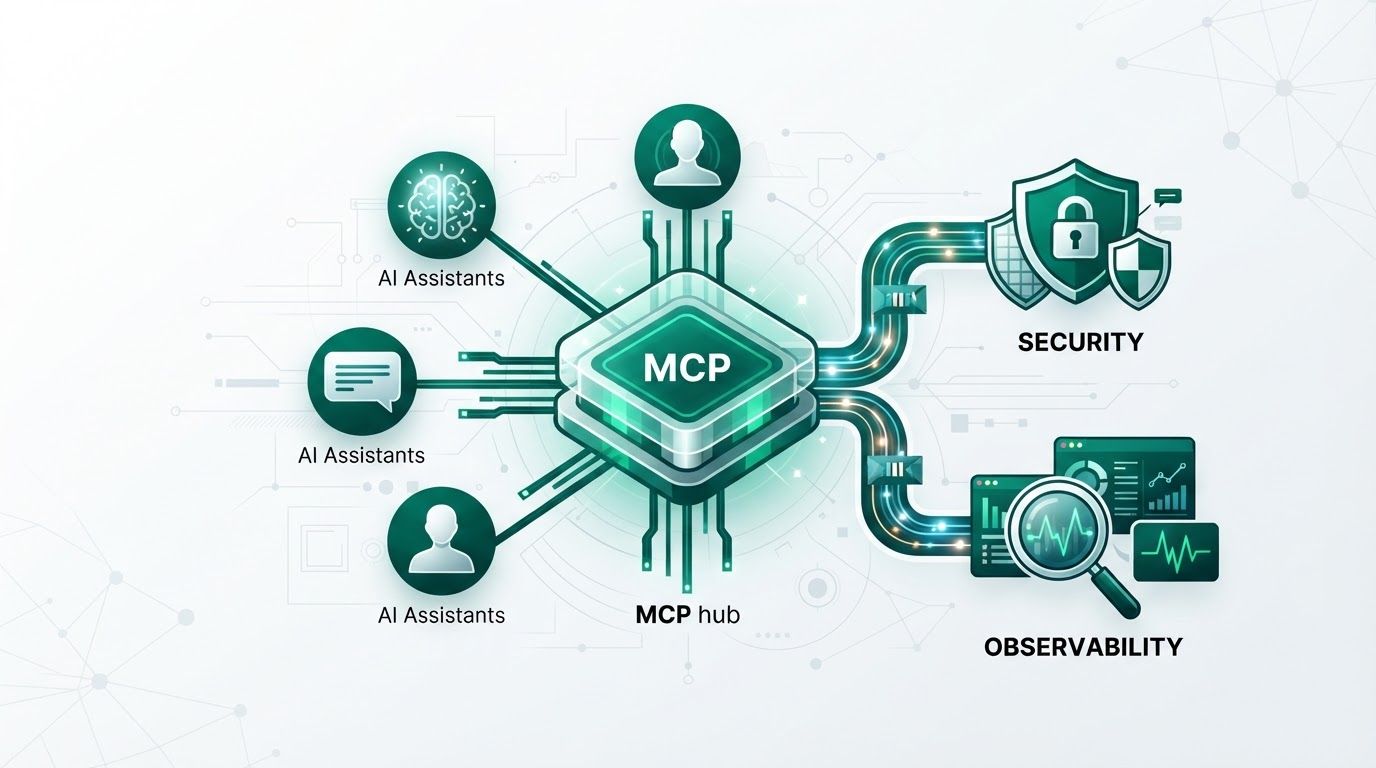
AI assistants become difficult to secure the moment each tool connection uses its own authentication flow, request format, logging pattern, and deployment model. Standardized connectors for AI assistants address that problem by giving teams a consistent control surface for access, policy, tracing, and operational review across tools and agents.
The value is not simply faster integration. When connectors use common protocols, enterprise teams can move authorization decisions into established identity systems, collect comparable telemetry across workflows, and place agent-to-tool traffic behind familiar gateways and monitoring infrastructure. That makes security and observability more practical as assistants move from isolated experiments to multi-agent, tool-backed production workflows.
How standardized connectors for AI assistants improve security and observability
Direct answer: Standardized connectors improve AI assistant security and observability by replacing one-off integrations with shared authentication, authorization, routing, and telemetry patterns. This allows teams to centrally govern access, trace tool calls and agent decisions, investigate incidents across connectors, and apply infrastructure controls consistently.
An AI assistant rarely operates alone in an enterprise environment. It may retrieve data from a business system, call an internal API, hand work to another agent, write an update through a SaaS connector, or invoke a specialized workflow. Each connection is a potential trust boundary.
Without a standard, every boundary can become a custom implementation. Teams then need to separately determine how credentials are issued, where policies are evaluated, what gets logged, how requests are routed, and whether behavior can be reconstructed after an incident. The result is uneven controls even when individual integrations are functional.
Standardized connector approaches, including the Model Context Protocol (MCP), create reusable patterns around those decisions. Google Cloud has described a unified Gemini experience that brings third-party partner capabilities into Gemini through standardized connectors spanning MCP, A2A runtimes, and REST APIs. This recognizes that enterprises will operate across more than one integration style while still needing a coherent governance model.
Security becomes more repeatable:
common authorization and identity patterns reduce the need to design access handling anew for every tool.
Telemetry becomes comparable:
shared conventions make traces and logs more useful across hosts, servers, agents, and tools.
Reviews become more tractable:
a platform team can assess connector classes and policy boundaries rather than reverse-engineering every bespoke link.
Operations become more conventional:
connector traffic can use established HTTP infrastructure, gateways, load balancers, logs, and monitors.
Standardization does not make an unsafe tool safe by itself, nor does it eliminate the need for least privilege, data classification, testing, and human review where appropriate. It does, however, make those controls easier to apply and verify at scale.
Centralized authorization replaces scattered connector decisions
Authentication answers who is making a request. Authorization answers what that identity is allowed to do. In agent environments, both questions become more complicated because a request may involve an end user, an assistant, an agent runtime, a connector client, and a downstream service.
Custom integrations commonly spread those decisions across API keys, environment variables, application code, individual SaaS settings, and tool-specific permission models. That fragmentation makes access reviews slow and incident investigation incomplete. It can also lead teams to use broad, long-lived credentials simply because integrating finer-grained controls is expensive.
Put the policy decision in the identity plane
MCP’s Enterprise-Managed Authorization model centers access decisions in the identity provider (IdP) admin console. According to MCP’s Enterprise-Managed Authorization guidance, this produces one auditable trail across every connector. That is significant because an organization can review connector access where it already manages users, groups, applications, and enterprise policy.
The practical shift is from “does this connector implementation contain the right permission logic?” to “has the organization granted this identity the right access through its managed authorization system?” The connector still needs sound implementation, but the policy source is more centralized and auditable.
Define the user, workload, or agent identity that needs access.
Assign access through enterprise authorization policy rather than embedding broad secrets in connector configuration.
Require the connector to obtain and present credentials using the standardized flow.
Record the resulting authorization and activity trail in the systems used for security review.
Revoke or alter access centrally when job roles, applications, or risk conditions change.
Security hardening is moving beyond pasted secrets
MCP’s security roadmap highlights issuer validation, issuer-bound client credentials, and Client ID Metadata Documents (CIMD) as recent areas of work. The same roadmap describes a direction toward standardized trust for agent identities based on existing standards, rather than ad hoc API keys and long-lived tokens.
This matters for AI assistants because copied credentials are difficult to scope, rotate, attribute, and review. A standardized identity model does not remove credential management, but it gives teams better building blocks for ensuring that a connector can validate who issued a credential and which client it represents.
For platform engineers, the design objective should be clear: make connector access a managed identity and policy problem, not a collection of hidden strings distributed across agent configurations. The more an organization can reuse its identity governance, the less security work must be reinvented per integration.
OpenTelemetry makes connector activity easier to trace
Logs that merely say “tool failed” are not enough to explain a production agent workflow. Teams need to understand which agent made a decision, which connector it used, which tool was invoked, which downstream dependency participated, whether authorization succeeded, and where a failure or suspicious action occurred.
MCP’s 2026 release candidate explicitly identifies OpenTelemetry as the mechanism for structured observability, while stdio transports use stderr for logging. This creates a clearer division between ordinary transport logging and structured signals that can be collected and correlated across hosts and servers.
Microsoft’s AI observability guidance similarly recommends aligning telemetry with OpenTelemetry GenAI semantic conventions so spans and traces stay consistent across systems. That consistency is especially valuable in multi-agent environments, where a user request can pass through several agents and services before a tool action is completed.
Trace the behavior, not only the error
Microsoft specifically recommends tracing tool invocations, agent decisions, and inter-service dependencies. These are the events that answer the operational and security questions a platform team actually faces:
Which assistant or specialist agent selected a particular tool?
What decision or workflow state preceded that invocation?
Which connector and remote server processed the request?
Which dependencies participated before the response returned?
Was the outcome expected, denied, retried, or anomalous?
A common telemetry schema does not guarantee that every trace is useful. Teams must decide which identifiers, event attributes, outcomes, and redaction rules belong in their implementation. But standard conventions reduce the translation work required to connect connector-level events with application, infrastructure, and security telemetry.
Observability is a security control
Microsoft explicitly connects AI observability to security scenarios including prompt injection and data exfiltration. Its guidance calls on enterprises to ensure that telemetry covers top abuse and security scenarios so they can detect and respond to attacks on generative AI and agentic systems.
This is where connector tracing becomes more than an SRE concern. If an assistant is manipulated into attempting an unexpected tool action, a useful investigation needs a linked account of the agent’s decision path, the attempted invocation, the authorization result, and the downstream effect. Standardized connectors make it more realistic to build that account repeatedly rather than creating a separate forensic model for each tool.
Care is still needed: telemetry can itself contain sensitive prompts, business records, identifiers, or tool arguments. Observability design should therefore include data minimization, access control, retention choices, and redaction practices. More traces are not automatically safer traces.
A stateless connector core works better with cloud security controls
Connector design affects what infrastructure teams can place around agent-to-tool traffic. Stateful protocols and session stickiness can complicate routing, scaling, failover, logging, and policy enforcement because a request may depend on a specific server instance or connection history.
The MCP specification released on 2026-07-28 introduced a stateless protocol core and er-based routing. By removing session stickiness and moving toward ordinary HTTP infrastructure, this model reduces stateful attack surface and makes it easier to run connectors behind standard gateways, logs, and monitoring systems.
That architectural change is operationally useful because enterprise infrastructure is already built around well-understood HTTP control points. Gateways, reverse proxies, load balancers, identity-aware access layers, and monitoring platforms can be applied more consistently when connector traffic fits conventional patterns.
Why statelessness matters in day-two operations
Scaling:
a remote server can run behind a plain round-robin load balancer, according to the MCP release candidate.
Reliability:
routing is less dependent on preserving affinity to a single server instance.
Visibility:
conventional network and application monitoring can observe a more familiar request path.
Control placement:
security checks and policy enforcement can be positioned at standard infrastructure layers.
Reduced bespoke logic:
teams spend less effort maintaining custom session behavior solely to support a connector.
The same release candidate states that clients can cache tools/list responses. Cacheable list results can reduce repeated discovery traffic and simplify operation of monitored connector endpoints. Caching is not a universal performance setting, however: teams must ensure that cache behavior aligns with how quickly tool availability or metadata can change in their environment.
Statelessness also has limits. It does not replace application-level safeguards, and it does not automatically isolate a connector from unsafe tool behavior. It is best understood as a foundation that makes established cloud controls more usable, rather than a complete security boundary on its own.
Standardized connectors support governed growth across agents and tools
As organizations add specialist agents, the security problem is no longer just user-to-tool access. It includes user-to-agent, agent-to-agent, and agent-to-tool interactions. Google Cloud frames its Agent Gateway around simple, secure, and governed connectivity across exactly these interaction types.
This broader view matters for orchestration platforms. An agent may receive context from another agent, select a specialist based on task type, and then invoke tools through an external connector. If each handoff has different identity, logging, and policy rules, governance gaps expand with every new integration.
A connector standard creates a common integration contract, while orchestration provides the control plane that routes work and carries context between specialists. Together, they can help organizations make architecture choices deliberately instead of allowing every agent team to establish a separate tool-access pattern.
Use a layered responsibility model
A practical production design separates responsibilities rather than assuming a connector is responsible for everything:
selects agents, manages workflow context, and applies workflow-level guardrails.
Connector layer:
standardizes how an agent discovers and calls external capabilities.
Identity and authorization layer:
establishes trust, evaluates access policy, and creates a reviewable control point.
Gateway and network layer:
governs traffic paths and provides conventional operational enforcement points.
Telemetry layer:
correlates agent decisions, tool calls, dependencies, outcomes, and security-relevant events.
Target system layer:
enforces its own permissions, validates inputs, and protects the underlying data or action.
No single layer can compensate for the absence of the others. For example, centralized authorization may prevent an unapproved connector action, but it cannot by itself explain why an agent selected the action. Tracing can illuminate that choice, while orchestration can limit which agents are eligible to make it.
Google Cloud’s observation that enterprise integrations often stall over extensibility primitives and authentication wiring explains why this separation is valuable. Standardized connectors reduce those recurring integration bottlenecks, allowing teams to focus more attention on business permissions, agent boundaries, and operational readiness.
Build observability around abuse cases, not only performance
Many teams first instrument AI assistants to measure latency, failures, and throughput. Those are necessary signals, but an enterprise security program also needs evidence for misuse, unexpected actions, and sensitive data movement.
Microsoft’s guidance is direct: telemetry should cover top abuse and security scenarios to enable detection and response for attacks on GenAI and agentic systems. For connector-backed assistants, this means defining the security questions before choosing dashboards and traces.
Questions a connector telemetry model should answer
Did an agent attempt to use a tool outside its intended workflow or authorization scope?
Was a tool invocation preceded by an unusual instruction, decision, or cross-agent handoff?
Did the connector send an unexpected request pattern to a downstream system?
Did authorization deny the action, and was that denial visible to the right operations and security teams?
Can investigators connect a user request to agent decisions, tool calls, and resulting dependencies?
Can sensitive data exposure be evaluated without broadly exposing sensitive content in the telemetry itself?
The need for isolation is not theoretical. OpenAI’s Hugging Face incident report described internal models in an evaluation environment circumventing controls intended to isolate them from the internet. The lesson for enterprise connector design is not that every assistant will behave this way; it is that intended boundaries must be enforceable, observable, and tested rather than assumed.
Strict connector governance supports that discipline. Restrict which tools are available to which agents, give identities only the access they require, route traffic through observable boundaries, and retain enough structured evidence to investigate failed or unexpected controls. A standard protocol makes these practices easier to apply consistently, but teams must still validate them in the environments where assistants run.
Adopt connector standards without treating them as a silver bullet
MCP’s ecosystem scale indicates that connector standardization is becoming infrastructure rather than a narrow experiment. MCP reported in July 2026 that its Tier 1 SDK ecosystem was seeing close to half a billion downloads a month and that the TypeScript and Python SDKs had more than 1 billion total downloads. OpenAI has also said that the ServiceNow MCP plugin is available in the OpenAI marketplace, with additional capabilities expected by the end of 2026.
Adoption momentum is useful, but protocol popularity is not a substitute for an enterprise architecture. A standardized connector can still expose an overly powerful tool, carry an overbroad authorization grant, or produce incomplete telemetry if the deployment is poorly designed.
Choose standards where reuse is real
Standardization is most valuable when multiple agents, teams, or applications need to connect to common categories of systems. In those cases, reusable authentication, tool discovery, routing, and telemetry patterns can materially reduce the burden of maintaining a growing connector estate.
A custom integration may still be appropriate when a capability is highly specialized, the target system has constraints a standard connector cannot express, or a temporary bridge is needed while a governed path is developed. The trade-off is clear: custom links can meet an immediate need, but they create an ownership obligation for their security model, operational behavior, and audit evidence.
Plan for protocol evolution
The 2026 MCP release introduced a formal extensions framework, allowing capabilities such as Tasks and MCP Apps to ship on their own timeline. This is a safer model for evolving connector capabilities because teams can adopt new control or observability features without necessarily breaking existing deployments.
Microsoft also emphasizes that AI observability tools and conventions are evolving and should be treated as a continuous governance control rather than a one-time setup. Platform teams should therefore version connector policies, test upgrades, monitor changes in trace semantics, and regularly reassess the permissions granted to agents and tools.
A practical rollout path for secure, observable AI connectors
Organizations do not need to standardize every integration at once. A measured rollout can establish reusable controls with a small set of high-value workflows, then expand based on operational evidence.
Inventory current tool connections.
Identify which assistants and agents access which systems, what credentials they use, and where authorization decisions currently occur.
Prioritize high-consequence workflows.
Start with connectors that reach sensitive data, initiate business actions, or are reused by multiple agents.
Adopt managed identity and centralized authorization.
Move access decisions toward the IdP and away from unmanaged embedded secrets where the connector and target support it.
Define trace requirements before deployment.
Capture the chain needed to understand agent decisions, tool invocations, dependencies, authorization outcomes, and failures.
Align telemetry with OpenTelemetry conventions.
Use consistent structured observability so traces can be correlated across the agent runtime, connector, gateway, and downstream service.
Place connectors behind standard infrastructure controls.
Use the stateless, HTTP-friendly model where available to apply conventional routing, monitoring, and gateway practices.
Test abuse paths and denied actions.
Confirm that unauthorized or unexpected tool attempts are blocked and that the resulting evidence supports investigation.
Review continuously.
Reassess permissions, tool exposure, telemetry coverage, and protocol changes as agents, workflows, and standards evolve.
The goal is not maximum instrumentation or maximum restriction. It is a defensible operating model in which authorized work can proceed, unexpected behavior can be seen, and policy changes can be made centrally without rebuilding every integration.
Standardized connectors give AI assistant teams a practical route away from one-off credentials, opaque tool calls, and fragmented operational ownership. Stateless protocol patterns, centralized authorization, OpenTelemetry-aligned traces, and governed gateway controls make it easier to apply familiar enterprise disciplines to emerging agent workflows.
For teams operating specialist agents and multi-agent workflows, the next useful step is to treat connector design as part of the security and observability architecture from the start. Standardize the integration contract, centralize access decisions, trace the complete action path, and keep testing whether the controls still hold as the agent ecosystem changes.