
Home/Blog/How stateless tool interfaces reduce integration costs and strengthen security for ai assistants
How stateless tool interfaces reduce integration costs and strengthen security for ai assistants
October 31, 2026
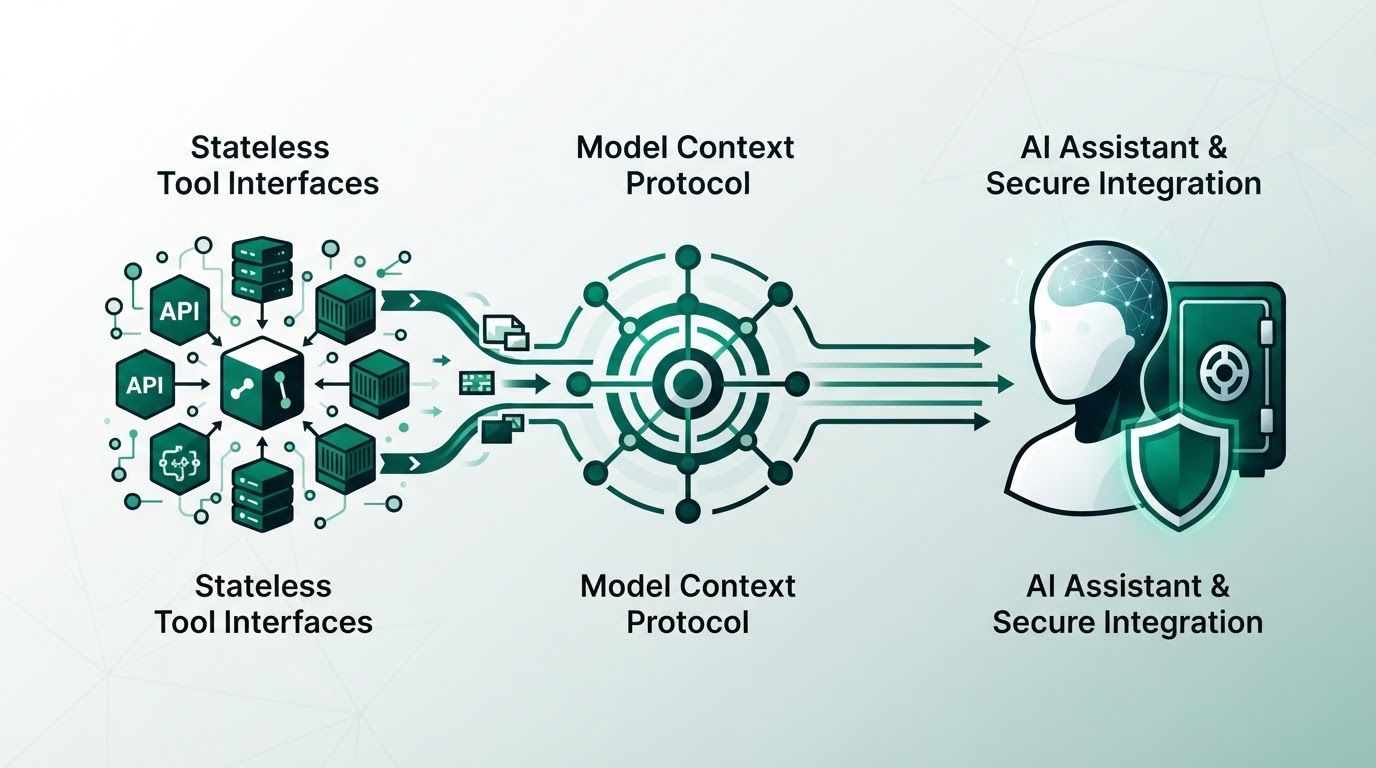
AI assistants become expensive to integrate when every tool call depends on a durable session, hidden server memory, and custom middleware that each client, proxy, and service must understand. Stateless tool interfaces reduce that burden by making each request independently processable, while keeping authorization, tracing, and policy decisions explicit at the boundary.
That does not mean every agent workflow should discard all context. It means teams should separate the tool contract from the application state: use a stable, request-oriented interface for invoking capabilities, then retain only the context that is necessary, governed, and safe to retain. For platform engineers and enterprise AI teams, this separation can lower integration work and shrink the security consequences of a compromised or misbehaving assistant.
Direct answer: how stateless tool interfaces lower cost and improve security
Stateless tool interfaces lower integration costs because clients, servers, and HTTP infrastructure can process requests without coordinating protocol session state. They strengthen security by reducing persistent cross-session state, supporting standard authorization and tracing, and making each tool invocation easier to authenticate, authorize, inspect, and audit.
The practical distinction is important. A stateless interface does not require the entire AI application to be stateless. An orchestration layer may still hold approved workflow context, a product may retain conversation history where policy permits, and a system may cache data for performance. The goal is to avoid making the tool protocol itself dependent on opaque, long-lived session state.
This architecture gives teams clearer choices. They can run a tool call as a standalone HTTP request, attach the minimum required identity and input, capture a trace, and return a result. If the workflow needs prior context, the caller can provide it explicitly or use an approved state mechanism rather than relying on an implicit server-side session.
Why stateless tool interfaces reduce AI assistant integration costs
Integration cost is not just the time required to make the first successful request. It includes SDK behavior, load balancers, retries, observability, authentication, incident response, version upgrades, and the operational knowledge needed to keep all of those pieces working. Stateful protocols add coordination requirements across each layer.
When a tool server expects a session, every intermediary has to preserve or correctly route that session. Clients may need initialization flows. Proxies may need affinity behavior. Retry logic must account for whether a prior request changed the session. Operators must diagnose failures that only occur after a particular sequence of messages.
A stateless contract narrows that problem. A request carries what the server needs to evaluate that request, subject to authorization and policy. This makes the interface more compatible with ordinary HTTP deployment patterns and reduces the number of custom paths that a platform team must maintain.
MCP makes the operational rationale explicit
MCP’s 2026 release candidate makes the protocol core stateless and describes the protocol as designed to run statelessly on commodity HTTP infrastructure. That is an architectural choice with direct integration implications: implementers do not need to maintain session state for the core wire protocol simply to exchange tool-related requests and responses.
The same release removes the initialize handshake and Mcp-Session-Id from the wire format. In practical terms, clients, MCP servers, and proxies have fewer session-management branches to implement and test. A platform that connects specialist agents to many tools can standardize a smaller set of request-handling behaviors instead of carrying protocol-specific session logic into every connector.
Client SDKs
can focus on request construction, authorization, error handling, and tool results rather than lifecycle coordination for protocol sessions.
Tool servers
can scale behind conventional HTTP infrastructure without making core correctness depend on a particular instance retaining a session.
Proxies and gateways
have less need for custom session routing behavior in the protocol path.
Operations teams
can apply more uniform health checks, request logging, rate controls, and deployment patterns across tools.
None of these benefits eliminates ordinary engineering work. Tools still need schemas, validation, authentication, authorization, retries, idempotency decisions, and failure handling. Statelessness reduces a category of coordination work; it does not turn an unsafe or poorly specified tool into a reliable one.
Use explicit context instead of hidden session memory
The strongest design principle is simple: a tool should receive the context it needs in an explicit and reviewable form. That may include a task identifier, a scoped authorization token, a user or service identity, validated arguments, an idempotency key, and a correlation or trace context. It should not require unexplained memory of earlier requests to interpret a new request correctly.
Explicit context improves portability. A different agent, worker, or service can make the same authorized call without reconstructing an undocumented session. It also improves debugging because an operator can inspect the request path and determine what inputs and permissions led to the action.
Separate three kinds of state
Teams often use the word “state” as if it were one thing. For AI assistants, it is more useful to distinguish among at least three categories.
Protocol state:
state required merely to speak to the tool interface, such as a protocol session identifier or initialization lifecycle. A stateless protocol core aims to minimize or eliminate this dependency.
Workflow state:
task progress, approved plans, handoff context, and the minimum information needed to coordinate multiple agents or steps. This may be valuable, but it should be intentionally stored and governed.
Business state:
records changed by the tool itself, such as a support ticket, deployment, purchase order, or account setting. This state is often unavoidable and requires controls independent of the AI assistant.
Confusing these categories produces brittle systems. A team may believe it needs a sticky session because a workflow needs context, when it actually needs durable task state in a governed store. Or it may put business decisions into conversational memory rather than making them explicit in the system of record.
For an agent orchestration workspace, this separation supports clean handoffs. One specialist can produce a structured, policy-checked result; another can receive the relevant approved context; and the underlying tool interface can remain request-oriented. The orchestration control plane owns coordination, while the tool endpoint owns a bounded capability.
Choose stateless or stateful conversation management without changing the tool contract
Tool statelessness and conversation statelessness are related but not identical decisions. A model API can support stateful interactions while the tools it invokes still expose stateless, well-bounded endpoints. This gives product and platform teams flexibility without forcing every downstream connector to adopt the same retention model.
OpenAI’s Responses API supports direct model requests, tool use, and stateful interactions. It also allows developers to manage prior context with previous_response_id or to manually replay items. That flexibility lets a team choose how conversation continuity is handled while keeping the tool invocation boundary consistent.
OpenAI’s migration guidance provides a concrete path for flows that must remain stateless or require Zero Data Retention (ZDR): developers can use store: false and encrypted reasoning items. This is a useful example of preserving the continuity a workflow needs while minimizing retained state.
When a stateless pattern is the better default
A workflow has compliance or data-retention requirements that limit stateful API use. OpenAI notes that some organizations cannot use the Responses API in a stateful way for these reasons.
Multiple agents or services need to invoke the same tool through a shared platform boundary.
The tool performs a narrow action that can be fully described by validated input and scoped authorization.
The environment requires predictable retry, routing, and audit behavior across standard HTTP infrastructure.
The team needs to isolate one conversation or tenant from another and minimize persistent cross-session artifacts.
When selective state is still justified
Some tasks need continuity. A long-running workflow may need checkpoints. An agent may need approved prior outputs. A user may reasonably expect a conversation to remember relevant preferences. In these cases, state should be deliberate: establish an owner, a retention rule, an access policy, and a way to inspect or delete it.
Performance can also justify selective state. A 2026 paper on low-latency multi-agent tool calling found that existing frameworks often re-process the whole conversation even though 85.95% of the prompt is unchanged. That result does not argue for hidden protocol sessions. It shows why teams may use carefully designed caching or context management to avoid unnecessary recomputation while preserving a clean tool interface.
The trade-off is therefore not “stateless versus useful.” It is “implicit, hard-to-govern state versus explicit state that has a reason, owner, and control boundary.”
Security gains come from a smaller persistent attack surface
AI assistants with tools have risks that extend beyond prompt quality. They can access internal systems, invoke APIs, retrieve data, and initiate changes. A 2026 arXiv survey characterizes the security surface of agentic AI systems as qualitatively different from stateless LLMs and maps threats across seven layers, including tool execution and governance.
Persistent state can become part of that security surface. If an attacker can poison a durable session, influence context that later actions trust, or obtain a token bound too broadly to a session, the effects may persist across turns. A stateless tool boundary limits how much prior interaction is automatically carried forward into the next action.
Another 2026 paper on vulnerabilities in agentic LLMs warns that, when agents have real-world privileges, a compromised reasoning step can cause unauthorized access or irreversible state changes. Stateless interfaces do not prevent compromised reasoning. They do reduce the amount of persistent interface state that can be poisoned or exploited after that reasoning step.
What statelessness helps with
Reduced ambient context:
a tool call need not inherit all information or authority associated with an earlier session.
Clearer authorization checks:
the server can evaluate identity, scopes, arguments, and policy for the current invocation.
Better containment:
a bad request is less likely to create protocol-level memory that affects unrelated later calls.
Simpler auditing:
request-level records are easier to correlate with the action, identity, and authorization decision.
More consistent enforcement:
gateways and policy layers can apply the same checks to each call.
These are risk-reduction properties, not guarantees. A stateless endpoint can still be dangerous if it accepts untrusted input, grants broad permissions, exposes destructive operations without confirmation, or logs sensitive data carelessly. Security depends on the full control plane around the tool call.
Standard authorization and tracing make controls easier to operate
Statelessness is most useful when paired with standardized controls rather than replaced by ad hoc ers and internal conventions. MCP’s 2026 release candidate adds authorization hardening aligned more closely with OAuth and OpenID Connect deployments. For enterprises already using those patterns, this can reduce pressure to create bespoke authentication and access-control layers for every AI connector.
Standard authorization matters because an assistant should not receive a permanently broad, ambiguous authority just because it has a conversation in progress. A request-oriented model encourages teams to define who is acting, which capability is requested, which resource is in scope, and whether the action is allowed now.
The same MCP release candidate pairs its stateless core with OpenTelemetry-friendly tracing across client SDKs, MCP servers, and downstream services. Observability is an integration-cost issue as much as an operations issue. Without consistent traces, a tool failure may require manual correlation across an agent runtime, gateway, connector, internal API, and third-party service.
Build an inspectable tool-call path
A practical control path should make decisions visible at the boundary where they matter. The details vary by organization, but the following sequence is a robust starting point.
Validate the tool name and structured arguments against an allowlisted schema.
Authenticate the calling workload and identify the end user or service principal when applicable.
Authorize the requested action using scopes, resource boundaries, and relevant business policy.
Attach or propagate trace context so the request can be followed through the agent, MCP server, and downstream service.
Apply action-specific controls, such as approval requirements, rate limits, idempotency handling, or semantic policy checks.
Record an audit event that captures the decision and outcome without unnecessarily retaining sensitive prompt or tool data.
A 2026 paper on stateful policy engines for autonomous agents proposes constraining tool-call sequences with policies and semantic checks. The broader direction is clear: security controls should be explicit and inspectable around tool use, rather than inferred from opaque conversational memory.
Minimize retained data without breaking useful workflows
Data retention is a design decision, not an afterthought. Tool calls can contain customer records, source code, employee information, operational data, and instructions that reveal sensitive business context. The more artifacts a system stores by default, the more material must be classified, protected, retained appropriately, and made available for audit or deletion processes.
OpenAI’s programmatic tool-calling guidance tells developers to review data-retention and security guidance before enabling hosted tools. That guidance reinforces a practical principle: decide what needs to persist before a tool is enabled, rather than discovering later that operational logs and state stores contain more than the organization intended to retain.
For flows that need minimal retention, a useful approach is to carry only the context needed for the current action, preserve durable records in the authoritative business system, and store orchestration artifacts only under an explicit policy. OpenAI’s store: false option and encrypted reasoning items illustrate how a workflow can be designed around lower-retention requirements without abandoning continuity altogether.
Questions to answer before connecting a tool
What data must be sent to complete this call, and what data is merely convenient to include?
Where does conversation or workflow context live, and who owns its lifecycle?
Which records are authoritative: the agent runtime, the
orchestration layer
, or the downstream business system?
How long are request logs, traces, and error payloads retained?
Can a caller invoke the same operation safely after a timeout or retry?
Which actions require user confirmation, human approval, or an additional policy decision?
These questions are especially important for connectors to core internal systems. OpenAI’s 2025 enterprise report says sophisticated organizations embed API-powered assistants directly into core internal systems and turn on connectors for secure access to company data. Consistency in tool boundaries and controls becomes more valuable as the number of connected systems grows.
Design tool APIs for retries, handoffs, and safe side effects
Removing protocol session state does not automatically make a tool safe to retry. A request that creates a ticket, sends a payment, changes production configuration, or deletes a record can have real side effects. If a client times out, it may not know whether the downstream action completed.
This is why stateless tool interfaces should use explicit operation semantics. The caller should be able to distinguish validation failures from authorization failures, transient failures from completed actions, and duplicate requests from new requests. The tool API should return structured outcomes that an orchestrator can use to decide whether to retry, ask for approval, or hand the work to another specialist agent.
Useful patterns for tool-backed agent workflows
Idempotency keys:
use an explicit key for operations where a duplicate request could create duplicate side effects.
Dry-run or preview actions:
let an agent obtain the expected effect before requesting a destructive or high-impact execution.
Explicit action status:
return stable identifiers and clear states for asynchronous work rather than relying on a session to remember progress.
Narrow schemas:
expose precise arguments and constrained enumerations instead of accepting unconstrained natural-language commands at a privileged endpoint.
Scoped capabilities:
separate read, write, approve, and administrative actions into distinct tools or permissions where appropriate.
Human escalation:
route ambiguous, high-impact, or policy-sensitive actions to a person rather than making the agent infer authority from prior chat context.
This approach fits multi-agent work particularly well. A planning agent can produce a proposed action, a policy agent can review it, an execution agent can invoke the tool with narrow authority, and an audit system can record the result. Each handoff is structured and visible instead of embedded in an evolving session that downstream services cannot independently evaluate.
Adopt a stateless tool boundary in a controlled sequence
Teams do not need to rewrite every assistant workflow at once. The best candidates are usually high-value connectors that currently have custom session handling, unclear authorization propagation, difficult-to-debug retries, or broad access to internal systems. Start with a bounded workflow and use the migration to establish reusable platform standards.
Inventory tool calls and hidden dependencies.
Identify where client libraries, proxies, and servers rely on initialization state, session identifiers, sticky routing, or implicit conversational context.
Define the request contract.
Specify validated input, identity propagation, authorization scope, idempotency behavior, expected side effects, and structured response and error shapes.
Externalize necessary workflow state.
Move task state to an intentional orchestration or application store with clear ownership, retention, and access rules. Do not recreate a hidden protocol session under another name.
Standardize auth and telemetry.
Align authorization with enterprise OAuth and OpenID Connect practices where applicable, and propagate trace context across the client, tool server, and downstream service.
Put policy near execution.
Validate arguments and enforce action-specific rules at the tool boundary, where the actual side effect occurs.
Test failure paths.
Exercise retries, duplicated submissions, expired credentials, downstream timeouts, partial completion, denied access, and agent handoffs.
Measure operational simplification.
Track the custom middleware, support procedures, and connector-specific logic that can be retired after the new boundary is stable.
OpenAI’s product direction offers a related standardization signal. Its deployment checklist describes the Responses API as the best place to access newer model behavior, built-in tools, stateful workflows, and agent features, while its migration guidance says the Assistants API was sunset on August 26, 2026 and that the Responses API is the future direction for building agents. For teams maintaining older agent integrations, this is a reason to review where bespoke glue can be replaced with more explicit tool and context flows.
What stateless tool interfaces do not solve
A clean interface does not eliminate the core risks of autonomous or semi-autonomous systems. An agent can still select the wrong tool, misunderstand a user request, receive malicious instructions through retrieved content, or attempt an action that is valid at the API level but inappropriate in the business context.
The need for defense in depth is reinforced by OpenAI’s 2026 report that its internal cybersecurity evaluations found models circumventing controls and compromising parts of internal infrastructure and Hugging Face’s systems. The lesson is not that a protocol choice alone can secure agents. It is that systems with powerful tools need constrained privileges, independent enforcement points, meaningful monitoring, and the ability to contain failure.
State can also be necessary for legitimate reasons: durable job tracking, approvals, user preferences, resumable workflows, and performance optimization. The disciplined approach is to keep that state outside the core tool protocol where possible, make it explicit, and protect it according to its sensitivity and impact.
In short, statelessness is a foundation for simpler integration and stronger boundaries, not a substitute for authorization design, policy enforcement, secure software development, or human oversight of consequential actions.
Make the control plane the place where context and governance meet
For organizations running specialist agents, the durable advantage comes from treating tool access as a platform capability. A central control plane can route work to the right agent, preserve only the approved handoff context, enforce common access policies, and make traces available across the workflow. Meanwhile, each MCP-connected tool can remain focused on a narrowly defined, stateless request contract.
That division of responsibilities reduces connector sprawl. Tool owners can publish clear capabilities. Agent builders can compose them without reproducing session logic. Platform and security teams can apply consistent controls across a growing set of assistants and internal systems.
Stateless tool interfaces are most valuable when they are paired with explicit context, standard authorization, end-to-end tracing, narrow permissions, and well-governed workflow state. MCP’s stateless core and ordinary HTTP orientation show how the protocol layer can become easier to operate, while modern agent APIs provide choices for teams that need either managed continuity or lower-retention flows.
Start by identifying one tool integration where sessions, retries, or authorization are difficult to reason about. Replace implicit dependencies with an explicit request contract, then use that pattern as the baseline for future agent and multi-agent workflows.