
Home/Blog/How to choose an orchestration layer for autonomous assistants and cross-system governance
How to choose an orchestration layer for autonomous assistants and cross-system governance
November 5, 2026
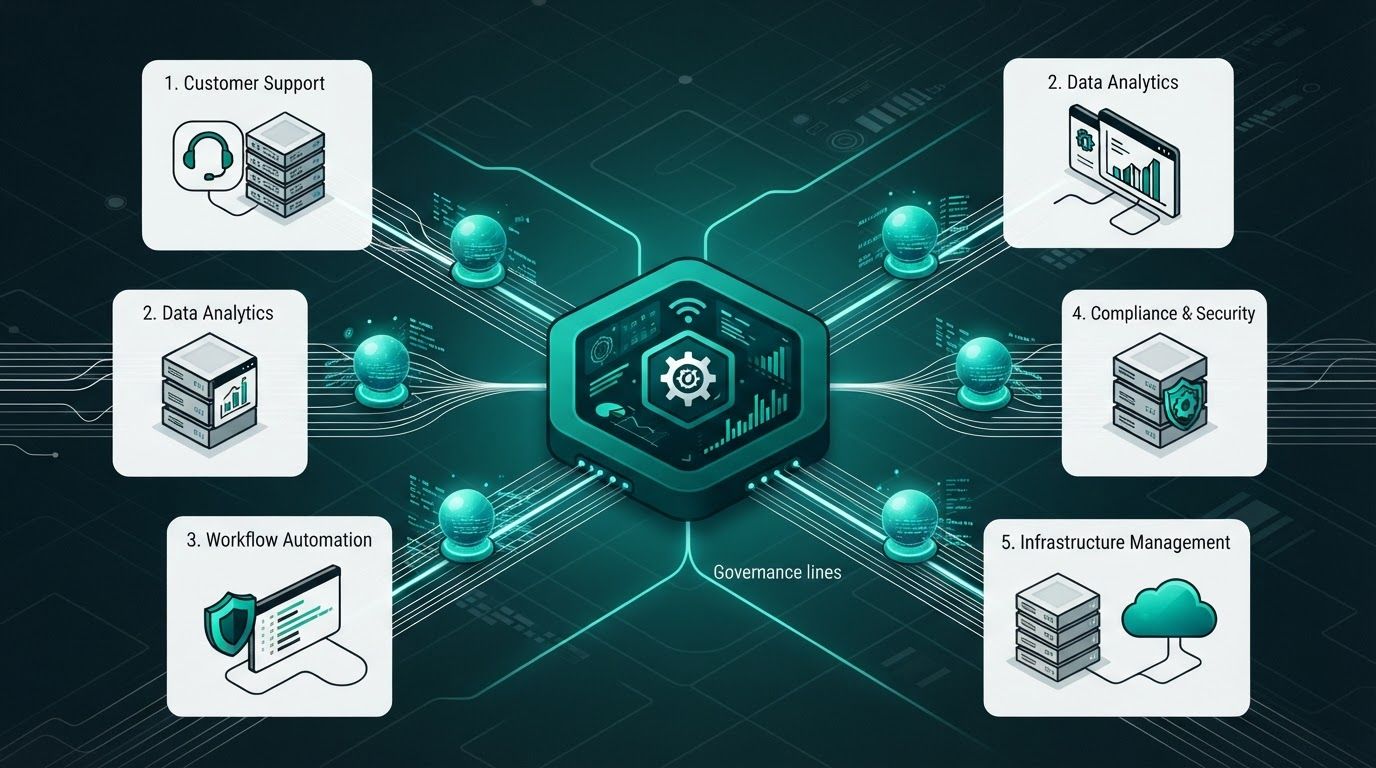
Choosing an AI agent orchestration layer is no longer mainly a question of which framework can call the most tools. When autonomous assistants can read from, write to, or coordinate work across business systems, the orchestration layer becomes the control plane for state, identity, policies, approvals, recovery, and evidence of what happened.
The right choice depends on the work you need assistants to perform, the systems they touch, and the governance burden your team must carry. A useful selection process starts with operational requirements,not model preferences,and tests whether a platform can coordinate specialized agents without turning cross-system automation into opaque custom glue code.
Direct answer: how to choose an AI agent orchestration layer
Choose an AI agent orchestration layer that preserves state across long-running work, coordinates agents and tools through controlled interfaces, propagates identity and permissions, enforces policies at the tool boundary, records auditable execution traces, and recovers safely from workflow failures. Prefer support for open interoperability protocols such as MCP and A2A when assistants must work across teams, tools, or platforms.
For a narrowly scoped assistant that answers questions from a single knowledge source, a lightweight application pattern may be sufficient. The evaluation changes when an assistant delegates to other agents, invokes enterprise tools, performs multi-step work, or acts over a period of time. In those cases, orchestration must make execution dependable and governable rather than simply possible.
OpenAI describes orchestration as handling multiple steps, tool use, handoffs between agents, guardrails, and context. That definition is a practical starting point because it captures the interconnected responsibilities that surface once an assistant moves beyond a single prompt-and-response interaction.
Coordination:
Route work to the right specialist, manage handoffs, and keep relevant context available.
Execution:
Invoke approved tools, sequence tasks, handle asynchronous operations, and manage failures.
Governance:
Apply permissions, policy checks, review gates, audit trails, and operational controls.
Operations:
Observe real behavior, diagnose incidents, version changes, and improve workflows safely.
A platform that is excellent at routing prompts but weak at permissions, checkpoints, or audit evidence may still be useful for prototypes. It is a poor fit for assistants that update orders, look up customer information, initiate operational actions, or coordinate several internal systems.
Start with the autonomous work, not the agent framework
Before comparing orchestration products or building a control plane, map the work an assistant will actually perform. “We need multi-agent support” is too broad to guide an architecture decision. Define the units of work, the systems of record, the acceptable degree of autonomy, and the people accountable for outcomes.
Classify the workflow by execution risk
A useful first distinction is between advisory, assistive, and action-taking workflows. Advisory assistants retrieve or synthesize information. Assistive systems prepare a draft, recommendation, or proposed action for a person. Action-taking systems use tools to change state in another system, such as creating a ticket, checking inventory, or updating a record.
Risk generally rises with the ability to change external state, the sensitivity of the data involved, and the cost of a wrong or duplicated action. An orchestration layer should make those differences explicit. It should not treat a read-only product lookup and a transaction-changing operation as equivalent tool calls.
List each intended outcome.
For example: resolve an order-status question, investigate an inventory discrepancy, prepare a support case, or route an approval request.
Identify every system boundary.
Include identity providers, knowledge stores, customer systems, ticketing tools, operational APIs, and human review queues.
Mark actions as read, propose, approve, or execute.
This creates a clear basis for tool permissions and escalation design.
Define failure behavior.
Decide whether the assistant should retry, pause for review, compensate for a completed step, or terminate with a clear status.
Set an evidence requirement.
Determine what a reviewer, operator, or auditor must be able to reconstruct after execution.
This exercise reveals whether you need a conversational assistant with a few integrations or a true workflow orchestration layer. It also prevents a common implementation error: embedding routing decisions, authorization assumptions, and recovery behavior inside prompts or individual agent code. That approach can work initially, but it makes policy changes and incident analysis harder as the number of tools and agents grows.
Use specialization where it has an operational purpose
A supervisor agent coordinating specialized sub-agents is a practical pattern for work that spans distinct business domains. A supervisor can decide whether an order question requires an order-status specialist, an inventory specialist, a product-information specialist, or more than one. AWS guidance presents this kind of supervisor-and-specialist arrangement for multi-agent business scenarios.
Specialization is not inherently better than one well-designed agent. Add specialists when separate tools, permissions, knowledge domains, or operational ownership justify the boundary. Otherwise, unnecessary agent handoffs increase latency, make state management harder, and create more execution paths to observe and govern.
Evaluate state, context, and long-running workflow recovery
State is the dividing line between a demo and an operational assistant. Stateless APIs can be appropriate for simple tasks, but OpenAI’s guidance notes that real agent workflows often span many steps, depend on prior actions, and require shared state and trusted guardrails. The orchestration layer should therefore own enough execution state to answer a basic operational question: what has happened, what is pending, and what can safely happen next?
Distinguish conversation memory from workflow state
Conversation memory captures what a user and assistant discussed. Workflow state records execution facts: the request identifier, selected agent, tool inputs and outputs, approval status, retry count, checkpoint position, and final outcome. Long-term memory may store durable insights, but it should not become an unbounded substitute for explicit workflow records.
Look for an architecture that can associate collaboration context with a durable identifier such as a conversation_id, while preserving finer boundaries for sensitive data. OpenAI’s agent-building guidance discusses shared memory keyed by conversation_id and agent-as-tool patterns. Those primitives are useful, but an enterprise implementation must still decide which agents can read or write which parts of that shared context.
Can a resumed workflow determine whether a previous tool call completed, failed, or timed out?
Can execution state be isolated between tenants, users, business units, or cases?
Can operators inspect state without exposing data to people who lack permission?
Can an agent handoff include only the context needed by the receiving agent?
Can the platform retain a durable record of approvals and external side effects?
Fine-grained access control and storage isolation matter for memory as much as they do for tools. AWS guidance identifies conversation history and long-term insights as agent memory needs, with fine-grained access control and storage isolation. That is a useful evaluation signal: a platform should not force every agent in a workflow to receive the same full transcript or long-term memory.
Require checkpoints for cross-system work
Work that crosses systems will encounter partial failures. A request may successfully obtain inventory data, then fail while creating a case. A downstream API may time out after receiving a request. A human approval may remain pending while the surrounding workflow continues to evolve.
For these workflows, select an orchestration layer with explicit checkpoints, error handling, and recovery paths. AWS highlights Step Functions for complex multi-agent workflows with checkpoints and error recovery. Whether you use that service or another mechanism, the architectural requirement is the same: the workflow must resume or stop safely without guessing whether an external action occurred.
Do not confuse retry capability with recovery design. Retrying a read operation may be harmless; retrying a state-changing action without idempotency controls can create duplicate work. Your orchestration design should support idempotent tool operations where possible, track correlation identifiers, and define compensating or escalation paths for operations that cannot simply be retried.
Make identity, permissions, and policy enforcement selection gates
Cross-system governance fails when the assistant has broad standing access and the organization cannot determine which identity acted, under what authority, and through which tool. Effective agent operations require identity propagation, permission boundaries, audit trails, and circuit breakers, according to AWS guidance. These are not optional add-ons for autonomous workflows; they are core criteria for selecting the orchestration layer.
Preserve the acting identity across boundaries
The layer should support a clear identity model from the initiating user or workload through the supervisor, specialist agents, and downstream tools. In practice, that means being able to distinguish the person requesting work, the service or agent executing it, and the permission scope granted for the action.
A useful design avoids a single all-powerful credential shared by every agent. Instead, give each agent and tool integration the minimum permissions needed for its defined role. The order-status agent may be allowed to retrieve order information, while a separate case-management agent may be allowed to create a support case only after an approval condition is met.
Enforce policy at the tool boundary
Prompt instructions are valuable, but they are not the only control that should protect external systems. Governance needs policy-based enforcement at the tool boundary, where an assistant attempts to read data or perform an action. AWS documents Policy in AgentCore for policy-based governance and control over agent interactions, illustrating the kind of runtime control regulated or high-impact environments should seek.
During evaluation, ask vendors and internal platform teams to demonstrate enforcement rather than describe it abstractly. Test what happens when an agent tries to access an unapproved tool, requests data outside its scope, exceeds a transaction threshold, or attempts an action that requires human approval. The result should be a deterministic denial, escalation, or constrained alternative,not a best-effort textual warning.
Governance is strongest when a model can recommend or request an action, but the orchestration and policy layers decide whether that action is allowed to reach the target system.
Circuit breakers are similarly important. They provide a way to stop execution when error rates, policy violations, unexpected behavior, or external-system conditions make continued automation unsafe. A platform does not need to eliminate human intervention; it needs to make intervention deliberate, visible, and operationally manageable.
Choose interoperability standards that reduce custom integration debt
An orchestration layer should not become an integration island. When teams need to connect specialist agents, MCP servers, internal tools, and external services, standards-based discovery and access reduce the amount of bespoke adapter code that must be maintained. AWS guidance explicitly recommends that agents securely discover, select, and access tools and other agents through well-known protocols such as MCP and A2A.
Model Context Protocol is an important signal in this evaluation, particularly where tool ecosystems are expected to grow. The MCP project’s 2026 specification and release candidate emphasize a stateless core, routing via ers, cacheable tool-list responses, authorization hardening oriented around OAuth and OpenID, and formal extension and deprecation policies. Those details matter because interoperability is not merely a matter of listing tools; it also requires durable conventions for routing, authorization, evolution, and compatibility.
Assess protocol support beyond a logo or connector count
Support for MCP should be evaluated as an operational capability. Ask whether the layer can discover tools in a controlled way, apply identity and policy before invocation, record usage, and manage version changes. A simple connector may make a tool available, but it may not provide the cataloging, approval, permissioning, or observability needed for enterprise deployment.
Discovery:
Can teams find approved agents, MCP servers, tools, and skills in a centralized inventory?
Registration:
Can owners describe capability, sensitivity, dependencies, and permitted audiences?
Authorization:
Can access use established identity and authorization patterns rather than static shared secrets?
Lifecycle:
Can a tool or agent be versioned, deprecated, reviewed, and removed without breaking unmanaged workflows?
Routing:
Can the control plane select the correct endpoint while maintaining policy and traceability?
An agent registry or catalog is particularly valuable as the number of capabilities grows. AWS Bedrock AgentCore documentation includes an AWS Agent Registry for discovering and managing agents, MCP servers, tools, and skills. Regardless of provider, the selection principle is to avoid a scattered collection of undocumented integrations whose ownership and permission model are unclear.
Interoperability also has limits. A common protocol does not automatically normalize business semantics, error behavior, data classification, or approval rules. Your platform still needs conventions for tool contracts, ownership, testing, and safe defaults. Standards reduce integration friction; they do not remove the need for platform engineering discipline.
Require observability that proves how assistants behave in production
Agent traces are not just debugging artifacts. They are governance evidence. AWS guidance says runtime documentation from observability can validate design against actual behavior and can gate promotion to production. This is essential because the behavior designed in an architecture diagram may differ from the behavior produced by live tool responses, user inputs, model decisions, and error conditions.
An orchestration layer should let authorized teams reconstruct an execution across agents and systems. At minimum, the record should connect the initiating request, routing decisions, agent handoffs, tool calls, policy outcomes, approvals, retries, checkpoints, and terminal status. The trace should preserve useful context without indiscriminately exposing sensitive prompts, customer data, or credentials.
Define operational questions before choosing telemetry
Teams often collect logs before deciding what those logs must answer. Reverse that process. Write the questions a support engineer, security reviewer, product owner, and compliance team will ask after an incident or unexpected result.
Which agent selected the tool, and what policy or permission allowed the call?
What context was handed off, and was any portion intentionally withheld?
Did the external system receive the action, and can that outcome be verified?
Where did the workflow pause, retry, branch, or require human review?
Which version of the prompt, tool definition, agent configuration, and workflow was active?
Can the same workflow be evaluated safely against representative scenarios before wider rollout?
These questions also clarify the difference between model monitoring and orchestration observability. Model-level information may show token use or response quality. Orchestration observability explains the operational path from intent to side effect. For cross-system assistants, you need both, with access controls appropriate to the data contained in traces.
Use production evidence as a release gate
Do not promote an assistant merely because it performs well in a controlled demonstration. Define a progression from development to controlled testing to production use, with expected traces, policy outcomes, and human-review behavior at each stage. Microsoft positions governance as part of deployment readiness in its Copilot agent governance materials, reflecting the broader operational reality that deployment is a governance event, not only a technical release.
Versioning supports this progression. AWS prescriptive guidance calls out versioning and review of prompts, tools, and agent configurations as elements of LLM orchestration governance. Treat those components as deployable assets. A changed prompt can alter tool-selection behavior; a changed tool schema can alter the effect of a valid call; a changed agent configuration can expand or narrow the workflow’s effective authority.
Design human review as a control path, not an exception
Autonomous does not have to mean unsupervised. Human review remains a practical pattern in modern orchestration: OpenAI’s Codex orchestration write-up describes Symphony as a control plane in which agents run continuously and humans review results. The important design question is not whether people will be involved, but where review produces the most risk reduction without making every workflow unusably slow.
Use human-in-the-loop controls for actions that are irreversible, unusually costly, outside a known policy envelope, or ambiguous given the available evidence. Review can be pre-action approval, post-action sampling, exception handling, or escalation after a circuit breaker triggers. Each option has a different effect on speed, accountability, and user experience.
Make review requests actionable
A reviewer should receive a concise decision package rather than an unfiltered transcript. Include the requested action, business reason, relevant retrieved evidence, intended tool call, impact scope, policy result, and available choices. The orchestration layer should also record the reviewer’s decision and connect it to the resumed or terminated workflow.
Review queues need ownership and service expectations. If no accountable team can approve an action in time, the workflow must have a defined timeout outcome. It may return a draft to the requester, create a case for later handling, or terminate safely. Silent waiting is not a governance strategy.
Pre-approval:
Best for consequential state changes and sensitive data access.
Exception review:
Useful when policy conditions, confidence signals, or tool responses fall outside normal parameters.
Sampling:
Appropriate for quality assurance where the workflow is otherwise permitted to proceed.
Post-action review:
Useful for learning and accountability when actions are reversible and clearly logged.
A mature control plane can combine these patterns by workflow and tool. That is more practical than a blanket rule requiring approval for every action or, conversely, trusting every tool call once an agent reaches production.
Compare build, framework, and managed control-plane options realistically
The best implementation approach is shaped by your integration estate, cloud posture, security requirements, and platform capacity. Recent vendor direction favors built-in orchestration primitives over extensive custom glue code: OpenAI recommends the Agents SDK when teams need to manage agent networks, inject guardrails, and coordinate context, while AWS packages orchestration, memory, policy, and registry capabilities into AgentCore and related services.
That does not mean one approach fits every organization. A lightweight framework can give builders flexibility. A managed cloud platform can align more closely with existing identity, audit, and workflow services. A dedicated orchestration workspace can provide a central place to route users to specialist MCP-connected agents, hand off context, and run tool-backed workflows. The decision should rest on control-plane requirements rather than on a preference for either custom code or a single vendor.
When a lean application pattern can be enough
A simpler design may be suitable when the assistant has one owner, limited read-only tools, short-lived interactions, low sensitivity, and no need for complex recovery. In that setting, adding a full multi-agent platform too early can increase operational over. Keep the architecture modular, however, so that routing, tools, state, and policy can be moved behind stronger boundaries as requirements grow.
When managed orchestration is a stronger fit
Managed capabilities become compelling when workflows need durable execution, enterprise identity integration, centralized auditability, tool catalogs, policy enforcement, and cross-team operations. They can reduce the amount of infrastructure a team must build and operate. The trade-off is provider coupling, so assess portability at the level that matters to your organization: tool contracts, agent definitions, data stores, traces, and workflow logic.
When custom orchestration is justified
Build more of the layer yourself when your workflow semantics are unusual, your regulatory or tenancy model requires controls not available in a managed offering, or the orchestration capability is a differentiating product feature. Custom work still needs the same foundations: explicit state, secure tool boundaries, identity propagation, policy enforcement, recovery, and observability. Writing the control plane in-house does not remove those obligations.
A practical compromise is to separate agent logic from execution infrastructure. AWS describes the agent layer as a central coordination hub between users, models, tools, and knowledge sources. Maintain that separation in your own design: agents should express goals and specialist capabilities, while the orchestration layer manages execution rules, access, state, and evidence.
Run a proof of control, not just a proof of concept
A polished prototype can demonstrate that an assistant can complete a happy-path task. It rarely proves that the system is ready to operate across business systems. Replace or supplement the proof of concept with a proof of control that tests the operational conditions your production environment will impose.
Select two or three representative workflows that cross meaningful boundaries. For example, an assistant could retrieve order status, consult inventory information, and draft or create a support case. AWS guidance uses controlled tool integration for near-real-time access to systems such as order status, inventory, and product information; this is the kind of workflow that exposes whether routing, permissions, state, and recovery actually work together.
Test the happy path.
Confirm correct routing, context handoff, tool usage, and a complete trace.
Test denied access.
Attempt an action outside the user, agent, or tool permission boundary and verify a clear, logged outcome.
Test partial failure.
Simulate a timeout or downstream error after a checkpoint and verify safe recovery or escalation.
Test configuration change.
Update a prompt, tool, or agent configuration and verify version visibility, review, and rollback behavior.
Test human review.
Route a consequential action to an approver, capture the decision, and verify that the workflow resumes or closes correctly.
Test discovery governance.
Add or deprecate an MCP-connected capability and confirm that only approved agents can find and use it.
Score each candidate on demonstrated behavior, not feature claims. The most valuable output is an evidence-backed decision on whether the layer provides the control plane your assistants require today and can extend as the number of agents, tools, and teams increases.
The durable choice is an orchestration layer that treats autonomous assistance as a governed operating model. Prioritize durable state, identity-aware tool access, policy enforcement, recovery, protocol-based interoperability, versioning, and observability over superficial agent counts or connector lists.
Start with one cross-system workflow, define its control requirements, and test failure and review paths as seriously as the happy path. That approach gives platform, product, and operations teams a practical foundation for expanding autonomous assistants without losing visibility, accountability, or control.