
Home/Blog/Linking remote tool endpoints for secure agent integrations
Linking remote tool endpoints for secure agent integrations
October 7, 2026
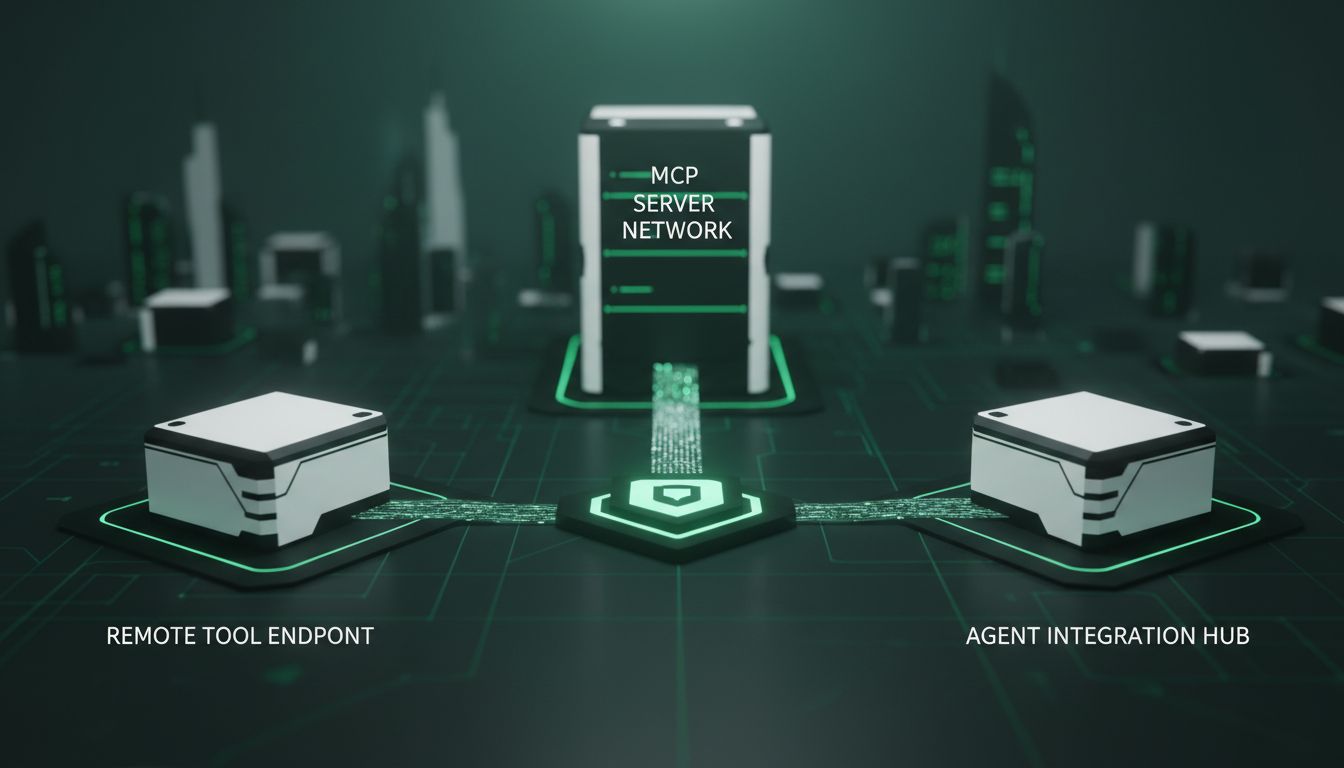
Linking remote tool endpoints for secure agent integrations is not primarily a connectivity problem. The difficult work is deciding which agent may discover a capability, which identity it uses, what data can leave the environment, which actions require approval, and how the workflow remains observable when a remote dependency fails.
For platform teams, the safest practical direction is to replace ad hoc endpoint wiring with a controlled integration layer: discover approved endpoints through a registry, route calls through policy enforcement, apply the correct outbound identity, and keep remote outputs within explicit validation and approval boundaries. This approach supports tool-backed workflows without treating every URL or MCP server as inherently trustworthy.
What secure agent integrations require
Direct answer: Secure agent integrations connect agents to remote tools through approved, discoverable endpoints; use scoped machine or user-delegated credentials; validate inputs and returned content; require approval for consequential actions; and log each invocation without exposing secrets. Remote MCP servers should be treated as third-party services with their own data retention and residency policies.
An agent endpoint may expose search, retrieval, ticketing, source-control, data, or operational capabilities. A connection becomes risky when an orchestrator hardcodes an address, attaches broad credentials, and lets model-generated text decide what to call next. That design makes ownership, policy application, credential rotation, and incident response harder than they need to be.
A more robust model separates four concerns:
Discovery:
determine which endpoint or tool is approved for a requested capability.
Authorization:
determine whether the calling agent and its current task may invoke that capability.
Authentication:
attach the appropriate identity and credentials to the outbound request.
Execution control:
validate parameters, enforce approvals, filter content where needed, and record the outcome.
This is useful whether a team uses Model Context Protocol (MCP), agent-to-agent communication, conventional function calling, or a combination. Protocol standardization can simplify connection and discovery, but it does not remove the need for trust decisions. A standardized remote interface still represents an external system with its own operator, policies, failure modes, and potentially sensitive outputs.
OpenAI’s current tool-calling guidance places external tools behind function calling or custom tools, with the Responses API as the main integration path and the Agents API managing sessions and action requests. The underlying architectural lesson applies beyond a particular API: tool access should be an explicit part of the agent runtime, not an ungoverned side effect of prompt text.
Replace hardcoded URLs with endpoint discovery and policy
Hardcoding remote endpoint URLs into prompts, agent definitions, or application code can be expedient during a prototype. It becomes a liability when the same capability has multiple environments, ownership changes, credentials rotate, or a tool must be withdrawn quickly. The caller has to know too much implementation detail, and the platform has too few central control points.
Google Cloud’s Agent Registry describes a model in which endpoints, agents, skills, and MCP servers are consolidated into a registry. Orchestrators can discover capabilities rather than embedding endpoint URLs directly. Its overview also describes standardized MCP or Agent2Agent (A2A) protocols as a way to locate and connect to functional endpoints.
Use a capability contract, not a free-form destination
At design time, define the business capability the agent needs: for example, “create a support ticket,” “retrieve approved account data,” or “open a pull request.” Associate that capability with an approved endpoint record and a narrow interface. The record should be managed as production configuration, with a clear owner and lifecycle.
The objective is not merely hiding a URL. It is making the route resolvable under policy. A registry entry can give an orchestrator a stable way to locate a service while allowing the platform to govern which endpoint version, environment, or provider is valid for a given workload.
Register the endpoint, MCP server, agent, or skill under a capability-oriented name.
Assign an accountable owner who maintains interface expectations and operational status.
Set the environments and callers that may resolve the capability.
Bind the required authentication pattern and applicable policy controls.
Resolve the destination at runtime rather than letting a model construct arbitrary network targets.
Google Cloud documents runtime endpoint resolution through ADK and describes Agent Gateway as a point for security policy enforcement, protocol mediation, and content filtering for discovered tools. This makes the gateway a useful policy choke point: it can mediate how an internal agent reaches an external capability without forcing every agent author to implement the same security logic independently.
Discovery should not become unrestricted browsing. An agent should resolve only capabilities it is authorized to use. Treat a registry as an allowlist with metadata, not as a catalog from which any model can select any available endpoint.
Choose the right remote tool-calling pattern
Security and reliability improve when the execution pattern matches the work. OpenAI recommends direct tool calling for single lookups or actions. It identifies programmatic tool calling as a stronger fit for dependent calls, filtering, deduplication, validation, and other predictable control flow.
That distinction helps teams avoid two opposite mistakes: using a long, model-directed chain for a simple operation, or asking the model to manage deterministic validation and reconciliation logic that belongs in code.
Use direct calls for bounded, independent work
A direct call is appropriate when the agent has a well-defined request and one approved tool can fulfill it. Examples include reading a specified record, checking a status, or submitting a constrained action after policy checks. The orchestrator can present a small tool surface, validate arguments, execute the invocation, and return a controlled result.
Keep the tool contract narrow. A function named for a business operation with typed, validated parameters is easier to secure than a generic remote request mechanism that accepts arbitrary paths, ers, or payloads.
Use programmatic control for predictable multi-step workflows
When a workflow needs to call one service, filter the result, deduplicate records, validate a field, then call a second service, use programmatic orchestration. This keeps known control flow in the runtime rather than relying on the model to repeat it correctly across turns.
Validate identifiers and required fields before a downstream call.
Deduplicate candidates before creating records or sending notifications.
Apply allowlists before an endpoint, repository, project, or account is selected.
Stop the sequence if a result violates policy or is incomplete.
Produce an auditable execution record for each step.
Programmatic orchestration is not a claim that the model has no role in a workflow. The model can classify intent, select from approved capabilities, or summarize returned information. The predictable portions,validation, routing constraints, retries, and sequencing rules,are usually safer when enforced by code and policy.
Build identity and authorization into every outbound call
An agent needs a secure way to authenticate outbound requests when it calls external tools. Google Cloud’s Agent Identity guidance specifically identifies this need for tools such as BigQuery, Jira, GitHub, and Google Maps. The important design question is not only “can the request authenticate?” but also “whose authority does it represent?”
Google Cloud distinguishes two common OAuth patterns. Two-legged OAuth is for agents acting with their own authority. Three-legged OAuth is for an agent acting on behalf of an individual user. Selecting between them affects auditability, access scope, consent, and what a downstream system should permit.
Use agent authority for service-owned operations
Use an agent’s own authority when the operation belongs to the service or workflow itself. The granted permissions should be limited to the exact resources and operations the agent needs. Do not turn a service identity into a broad substitute for every user who might trigger a workflow.
Use user-delegated authority when the action is truly on a user’s behalf
Use a user-delegated model when downstream access must reflect the individual user’s permissions. This better preserves the distinction between “the platform is performing a managed task” and “the user has authorized an action in their own account.” The workflow should retain sufficient context to explain which identity was used and why.
Where available, an auth manager can remove repeated credential-handling code from individual tools. Google Cloud documents that ADK’s auth-manager can transparently retrieve and inject outbound ers, including Authorization and X-Goog-Api-Key, into tool and MCP invocations. Central injection can reduce inconsistent implementation, but it should be paired with narrow scopes and policies that prevent credentials from being sent to an unintended destination.
In operational terms, keep credentials out of prompts, tool descriptions, and model-visible logs. A tool invocation should reference a configured identity relationship, while the execution layer retrieves and supplies the required er or token. This supports rotation and reduces the chance that sensitive authentication material becomes part of conversational context.
Set firm boundaries for remote MCP servers and returned URLs
MCP can make remote tools easier to expose and consume, but an MCP connection is not a trust endorsement. OpenAI’s MCP guidance warns that remote MCP servers are third-party services. Data sent to them is therefore subject to the server operator’s retention and residency policies.
This has direct implications for tool selection. Before enabling a remote server, determine the categories of information the agent might send, whether those categories are permitted by internal policy, and whether the operator’s retention and residency approach fits the workload. A tool description that appears harmless may still receive sensitive context if the orchestration layer passes it indiscriminately.
Treat tool output as untrusted input
OpenAI also warns that requesting or embedding URLs returned by connector or remote MCP tool outputs can be dangerous. This is a meaningful agent security boundary: a returned URL can be an attempt to redirect later steps, induce data exfiltration, or introduce hostile instructions into a workflow.
Do not automatically fetch, render, or pass through links returned by a remote tool. Instead, apply a deliberate handling path:
Classify the returned value as data from an external system, not as an instruction.
Validate its format and destination against a defined allowlist where a follow-up request is necessary.
Block credentials, internal-only data, or broad conversational context from being appended to a follow-up request.
Require an approval or explicit policy decision before high-impact navigation or action.
Log the decision and the endpoint reached, without recording secrets.
The same principle applies to text returned by tools. A remote endpoint may produce content that tries to influence the agent’s instructions or future tool use. Keep tool results separated from trusted workflow policy, and ensure only validated fields can drive downstream actions.
Use isolation, approvals, and action boundaries for sensitive work
Runtime isolation limits the damage that tool-connected code can cause. OpenAI’s programmatic tool-calling documentation describes agent code running in an isolated V8 runtime with no direct network access, filesystem access, subprocess access, or persistent JavaScript state. In that model, tools are the only route to external systems.
That restriction provides a useful design pattern even when using a different runtime. An agent should not have open-ended access to the network or host environment just because it needs one external capability. Route external effects through defined tools, where identities, parameters, destinations, and approvals can be controlled.
OpenAI’s Agents API includes action types such as function_call, environment_connection, and computer_use_approval_request. These action categories reflect an explicit boundary around what an agent may attempt and what needs connection or human approval.
Define approval by impact, not by tool name
A read operation may be low risk in one dataset and sensitive in another. Likewise, an action that appears routine can have material consequences if it changes production configuration, contacts a customer, or commits code. Approval policies should consider the target, scope, data classification, and effect of the operation.
Allow routine, low-impact reads only against approved resources.
Require review for external communications, irreversible changes, or privileged targets.
Pause when an invocation expands beyond the user’s stated objective.
Escalate when tool output asks the agent to alter its approved workflow.
Approval is not a substitute for authorization. A reviewer should not be asked to approve a request that the agent was never allowed to make. First restrict the capability and identity; then use approval to handle actions that remain legitimate but require a human decision.
Operate remote endpoint links as a durable orchestration system
Agents that execute multi-step work need more than a successful first tool call. They need durable context, recovery behavior, and a record of where the workflow is in its execution. OpenAI describes the Agents API as providing a durable session and orchestration layer for long-running agents, including management of context, recovery, and multi-step execution.
For platform engineering teams, this means endpoint linking must be designed for normal operational events: a remote service is unavailable, credentials are no longer valid, a policy changes, a tool returns an incomplete result, or a workflow resumes after interruption. A reliable system should identify the failed step and preserve enough state to recover safely without replaying unintended side effects.
Keep an execution record that helps operators answer real questions
Record the capability selected, resolved endpoint identity, calling agent, authorization decision, credential mode, approved parameters, outcome, and approval event where applicable. Avoid treating raw prompts or secret-bearing ers as the audit record. The goal is to enable investigation and governance while minimizing the sensitive material retained by the orchestrator.
Monitoring should distinguish model behavior from endpoint behavior. If a workflow fails, operators need to know whether the agent selected the wrong approved tool, argument validation rejected the request, authentication failed, policy blocked the action, or the remote dependency returned an error. Those categories lead to different owners and different fixes.
Managed orchestration layers, runtime isolation, and explicit authentication boundaries are increasingly important patterns for this reason. They make endpoint access a governed part of the system rather than a collection of one-off integrations that each team must secure and operate alone.
A practical rollout path for remote tool endpoint linking
Teams do not need to connect every existing endpoint at once. Start with a small number of high-value, bounded capabilities and establish the control model before expanding the catalog. This reduces the chance that an early prototype becomes an unmanaged production dependency.
Inventory current connections.
Identify hardcoded URLs, exposed credentials, broad service identities, and tool interfaces that accept arbitrary destinations.
Classify each capability.
Document its owner, data sensitivity, expected inputs and outputs, downstream systems, and whether it reads or changes state.
Publish approved endpoint records.
Put MCP servers, agents, skills, and conventional tools behind a registry or equivalent discovery layer.
Bind identity deliberately.
Choose agent authority or user-delegated authority based on who should own the downstream action.
Introduce gateway controls.
Apply protocol mediation, security policies, and content filtering at a shared integration boundary where appropriate.
Constrain workflows in code.
Use programmatic orchestration for known dependencies, validation, filtering, and deduplication.
Add approvals for material effects.
Make the approval request specific enough for a person to understand the target and consequence.
Test hostile and abnormal outputs.
Include malformed parameters, unexpected URLs, authorization failures, interrupted sessions, and remote error conditions.
Success is not measured by the number of tools an agent can reach. It is measured by whether teams can add a useful capability while retaining a clear answer to five questions: what was called, why it was selected, which identity acted, what information was shared, and how the action was controlled.
Secure endpoint linking is a system design discipline. Use discovery to avoid brittle wiring, use narrow tool contracts and programmatic control for predictable workflows, attach the correct identity at the execution boundary, and treat every remote result,including returned URLs,as untrusted until it has passed policy and validation.
For an agent orchestration workspace, the practical next step is to define a governed capability catalog and route new integrations through it. That gives specialist agents a controlled way to find, authenticate to, and use remote tools while preserving the operational visibility enterprise workflows require.