
Home/Blog/Scaling artificial intelligence toolchains: patterns for coordinating model-driven workflows
Scaling artificial intelligence toolchains: patterns for coordinating model-driven workflows
August 5, 2026
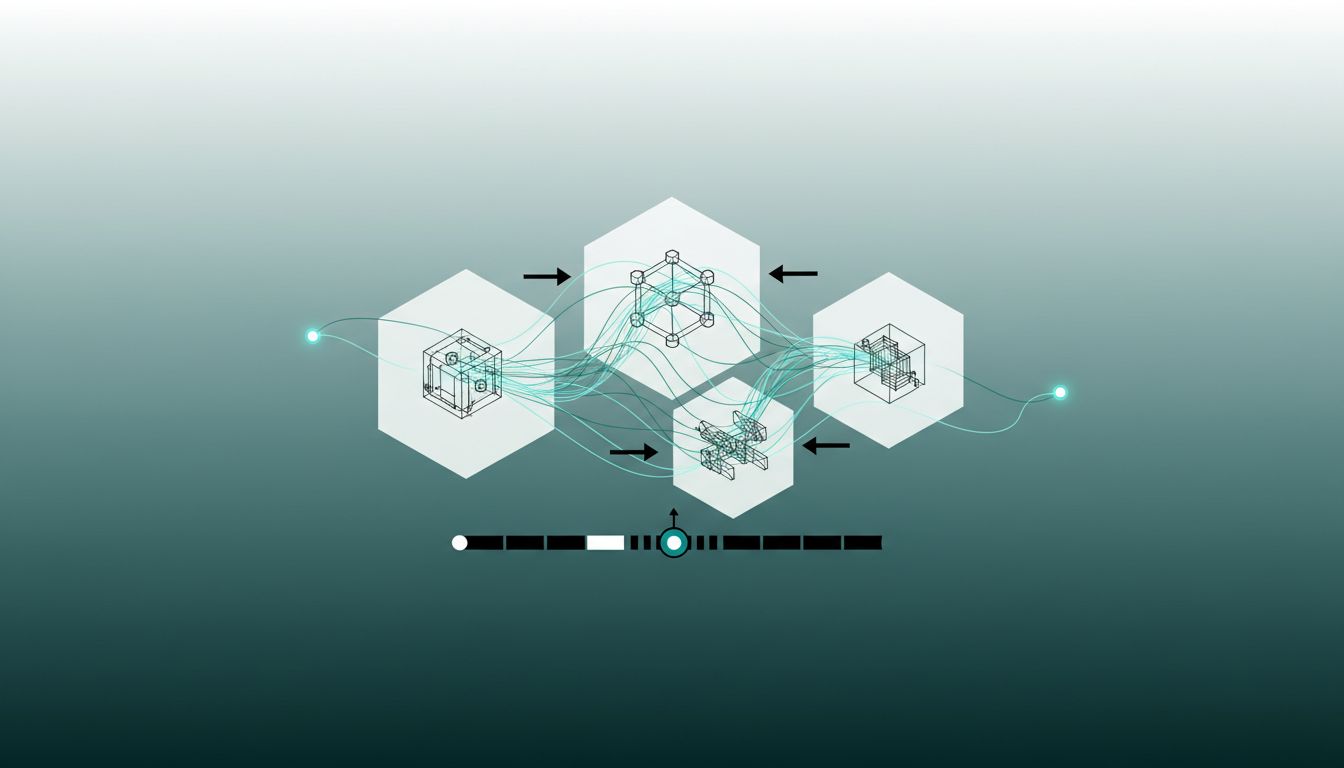
Scaling artificial intelligence toolchains has become less about adding another model endpoint and more about coordinating a dependable workflow layer around models, tools, memory, policies, and people. Across enterprise teams, AI workflow orchestration is increasingly treated as a distinct architecture layer rather than an extension of prompting alone. That shift matters because the operational challenge is no longer simply generating outputs, but reliably planning, routing, validating, retrying, and governing multi-step work across specialist agents and connected systems.
For platform engineers and product teams, the practical question is how to design model-driven workflows that survive real production conditions: partial failures, long-running tasks, changing context windows, policy constraints, audit requirements, and legacy integration boundaries. Recent guidance from cloud providers, model vendors, and workflow infrastructure platforms points in the same direction: scale comes from orchestration patterns, durable execution, and explicit control planes. The organizations getting value are not just embedding AI into old workflows; they are redesigning how work is coordinated.
Why orchestration is now an architecture layer
A consistent theme in 2026 guidance is that orchestration should be designed as its own layer. Google Cloud frames agent design as a decision about how models integrate software components and coordinate single-agent or multi-agent workflows, with orchestration serving as the planning-and-connection layer for multi-step tasks. In other words, the model is only one runtime participant. The broader system must decide what gets called, in what sequence, under which policies, and with what handoff of context.
This distinction is important because model-driven workflows behave more like distributed applications than chat interfaces. A workflow may involve retrieval, tool calls, approvals, structured generation, validation, ticket updates, and human escalation. Each step can have different latency, cost, and failure characteristics. Treating orchestration as a first-class architecture layer gives teams a place to express retries, branching, dependencies, ownership boundaries, and governance rules without burying everything inside prompts.
It also helps enterprises separate concerns cleanly. Models can evolve, prompts can change, and specialist agents can be swapped, while the coordination layer preserves system behavior and policy intent. For a control-plane-oriented workspace, this is the foundation for routing users to MCP-connected specialists, passing forward relevant context, and running tool-backed workflows predictably across teams and environments.
The orchestrator pattern for complex, failure-prone work
One of the most common scaling patterns is the orchestrator pattern. Google Cloud’s March 2026 guidance argues that complex workflows are better handled by an orchestrator, especially when tasks such as research, generation, and grading can fail or time out independently. Rather than asking one model turn to do everything, the orchestrator decomposes work into bounded tasks and coordinates the lifecycle of each step.
This pattern works well because enterprise workflows are rarely linear in practice. A research subtask may need to fan out across sources, a code-generation step may trigger static analysis, and a grading phase may reject outputs that do not meet policy or quality thresholds. By isolating these stages, teams gain observability into where work stalls, where cost accumulates, and where intervention is needed. Failures become local events instead of total workflow collapse.
An orchestrator also creates a natural place to enforce business rules. It can route specific tasks to specialist agents, choose a model mix based on complexity or sensitivity, and gate progression on tool outputs or human approval. This is particularly useful in multi-agent environments where handoffs must be explicit. Instead of relying on implicit conversational continuity, the orchestrator defines state transitions, payload contracts, and fallback behavior.
ReAct, tool use, and bounded reasoning loops
Even as orchestration matures, ReAct remains a widely cited pattern for coordinating model-driven workflows. Google Cloud continues to describe ReAct, combining reasoning and action, as an effective way to interleave thought processes with task-specific tool use. In practical systems, that means the model can evaluate the current state, decide which tool or subagent to invoke, inspect results, and then continue toward the goal.
The key to using ReAct at scale is not unlimited autonomy but bounded loops. Teams should define which actions are allowed, how many iterations are acceptable, what constitutes sufficient evidence, and when the workflow should escalate or terminate. This prevents runaway tool usage and makes cost, latency, and correctness easier to control. It also keeps workflows compatible with enterprise governance, where every action may need to be attributable and reviewable.
ReAct is especially useful when combined with specialist agents. An orchestrator can assign research to one agent, file analysis to another, and policy grading to a third, while still letting each participant use local reasoning plus approved actions. The result is a workflow that is flexible enough to adapt to intermediate findings but structured enough to remain predictable under production constraints.
Durable state is the backbone of reliable AI workflow orchestration
As workflows become longer and more tool-heavy, durable state and auditability move from nice-to-have features to core requirements. Google Cloud highlights the need for an operational data lake and a durable system of record for conversation transcripts, workflow state, and non-repudiable audit trails. This reflects a hard production truth: if the system cannot recover its state after retries, timeouts, or handoffs, it is not ready for enterprise use.
Durability matters because model-driven workflows often span minutes, hours, or even days. They may depend on asynchronous events, external system updates, or human approvals. Inngest’s 2026 benchmark report, centered on AI production workflows and durable execution, reinforces the same point: long-running AI processes must survive failures and resume cleanly. The workflow engine should know what has already happened, what remains pending, and which outputs are authoritative.
Persistent state also improves trust. Teams can inspect why an agent chose a path, what tools were invoked, which model version was used, and what context was available at the time. In regulated or high-stakes settings, this is not just operationally helpful; it is often mandatory. A robust AI workflow orchestration layer therefore needs event history, state snapshots, immutable logs, and policy-aware retention strategies as part of the core platform design.
Workflow policy as code and state machines for execution
Another pattern gaining traction is treating workflow policy as code. OpenAI’s 2026 Codex orchestration specification describes Symphony as keeping workflow policy in-repo via WORKFLOW.md, normalizing tracker payloads into a stable issue model, and using ticket status as a state machine for agent execution. This approach is powerful because it moves workflow behavior out of ad hoc prompt text and into versioned, reviewable artifacts.
For engineering teams, policy-as-code creates a shared language between platform, application, and operations functions. Routing rules, approval gates, tool permissions, and escalation paths can be tested, code-reviewed, and deployed through familiar software delivery workflows. It also reduces ambiguity. Instead of asking whether an agent “should probably” take an action, the system can consult an explicit policy contract tied to business context.
State machines complement this model by making workflow progression legible. A ticket, case, or job can move through states such as triaged, researching, waiting-for-input, ready-for-review, blocked, and completed. Each transition can trigger subagents, validations, or external actions. This design is especially effective in enterprises where work already lives inside service desks, issue trackers, and operational systems. The workflow becomes governable without forcing teams to abandon existing tools.
Memory, context compaction, and specialist subagents
Long workflows create a context management problem long before they create a model quality problem. OpenAI’s May 2026 Warp case study highlights the use of context compaction, persistent memory, and dedicated subagents for code search and file analysis. The lesson is straightforward: reliable orchestration depends on controlling what context is preserved, summarized, discarded, and forwarded at every handoff.
Persistent context does not mean keeping every token forever. It means retaining the right facts in the right form. Workflow systems should distinguish between ephemeral reasoning, stable task state, reusable memory, and audit logs. A compact summary may be enough for the next planning step, while raw evidence should remain addressable in durable storage. This reduces prompt bloat, improves latency, and lowers the chance that critical instructions are crowded out by stale detail.
Specialist subagents reinforce this pattern. Rather than one general agent repeatedly reloading broad context, subagents can operate over narrower domains with focused tools and memory boundaries. A file-analysis agent can own repository structure, a policy agent can own compliance checks, and a research agent can own external evidence gathering. The orchestrator then assembles their outputs into a coherent workflow without overloading any single participant.
Operating model redesign matters more than adding another model
Many organizations still treat AI as an add-on to legacy workflows, and recent enterprise research suggests that this often produces only incremental gains. McKinsey’s June 2026 report on the symbiotic enterprise notes that AI is frequently embedded into existing processes rather than used to redesign them. Gartner’s 2026 survey findings point to technology integration and talent constraints as major blockers, especially in legacy environments. The bottleneck is often the workflow system, not the model.
That is why scaling artificial intelligence toolchains requires operating model changes. Teams need clarity on who owns prompts, policies, tools, quality thresholds, exception handling, and escalation paths. They also need control planes that unify model selection, workflow routing, and observability across specialist agents. Without these changes, enterprises accumulate disconnected proofs of concept that cannot be governed or improved systematically.
The World Economic Forum makes a related point: scaling advanced technologies requires orchestrating people, data, and workflows together. Human-machine interfaces frequently become the new bottleneck. In practice, that means successful platforms do not only automate tasks. They also define where humans review, intervene, override, and learn from the system. Pragmatic orchestration design therefore includes operational roles and handoffs, not just technical integrations.
From distributed systems thinking to measurable agent intensity
As compound AI systems mature, they are increasingly optimized like distributed systems. The 2026 Compass paper defines Compound AI as a unified system coordinating specialized models and software components, with runtime adaptation improving SLO compliance under dynamic load. This is a useful framing for production teams. It suggests that throughput, tail latency, contention, locality, and degradation strategies matter just as much in AI workflow orchestration as they do in service-oriented infrastructure.
Research into distributed, coalition-based coordination extends this idea further. The “Internet of Agentic AI” paper explores heterogeneous agents forming coalitions across cloud and edge infrastructure, constrained by capability coverage, locality, and economic implementability. While many enterprise stacks are not yet operating at that scale, the architectural implications are already visible: capability discovery, location-aware routing, and cost-aware delegation are becoming practical design concerns.
Measurement is evolving as well. Microsoft’s 2026 Work Trend Index introduces “agent intensity” using signals such as tool use, orchestration depth, reasoning steps, and response complexity. These are useful operational metrics because they shift attention from model novelty to workflow sophistication. Teams can use them to identify where orchestration is shallow, where tool use is ineffective, and where reasoning depth is not translating into outcomes. Over time, this supports a more disciplined approach to capacity planning and workflow optimization.
Governance, model planes, and the future execution stack
Operational orchestration and governance are emerging as differentiators in enterprise AI. Kearney’s 2026 trends report highlights transparent, governed AI embedded into core workflows and describes the model plane as a governed portfolio of LLMs and traditional ML systems. This aligns well with a control-plane architecture where workflow routing, model selection, access controls, and observability are centrally managed rather than scattered across applications.
At the same time, workflow management is moving toward specification-driven generation paired with execution layers. A 2026 scientific workflow paper combines natural-language workflow generation, automated debugging, distributed execution, and an MCP layer for submission, monitoring, and control. That stack points to an important future pattern: humans define intent and constraints, the system synthesizes a workflow specification, and a governed execution layer runs it with durable state, monitoring, and correction loops.
Adoption signals suggest this category is becoming measurable. Zapier’s Q2 2026 AI Workflow Index reports hundreds of companies with at least one durable AI workflow, while CNCF’s Technology Radar places workflow orchestration among leading cloud-native production topics. The message for platform teams is clear: AI workflow orchestration is no longer an experimental wrapper around models. It is becoming a production discipline that blends software architecture, platform operations, and service design.
The strongest pattern across these developments is simple: scale comes from combining model mix, orchestration, and memory inside a durable execution environment. OpenAI’s GPT-5 guidance underscores this by noting that the Responses API can persist reasoning items across turns and tool calls, helping future-proof agent workflows. When paired with policy-as-code, specialist subagents, and clear state management, this creates workflows that are easier to evolve without sacrificing reliability.
For enterprise teams building or operating specialist AI agents, the next maturity step is to treat coordination as the product. That means investing in explicit orchestration patterns, stateful execution, auditability, and human-aware operating models rather than assuming better prompts will close the gap. AI workflow orchestration is where technical design, governance, and business process redesign now meet, and it is increasingly the layer that determines whether model-driven systems remain demos or become dependable infrastructure.