
Home/Blog/Scaling autonomous assistants with persistent memory and a unified orchestration layer
Scaling autonomous assistants with persistent memory and a unified orchestration layer
September 10, 2026
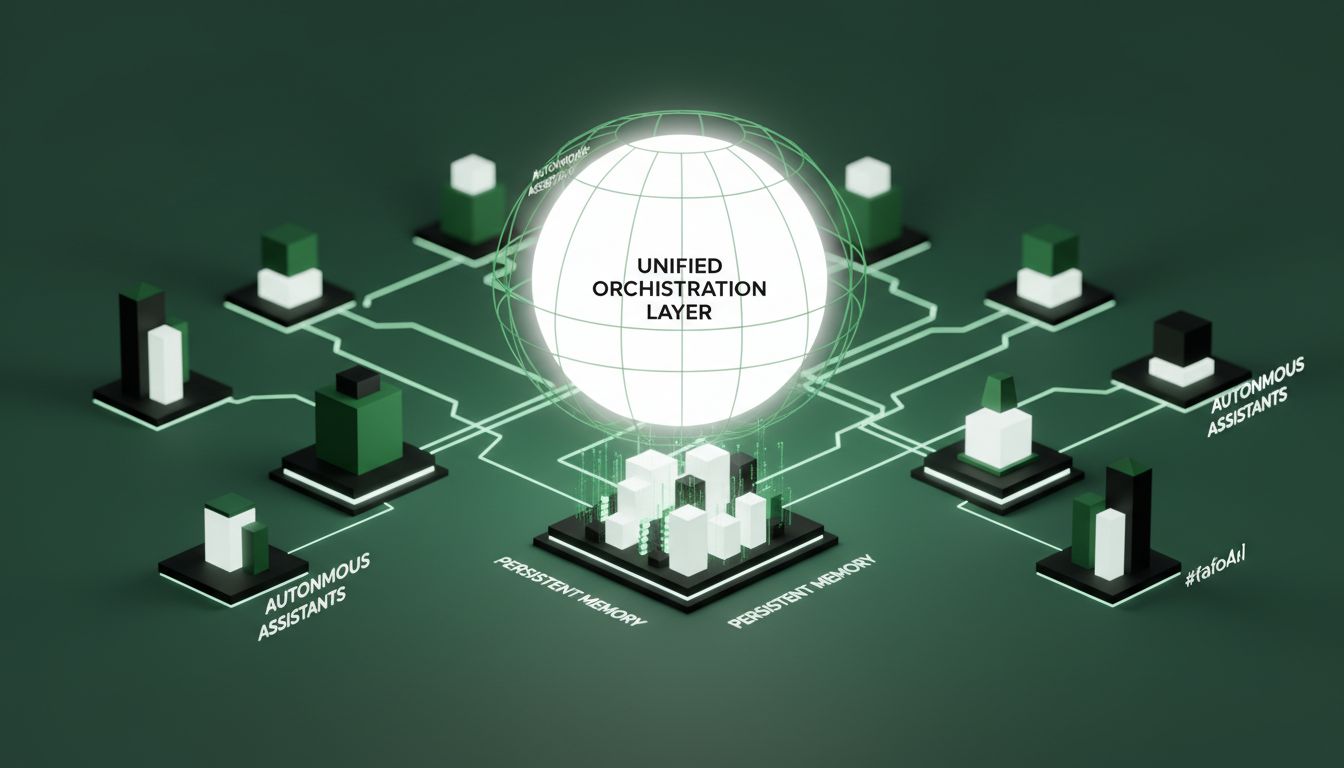
Autonomous assistants do not become reliable enterprise systems simply because they can call tools or complete a multi-step prompt. They need to retain the right context across work sessions, coordinate actions across specialist agents and systems, and operate within clear technical and organizational controls. As assistants move from single-turn interactions toward long-running work, scaling depends less on adding another model and more on building a dependable system around the model.
That system increasingly has three connected parts: a persistent memory layer, a unified orchestration layer, and a governance and observability layer. Together, they allow a platform to preserve useful context, route work to the appropriate specialist, execute tools and workflows safely, and show operators what occurred. For platform engineers and product teams, the goal is not unrestricted autonomy. It is human-directed, evidence-based automation that can be inspected, improved, and deployed across real enterprise processes.
Why autonomous assistants fail to scale as isolated sessions
A session-only assistant can be useful for drafting, answering questions, or performing a bounded task. It receives an input, reasons over available context, returns an output, and then loses most of the operational state that would make the next interaction more informed. This model is straightforward, but it breaks down when work spans days, involves multiple systems, or requires continuity between people and agents.
Microsoft Foundry’s March 2026 persistent-memory announcement identifies this limitation directly: most agents still rely on short-term, session-based memory. Its user-scoped persistent-memory approach targets adaptive and personalized agents that can retain relevant context beyond a single interaction. That shift matters because scaling is not just a matter of serving more requests. It means allowing the same assistant or workflow to continue work without repeatedly reconstructing who the user is, what has happened, and what constraints apply.
Consider a support operations assistant that investigates a recurring incident. In one session it may identify a service owner, collect logs, and open a ticket. In a later session, it should be able to understand that the ticket already exists, recognize the approved escalation policy, distinguish provisional observations from confirmed findings, and avoid contacting the same person twice. Without managed memory and a shared execution layer, that continuity tends to be recreated through brittle prompts, manually assembled histories, or application-specific code.
The hidden costs of ad hoc agent wiring
Context fragmentation:
user preferences, prior decisions, task artifacts, and tool outputs end up scattered across chat histories, databases, files, and individual agent state.
Inconsistent handoffs:
a routing agent may pass a summary to a specialist, but omit the evidence, permissions, or unresolved questions required for safe execution.
Duplicated integrations:
each agent implements its own retries, credentials, tool schemas, file handling, and error treatment.
Weak traceability:
teams can see a final answer but cannot easily reconstruct which tool ran, what data was read, or why a workflow took a particular branch.
Uncontrolled memory growth:
if every conversation is saved without filtering or lifecycle rules, retrieval quality, privacy exposure, and latency can all worsen.
These are systems problems, not merely prompt-engineering problems. OpenAI’s March 2026 Responses API update framed agent building as an execution-loop problem: the model proposes actions, the platform runs them, and the results feed the next step. This framing is useful because it places tool execution, results, and subsequent reasoning inside one deliberate loop rather than treating tool calls as incidental extensions of chat.
OpenAI’s practical guide to building agents similarly recommends incremental orchestration patterns. It also notes that agents can interact with legacy systems through computer-use models where APIs are unavailable. This expands what assistants can reach, but it also raises the importance of policy-aware routing, sandboxing, confirmation points, and detailed run records. The more varied the systems an assistant can operate, the less viable it is to manage each connection as a one-off integration.
Persistent memory is an engineering capability, not a chat-history archive
Persistent memory is often described casually as giving an agent “long-term memory.” In production architecture, that description is incomplete. A durable memory capability needs explicit choices about what is stored, who can access it, how it is retrieved, how conflicting information is resolved, and when it expires. Memory should help an agent make a better next decision; it should not become an unbounded transcript store.
Microsoft’s 2026 platform messaging treats persistent memory as a product capability rather than solely a research concept. Microsoft Foundry describes user-scoped persistent memory, while OpenAI’s April 2026 Agents SDK update emphasizes configurable memory alongside sandbox-aware orchestration. Both directions point toward memory as a controllable subsystem with settings, boundaries, and operational consequences.
Separate memory by purpose
A practical design begins by separating memory categories. The exact implementation can vary, but the purpose and access rules should remain visible to operators and application owners.
Working memory
supports the current run: active objectives, intermediate results, pending tool calls, and a short execution trace.
User or account memory
may hold durable preferences, approved communication styles, accessibility needs, or established business context. User scoping is particularly important when personalization is involved.
Task and project memory
preserves objectives, decisions, artifacts, status, and open issues for a long-running initiative shared by a team.
Organizational knowledge
is grounded in controlled enterprise sources, such as policies, product documentation, operational procedures, and approved records.
Agent-operational memory
can record learned workflow state, prior failures, validated tool behavior, and checkpoints, subject to strict safety rules.
These categories should not automatically share the same retrieval path. A specialist coding agent may need the repository task state and relevant engineering standards, but it does not necessarily need an individual user’s unrelated preferences. A finance workflow may need a policy document and a case record, while being explicitly barred from retrieving another department’s information. Scoping is a design decision that should be enforced in the memory and orchestration layers, not left to model instructions alone.
Control writes before optimizing retrieval
The 2026 survey Memory for Autonomous LLM Agents discusses latency, contradiction handling, privacy, and write-path filtering. Those concerns are tightly connected. A memory system that stores too much low-quality material creates noisy retrieval; a system that stores contradictory claims without provenance makes future actions less trustworthy; and a system that stores sensitive data indiscriminately creates compliance and access-control risk.
Classify the proposed memory write: preference, task fact, generated hypothesis, tool result, policy, or transient execution detail.
Attach provenance, scope, timestamps or lifecycle metadata where appropriate, and the confidence or source state needed for later evaluation.
Apply policy checks before persistence, including sensitivity rules, user scope, project boundaries, and retention requirements.
Use deduplication, contradiction detection, or review workflows for facts likely to affect future decisions.
Make the stored item retrievable only by agents and users authorized for that category and scope.
This approach avoids a common failure mode: treating memory writes as harmless because they are internal. Internal state can still influence external actions. If an assistant persists an unverified assertion that a customer approved a change, a later agent could act on it. Memory therefore requires the same care applied to other consequential system inputs.
Persistent memory should preserve decision-ready context, not merely accumulate conversational residue.
The 2026 paper on Memori argues that API-layer persistent memory is essential for context-aware behavior across multiple sessions and autonomous-agent workflows. The architectural implication is important: if memory lives only inside one agent’s temporary runtime, it becomes difficult to share, govern, migrate, or inspect. A managed memory interface can provide a durable contract across interactions while retaining control over permissions and lifecycle.
Build a unified orchestration layer around the execution loop
Persistent memory alone does not coordinate work. An assistant still needs a layer that chooses a next action, delegates to a specialist, executes a tool, handles an error, records the outcome, and determines whether the objective has been met. That is the role of orchestration.
OpenAI’s March 2026 Responses API update described the core pattern clearly: the model proposes actions, the platform runs them, and results return to the next step. This is not simply a technical detail of an API. It is a scalable operating model for assistants because it separates reasoning from controlled execution. The model can propose; the platform can validate, authorize, run, observe, and return structured results.
What the orchestration layer should own
A unified orchestration layer should centralize the parts of agent operation that must work consistently regardless of which model or specialist agent is selected. In an orchestration workspace, it becomes the control plane through which users access specialists, context is handed off, and tool-backed workflows are executed.
Routing:
select the appropriate specialist agent, model, or workflow based on task type, permissions, cost constraints, and required tools.
Context assembly:
retrieve only the memory, files, project state, and tool outputs relevant to the current action.
Tool execution:
enforce schemas, identity, authorization, network controls, confirmation requirements, and result normalization.
State management:
maintain run state, checkpoints, artifacts, retries, dependencies, and durable task status.
Handoffs:
pass structured objectives, evidence, limits, and expected outputs between agents rather than relying on vague summaries.
Human intervention:
request review or approval at defined escalation points and make it possible to pause, modify, or stop a run.
Observability:
capture traces, tool calls, memory reads and writes, failures, and final outcomes for debugging and audit.
OpenAI’s April 2026 Agents SDK update emphasizes configurable memory and sandbox-aware orchestration, signaling movement away from ad hoc tool wiring and toward a more standardized execution layer. Sandboxing matters because autonomous workflows increasingly operate tools that can access files, shells, browsers, and internal systems. A unified layer can make the execution environment part of the policy boundary rather than an invisible implementation detail.
The addition of a shell tool in the March 2026 Responses API update also illustrates why centralization matters. Broader task execution can improve utility, especially for technical workflows, but it increases the need for controls around environment isolation, command validation, secrets, file access, and logging. A platform should know not only that an agent intended to run a command, but also where it ran, under which identity, with what inputs, and what output informed the subsequent step.
Design agent handoffs as contracts, not conversations
Multi-agent workflows often fail at the boundary between specialists. A planner may produce a polished description of work, but a downstream agent needs actionable state: a target, allowed tools, constraints, source artifacts, success criteria, and unresolved risks. When those elements are missing, the downstream agent either repeats discovery or makes unsupported assumptions.
A unified orchestration layer can turn handoffs into structured contracts. Instead of passing only natural-language summaries, it can pass typed fields and references to governed state. The receiving agent can then reason over a stable packet while the platform retains the full run trace.
A useful handoff packet
The business or technical objective, including what is explicitly out of scope.
The current task state and a checkpoint identifier for resumption.
Relevant memory references and provenance, rather than an unfiltered history dump.
Authorized tools, data scopes, execution environment, and spending or time limits where applicable.
Artifacts already produced, such as files, issue links, test output, or research notes.
Known uncertainties, failed attempts, blocked dependencies, and conditions that require human review.
A machine-checkable expected result, such as a validated report, updated record, test result, or approval request.
This structure supports efficient specialization. A research agent can gather source-grounded findings, a policy agent can evaluate constraints, a workflow agent can update an approved system of record, and a reviewer can assess the proposed output. Each role receives enough context to act without receiving unrestricted access to all historical data.
OpenAI’s April 2026 Symphony specification offers a concrete illustration of unified orchestration for long-running work. It describes an orchestrator that turns a project board into a control plane for coding agents. The broader lesson is that the work-management surface can become part of the agent system: project state, assignments, execution status, and human oversight are coordinated in one place instead of existing as disconnected side channels.
For enterprise teams, this pattern can apply beyond software delivery. A project board, case queue, incident system, lab workflow, or operations console can supply the durable work state. The orchestration layer should not replace every existing operational system. It should connect to those systems, preserve their authority where they are systems of record, and coordinate assistant actions around them.
Use memory and orchestration together for long-running workflows
Scaling autonomous assistants requires treating a workflow as a sequence of governed loops, not as one large inference. Microsoft’s September 2026 infrastructure blog says that generation, retrieval, tool use, and persistent memory can run together in loops lasting minutes or hours. It also states that memory bottlenecks are not solved by a single layer. This is a useful warning against simplistic architectures that attempt to solve continuity with only a larger context window or a single vector store.
A long-running workflow can contain multiple time horizons. One step might retrieve a policy in milliseconds. Another may wait for an external system, require a human approval, or resume after a scheduled interval. The platform needs to preserve a durable task state through all of those events while keeping the active context compact and relevant.
An operational loop for durable assistants
Interpret the goal.
Convert the user’s request or queue item into an explicit objective, constraints, and measurable completion conditions.
Assemble scoped context.
Retrieve project state, user-scoped memory when appropriate, enterprise knowledge, and relevant prior artifacts.
Plan the next bounded action.
Select a specialist agent or tool path rather than attempting to plan every possible step at once.
Authorize and execute.
Apply the tool, sandbox, identity, and approval rules before performing a consequential action.
Validate the result.
Check tool output, evidence quality, policy conformance, and whether the result actually advances the objective.
Persist curated state.
Store only durable task facts, validated artifacts, and decision-relevant observations under the right scope.
Continue, escalate, or stop.
Resume with the next action, request human input, hand off to a specialist, or close the workflow with a recorded outcome.
This loop reflects the distinction between a model’s proposed action and the platform’s executed action. It also helps teams control autonomy progressively. Early deployments may require approval for every write to an external system. Later, once instrumentation and policies are proven, the same workflow may proceed automatically within a narrow set of pre-approved conditions.
Microsoft’s July 2026 post on the Genesis Mission says Microsoft Discovery includes autonomous lab orchestration and agentic memory. That example demonstrates why the pairing matters in scientific workflows: work may need to retain hypotheses, experimental state, data references, and prior results while coordinating actions over a longer process. OpenAI’s January 2026 scientific-computing report similarly notes a shift by researchers from implementation toward verification and orchestration. The human role remains essential, but it changes toward setting direction, reviewing evidence, and governing the system that carries out bounded work.
Make governance and observability part of the architecture
As assistants gain the ability to retrieve information, use tools, persist memory, and coordinate multiple steps, governance cannot be an after-the-fact review process. It has to be integrated into the execution path. Microsoft’s June 2026 leadership blog argues that AI value depends on the “system around the AI,” including how agents are built, governed, observed, and improved over time. That principle aligns with the architecture required for reliable autonomy.
OpenAI’s Frontier Governance Framework highlights autonomous discovery, exploitation, campaign orchestration, and resilience as governance concerns for increasingly agentic systems. These concerns reinforce a basic operational point: an agent platform must account for what a system can do over repeated actions and connected tools, not only what it can say in a single response.
Controls that should be explicit
Identity and authorization:
every agent, tool call, and delegated action should operate under an attributable identity with least-privilege access.
Data boundaries:
retrieval and memory writes should respect user, tenant, project, and classification boundaries.
Action policy:
define which actions are permitted automatically, which require a confirmation, and which are prohibited.
Sandbox and environment controls:
isolate code and shell execution; constrain network, files, packages, and secrets according to workload risk.
Auditability:
retain run-level evidence of inputs, retrieved context references, actions proposed, actions executed, approvals, and outputs.
Evaluation and improvement:
measure workflow outcomes, tool reliability, escalation rates, memory quality, and recurring failure modes before expanding autonomy.
Observability should support both incident response and product improvement. When a workflow fails, an operator should be able to distinguish among several causes: poor task interpretation, incorrect routing, irrelevant memory retrieval, a tool permission failure, a downstream-system error, or an inadequate validation step. A single aggregate success metric cannot provide that diagnosis.
OpenAI’s agentic-AI governance paper distinguishes agentic AI systems from fully autonomous systems, noting that agentic systems typically pursue human-defined goals in human-determined environments. This distinction is operationally valuable. Enterprise platforms can keep goals, boundaries, permissions, and escalation criteria human-defined while allowing assistants to perform meaningful multi-step work within those boundaries. Governance is not the opposite of autonomy; it is what makes bounded autonomy deployable.
Support portability so long-lived agents are not trapped in one runtime
Assistant systems evolve. Teams change models, upgrade tool harnesses, reorganize services, shift cloud environments, and replace individual specialist agents. If an agent’s identity, memory, and task state are inseparable from one runtime, change becomes risky and continuity becomes fragile.
A September 2026 paper on Runtime-Independent Persistent Agents argues that long-lived agents need to preserve identity, memory, and code across different models, harnesses, and servers. Whether or not an organization adopts a particular implementation, the design principle is sound: define durable interfaces for state and execution so the system can evolve without losing the continuity needed for ongoing work.
Practical portability boundaries
Keep durable task state outside the transient model context. Store artifacts using stable references. Represent tool contracts in a way that is not tied to one prompt template. Maintain agent identity, policy assignments, and memory scopes as platform-managed records. These choices make it easier to route a task to a different approved model or specialist when performance, availability, cost, or compliance requirements change.
Portability does not mean every agent must be interchangeable. A specialist may depend on a particular toolchain or evaluation process. The objective is to avoid unnecessary lock-in of the durable elements: identity, work state, governed memory, artifacts, and audit history. The orchestration layer can then provide a stable control surface even as individual execution components change.
The same reasoning appears in distributed-system research. A September 2026 paper on AI-native orchestration for 6G describes autonomous agents managing persistent service contexts and enabling closed-loop control. In distributed environments, no individual runtime can be assumed to hold all durable state forever. Coordinated, persistent context and explicit orchestration are foundational requirements.
Implement incrementally: a pragmatic rollout path
Teams do not need to begin with a fully autonomous multi-agent platform. OpenAI’s practical guide recommends incremental orchestration patterns, and that is the right adoption posture for most organizations. Begin with a workflow that has a clear owner, bounded tool access, verifiable outcomes, and a meaningful cost of manual repetition.
Phase 1: stabilize one tool-backed workflow
Start with one assistant that can retrieve approved context and execute a small number of read-only or low-risk tools. Instrument each step. Record what context was retrieved, which tool was selected, whether the result was useful, and where the workflow needed human intervention. This establishes an evidence base before adding persistence or delegation.
Phase 2: introduce curated persistent memory
Add durable memory only for information that has a defined future use. Prefer task state, validated artifacts, approved preferences, and structured outcomes over raw conversation storage. Establish who may read and write each memory class, how long it should remain available, and how incorrect information can be corrected or removed.
Phase 3: add specialist routing and handoffs
Once one workflow is observable, route discrete subproblems to specialist agents. Make handoff contracts explicit. Require the receiving agent to return structured outputs and evidence rather than only prose. Keep a human owner accountable for the end-to-end workflow even when multiple agents contribute.
Phase 4: automate within proven boundaries
Expand automated execution only after evaluation shows that routing, retrieval, validation, and tool policies behave reliably in representative conditions. Add retries with limits, checkpoints for long-running work, and escalation paths for uncertainty or policy conflicts. Continue to treat the ability to stop or override an agent run as a product requirement.
This staged approach helps avoid two unproductive extremes: leaving assistants trapped in chat because production architecture seems too difficult, or granting broad tool access before the platform can explain and control what the assistant does. The target is a controlled progression from assistive interaction to bounded, observable autonomy.
Measure the system around the assistant
Scaling requires feedback loops that evaluate the whole system, not just model output quality. Microsoft’s guidance that value depends on how agents are built, governed, observed, and improved over time is especially relevant here. A fluent final response can hide a poor retrieval decision, an unnecessary tool call, an unsafe memory write, or a workflow that cost more than it saved.
Teams should define metrics that correspond to the workflow’s actual operating goals. The exact measures will differ by domain, but the categories should cover task completion, evidence quality, action safety, latency, tool reliability, escalation behavior, and memory quality. Review the metrics alongside representative traces, because aggregate performance alone may not expose harmful edge cases.
Did the workflow reach a verified completion state, rather than simply produce a plausible answer?
Were retrieved memories relevant, authorized, current, and correctly scoped?
Did the system execute only necessary tools, and did it recover appropriately from failures?
How often did it require human clarification, approval, correction, or rollback?
Can an operator reconstruct the path from the initial request to the final external action?
Did persistent memory improve continuity without creating unacceptable privacy, contradiction, or latency costs?
The dominant architectural theme across the 2026 sources is a three-part stack of memory, orchestration, and governance or observability. This is an inference from OpenAI’s memory and orchestration updates and Microsoft’s persistent-memory and system-level guidance, rather than a single vendor-prescribed blueprint. Its practical value is that it directs engineering attention to the dependencies that matter: memory needs controls, orchestration needs durable state, and autonomy needs evidence.
Persistent memory and a unified orchestration layer are therefore not separate upgrades to an assistant. Memory supplies continuity, but only when its writes, retrieval, scope, provenance, and lifecycle are governed. Orchestration supplies execution, but only when routing, tools, handoffs, sandboxing, and checkpoints are handled as shared platform responsibilities. Observability and governance connect both layers to the people accountable for outcomes.
For teams building enterprise agent workflows, the practical next step is to select one bounded process and make its execution loop visible end to end. Centralize routing and tool control, introduce curated memory where continuity demonstrably helps, and preserve human control over objectives and consequential actions. That foundation allows autonomous assistants to scale across specialists and sessions without sacrificing the reliability, security, and operational clarity required in production.