
Home/Blog/Securely bridge AI tool endpoints using stateless context protocols
Securely bridge AI tool endpoints using stateless context protocols
November 11, 2026
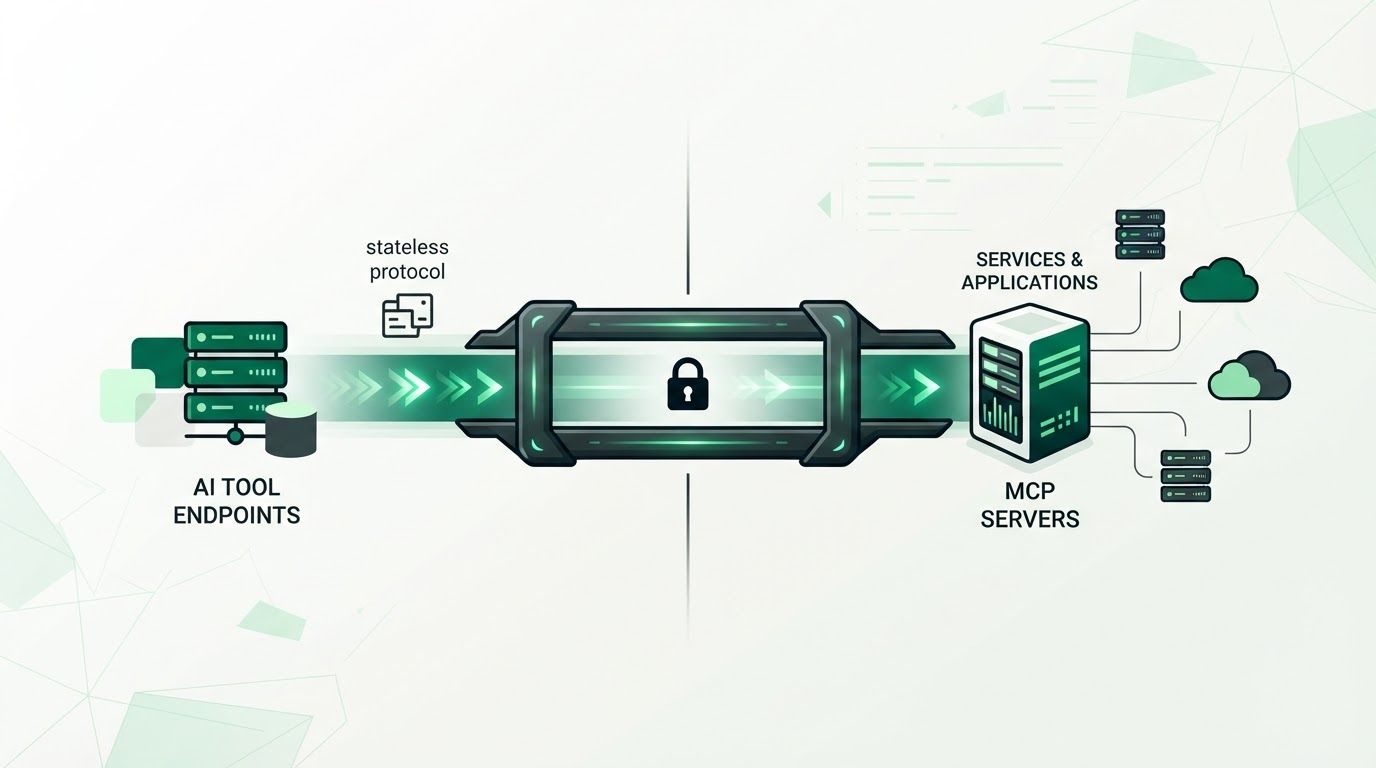
AI tool integrations become difficult to operate when every connection depends on a long-lived session, a fixed backend instance, or a public endpoint that should have remained private. A stateless MCP design gives platform teams a more practical way to bridge AI tool endpoints: keep protocol interactions independent, carry only the explicit context a later call needs, and enforce identity and access controls at clear boundaries.
This matters for teams connecting specialist agents to internal systems, SaaS APIs, browser workflows, and operational tools. The Model Context Protocol (MCP) direction published on July 28, 2026 moves the core protocol toward stateless request/response interactions that can run on ordinary HTTP infrastructure, while extensions such as Tasks address work that must continue beyond a single request. The result is not automatic security or scalability, but it creates a cleaner foundation for building both.
What stateless MCP means for AI tool endpoints
In the 2026 MCP specification direction, the protocol core shifts away from bidirectional, stateful connections and toward a stateless request/response model. Each request should contain the information required for the server to process it, rather than depending on hidden connection state held by one specific server process.
That distinction is especially important when an AI host, an orchestrator, or a specialist agent invokes a tool through MCP. A tool endpoint may still work with stateful business systems such as a shopping basket, a browser session, or a case-management record. The difference is that the MCP transport no longer treats that state as an implicit property of a persistent protocol connection.
Direct answer: Securely bridging AI tool endpoints with stateless MCP means exposing tools through independent HTTP-style requests, using explicit context handles for any continuity, authenticating every relevant request, and choosing either a managed remote endpoint or a narrow private tunnel based on where the tool server can safely reside.
For example, a browser-oriented tool server can create a browser_id when it opens a browser context. Later calls that navigate, extract information, or close the browser pass that browser_id as a normal argument. Similarly, a commerce tool might return a basket_id and require it on subsequent add, remove, or checkout operations.
This model makes continuity visible in the tool contract. It also forces an important design question: what is the minimum context that a later request needs, and how will the service authorize use of that context?
Why stateless MCP improves deployment and routing choices
Stateful protocol designs often tie a conversation or tool workflow to a particular server instance. Teams then compensate with sticky sessions, a shared session store, or gateway logic that understands connection-level details. Those patterns can work, but they add operational coupling and make ordinary load balancing less straightforward.
The MCP release candidate states that a remote MCP server can operate behind a plain round-robin load balancer without requiring sticky sessions, a shared session store, or deep packet inspection at the gateway. That is a meaningful simplification for teams running several replicas of a tool server.
Use ordinary HTTP infrastructure where it fits
With stateless request handling, an ingress layer can distribute eligible requests among healthy server instances without knowing which instance handled the prior call. The server that receives the request validates the caller, interprets the explicit handle, and performs the action using its backing service or durable data store.
Round-robin routing:
A load balancer can distribute independent tool calls across available replicas.
Header-based routing:
The July 2026 MCP release highlights routing based on an
Mcp-Method
er, which can help gateways apply method-aware policies.
Horizontal operation:
A tool service can add or replace instances without assuming a client remains attached to one process.
Clearer gateway responsibility:
The gateway can focus on TLS, authentication-related controls, routing, rate controls, and observability rather than preserving hidden protocol state.
Stateless transport does not mean the overall application has no state. Inventory, tickets, files, user permissions, job status, and audit records all remain stateful concerns. The architectural gain is that the routing layer does not need to preserve an opaque, long-lived MCP session merely to let the next tool call succeed.
Make context explicit without turning handles into bearer credentials
Explicit handles are central to a stateless MCP architecture, but they need careful treatment. A basket_id, browser_id, job reference, or workspace reference identifies continuity; it should not silently grant broader access than the current caller is allowed to have.
A practical rule is to validate both the caller and the handle on every operation. The tool server should determine whether this authenticated principal may use that specific handle for that requested action. Do not assume that possession of an identifier alone proves entitlement.
Design a small, durable context contract
Create context deliberately.
When a tool starts a workflow, return a narrowly scoped handle rather than exposing internal connection state.
Pass it as an ordinary tool argument.
Make continuity visible in the tool schema so agent builders and reviewers can understand what later calls depend on.
Bind use to identity and scope.
On each call, verify the authenticated subject, tenant or workspace boundary, requested operation, and handle validity.
Set lifecycle rules.
Define when a handle expires, is closed, or becomes invalid after a workflow reaches a terminal state.
Keep sensitive material server-side.
The handle can point to protected state, but it should not require returning credentials, tokens, or unnecessary personal data to the model.
This approach also improves debugging. When a workflow fails, operators can inspect a specific tool invocation and its declared context rather than reconstructing meaning from a server-affine connection. The context contract becomes part of the observable interface between the host, agent, and tool service.
There is a trade-off. Explicit context increases schema and lifecycle design work. A persistent connection can feel simpler in an early prototype because the server remembers everything implicitly. For production tool endpoints that need replication, controlled handoffs, and predictable recovery behavior, the explicit approach is generally easier to reason about across infrastructure boundaries.
Choose the right bridge: remote MCP server or Secure MCP Tunnel
The right connectivity model starts with network placement. OpenAI distinguishes remote MCP servers, which are public-internet endpoints implementing the protocol, from private MCP servers that can be connected through Secure MCP Tunnel. Both can be appropriate, but they solve different deployment constraints.
OpenAI’s MCP connection documentation supports connecting through a server_url for a remote MCP server or a tunnel_id for a local server accessed through Secure MCP Tunnel. The choice should follow the location of the service, the approved exposure model, and the organization’s security requirements.
Use a remote MCP server when public endpoint operation is intended
A remote server is appropriate when the service is designed to be reachable on the public internet and the team can operate its network edge, authentication, authorization, and lifecycle as an internet-facing integration. This path can suit broadly accessible products and centrally hosted services with a mature external API posture.
Public reachability is not a substitute for access control. A remote MCP endpoint still needs carefully scoped authorization, validated requests, safe tool behavior, and operational monitoring. Stateless MCP can simplify how requests are routed to replicas, but it does not reduce the need to secure the endpoint itself.
Use Secure MCP Tunnel when the tool server must remain private
OpenAI describes Secure MCP Tunnel as a way to connect private or on-premises MCP servers to supported OpenAI products without exposing those servers to the public internet. Its client is intentionally described as a small, inspectable open-source client placed next to the private server, with a goal of preserving private network boundaries rather than acting as a general-purpose network bridge.
This is useful for an internal inventory tool, a controlled operations system, or a service running in a private environment that should not gain a public ingress merely to support an AI workflow. The tunnel can bridge the supported product to the private MCP server while retaining that network boundary.
Choose a
remote MCP server
when the endpoint is intentionally public and can be operated as an external service.
Choose
Secure MCP Tunnel
when the server needs to remain private or on premises while connecting to supported OpenAI products.
Do not treat a tunnel as a generic public publishing mechanism. OpenAI’s plugin and MCP guidance says not to use Secure MCP Tunnel alone, a temporary tunnel, or a local endpoint for public submission.
A tunnel solves a connectivity and exposure problem; it does not eliminate application-layer responsibilities. The private server should still enforce its own authorization decisions, validate tool inputs, constrain permitted actions, and produce safe outputs.
Build authorization and transport security into the MCP boundary
The 2026 MCP release and release candidate emphasize authorization hardening, including alignment with OAuth and OpenID Connect deployments. That alignment matters because an AI tool invocation often crosses several identities: the end user, the host application, the agent or orchestration service, and the downstream system the tool controls.
Start by deciding which identity the tool server receives and what that identity can authorize. The answer should be explicit for every tool that reads data, writes data, triggers a workflow, or operates on behalf of a user. Avoid a design in which the model’s access is broader simply because the integration is technically connected.
Support standardized authorization discovery
OpenAI’s MCP authentication guidance says servers should expose a /.well-known/oauth-protected-resource endpoint, or advertise the same URL through WWW-Authenticate on a 401 response, so ChatGPT can discover authorization metadata. This gives clients a standardized path to discover how the protected resource expects authorization to work.
Transport-layer controls also matter. OpenAI says ChatGPT presents an OpenAI-managed client certificate when connecting to MCP servers, enabling mutual TLS verification at the transport layer. Where this option applies, mTLS verification provides a way for the server to verify the client certificate during connection establishment in addition to the application-layer authorization model.
Apply least privilege at the tool level
Tool names and schemas are part of a security boundary because they define what an AI-enabled workflow can ask the service to do. Prefer distinct, purpose-built operations over one broad administrative tool. A narrowly defined tool such as “create a draft purchase request” is easier to constrain and review than a generic tool that accepts arbitrary backend commands.
Require authorization for each protected operation, not only when a connection is created.
Scope access by tenant, workspace, user role, and action where those concepts apply.
Separate read capabilities from write or irreversible capabilities when possible.
Validate input semantics on the server even if the agent has already selected structured arguments.
Record the identity, tool, requested action, and outcome in audit-relevant operational logs without recording secrets.
Stateless handling makes per-request enforcement natural. Because each call must stand on its own, there is less temptation to rely on an authorization decision made only at the beginning of a long-lived connection. The server can make the current request’s identity, scope, context handle, and action part of one repeatable policy decision.
Keep tool outputs safe and tool discovery efficient
Tool endpoint security is not limited to inbound requests. Tool results are returned into an AI workflow, where they can be passed through host applications, orchestration layers, logs, or other tools. OpenAI’s MCP build guidance specifically says not to place secrets, access tokens, or unnecessary personal data in tool results.
Design the response schema around what the next step actually needs. If an operation succeeds, a status, a business-safe identifier, and the permitted next action may be sufficient. Do not return raw credentials, internal configuration, or an entire upstream API payload merely because it was available to the connector.
Use bounded, purpose-oriented responses
For a customer-support workflow, a tool might return a case identifier, current status, and a concise set of fields the user is allowed to see. For an approval workflow, it may return whether a request was created and which human approval stage comes next. This keeps downstream agent reasoning focused while reducing unnecessary data propagation.
The updated MCP specification also adds cacheable tools/list results. Clients can reuse tool metadata for as long as the server’s ttlMs allows. This can reduce repeated discovery calls when the tool catalog has not changed.
Cacheability has an operational implication: choose a ttlMs that matches how quickly tool definitions, descriptions, or schemas can change. A longer lifetime can reduce discovery traffic, while a shorter lifetime helps clients learn about changes sooner. When changing tools with security or authorization implications, teams should plan metadata rollout and cache behavior rather than assuming every client immediately sees the new definition.
Handle long-running agent work with Tasks, not hidden connections
A common objection to stateless protocols is that agent work is often not short-lived. A workflow may need to wait for an external system, process a multi-step operation, require approval, or continue after the original request returns. The 2026 MCP direction addresses this by separating long-running work from the stateless core.
The formal extensions framework introduced in the 2026 release includes Tasks and MCP Apps. The Tasks extension is presented as a way to support reliable long-running agents while keeping the protocol core stateless. This division is useful: request/response interactions remain easy to route and scale, while task lifecycle is modeled explicitly rather than concealed in a persistent transport session.
Model asynchronous work as a visible lifecycle
When a tool starts work that cannot reasonably finish within one interaction, return a task-oriented reference and a clear state. A later request can retrieve permitted task status or results using an explicit identifier. The tool contract should make it clear whether the operation has started, completed, failed, needs input, or awaits another business event.
Validate the request and authorization before starting work.
Create a durable task record in the system responsible for executing or coordinating the work.
Return an explicit task reference and a non-sensitive initial state.
Allow authorized follow-up requests to inspect status, retrieve allowed results, or take defined next actions.
Capture enough trace context to connect the initiating tool call with downstream execution.
This is also a better fit for multi-agent orchestration. One specialist agent can create a bounded task, while another agent or a human-approved step handles a later phase using a controlled handoff. The coordination layer can retain workflow-level context without requiring the underlying MCP transport to remain stateful.
Operate stateless MCP with end-to-end traces and controlled extensions
Production reliability depends on being able to follow a tool call across the host application, client SDK, MCP server, and downstream dependencies. The MCP release candidate describes OpenTelemetry-compatible tracing with fixed key names so a trace can follow this path as a single span tree.
For an AI agent orchestration workspace, this observability model helps answer operational questions that are otherwise difficult to isolate: Which agent selected the tool? Which explicit context handle was used? Which MCP method ran? Did the tool fail at authorization, routing, backend execution, or result processing? Did a downstream dependency cause the delay?
Trace the workflow without logging sensitive payloads
Tracing should identify the execution path and timing while respecting data handling boundaries. Use stable operational identifiers, outcome codes, and carefully selected attributes. Avoid treating traces as a convenient place to copy credentials, raw access tokens, or full sensitive tool outputs.
The formal MCP extensions framework is another reason to make compatibility decisions intentionally. Extensions can add capabilities such as Tasks and MCP Apps, but each extension adds behaviors that clients, servers, gateway policies, and operations teams must understand. Support the extensions that solve a concrete product or workflow need, and document how unsupported extension behavior is handled.
Define ownership for tool schemas, authorization policy, and extension adoption.
Test failure paths, including expired context handles, denied access, unavailable backends, and task status transitions.
Use trace correlation to connect host, agent, MCP server, and downstream service activity.
Review tool changes as interface changes, especially when a schema expands a write capability or alters returned data.
A stateless core is not a replacement for dependable backends, clear service ownership, or incident response. It does, however, give teams a more legible boundary at which to observe, secure, and scale AI tool interactions.
Implement a secure stateless MCP bridge in practical stages
Teams do not need to redesign every tool integration at once. Start with one workflow where the security boundary, tool ownership, and desired outcome are clear. A read-oriented internal knowledge lookup or a narrowly scoped operations action is often easier to govern than a broad, highly privileged connector.
Map the endpoint boundary.
Identify the MCP server, the host or agent that calls it, the downstream systems, and whether the server belongs on the public internet or in a private network.
Select the connection model.
Use a remote MCP server for an intentionally public endpoint, or use Secure MCP Tunnel when a supported OpenAI product needs to reach a private or on-premises server without public exposure.
Define each tool as a constrained capability.
Specify inputs, allowed actions, expected outputs, and what authorization is required. Avoid generic tools that can perform unbounded backend operations.
Replace implicit continuity with explicit handles.
Return identifiers such as a task, browser, or basket reference only when needed, and validate both identity and handle on follow-up calls.
Implement authorization discovery and transport controls.
Support the documented protected-resource metadata pattern and use applicable transport-layer verification, including mTLS verification where provided.
Make discovery and results safe.
Set a deliberate
tools/list
cache lifetime, and ensure results omit secrets, access tokens, and unnecessary personal data.
Instrument before broad rollout.
Connect tracing across the host, SDK, MCP server, and downstream service, then test denied, expired, and failed states as carefully as successful calls.
Add Tasks for durable work.
Use the Tasks extension for operations that outlive a request instead of preserving hidden transport state.
OpenAI’s SDK examples already show a FastMCP(..., stateless_http=True) configuration, reflecting the practical move toward stateless server behavior. Treat that setting as one implementation element, not a complete architecture: the surrounding tool design, authorization model, network choice, output controls, and observability determine whether the integration is truly ready for production use.
Secure AI tool bridging is most effective when the protocol boundary is simple and explicit. Stateless MCP allows requests to be routed on ordinary HTTP infrastructure, supports explicit continuity through handles rather than hidden sessions, and separates long-running work into an extension designed for that purpose.
For platform teams, the next useful step is to inventory existing MCP-connected tools and classify each one by exposure model, identity requirements, state handles, output sensitivity, and long-running behavior. That inventory turns the move to stateless MCP from a protocol change into a concrete plan for shipping safer, more scalable agent workflows.