
Home/Blog/Securely link MCP endpoints using http, stdio and environment-based connections
Securely link MCP endpoints using http, stdio and environment-based connections
September 30, 2026
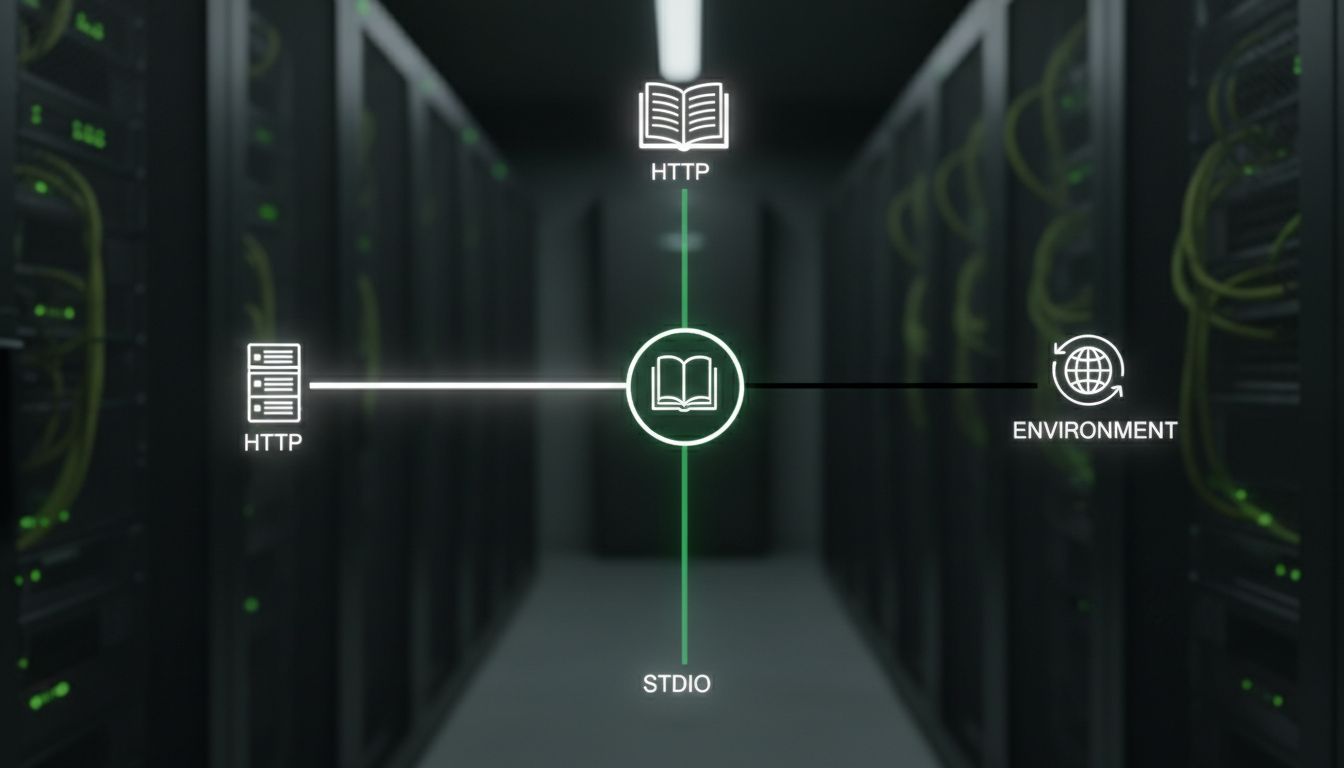
Securely linking MCP endpoints starts with separating the transport decision from the configuration and trust decision. Secure MCP endpoint connections use STDIO when an agent runner launches a local tool process, Streamable HTTP when a remote service must operate through standard HTTP infrastructure, and environment-based configuration to supply endpoint addresses and credentials without hard-coding them into agent code.
The difficult part is not opening a connection. It is ensuring that each agent can reach only the intended MCP server, that credentials are handled deliberately, and that operations teams can route and observe remote requests without coupling system behavior to a single process or connection. This guide explains how to select and implement the connection model for local development, production services, and multi-agent orchestration.
Direct answer: choose the right secure MCP endpoint connection
Use STDIO for a process-local MCP server that an agent runner starts and supervises. Use Streamable HTTP for remotely hosted MCP servers that need standard HTTP routing, observability, and scaling. Use environment variables to configure the selected connection,such as an approved endpoint URL, credential reference, or runtime mode,rather than treating environment configuration as a third MCP transport.
MCP now standardizes two official transports for most deployments: STDIO for local process-based connections and Streamable HTTP for remote connections. Custom transports remain possible when a specialized environment requires them. Official SDK documentation also lists SSE, but identifies it as legacy; the 2026-07-28 specification deprecates the legacy HTTP+SSE transport with a year-long transition period.
This distinction matters for security architecture. A local process and a remote HTTP service have different boundaries, failure modes, and operational controls. Environment variables can make either deployment portable, but they do not replace a transport protocol and do not themselves establish identity, authorization, or encryption.
STDIO:
a bidirectional, process-local connection with one-process-per-connection semantics.
Streamable HTTP:
a remote, request-response connection designed for HTTP infrastructure, with optional SSE-based server-to-client notifications.
Environment-based configuration:
a deployment mechanism for selecting endpoint URLs, credentials, policy modes, and non-secret identifiers at runtime.
Start with the trust boundary, not the SDK default
Before choosing a transport, identify where the MCP client runs, where the MCP server runs, and who is allowed to control each side. In an agent orchestration workspace, the client may be an agent runner that invokes a specialist tool server. The connection design should make that handoff explicit: which runner may use which server, under which identity, and with which tool permissions.
A useful design review begins with four questions:
Is the MCP server a child process on the same machine or a service reached over a network?
Can the agent runner be trusted to launch the executable or container image specified for the local server?
For a remote server, what gateway or network path receives the HTTP request before it reaches the application?
What configuration determines the endpoint, and who can change that configuration in each environment?
Keep transport and authorization as separate decisions
STDIO does not remove the need for authorization design; it changes the location of the control point. If the runner can start a local server process, process-launch permissions, executable provenance, working-directory controls, and the supplied environment become central. A local tool can still access sensitive systems if its process identity and configuration allow it.
For Streamable HTTP, network reachability alone should not be the authorization model. Treat the endpoint as a service boundary. Define how the calling runner proves its identity, how the server decides which tools or operations that caller may invoke, and how the gateway and service reject requests that do not meet policy.
Environment variables should be assessed as a configuration channel. They are useful for separating code from deployment-specific values, but a variable such as MCP_SERVER_URL only tells a client where to connect. A variable containing a credential or a pointer to one must be controlled by the runtime’s secret-management and deployment practices.
Use STDIO for tightly controlled local MCP tools
STDIO is the natural choice when a host application or agent runner launches the MCP server as a local process. The C# SDK transport comparison describes STDIO as bidirectional and process-local, and its one-process-per-connection semantics align well with local tools and agent runners. The TypeScript migration guidance similarly notes that serveStdio pins a server factory per STDIO connection.
That model has a practical advantage: the connection stays within the process-launch boundary instead of requiring a listening network endpoint. It is a strong fit for development tools, local automation, desktop-adjacent integrations, and isolated worker environments where the runner owns the server lifecycle.
Control what the agent runner is allowed to start
The security question for STDIO is not “which port is exposed?” It is “what exact program is this runner authorized to execute?” Keep the server command, arguments, and working directory under deployment control. Avoid allowing arbitrary agent-produced values to become executable paths or shell fragments.
Where a local MCP server needs configuration, pass only the values it needs. Prefer a narrowly scoped environment for the child process over inheriting a broad runtime environment by default. This reduces accidental coupling to unrelated credentials, feature flags, or operational settings present in the parent process.
Use an explicit allowlist of local MCP server commands or packaged server identities.
Keep command arguments structured rather than constructing a shell command from free-form input.
Assign the local process only the filesystem, service, and credential access required for its tools.
Record the server identity, version or build reference, and selected configuration in deployment records.
Make process exit, restart, and timeout behavior visible to the
orchestration layer
.
Understand the lifecycle trade-off
One process per connection makes ownership clear, but it also means lifecycle management belongs to the host. The agent runner must handle startup failures, server exits, cancellation, and cleanup. This is usually appropriate for a local capability, but it is not a substitute for a shared remote service when many independent clients need a common endpoint.
STDIO also creates a deliberate isolation choice. A separate process can limit direct in-process coupling, but the launched process still receives the privileges and configuration intentionally granted to it. Review that boundary as carefully as a remote service account.
Deploy Streamable HTTP for remote MCP services
Streamable HTTP is the modern, fully featured transport in the official SDK documentation. It uses request/response communication over HTTP POST and can support optional SSE-based server-to-client notifications. It is designed for HTTP infrastructure, making it the appropriate default when an MCP server is operated as a remote service behind gateways, proxies, and load balancers.
The 2026-07-28 MCP specification release candidate emphasizes a stateless protocol core so remote HTTP deployments are easier to scale behind ordinary load balancers and gateways. This direction is operationally important: the more routing and policy can be expressed through normal HTTP infrastructure, the less a platform needs transport-specific connection handling.
Take advantage of routing and observability ers
Streamable HTTP requests now require Mcp-Method and Mcp-Name ers. Infrastructure can use these ers to route requests, apply rate limits, and observe traffic without inspecting the request. For platform teams, that gives a gateway a clear, protocol-aware signal while retaining conventional HTTP request handling.
Use these ers as part of an explicit gateway policy. For example, the platform can route requests for approved MCP methods to the intended backend, attach request telemetry at the edge, and apply method-aware operational controls. The ers improve infrastructure visibility; they do not by themselves authorize a caller, so identity and server-side authorization remain required parts of the design.
Make stateless operation the default remote design
Official SDK documentation describes a stateless Streamable HTTP mode with no session tracking. This improves horizontal scaling and fits API-style deployments. The TypeScript migration guide also notes that serving the 2026-07-28 revision over HTTP requires explicit stateless configuration, reinforcing the direction of the newer specification line.
Design tool invocations so a server can evaluate each request from the request content, the authenticated caller context, and durable or explicitly supplied application state. Do not rely on a particular load balancer path returning a later call to the same in-memory server instance.
The protocol direction also removes protocol-level sessions and the Mcp-Session-Id er from Streamable HTTP. When work must continue across calls, use explicit server-minted handles instead of relying on transport session affinity. A handle should have a defined purpose, owner, lifetime, and validation behavior in the server’s application design.
Know when stateful HTTP is still a valid trade-off
Stateful Streamable HTTP remains documented in official SDK materials. In that mode, session IDs are tracked in memory, and horizontal deployments need session affinity. It can be useful when an existing server implementation genuinely depends on connection-associated state and the operating environment can support sticky routing.
However, stateful operation adds coupling between application state and the route taken through the infrastructure. It changes deployment planning, failure recovery, and scaling behavior. It also makes the connection path more significant to correctness, which is exactly what the newer stateless protocol direction seeks to reduce.
Choose a stateful mode only after documenting why explicit server-minted handles or durable application state are insufficient for the workload. Then make session affinity an intentional platform requirement rather than an accidental behavior of a particular proxy configuration.
Stateless HTTP is usually the better fit
when multiple replicas, ordinary load balancing, independent request handling, and API-style operations are priorities.
Stateful HTTP can fit
when a controlled deployment has a real requirement for in-memory, connection-associated state and can provide session affinity.
STDIO is usually clearer
when state belongs naturally to a process launched for one local runner connection.
Do not confuse old HTTP+SSE deployment patterns with Streamable HTTP’s optional notification capability. The legacy HTTP+SSE transport is deprecated in the 2026-07-28 specification, even though current SDK documentation still lists SSE as a legacy mechanism during the transition. New endpoint designs should plan around the current Streamable HTTP direction rather than expanding a legacy transport footprint.
Use environment-based MCP connections without turning configuration into a secret leak
Environment-based connections are best understood as a configuration discipline. The application reads values supplied by its deployment environment to select an MCP transport and endpoint. This lets the same agent integration point to a local STDIO tool in development and a remote Streamable HTTP service in a managed environment without embedding those environment-specific values in source code.
A practical configuration model separates ordinary connection metadata from sensitive material. Endpoint URLs, transport selection, expected server names, and non-secret deployment identifiers can be configured independently from credentials. A credential should be injected through the organization’s approved runtime mechanism or referenced from it, rather than copied into repository files, example configurations, or agent prompts.
Use a small, explicit configuration contract
Define the variables and settings a connector is allowed to read. For example, a deployment may provide a transport selector, a remote endpoint value for HTTP mode, and a local command reference for STDIO mode. The connector should reject incomplete or contradictory settings instead of silently falling back to an unintended endpoint.
MCP_TRANSPORT=streamable-httpMCP_ENDPOINT=https://approved-mcp-service.exampleMCP_SERVER_NAME=approved-tool-service
The example shows configuration shape, not a complete security implementation. In a real deployment, validate that the selected transport is expected for the environment and that the endpoint matches the deployment’s approved service boundary. Do not make configuration so flexible that an unreviewed variable can redirect a privileged agent to an arbitrary tool server.
Keep secrets distinct from endpoint selection
Environment variables are commonly convenient at process startup, but convenience is not a reason to expose a credential broadly. Limit which workloads receive sensitive values, avoid logging the process environment, and avoid placing secrets in diagnostic messages, serialized workflow state, or tool inputs. When an MCP server needs downstream access, give it its own deliberately scoped identity instead of assuming the client’s environment should be forwarded.
For local STDIO servers, this rule is especially important because child processes may inherit the parent environment. For remote Streamable HTTP, it means the client should obtain and present only the credentials required for the remote endpoint rather than sending unrelated runtime configuration across the network.
Make discovery, caching, and tracing part of endpoint design
Secure operations also require understandable operations. MCP’s newer HTTP direction combines routing ers with deterministic list behavior and standardized trace-context propagation, giving platform teams useful foundations for observing distributed agent workflows.
The changelog states that list endpoints such as tools/list, resources/list, and prompts/list no longer vary per connection. Servers should return tools/list in deterministic order to improve client-side caching and prompt-cache hit rates. This reduces unnecessary dependence on a particular transport connection and helps clients treat discovery as stable server behavior.
Design discovery as server-level behavior
Do not make tool availability depend implicitly on which socket, process, or HTTP session happened to handle a request. Publish a stable, deterministic tool list for the server behavior being deployed. When access needs differ by caller, make authorization decisions explicit rather than relying on connection-specific discovery results that are hard to cache and reason about.
That approach also improves change management. When a platform adds, removes, or changes a tool, it can evaluate the effect as a server-level release and coordinate client cache behavior, agent policy updates, and observability rules around that release.
Propagate traces across the agent-to-tool path
MCP now documents trace context propagation in _meta keys using traceparent, tracestate, and baggage. Use this context to connect an agent’s tool request to the MCP server’s work and to downstream systems involved in fulfilling that request.
Tracing does not replace access controls, but it supports incident response and operational debugging. Preserve the relevant context through the orchestration handoff, record the selected MCP server and transport in application telemetry where appropriate, and ensure sensitive request content is handled according to the organization’s logging policy. The aim is to answer which workflow invoked which tool service and where the request spent time, without treating raw logs as a place for credentials.
Build a connection policy for multi-agent orchestration
In a multi-agent workspace, endpoint configuration should not be an ungoverned property of each prompt or workflow step. Treat MCP connectivity as part of the control plane. A specialist agent should receive a defined set of MCP capabilities, and handoffs should preserve the context needed to continue work without granting every downstream agent every tool connection.
A connection policy can be simple, but it should be explicit. Associate an approved server identity with the agent role, the transport allowed in each environment, the configuration source, and the operational owner. This makes it easier to review a new integration before it becomes an available capability in a production workflow.
Register the endpoint purpose.
Describe the server’s tools, owning team, and the workflows that need it.
Select the transport.
Use STDIO for controlled local execution or Streamable HTTP for a remote service; document any custom transport separately.
Define configuration inputs.
Specify which environment values select the connection and which approved mechanism supplies credentials.
Set agent access boundaries.
Map the endpoint to only the specialist agents and workflow stages that need it.
Operate it through standard signals.
Use HTTP routing ers for remote traffic, deterministic discovery behavior, and trace context for end-to-end visibility.
Review lifecycle behavior.
For STDIO, review process launch and shutdown; for HTTP, review stateless behavior, load balancing, and any explicit state handles.
This policy is also where exceptions belong. If a legacy SSE connection remains during the transition period, record why it exists, who owns its migration, and how it is isolated from new endpoint standards. If stateful HTTP is required, record the session-affinity dependency and the planned path for managing state safely.
Common design mistakes when linking MCP endpoints
Several errors come from collapsing separate concerns into one setting or one implementation shortcut. Avoiding them makes connection behavior more predictable for both engineers and operations teams.
Calling environment variables a transport:
environment values configure a connection; they do not provide the STDIO or HTTP protocol behavior.
Using STDIO as an excuse to skip privilege design:
local process launch is a security boundary that requires command, environment, and identity controls.
Deploying remote HTTP with hidden in-memory connection state:
this conflicts with the benefits of stateless scaling unless stateful behavior and affinity are intentional.
Relying on legacy HTTP+SSE for new work:
SSE is described as legacy, and the 2026-07-28 specification deprecates the legacy HTTP+SSE transport.
Ignoring required HTTP routing ers:
Mcp-Method
and
Mcp-Name
enable routing, rate limiting, and observation without inspection.
Letting tool discovery vary accidentally by connection:
newer MCP behavior supports connection-independent list endpoints and deterministic
tools/list
ordering.
Logging configuration indiscriminately:
endpoint diagnostics should support troubleshooting without exposing credentials or inherited process environment.
These are not merely implementation details. They determine whether an MCP integration remains manageable when agent count, tool count, and deployment environments increase. A connection that is easy to test locally but has ambiguous ownership, hidden state, or unbounded configuration flexibility becomes difficult to operate as a shared platform capability.
Secure MCP endpoint connections are therefore a combination of clear transport selection, constrained runtime configuration, and observable operations. Use STDIO for supervised process-local tools, adopt stateless Streamable HTTP for remotely operated services whenever the workload allows it, and use environment-based settings to make approved connections portable rather than arbitrary.
For an agent orchestration platform, make those choices visible in the control plane: register endpoint ownership, restrict which specialists can use each connection, propagate trace context across handoffs, and plan migrations away from legacy SSE. That creates a practical foundation for tool-backed workflows that can be routed, scaled, and reviewed with the same discipline as the rest of the application platform.