
Home/Blog/Securely link remote model endpoints with streamable HTTP and tunneled transports
Securely link remote model endpoints with streamable HTTP and tunneled transports
November 19, 2026
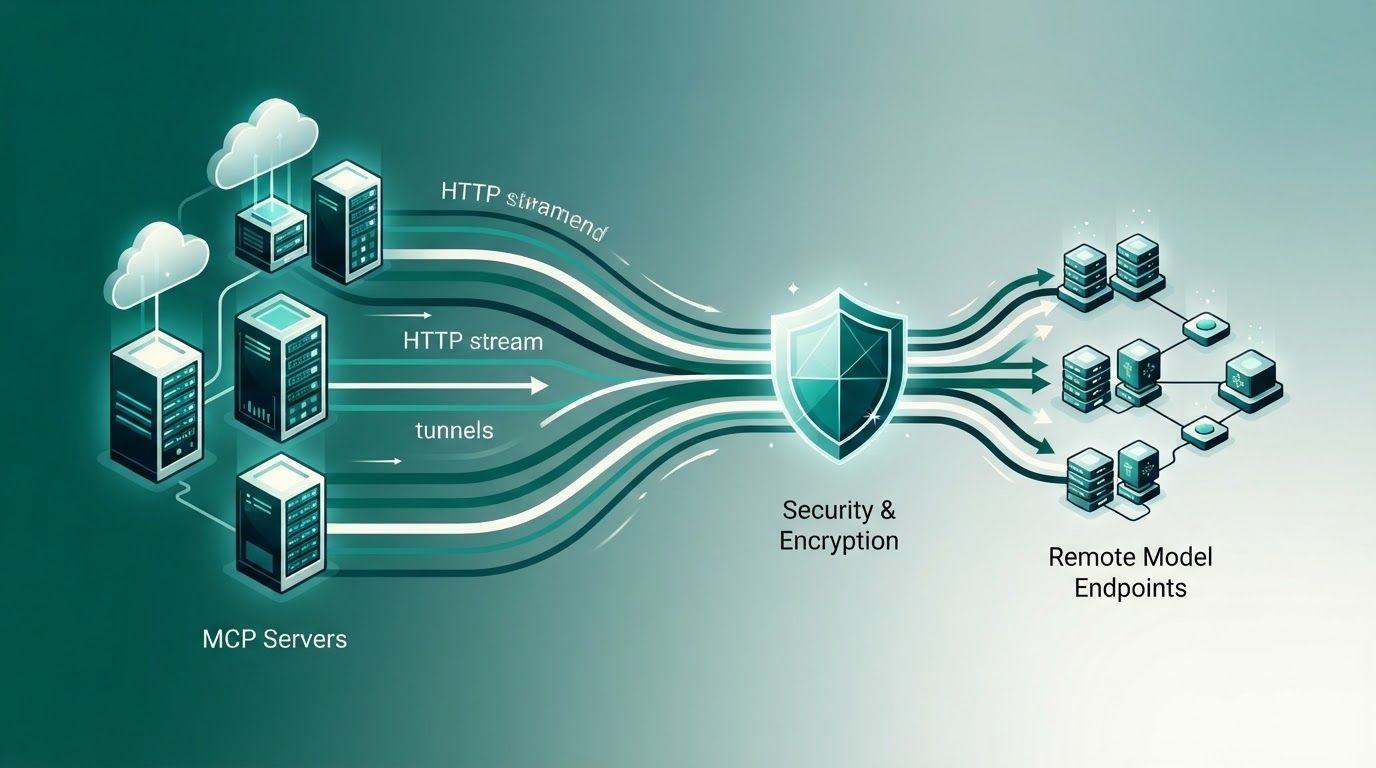
Remote agent workflows become fragile when a model endpoint is exposed as an ad hoc webhook, a long-lived event stream, or an unauthenticated tunnel. Streamable HTTP for MCP provides a more disciplined way to link remote model-facing tools and services: one HTTP endpoint, POST-based JSON-RPC messages, standard HTTP controls, and responses that can be plain JSON or an SSE stream when needed.
For platform teams, the important design decision is not simply how to make an endpoint reachable from outside a network. It is how to make that reachability secure, routable, observable, and maintainable as agents, tools, gateways, and environments multiply. Streamable HTTP is now the recommended remote transport for MCP, while a tunnel should be treated as a controlled network access layer,not as a substitute for authentication, origin validation, or policy enforcement.
What Streamable HTTP for MCP changes for remote endpoints
Streamable HTTP was introduced in MCP protocol version 2025-03-26 as a replacement for the legacy HTTP+SSE transport. The 2026-07-28 revision simplified the remote transport further: an MCP server exposes a single HTTP endpoint that supports POST, and each JSON-RPC request or notification is delivered in its own HTTP POST.
A response to that POST can be returned as ordinary JSON or as an SSE stream associated with the request. This preserves support for streamed output without requiring a separate, permanent event-stream connection. In practical terms, remote MCP traffic can fit the operational model teams already use for API workloads.
Direct answer: Securely link a remote MCP endpoint by exposing one HTTPS Streamable HTTP endpoint, authenticating every request, validating the Origin er, placing the endpoint behind your normal gateway controls, and using a tunnel only to create a narrowly scoped network path. Do not treat a public tunnel URL or a legacy HTTP+SSE stream as the security boundary.
The distinction matters because an MCP connection across HTTP does not inherit the trusted local process boundary associated with stdio. A local stdio server is launched and connected as a local process. A remote HTTP server is reachable over a network path and therefore needs explicit protections for identity, request origin, access policy, and exposure.
One endpoint does not mean one simplistic workflow
A single POST endpoint can still support varied agent activity. A client can send an individual request, a notification, or another JSON-RPC message to the same endpoint. The server can complete quickly with JSON when the result is ready, or use an SSE response stream tied to that particular request when incremental output is appropriate.
This design reduces transport-specific branching in the client and server. It also makes it easier for a control plane to apply the same operational conventions to specialist agents, internal tools, model gateways, and externally hosted MCP services.
Request delivery:
every JSON-RPC request or notification is its own HTTP POST.
Response delivery:
the server may return JSON or an SSE stream for that request.
Infrastructure fit:
the endpoint can be handled as an ordinary HTTP workload by gateways and load balancers.
Security model:
authentication and network protections are explicit responsibilities for remote deployments.
Separate the MCP transport from the tunnel that exposes it
“Tunneled transport” can blur two different layers. Streamable HTTP is the MCP transport: it defines how client and server exchange MCP messages. A tunnel is an access mechanism that forwards traffic from a public or external address to a service that may otherwise be private, local, or inaccessible from the calling environment.
That separation is essential to sound architecture. A tunnel can solve temporary reachability during development, enable a controlled connection from one network zone to another, or bridge a private service while network routing is being established. It does not by itself determine whether the caller is allowed to invoke a tool, whether the request came from an expected browser origin, or whether the endpoint should be publicly discoverable.
Use a tunnel as a constrained ingress path
When a remote model endpoint must be reached through a tunnel, define the tunnel’s purpose before connecting an MCP client. Is it for local development? A short-lived integration test? A private environment that lacks direct ingress? A production path between managed infrastructure domains? Each answer changes the controls that should surround it.
The most useful mental model is that the tunnel terminates or forwards network traffic, while the MCP application still verifies and authorizes the request. An agent orchestration platform should keep its own record of which endpoint is being called, what identity is used, which tools are available, and which workflow is permitted to invoke them.
Identify the service boundary.
Decide whether the MCP server is a developer-local process, a private service, or an internet-facing workload. Avoid treating these environments as equivalent.
Publish one HTTPS-facing path.
Point the tunnel or ingress layer at the server’s single Streamable HTTP endpoint rather than creating separate request and event-stream paths.
Keep endpoint ownership explicit.
Record the canonical external URL, environment, responsible team, and expected client identities in the service configuration.
Apply authentication at the application or gateway boundary.
A reachable URL should not be interpreted as an authorized client relationship.
Restrict the tunnel’s scope.
Limit it to the service, environment, and access path actually needed. Remove it when direct private routing or standard production ingress is available.
This approach also prevents a common operational mistake: embedding a temporary tunnel address directly into a production agent configuration. Endpoint discovery, credential delivery, and lifecycle management should be deliberate control-plane functions, not artifacts of an individual developer session.
Build authentication and origin validation into every remote request
The MCP transport specification requires servers to validate the Origin er to prevent DNS rebinding. It also says servers should implement proper authentication for all connections. These are separate checks that address different risks, and neither should be omitted because a service sits behind a tunnel, reverse proxy, or load balancer.
Origin validation evaluates whether a browser-originated request is coming from an allowed origin and is specifically important for defending against DNS rebinding scenarios. Authentication establishes who or what is making the call. Authorization then determines what that authenticated identity can do: which MCP server it may reach, which tools it may invoke, and which resources it can affect.
Why bearer authentication fits the HTTP-native design
OWASP’s MCP security research notes that Streamable HTTP permits an Authorization: Bearer er on every message envelope. That is a useful property for remote deployments because security systems can examine and enforce credentials on individual HTTP requests instead of inferring identity from a long-lived event-stream arrangement.
Standard HTTP ers also work naturally with established reverse-proxy and gateway patterns. CORS policies can be applied using normal HTTP mechanisms, and authentication middleware can run before the MCP request reaches tool dispatch logic. The transport itself does not select an organization’s identity provider or authorization model, but it gives those systems a conventional request boundary on which to operate.
Require authentication for every remote connection path, including paths reached through a tunnel.
Validate
Origin
according to the server’s expected client origins rather than accepting arbitrary values.
Terminate and inspect traffic at an HTTPS-capable edge appropriate to the deployment.
Apply authorization after authentication, using policies appropriate to the tools and data exposed by the server.
Keep credentials out of endpoint URLs and avoid relying on URL obscurity as an access control.
For a multi-agent environment, this often means distinguishing several identities rather than collapsing them into one credential: the human or service initiating a workflow, the orchestration layer routing the task, and the remote MCP endpoint performing the work. The transport’s request-level model makes it practical to carry and evaluate identity at the point where the action is requested, while the surrounding platform can maintain workflow context and policy.
Put remote MCP servers behind ordinary HTTP controls
The MCP blog describes the 2026-07-28 release as a major transport-security update that lets remote servers behave like ordinary HTTP workloads while preserving security controls. This is more than a convenience for deployment teams. It is an architectural opportunity to stop creating one-off network handling for agent tools and instead use the same disciplined ingress patterns applied to other sensitive internal services.
“A remote MCP server is now no different from any other HTTP workload,” and “Unifying on one transport lets us simplify MCP server and client development even further.”
In practice, the HTTP edge is the place to centralize concerns that should not be scattered through every agent implementation. A gateway or equivalent control point can handle TLS termination, authentication integration, rate-related controls, request logging, routing, and environment-specific policy. The MCP server can then focus on protocol correctness and safe tool execution.
Use protocol-aware ers without inspection
The 2026-07-28 release adds the Mcp-Method and Mcp-Name ers. These allow gateways, rate limiters, and load balancers to route requests without inspecting the JSON. That makes policy application more reliable in infrastructure layers that are designed to work from HTTP metadata rather than application payload parsing.
For example, a platform team can use the ers to separate traffic ed to different MCP capabilities, apply service-specific routing, or make request-handling decisions before forwarding the to a backend. The exact policy depends on the environment, but the key benefit is consistency: the routing layer has protocol-relevant information available in a standard er-based form.
Be careful not to confuse er-based routing with authorization. A er can help identify the intended MCP method or target name for operational policy, but authorization still needs to rely on authenticated identity and server-side permission checks. Routing says where a request goes; authorization says whether it should be allowed to proceed.
Prefer explicit observability over opaque tunnel troubleshooting
Tunneled endpoints are particularly difficult to operate when the only signal is that “the client cannot connect.” Instrument the HTTP boundary so operators can tell whether the failure happened before the tunnel, at the gateway, during authentication, during origin validation, while routing, or within MCP tool execution.
Useful operational records include the endpoint name, environment, request outcome, authenticated principal, routing decision, and correlation identifier. Take care to avoid recording credentials or sensitive tool arguments indiscriminately. The objective is to create enough evidence to debug delivery and policy decisions without turning logs into an uncontrolled copy of agent context.
Design for stateless scaling instead of sticky remote sessions
Stateless remote deployment is a central goal of the evolving MCP transport model. The release candidate and roadmap describe eliminating sticky sessions and relying on explicit state handles instead of protocol-level sessions. This makes remote MCP servers easier to scale and position behind standard infrastructure.
For an agent orchestration workspace, this is especially relevant. A workflow may hand context from one specialist agent to another, retry a request, route activity across environments, or use multiple service instances. If correctness depends on one client always returning to one backend process, ordinary load balancing becomes much harder and recovery paths become fragile.
Move durable workflow context above the transport
Do not use an HTTP connection as the system of record for workflow state. Store durable workflow state in the orchestration layer or in a service designed for that purpose, then use explicit references or state handles where the protocol and application design require them. This gives teams a clearer boundary between transport delivery and business or agent state.
That boundary also supports safer handoffs. The orchestration layer can decide what context a downstream specialist receives, rather than assuming an old connection implicitly carries the full history. In sensitive workflows, this reduces accidental context leakage and makes the flow of data easier to reason about.
Scale-out:
requests can be routed through standard load-balancing infrastructure without a transport-level affinity requirement.
Recovery:
a failed instance does not need to retain an opaque connection-specific session for the system to continue.
Handoffs:
agent context can be passed deliberately through explicit orchestration mechanisms.
Deployment:
services are easier to move between private networks, gateways, and managed environments.
Statelessness does not mean an application has no state. Model runs, tool jobs, approvals, and user interactions may all be stateful. It means that the remote transport should not force infrastructure to preserve affinity merely to maintain the protocol relationship. Make state explicit, secure it according to its sensitivity, and let the HTTP layer deliver independently routable requests.
Migrate from legacy HTTP+SSE without carrying forward its assumptions
Legacy HTTP+SSE is deprecated. New implementations should not adopt it for remote MCP servers, and existing implementations are expected to migrate to Streamable HTTP, although compatibility guidance remains for older clients and servers. The migration is a chance to reduce complexity rather than simply recreate old endpoints under a new name.
The key change in the 2026-07-28 revision is that the current model uses a single POST endpoint and does not require a separate GET stream. Each request is posted to that endpoint, and the response can be JSON or an SSE stream attached to the request. Teams that previously designed separate request and response-stream infrastructure should revisit the assumptions embedded in their clients, proxies, monitoring, and authentication rules.
A practical migration sequence
Inventory remote MCP integrations.
Identify legacy HTTP+SSE servers, clients, URLs, proxy rules, and documentation that assume separate request and event-stream endpoints.
Implement the Streamable HTTP endpoint.
Expose one HTTPS endpoint that accepts POST-based JSON-RPC requests and returns JSON or request-tied SSE as applicable.
Test the security boundary.
Confirm authentication behavior, Origin validation, CORS behavior where relevant, and gateway forwarding before moving production agent workflows.
Update routing and observability.
Configure the infrastructure layer for the new endpoint model and use available MCP ers where they support routing or request policy.
Move clients deliberately.
Use compatibility guidance for older implementations where necessary, but set a planned path to the current transport instead of indefinitely operating both patterns.
Retire obsolete exposure paths.
Remove unnecessary legacy URLs, tunnel mappings, and event-stream-specific rules once consumers have migrated.
A migration should include negative testing, not only successful calls. Verify that missing or invalid credentials fail, disallowed origins are rejected, unintended hosts cannot reach the service, and requests do not bypass the expected gateway controls. A remote endpoint that works only in the happy path is not ready for an enterprise agent workflow.
Choose the right deployment pattern for local, private, and public access
The right way to link an endpoint depends on where it runs and who needs to call it. The MCP security model explicitly distinguishes local stdio from HTTP-based transports: stdio relies on a local process boundary, whereas HTTP requires its own authentication and network protections. Do not expose a local service remotely merely because a remote client would be convenient.
Local development endpoints
For local services, bind local servers to 127.0.0.1 rather than 0.0.0.0, as the specification recommends. If a tunnel is needed for a temporary integration, ensure it forwards only the intended local listener and preserve the same authentication and Origin-validation expectations that will apply in a remote environment.
A tunnel can be useful here, but it creates an externally reachable path where none existed before. Treat that as a change in threat model. Keep the scope narrow, avoid using production credentials by default, and remove the mapping when the integration test is complete.
Private remote services
For a service running in a private environment, Streamable HTTP works well behind normal internal ingress, gateways, and load balancers. This is often the cleanest pattern for an enterprise orchestration system: the remote server has a stable HTTPS endpoint, clients authenticate through the organization’s chosen mechanisms, and network reachability is controlled by the surrounding platform.
If a tunnel bridges private environments, model it as one leg of the connectivity architecture. Document what it connects, who administers it, what endpoint it exposes, and what happens when it is unavailable. The MCP server should remain independently secure even if that network component is misconfigured.
Internet-facing remote services
Internet-facing MCP endpoints deserve the strongest operational discipline because discoverability and unsolicited traffic become realistic concerns. Research published in 2026 reported that Censys telemetry found more than 21,000 publicly accessible MCP endpoints by May 2026. That measurement does not determine whether any individual endpoint is secure, but it underscores that remote MCP exposure is not merely a theoretical deployment scenario.
Use HTTPS, request authentication, Origin validation, gateway policy, and carefully designed authorization when publishing a remote service. Make public reachability a deliberate product or platform decision. A service intended only for internal agent workflows should not become internet-facing simply because a temporary tunnel or broad listener made it easy to connect.
Operationalize secure linking in an agent control plane
A secure remote endpoint is more useful when it can be managed consistently across many agents and workflows. An agent control plane should treat MCP connection settings as governed configuration: endpoint address, transport selection, allowed identities, environment, health expectations, ownership, and policies for which agents can call which tools.
This is where transport simplification creates compounding value. Because Streamable HTTP uses a familiar single-endpoint HTTP model, platform teams can standardize connection onboarding, testing, logging, routing, and decommissioning rather than building a distinct operational playbook for every specialist agent.
Connection review checklist
Is the server using the current single-endpoint, POST-based Streamable HTTP model for remote MCP?
Is the external URL HTTPS and owned by the expected environment and team?
Does every connection require proper authentication?
Does the server validate the
Origin
er?
Is the endpoint behind the expected gateway, proxy, or ingress controls?
Are
Mcp-Method
and
Mcp-Name
available to infrastructure that needs er-based routing or policy?
Is workflow state held explicitly rather than depending on sticky protocol sessions?
If a tunnel is involved, is its scope documented, constrained, monitored, and temporary where possible?
Have legacy HTTP+SSE paths and broad local bindings been removed or scheduled for retirement?
MCP’s 2026 roadmap continues to emphasize HTTP-native transport unification and hardening, enterprise-ready security, and agent identity work. Teams should therefore avoid designs that depend on transport quirks or undocumented tunnel behavior. Build around the stable principle: remote agent services need clear identity, conventional HTTP controls, explicit state, and intentionally managed exposure.
Streamable HTTP gives remote MCP connectivity a practical operating model: one POST endpoint, standard HTTP integration points, optional request-tied streaming, and better compatibility with gateways and load balancers. Use it to simplify the transport layer, but keep security decisions explicit at every layer around it.
When a tunnel is necessary, make it a narrow and observable route to a properly hardened endpoint,not the reason the endpoint is considered secure. That approach lets platform, product, and operations teams connect specialist agents confidently while retaining control over routing, authorization, state, and lifecycle.