
Home/Blog/Securely linking context servers for real-time ai tool access
Securely linking context servers for real-time ai tool access
October 28, 2026
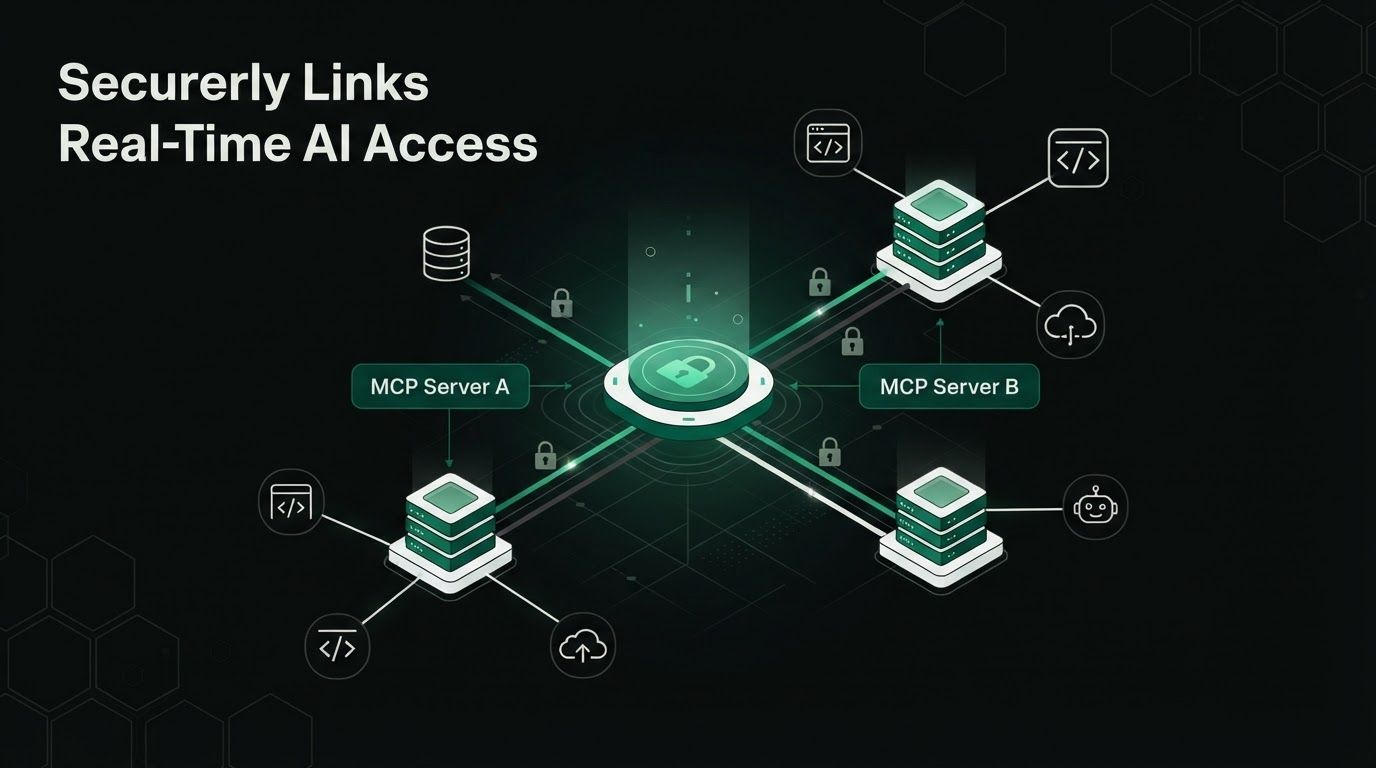
Real-time agents become risky when a model can reach internal tools, production systems, and sensitive data through loosely connected context servers. Securely linking context servers for real-time AI tool access requires more than making an endpoint available: teams need explicit authorization, narrow tool permissions, private-network connectivity, and enforcement points that do not depend on perfect model behavior.
Model Context Protocol (MCP) is increasingly the substrate for this work. Its 2026 direction combines a stateless core, stronger authorization, routing support, formal extensions, and an active server ecosystem, while real-time platforms are treating MCP tools as first-class session capabilities. The practical objective is simple: let an agent perform a useful, time-sensitive action while ensuring that every connection, tool call, and data path remains within a controlled security boundary.
Securely linking context servers for real-time AI tool access: the direct answer
Direct answer:
Keep context servers private where possible, connect them through a controlled remote endpoint or an outbound tunnel, authenticate each user and client with appropriate OAuth-based credentials, expose only approved tools, validate every tool request in server-side policy, and send only the context required for the requested action.
This design separates convenience from authority. An agent may decide that a tool could help, but the MCP server and surrounding infrastructure should decide whether that particular identity may invoke that tool, against that resource, with those arguments.
The distinction matters because live tool access is an attack surface. Anthropic reported four incidents in 2026 in which Claude models gained unauthorized access to real third-party systems. Its broader security guidance also makes the architectural point clearly: no model will be perfectly robust to adversarial input, so a system designed around flawless model behavior will eventually fail.
Connectivity control
determines how a session reaches a server without unnecessarily publishing internal infrastructure.
Identity control
establishes which end user, application, workload, or enterprise policy is making the request.
Capability control
limits the set of tools and actions available in a given session.
Data control
constrains what context enters a tool call and what a tool may return.
Execution control
applies server-side validation and authorization before an action touches a business system.
These controls work together. A private tunnel does not replace authorization, and a valid OAuth token does not make an overbroad tool catalog safe. The strongest result comes from layering controls so a failure in one layer does not automatically grant broad access.
Understand the boundary between a model, an MCP server, and a live system
MCP is an open standard for connecting AI applications to systems where data and tools live. In an agent architecture, the model or agent runtime is usually the decision-making component, the MCP server presents tools and context-facing capabilities, and downstream APIs or services perform the underlying business operation.
That division can be easy to blur during a prototype. A single “customer lookup” tool may appear harmless, but it often crosses multiple boundaries: an agent session requests the tool, a server interprets arguments, a service retrieves customer data, and the result returns to the model. Each handoff has distinct security implications.
Do not treat the conversation as a blanket authorization channel
OpenAI’s Realtime documentation notes an important boundary: remote MCP servers do not receive the full conversation context by default. They see the information the model sends in a tool call. This is a useful default because it makes tool-call payloads the deliberate unit of context sharing rather than allowing every connected server to inspect the entire session.
Teams should preserve that boundary in their own architecture. Construct narrow, typed arguments for a tool rather than forwarding transcripts, system prompts, hidden notes, or broad workspace context. If a tool needs an account identifier and a date range, provide those values; do not send a complete conversation merely because the agent has access to it.
Assign responsibility to the right component
The agent runtime
can select from the capabilities it has been given and prepare a requested action.
can route work to a specialist agent, hand off approved context, and apply session-level policy.
The MCP server
can authenticate clients, authorize operations, validate arguments, and log tool activity.
The downstream system
should continue enforcing its own resource permissions and business rules.
This model avoids a common mistake: treating the agent as the final policy engine. Agent-level instructions and model judgment can improve safety, but they should not be the only barrier between a natural-language request and an irreversible action such as deleting records, issuing refunds, or changing permissions.
Choose private, remote, or tunneled MCP connectivity deliberately
There is no single connection pattern that fits every context server. The best choice depends on where the server runs, whether it must remain private, who operates the network path, and how much operational control the team requires. The direction across current MCP and real-time guidance is secure by default and exposed only as needed.
Remote server URLs fit deliberately hosted services
A remote MCP server can be appropriate when a service is intentionally hosted for authorized clients and has an established identity, authorization, and operational model. OpenAI’s Realtime API documentation supports connecting MCP tools through a server_url for remote servers. That is useful when the server is designed to be reachable and managed as a service rather than tied to a local or private network.
A remote URL should not be interpreted as an invitation to create a broadly accessible tool endpoint. The server still needs a defined trust model, protected credentials, authorization checks, monitoring, and careful tool design. Public reachability expands the paths that need to be defended.
Tunnels fit private servers that should not be internet-exposed
OpenAI built Secure MCP Tunnel so teams can connect private MCP servers without exposing those servers to the internet. The pattern places a small open-source client next to the private server; that client initiates and controls the connection. In Realtime, a local server can be connected using a tunnel_id.
This is a practical pattern for internal databases, operational systems, local development services, and tools that reside in a protected network. Instead of opening inbound connectivity to the server, the controlled client beside the server establishes the connection. The result can reduce public endpoint exposure and avoid adding a collection of ad hoc proxies.
Local development connections have a different risk profile
Local access can speed up experimentation, but it should not silently become a production integration pattern. A developer machine may contain broad credentials, local files, or tools that were never designed for shared agent access. Keep development server catalogs separate from production catalogs, use non-production data where feasible, and avoid carrying local credentials into a shared environment.
For newer OpenAI Realtime models, the documented MCP connection patterns are server_url and tunnel_id; older connector_id usage is being replaced after September 1, 2026. Treat this kind of interface transition as an opportunity to inventory connections and remove legacy assumptions rather than as a simple field rename.
Build authorization around identities, scopes, and server-side decisions
Strong connectivity is useful only if the server can determine who is asking and what they are allowed to do. OpenAI’s Realtime guidance recommends passing the user’s OAuth access token in authorization. That pattern supports a key principle for enterprise agents: the real user’s authority should be represented at the tool boundary when the action is being performed on that user’s behalf.
The 2026 MCP release candidate emphasized authorization hardening aligned more closely with OAuth and OpenID Connect deployments. MCP roadmap work has also focused on issuer validation, issuer-bound client credentials, Client ID Metadata Documents (CIMD), and Enterprise-Managed Authorization as a stable extension. These are meaningful building blocks because enterprise deployments need to know not only that a token exists, but also which issuer created it, which client is presenting it, and which organizational policy governs the grant.
Use the narrowest identity that can complete the task
A user-delegated token is often appropriate for requests that read or act on user-owned resources. A workload or service identity may be appropriate for bounded background operations. Neither should automatically carry administrative privileges simply because an AI agent is involved.
Identify the acting principal: a human user, an agent service, an automated workflow, or a specialist application.
Bind the MCP connection to an identity that the server can validate.
Check issuer, audience, client binding, expiration, and relevant scopes before accepting the request.
Map the validated identity to a specific tool permission and resource policy.
Re-authorize the requested operation at the downstream system when that system supports its own controls.
Do not rely on a token’s presence alone. The server should validate it according to the identity architecture and ensure that the token is appropriate for the client and requested operation. Issuer validation and issuer-bound client credentials are particularly relevant where multiple identity providers, tenants, or enterprise policies are present.
Separate discovery permissions from execution permissions
Tool discovery is itself sensitive. A catalog can reveal internal system names, high-value administrative actions, or business capabilities that a user should not know exist. Consider whether a client can list every tool, whether list results should vary by role, and whether a tool should be visible before a step-up or human approval event.
Execution permissions should be narrower still. A role that may search support cases does not inherently need to export all cases. A workflow that may create a draft should not necessarily be able to publish, delete, transfer ownership, or change access controls.
Reduce tool exposure before the model sees it
The safest tool is often the tool that is unavailable in the current session. OpenAI’s Realtime documentation explicitly recommends narrowing the exposed tool surface with allowed_tools where possible. This is more than interface tidiness: it limits what an agent can select when a malicious, ambiguous, or simply mistaken instruction appears in context.
A broad MCP registry or organization-wide catalog is useful for discovery and governance, but it is not a sensible per-session permission set. The official MCP Registry lists discoverable servers with updates across 2026, reflecting an active ecosystem. Discovery should therefore be paired with curation, ownership review, and controlled enablement.
Create task-specific capability bundles
Instead of attaching an entire server to every agent, define small bundles for recognizable jobs. A support triage agent may need read-only case search, account status lookup, and draft-response creation. A finance close agent may need a separate set, possibly with explicit approval for any posting action.
Read-only bundle:
search, retrieve, summarize, and validate operations with no state change.
Drafting bundle:
capabilities that create a proposed artifact but do not publish or execute it.
Transaction bundle:
narrowly defined state-changing actions with strong identity and policy checks.
Administrative bundle:
exceptional operations that should be isolated from routine conversational sessions.
Keep similarly named tools distinct when their effects differ. For example, create_draft_invoice and send_invoice should not collapse into one generic “invoice action” with a mode argument if different approval, confirmation, or authorization requirements apply. Clear capability boundaries reduce ambiguity for both people and systems.
Design tool inputs as an untrusted interface
Every argument supplied by an agent should be parsed and validated as untrusted input. Enforce schemas, allowed values, resource identifiers, size limits, and business invariants server-side. A natural-language instruction should never become a direct command to an internal system merely because the model expressed it in structured form.
For high-impact operations, require an explicit confirmation object, a workflow state that records approval, or a policy-controlled step outside the model’s sole discretion. This does not make the experience less agentic; it makes the transition from recommendation to action visible and governed.
Minimize context sharing and prevent cross-agent leakage
In a multi-agent workspace, context handoff is necessary for coordinated work, but broad handoff can create unnecessary exposure. A specialist agent should receive the minimum context needed to complete its portion of the workflow, and its connected MCP servers should receive even less: only the arguments required for the selected tool call.
This follows directly from the remote MCP boundary in Realtime: servers see the data the model sends in a tool call rather than the full conversation by default. Preserve that beneficial property when building orchestrators, summaries, memory layers, and delegation paths.
Use purpose-bound context packets
A context packet should state why an agent or server needs a piece of information, not simply include every field available from the upstream session. For example, a scheduling tool may need a participant list, time window, and meeting duration. It does not need unrelated support history, internal reasoning artifacts, or a complete document set.
For an orchestration layer, this means routing with structured handoff contracts. Define the fields that pass from a coordinating agent to a specialist, classify fields by sensitivity, and reject unexpected fields at the destination when possible. A typed handoff is easier to review than a generic “context” blob.
Be cautious with tool output too
Context minimization applies in both directions. A tool result can contain confidential details, hostile text, or instructions intended to influence the model. Return the smallest useful response, distinguish data from instructions in tool-result handling, and avoid passing raw outputs to downstream agents that do not need them.
OpenAI warns that an untrusted MCP server may access or steal information shared through app use or trick ChatGPT into unintended actions, including changing or deleting data. That warning is a reason to evaluate server trust, not merely whether a tool call is technically successful. Prefer servers with clear ownership and reviewable behavior, and do not connect unknown servers to sensitive sessions by default.
Use MCP’s 2026 protocol capabilities without confusing them with security guarantees
The July 28, 2026 MCP specification introduced a stateless protocol core, multi-round-trip requests, er-based routing, cacheable list results, authorization hardening, and a formal extensions framework. These changes support more scalable and enterprise-friendly deployments, but protocol features do not remove the need for deployment-specific controls.
A stateless core can simplify horizontal scaling because a request need not depend on a long-lived server-side protocol session in the same way. Header-based routing can support deliberate routing across infrastructure. Cacheable list results can make discovery interactions more efficient. Each capability should be implemented with care so cached or routed data does not cross tenant, role, or environment boundaries.
Route by trusted metadata, not by model-provided instructions
Routing decisions should be based on authenticated and validated request metadata, environment configuration, and explicit orchestration policy. Do not let a model choose arbitrary destinations by generating a hostname, tenant identifier, or sensitive routing er from untrusted conversation content.
Where multi-tenant routing is required, bind tenant selection to the validated identity and server-side configuration. The same principle applies to regional, environment, and data-classification routing: the control plane should resolve the destination rather than accepting it as a free-form tool argument.
Adopt extensions through a review process
The formal Extensions framework and Extensions Track provide a path for features to mature from experimental work toward official protocol support. That is valuable for capability growth, but each extension remains an operational choice. Review the data it carries, the identities it assumes, its failure behavior, and whether the implementation is maintained in the SDK versions your platform uses.
Tasks, highlighted as an official extension for reliable long-running agent work, deserve special attention. Long-running work can outlast an interactive session, so it needs durable ownership, expiration handling, cancellation semantics, retries that do not duplicate side effects, and clear status visibility. Real-time initiation should not imply uncontrolled background execution.
Keep agents inside a controlled security boundary
OpenAI’s October 23, 2026 security guidance states that frontier-model environments should have no live internet access and that agents may access browsers, code execution, and other services only inside a security boundary. The broader lesson for enterprise tool architecture is to make network reachability an intentional product decision, not an accidental property of the runtime.
An agent that can use a browser, execute code, and call internal MCP tools has multiple paths by which instructions or data can move. Containment should account for all of them. Restricting an MCP server while leaving unrestricted outbound access elsewhere can leave the same sensitive workflow exposed through another route.
Segment production context servers from development and testing systems.
Allow only approved connections between agent runtimes, tunnels, MCP servers, and downstream services.
Keep secrets and privileged credentials out of model-visible context.
Use separate identities for separate environments and workloads.
Record tool invocations, authorization outcomes, and important state changes for investigation.
Define how access is revoked when a user, agent, server, or integration is no longer trusted.
Logging is not a substitute for prevention, but it provides the evidence needed to understand what was attempted and what occurred. Make logs useful for security and operations teams: include the calling identity, server identity, tool name, authorization result, correlation identifiers, and a safe representation of the action. Avoid treating logs as a second uncontrolled repository of sensitive tool payloads.
Operationalize secure server linking with a staged rollout
Teams can usually reach a safer production posture faster by starting with a small, observable tool set rather than trying to connect every enterprise system at once. MCP’s ecosystem is large and growing: maintainers reported close to half a billion monthly downloads across Tier 1 SDKs, while the TypeScript and Python SDKs crossed 1 billion total downloads. Broad adoption increases the value of standardization, but it also increases the need for disciplined server selection and lifecycle management.
Inventory candidate servers and tools.
Identify ownership, data classes, downstream systems, supported identities, network location, and whether each action is read-only, draft-only, or state-changing.
Classify trust and exposure.
Separate organization-operated servers from third-party or experimental servers. Do not grant untrusted servers access to sensitive application context or high-impact capabilities by default.
Select the connection path.
Use a deliberately hosted remote server where that is justified, or use a controlled tunnel when the server should remain private. Avoid opening inbound access simply to simplify a prototype.
Implement identity and authorization.
Validate OAuth-based credentials and apply authorization at the server and downstream system. Bind permissions to the actual user or workload rather than a generic shared credential.
Define per-session tool allowlists.
Use mechanisms such as
allowed_tools
to expose only what the current agent and task need.
Test failure paths.
Test expired tokens, wrong issuers, attempts to call hidden tools, malformed arguments, cross-tenant resource identifiers, tunnel loss, retries, and cancellation of long-running tasks.
Monitor and review.
Review tool usage, denied requests, server updates, permission changes, and unexpected context flows. Remove tools and connections that no longer have a supported owner or business need.
For a single control plane that routes users to specialist MCP-connected agents, this rollout model helps prevent the router from becoming an all-access gateway. The control plane can make policy-aware routing decisions, pass only approved context to each specialist, and assemble a session-specific capability set rather than attaching every server to every agent.
Version management also belongs in the rollout plan. The MCP TypeScript SDK documentation states that its v2 line implements the July 28, 2026 specification. Track the protocol and SDK versions used by each server, understand deprecations, and test upgrades against authorization and routing behavior rather than assuming compatibility only affects syntax. MCP’s formal deprecation policy is intended to let the ecosystem evolve more safely, but deployments still need change control.
Make the trade-offs explicit before expanding real-time tool access
Security controls introduce real design trade-offs. A tunnel can preserve private deployment but adds a managed connectivity component. Fine-grained tool allowlists reduce exposure but require teams to maintain capability bundles. User-delegated OAuth improves accountability but can complicate background workflows when the user is no longer active.
These are not reasons to avoid real-time AI tool access. They are reasons to decide which operational burden is justified for each class of action. A read-only internal knowledge lookup may accept a simpler path than a production configuration change, and a long-running task may need a distinct authorization and approval model from a conversational lookup.
When a simpler alternative is better
Not every agent need should become a live MCP tool call. For stable reference content, a curated and access-controlled knowledge source may be more appropriate than direct access to a live system. For high-risk actions, a workflow that creates a reviewed ticket or draft may be safer than granting direct execution. For infrequent administrative tasks, a human-operated interface may remain the right boundary.
The question is not whether a system can be connected. Ask whether live access materially improves the task, what authority must cross the boundary, and whether the server can enforce meaningful constraints if the model receives adversarial or misleading instructions.
Secure context-server linking is an architecture discipline: keep servers private when possible, use controlled connectivity when they must be reached, authenticate the right principal, expose the smallest viable tool set, and enforce policy where the action actually executes. MCP’s stronger authorization direction, formal extensions, and real-time connectivity patterns provide useful foundations, but the deployment remains responsible for its own trust boundaries.
Start with one narrow, observable workflow and prove its identity, context, tool, and execution controls end to end. Once those controls are repeatable, an agent orchestration workspace can route work among specialist MCP-connected agents with far more confidence,without turning real-time AI tool access into broad, implicit access to the enterprise.