
Home/Blog/Setting up remote tool endpoints for AI assistants using streamable HTTP
Setting up remote tool endpoints for AI assistants using streamable HTTP
October 22, 2026
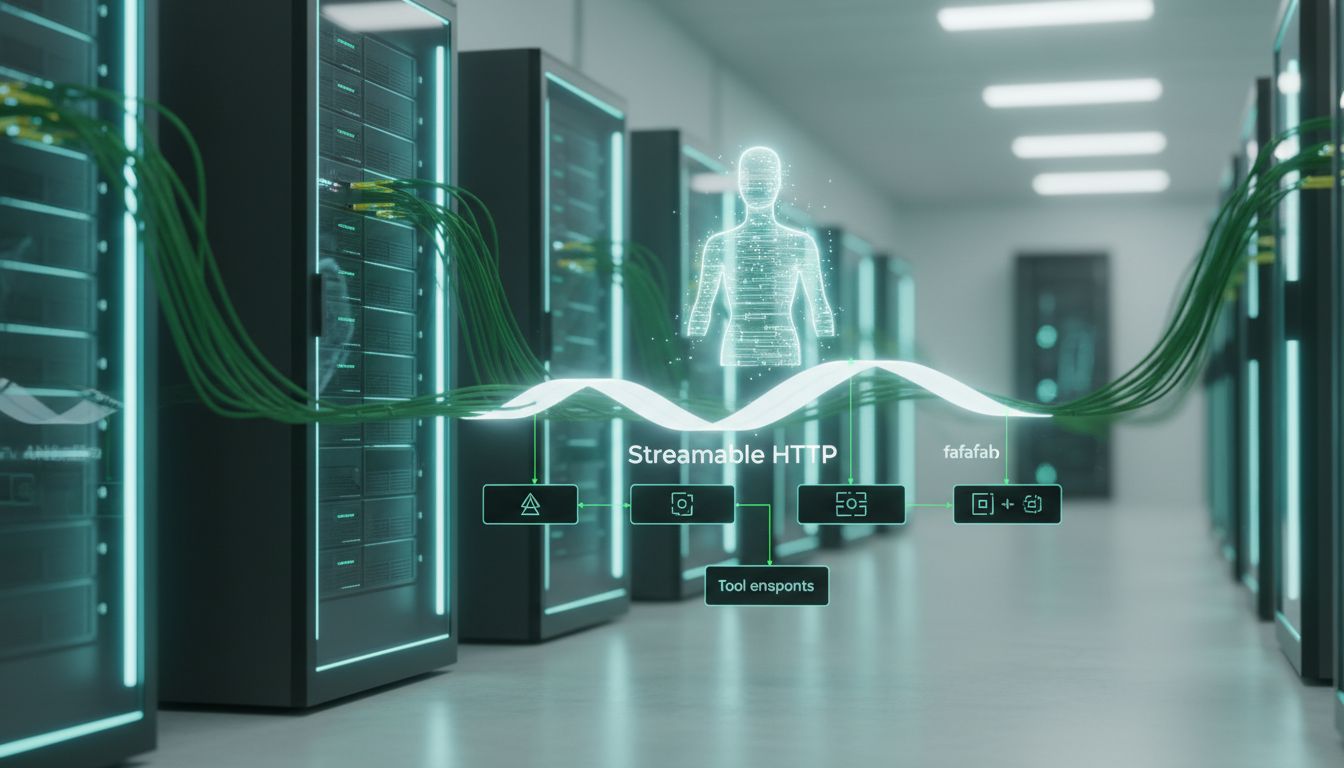
Remote AI assistants become difficult to operate when tools live behind one-off connections, stateful sessions, or infrastructure that cannot route a request without parsing its JSON. Setting up remote tool endpoints for AI assistants using streamable HTTP provides a practical path to expose MCP tools at stable HTTPS URLs while retaining the operational controls that platform teams already use.
For teams building specialist-agent workflows, the important design choice is not simply how to make a tool callable. It is how to make discovery, authorization, routing, caching, tracing, approval, and long-running work reliable across an ordinary web stack. Streamable HTTP is designed for that remote deployment model.
What streamable HTTP changes for remote AI tool endpoints
Streamable HTTP is the modern remote transport for the Model Context Protocol (MCP). It became the standard remote transport in the 2025-03-26 MCP revision, which also introduced OAuth 2.1 authorization and tool annotations. For most deployments, it superseded the earlier Server-Sent Events (SSE) approach.
The core operational benefit is straightforward: a remote MCP server can behave like a conventional HTTPS service. Instead of designing around a long-lived, session-bound connection, teams can use request/response semantics and the infrastructure patterns that fit standard HTTP services.
Direct answer: Set up a remote tool endpoint by running an MCP server at a stable HTTPS URL, implementing the Streamable HTTP transport, accepting the required
Mcp-MethodandMcp-Namerouting ers, validating OAuth bearer tokens where access is protected, and exposing tool discovery responses that clients can cache safely.
In the 2026-07-28 MCP specification, Streamable HTTP is stateless at the protocol layer. State can still exist when an application needs it, but it must be carried explicitly rather than assumed from a transport session. This distinction matters for architecture: a tool may keep workflow data in a database, job system, or application service, while any healthy server instance can receive the next HTTP request.
That model is especially useful when an orchestration workspace routes work among specialist agents. One agent can discover an approved tool, another can invoke it with relevant context, and the platform can preserve the workflow state independently of the individual MCP server connection that handled a particular request.
Choose streamable HTTP when standard HTTPS operations matter
Streamable HTTP is a strong fit when a tool server needs to be remotely reachable by AI products, internal agents, or multiple environments. The newer stateless core is intended to scale on standard HTTP infrastructure, avoiding the need for sticky sessions and deep packet inspection that session-oriented designs can introduce.
That does not mean every tool must be remote. A local process transport can still be appropriate for a developer workstation, a tightly coupled desktop integration, or a tool that should never cross a network boundary. The decision should follow the deployment boundary and operational requirements, not a preference for a newer protocol alone.
Good use cases for a remote MCP endpoint
A centrally managed knowledge, ticketing, deployment, or operations tool that several assistants need to call.
A specialist agent capability that must be available from a shared orchestration control plane.
A service that needs enterprise authentication, auditing, gateway enforcement, and controlled rollout.
A tool that must run in a managed environment with its own network access, service credentials, or job workers.
A production integration exposed at a stable endpoint for supported AI runtimes.
When a remote endpoint adds unnecessary complexity
A remote endpoint is not automatically better for a single-user workflow. It creates an HTTP service to secure, deploy, monitor, version, and support. If the capability only needs local file access or is intentionally limited to one developer machine, a remote network service may expand the attack surface and operating burden without delivering a meaningful advantage.
There is also a product-design limit. Turning every internal function into a tool can make agent behavior harder to govern. Prefer tools with a clear purpose, bounded inputs, understandable effects, and a defined authorization model. A remote transport improves delivery and operations; it does not make an ambiguous or overly powerful tool safe by itself.
Design the endpoint contract before deploying the server
Start with the tool contract rather than the server framework. An AI assistant needs a discoverable name, a usable description, structured inputs, and results that let the calling system decide what to do next. Platform owners additionally need to know which requests are read-only, which can mutate a system, which must be approved, and which may run for a long time.
Tool annotations introduced alongside Streamable HTTP can help communicate tool characteristics. Treat those declarations as useful metadata for clients and operators, but continue to enforce real controls at the service boundary. A description or annotation is not an authorization policy.
Define tools around an operational action
A useful remote tool represents an action that a service can perform predictably. For example, an incident platform might expose tools to retrieve incident details, add a note, or create an escalation. These are easier to inspect and approve than a broad tool that accepts arbitrary commands or unrestricted query text.
Give each tool a stable name and make the input contract explicit. Validate inputs server-side even if the client generated them from a schema. The assistant, its host application, and intermediary services should all be treated as potential sources of malformed or incomplete data.
Separate read operations from state-changing operations.
This allows the calling product and your policy layer to apply different approval and authorization rules.
Limit each tool to a coherent responsibility.
A focused tool is easier to document, test, trace, and permit.
Return application-relevant outcomes.
Include enough structured information for the workflow to continue without exposing more internal data than necessary.
Design failures as part of the contract.
Distinguish invalid input, denied access, unavailable dependencies, and asynchronous work that has been accepted but not completed.
Plan discovery as a production interface
Remote MCP clients discover server capabilities through endpoints such as tools/list, prompts/list, and resources/list. In the newer specification, these list endpoints no longer vary by connection because protocol-level Streamable HTTP sessions were removed. Do not build server behavior that relies on a particular client connection retaining a private discovery view.
Use authorization and policy to control what a caller may access, but avoid accidental connection-specific behavior. If discovery needs to differ for a caller, make the relevant identity and authorization context explicit and ensure your caching policy reflects that variation.
Implement Streamable HTTP routing for gateways and load balancers
Remote MCP requests now require standard routing ers: Mcp-Method and Mcp-Name. These ers allow a gateway, web application firewall, load balancer, or rate limiter to route and enforce policy without examining a JSON request.
This is a material improvement for platform operations. Body inspection can be expensive, brittle, and unavailable at the layer where an organization wants to make routing decisions. Header-based classification lets the edge understand the intended MCP operation while leaving the payload to the application server.
Use the ers as part of your edge policy
Route the stable HTTPS endpoint through the same perimeter patterns used for other production APIs. The exact gateway product is an implementation choice, but the policy goals are consistent: terminate or pass through TLS according to your security model, forward required MCP ers, apply request limits, authenticate requests, and capture operational logs.
Allow and forward
Mcp-Method
and
Mcp-Name
rather than dropping unfamiliar ers.
Configure route and rate-limit rules using those ers where that matches your control model.
Keep the MCP server behind a stable HTTPS URL so clients can be configured predictably.
Make error responses diagnosable to authorized operators without revealing unnecessary internal implementation details to callers.
Test the full path through the load balancer, gateway, and service, not only direct calls to the server process.
The removal of the Mcp-Session-Id er from newer Streamable HTTP also changes what infrastructure needs to preserve. A load balancer no longer has to maintain affinity for a protocol session. Any instance that can validate the request and access the required explicit application state can process it.
Do not confuse stateless transport with stateless business logic
A remote tool may still need durable state. A report-generation tool might create a job, a change-management tool may track an approval, and an order tool may need idempotency controls. Streamable HTTP does not remove those concerns; it removes the expectation that the transport connection is where they live.
Keep workflow state in a suitable backing system and use explicit identifiers in the application contract when they are required. This makes retries, horizontal scaling, deployments, and failover easier to reason about than an approach that ties work to a held-open connection.
Secure remote MCP tools with OAuth 2.1 and explicit approval
Authorization for Streamable HTTP MCP servers follows standard web authorization patterns. MCP SDK documentation describes HTTP-based servers as OAuth 2.1 resource servers: they validate bearer tokens rather than issuing those tokens themselves.
This separation is useful for enterprise teams. Your identity provider or authorization system can handle client identity and token issuance, while the MCP service focuses on validating tokens and enforcing the permissions needed for a particular tool action. The service should not assume that authentication alone authorizes every exposed capability.
Build authorization in layers
Authenticate the caller.
Validate the bearer token according to your organization’s OAuth 2.1 setup.
Validate token context.
Apply the issuer validation and related interoperability expectations supported by the newer MCP authorization guidance.
Authorize the requested tool.
Decide whether this caller may invoke this tool and perform the requested action.
Enforce data-level access.
A caller allowed to use a ticket tool may still be limited to selected projects, tenants, or records.
Record the decision.
Emit enough audit data to explain who invoked what, under which policy, and with what result.
The 2026 MCP authorization guidance includes improvements around issuer validation and dynamic client registration intended to reduce mix-up and localhost redirect issues. Treat these protocol improvements as a reason to review your implementation and identity integration, not as a reason to skip normal application authorization.
Approval is a separate control from OAuth authorization. OpenAI’s MCP examples show the server URL declared in the tools array and note that each invocation produces an mcp_tool_call item that may require explicit approval by default. For sensitive actions, preserve an approval path in the host product or orchestration layer even when the caller has a valid token.
In practice, a useful policy split is to allow low-risk retrieval tools under tightly scoped permissions, while requiring a human or policy-engine decision for actions that modify production systems, expose sensitive information, or create external commitments. The precise rule belongs to the business and security context of the tool.
Make tool discovery cacheable without serving stale permissions
Caching is now a first-class remote MCP concern. Responses from tools/list, prompts/list, resources/list, and resources/read can return ttlMs and cacheScope. These fields let clients cache results more intelligently and reduce unnecessary re-fetching.
This matters for agent systems because discovery can occur repeatedly across users, tasks, or specialist-agent handoffs. Cache-aware discovery reduces avoidable work, but the cache policy must match the sensitivity and variability of the response.
Choose cache scope based on what can vary
First identify whether a response is identical for every caller, unique to one caller, or dependent on changing authorization and data. Then set the response metadata so a client can make an informed cache decision. Short-lived or narrowly scoped caching is preferable when permissions, tenant boundaries, or resource content can change frequently.
Do not treat a long TTL as a performance default. If a cached discovery response reveals a tool a caller should no longer see, the operational convenience is not worth the authorization confusion. Align cache invalidation and token or permission changes with your security expectations.
Return tool lists in deterministic order
MCP recommends that servers return tools/list results in deterministic order. The stated reason is better client-side caching and improved LLM prompt-cache behavior. It is also a practical discipline: stable ordering makes response changes easier to review and reduces irrelevant diffs in integration tests.
Use a stable ordering rule for tool discovery output.
Keep names and descriptions stable unless a contract change is intentional.
Set
ttlMs
and
cacheScope
based on actual response variability.
Test how clients behave when a cached list expires, a tool is removed, or permissions change.
Monitor discovery request volume before and after enabling cache metadata.
For an agent orchestration platform, cache-aware discovery also helps avoid reloading the same capability inventory at every handoff. The orchestration layer can retain useful, policy-appropriate knowledge of available tools while still asking the remote server for fresh data when the declared cache policy requires it.
Connect AI runtimes to stable remote MCP servers
Deployment is only useful if the target AI runtime can consume the endpoint. OpenAI documents remote MCP servers as a supported tool type and describes deploying production MCP servers at stable HTTPS endpoints using the Streamable HTTP transport. Its public documentation MCP server is available at https://developers.openai.com/mcp and is documentation-only.
A stable endpoint does not mean an unchanging implementation. It means that clients have a dependable address while the platform team manages compatible service evolution behind it. Version negotiation support in modern MCP SDKs across Python, Java, PHP, Ruby, and TypeScript helps teams adopt the current transport across different implementation stacks.
Account for transport detection and runtime context
OpenAI’s Responses API can detect whether an MCP server uses Streamable HTTP or the older HTTP-over-SSE variant, then use the appropriate transport. That can support migration, but a new remote deployment should be designed around Streamable HTTP rather than relying indefinitely on older transport behavior.
OpenAI’s Realtime API also supports remote MCP tool servers. However, the remote server does not automatically receive the full conversation context. This is an important integration boundary: send only the task-specific context the tool actually needs, and do not design a tool that silently depends on access to the entire assistant conversation.
That boundary is beneficial for privacy and system design. It forces teams to define the minimum input required for an action and makes context handoffs visible in the workflow. An orchestration layer can decide which specialist agent has the right context and which subset should be passed to the tool.
Use a controlled rollout sequence
Deploy the MCP service at a non-production stable HTTPS endpoint.
Verify discovery, authorization failures, successful tool calls, and gateway er forwarding end to end.
Connect one approved client or agent workflow with low-risk tools first.
Review logs, trace data, approval behavior, and cache behavior under real request patterns.
Promote the endpoint and expand tool access only after the operational controls work as designed.
This sequence is deliberately less exciting than exposing every internal system at once. It is more likely to produce a remote tool integration that teams can maintain after the initial demo.
Support long-running tool work without held-open streams
Some operations cannot finish within a short synchronous request. Examples include waiting for an external system, producing a substantial artifact, or coordinating a multi-step workflow. Older designs often tried to keep a stream open so that the server could initiate additional communication.
The 2026 MCP specification introduces MRTR for remote tools, replacing server-initiated requests that previously required a held-open stream. This makes long-running workflows more practical over stateless HTTP because the protocol no longer depends on keeping a connection open solely to preserve that interaction pattern.
For implementation planning, separate acceptance of work from completion of work. A tool can validate the request, apply authorization and approval controls, create or continue a durable workflow, and return a result appropriate to that stage. The system can then use explicit state and follow-up interactions rather than relying on a particular transport connection remaining alive.
Operate asynchronous work deliberately
Long-running tools need the same discipline as other distributed workflows: durable state, clear identifiers, retry strategy, timeouts, and observable transitions. Streamable HTTP makes the transport easier to scale, but it does not solve duplicate requests or downstream side effects automatically.
Make the tool behavior clear to the agent host and to human operators. A response that indicates work has been accepted should be distinguishable from one that confirms completion. Where a workflow can change a real-world system, record enough information to reconcile the final outcome if the calling assistant is interrupted or a downstream dependency fails.
Trace remote tool calls across agents, gateways, and services
A remote tool invocation can cross an AI runtime, an orchestration layer, an API gateway, an MCP server, and several downstream services. Without shared trace context, incident investigation often becomes a manual exercise in matching timestamps and request fragments.
The newer MCP transport guidance documents W3C Trace Context propagation through _meta keys such as traceparent, tracestate, and baggage. Use these fields to carry trace context where your observability architecture supports it, and propagate that context into downstream calls.
Decide what each log record must answer
Which remote MCP endpoint and tool were targeted?
Which authenticated principal, client, or workflow initiated the request?
Was the request allowed, denied, awaiting approval, accepted, or completed?
Which trace identifier connects the gateway event, MCP service activity, and downstream dependency calls?
Did the request use a cached discovery result or a newly fetched capability response?
What error category occurred if the tool did not complete?
Do not put secrets, bearer tokens, or unnecessary sensitive conversation content into traces. Traceability should explain system behavior, not become another uncontrolled copy of customer data. Establish redaction and retention rules before sending tool telemetry into shared observability systems.
For multi-agent workflows, trace context is also a coordination tool. It lets a platform team see whether a failure originated in agent selection, a policy decision, a remote tool request, or the downstream system that the tool called. That distinction improves both reliability work and product decisions.
Common implementation mistakes with remote tool endpoints
The move from session-oriented remote transports to Streamable HTTP changes several old assumptions. The following mistakes tend to undermine otherwise sound MCP integrations.
Requiring connection affinity:
newer Streamable HTTP removed protocol sessions, so relying on a particular instance or connection for continuity limits scalability and resilience.
Ignoring required routing ers:
if proxies do not forward
Mcp-Method
and
Mcp-Name
, edge routing and policy enforcement cannot work as intended.
Using discovery responses without cache metadata:
clients may repeatedly fetch capabilities that could be cached safely with appropriate
ttlMs
and
cacheScope
.
Returning tools in arbitrary order:
nondeterministic
tools/list
output weakens caching behavior and makes integration changes harder to inspect.
Treating OAuth as the entire permission model:
token validation must be followed by tool-level and data-level authorization.
Assuming the tool sees the full assistant conversation:
this is not automatic for remote servers, including in Realtime integrations.
Making long-running work depend on an open stream:
design around explicit workflow state and the newer remote transport capabilities instead.
Skipping approval for consequential actions:
a valid invocation path does not eliminate the need for human or policy-based review.
A final operational mistake is testing only the happy path. Test expired credentials, denied permissions, malformed inputs, unavailable dependencies, deployment rollovers, cache expiration, and retried requests. Remote AI tool endpoints become dependable when these ordinary failure conditions are designed into the service rather than discovered during an incident.
Streamable HTTP gives remote MCP tools a deployment model that fits real production infrastructure: stable HTTPS endpoints, er-aware routing, OAuth 2.1 resource-server behavior, cacheable discovery, explicit state, and trace propagation. It is a practical foundation for connecting AI assistants to governed operational capabilities without tying those capabilities to fragile, long-lived sessions.
Start with a small set of well-bounded tools, place them behind a stable endpoint, validate authorization and approval flows, and prove gateway, caching, and tracing behavior end to end. From there, an agent orchestration workspace can route work to specialist MCP-connected agents with clearer controls and a more maintainable remote tool surface.