
Home/Blog/Verifiability-first handoffs for distributed assistants
Verifiability-first handoffs for distributed assistants
October 5, 2026
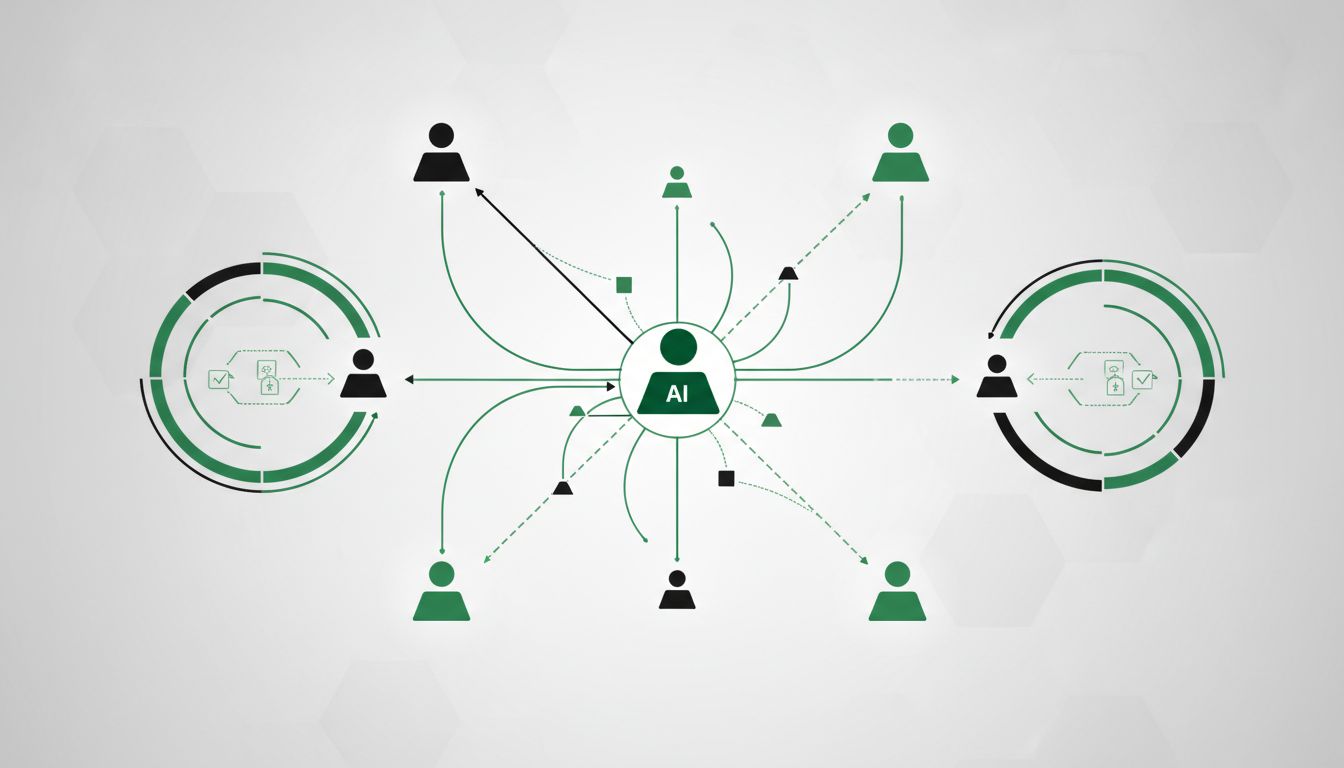
Distributed assistants fail at handoffs when a downstream specialist receives a polished summary but cannot establish what actually happened before the transfer. Verifiability-first handoffs address that gap by treating evidence, authority, scope, and execution lineage as artifacts that travel with the work rather than details an agent is expected to remember or narrate accurately.
For platform engineers and operations teams, this is an orchestration concern, not just a logging concern. A useful handoff must let the receiving agent continue safely, let a verifier assess critical actions independently, and let operators reconstruct a run after the fact,even when the workflow spans retrieval, browser use, code, APIs, persistent sessions, and multiple MCP-connected specialists.
What verifiability-first handoffs mean for distributed assistants
A handoff is a change in responsibility. One agent, coordinator, or workflow stage delegates a branch of work to another specialist, which then acts within a defined scope. OpenAI’s Agents SDK treats handoffs as a core orchestration primitive: a specialist can take over a branch of work while the SDK and runtime handle orchestration and continuation.
That is useful, but continuation alone is not proof. A verifiability-first design asks a stricter set of questions at the transfer boundary: Who granted the authority? What was the agent given? Which plan and policy applied? What tools were used? What evidence supports the output? Which parts were independently recorded?
Direct answer: A verifiable handoff is a transfer of task context plus independently reviewable evidence of identity, delegated authority, scope, inputs, tool activity, outputs, and lineage. It should enable a downstream agent or external reviewer to validate the transfer without relying only on the sending agent’s summary.
This framing aligns with a broader move toward execution provenance as a first-class property of multi-agent systems. A 2026 survey on LLM-agent provenance connects retrieval grounding, claim support, tool-use safety, memory lineage, observability, debugging, audit, and recovery. The important practical implication is that provenance cannot be bolted on only at the final answer: it needs to survive each routing and delegation decision.
The distinction is especially important in high-risk operations. Recent verifiability-first architecture work proposes combining runtime attestations, lightweight audit agents, and challenge-response protocols. Rather than making the acting agent the sole narrator of its own behavior, the architecture introduces mechanisms that can test or attest to important execution claims.
Why a normal context handoff is insufficient
A conventional context package is optimized for relevance and continuity. It may include a user request, a summary, open questions, selected documents, and a suggested next step. That makes the next agent more productive, but it does not necessarily make its predecessor accountable.
A summary may omit failed tool calls, contradictory evidence, or rejected actions.
Conversation history may show what was said without proving what an external system returned or changed.
Agent-generated state can be altered, truncated, or reinterpreted before a reviewer sees it.
A receiving specialist may not know whether the sender had authority to request a sensitive action.
Operators cannot reliably debug a disputed result if raw events were replaced by a narrative.
Verifiability-first handoffs do not require retaining every token indefinitely. They require deliberate preservation of the evidence needed to justify consequential transitions and actions. That is a design decision about trust boundaries, retention, and replay,not merely an observability dashboard feature.
Preserve the evidence a receiving agent and reviewer need
The most durable handoff packet distinguishes operational context from evidentiary context. Operational context helps the next assistant proceed efficiently. Evidentiary context lets that assistant, a policy engine, or an independent reviewer determine whether proceeding is justified.
Across recent work on audit trails, provenance, and verifiable records, the recurring minimum is simple: preserve what the agent received, what it produced, what tools it used, and whether those events were independently recorded. For distributed assistants, that minimum should be expanded into a coherent packet with stable identifiers and clear links between its parts.
Core fields for a verifiable handoff packet
Handoff identity and lineage.
Assign a handoff ID, parent run ID, sender identity, recipient identity, timestamps, and references to prior handoffs. This lets operators locate the exact branch rather than treating a whole session as one undifferentiated event.
Delegated authority.
Record who authorized the sender, what authority was delegated onward, the permitted scope, policy constraints, expiry conditions, and any approvals required before action. Research on reasoning provenance specifically includes delegation authority chains as part of an Agent Execution Record.
Intent and success conditions.
Preserve the bounded task, expected outcome, decision criteria, and unresolved questions. Intent should be specific enough to expose scope expansion, such as moving from “draft a remediation plan” to “apply production changes.”
Input and retrieval references.
Capture the source set, user-provided materials, memory references, retrieval identifiers, and relevant versions. Where retention rules prevent copying content, retain integrity-protected references and access metadata instead of an unsupported summary.
Plan and policy version.
Include the versioned plan, workflow configuration, model or agent configuration where appropriate, and policy versions evaluated at the boundary. Versioned plans are important because the same natural-language instruction can be operationalized differently over time.
Tool and environment evidence.
Link tool requests, responses, approvals, side effects, environment identity, and failure states. A successful final response cannot substitute for evidence about a browser action, code deployment, ticket update, or database mutation.
Output, evidence chain, and verdict.
Record the produced artifact, claims it depends on, supporting evidence references, verifier outcome, and reason codes for blocking or escalation. The proposed Agent Execution Record similarly brings together intent, observations, inference, plans, evidence chains, and verdicts.
These fields should be linked, not dumped into an unstructured transcript. A reviewer needs to understand which evidence supports which claim, which tool response supports which decision, and which authority enabled which action. A graph or append-only event model is often more useful than a single growing “context” document because it preserves those relationships.
Use references carefully when privacy or scale matters
Full-fidelity capture has costs. Sensitive data, customer records, credential-bearing tool output, and long trajectories cannot always be copied into every downstream context window. The answer is not to discard provenance; it is to separate evidence storage from the small, purpose-built context view that a specialist receives.
Store protected source artifacts under the appropriate access controls, then pass signed or integrity-protected references, content hashes where suitable, authorization claims, and a concise operational brief. The receiving agent can request more evidence only when its authority and the policy permit it. This approach reduces unnecessary disclosure while retaining the ability to reconstruct a decision later.
Keep the verifier outside the acting agent’s control boundary
The central control in verifiability-first orchestration is independence. The actor can produce a claim, but it should not be the only system able to declare that claim valid. Recent verifier and audit-trail guidance converges on an independent verifier that is separate from the actor, with enforcement and verification below or outside the agent’s own control boundary.
Microsoft Research makes the case plainly for computer-use agents: success cannot be trusted without reliable verification, because verification is essential both for evaluation and for training signal quality. Its Universal Verifier work also separates process from outcome, and controllable from uncontrollable failures. Those distinctions are directly relevant to handoff design.
Verify process and outcome separately
An outcome check asks whether the target state was reached. For example, did a ticket enter the requested queue, did a deployment produce the required version, or did a report contain the requested fields? Outcome verification matters, but it is incomplete when the path is regulated, permissioned, or destructive.
A process check asks whether the work was performed through an acceptable sequence: correct authority, allowed tools, required approval, valid environment, and sufficient evidence. An agent may reach the right outcome after using an unauthorized account, acting outside scope, or bypassing a mandatory review. In those cases, “it worked” is not a complete verdict.
Outcome verifier:
checks the resulting state against explicit success conditions.
Process verifier:
checks policy compliance, authority chain, approvals, and permitted execution path.
Evidence verifier:
checks whether claimed facts are linked to durable source or tool evidence.
Handoff verifier:
checks sender and recipient identity, scope, lineage, freshness, and replay resistance.
Not every workflow needs all four as separate services. A low-risk research handoff may use lightweight checks, while a production-change workflow may require independently recorded approvals and tool results. The key is to decide which assertions matter before agents begin delegating, rather than asking a final model to infer compliance from a transcript.
Classify failures before assigning blame
Distributed work creates failures the receiving agent cannot control: an API may be unavailable, a browser session may expire, a user may revoke a permission, or an external system may return inconsistent data. A verifier should preserve these distinctions rather than labeling every incomplete task as an agent failure.
Microsoft’s verifier research emphasizes controllable versus uncontrollable failures and divide-and-conquer context management over long trajectories. For operations teams, that suggests segment-level verification. Validate each consequential stage, retain the evidence and verdict, and escalate only the failed segment with its local context. This is more actionable than sending an entire multi-hour run back to a general-purpose agent with the instruction to “try again.”
Design secure authority, scope, and replay controls for agent handoffs
A downstream specialist should receive only the authority needed for its assigned branch. This is least privilege applied to delegation: the coordinator may route a task, but the specialist should not inherit unrestricted access just because it appears in the same user session or workflow.
The emerging consensus around verifiable handoffs emphasizes authority, scope, and lineage. That maps to concrete control-plane decisions: which identity is acting, which principal authorized it, what it can do, how long the delegation lasts, and how an operator can determine whether the packet is current and unique.
Bind authority to a narrow, inspectable grant
Make the delegation grant explicit. It should identify the sender, recipient, permitted operations, target resources or environments, constraints, expiry, and the parent authority from which the grant derives. Avoid grants expressed only as free-form instructions such as “take over deployment work.” They are difficult for policy engines to evaluate and nearly impossible to audit consistently.
Identity attribution is becoming more granular in enterprise systems. Microsoft Entra documentation states that initiatedBy.app in audit and sign-in logs includes agentType and blueprintId. That is a useful direction: attribute actions to a specific agent configuration or blueprint, not only to a generic service principal shared by many workflows.
Make stale or duplicated handoffs detectable
A signed packet can establish integrity and origin, but a signature alone does not resolve replay. A previously valid instruction may become unsafe if reused after an approval expires, a target state changes, or the user withdraws consent. Handoff-focused tooling such as TrustHandoff explicitly describes replay-resistant handoffs and signed task packets, illustrating the importance of both properties.
In practice, bind a packet to a unique handoff ID, parent lineage, intended recipient, expiry, nonce or equivalent freshness control, and expected task state. The verification service should reject or quarantine packets that are expired, already consumed, addressed to another recipient, or inconsistent with the latest authoritative state.
This is not an argument for adding cryptographic complexity to every internal note. It is an argument for applying stronger integrity and freshness controls where a handoff unlocks a privileged tool, a financial or operational commitment, access to sensitive information, or an irreversible side effect. Risk tiering keeps the control plane usable.
Build execution provenance into the orchestration control plane
Verifiability-first handoffs work best when provenance is generated by the orchestration layer and tool boundary, not reconstructed from agent prose. The application can control state and orchestration details even when using an agent framework. OpenAI’s platform guidance notes that the SDK runs in the application, supports persistent sessions, and gives developers control over conversation state and orchestration details.
That architecture creates a practical division of responsibility. Agents reason and propose; the control plane assigns work, issues constrained credentials or capabilities, records transitions, invokes tools, and routes verification. The resulting record is more trustworthy because material events are captured where they occur.
Capture events at the points that matter
At intake:
bind the user request, policy context, source references, and initial authority to a run.
At routing:
record why a specialist was selected, the scope it receives, and the authority it is granted.
At tool invocation:
record request intent, tool identity, capability used, approval state, response, and resulting side effect or error.
At handoff:
record the packet manifest, sender and recipient, lineage edge, validation result, and any context redaction.
At verification:
record the checks executed, evidence references, verdict, confidence or status where used, and escalation path.
At recovery:
record retries, rollback decisions, human overrides, and the event that closed the run.
Keep the event ledger external to the agent process wherever possible. Recent discussion of tamper-evident audit trails recommends that the trail sit outside the agent’s control so a run can be reconstructed and replayed. “Replay” here should mean an operator can inspect or reproduce the relevant sequence under controlled conditions; it does not imply that every external side effect should be executed again.
Separate working memory from durable lineage
Agent memory is valuable for continuity, but it is not automatically authoritative. Memories can be summarized, replaced, retrieved selectively, or influenced by an earlier agent’s interpretation. A provenance design should therefore record memory lineage: which memory item was consulted, where it came from, its version, and whether it was a source of fact, a prior decision, or merely a working hypothesis.
For the same reason, chat history should not be treated as an audit trail. The recurring failure mode is a summary replacing evidence. A handoff summary remains useful as an interface for the next specialist, but it should point to the underlying events and artifacts instead of becoming the sole record of them.
Implement verifiability-first handoffs without stopping delivery
Teams do not need a new universal record format before improving their handoffs. Machine Testimony’s work on verifiable agent records explicitly emphasizes that adoption does not have to begin with a new record format. A pragmatic rollout can start with the events already available in an orchestration workspace, MCP tool gateway, approval system, identity provider, and application logs.
The goal is to make a few high-value handoffs explainable and enforceable, then expand coverage based on incident patterns and risk. Begin where a summary is most likely to conceal a consequential assumption or side effect.
Map your handoff inventory.
Identify agent-to-agent transfers, human-to-agent approvals, tool-boundary transitions, and recovery routes. For each one, document sender, recipient, authority source, data classification, allowed tools, and expected output.
Define a small assertion set.
Start with assertions such as “recipient identity is approved,” “grant is within scope,” “required evidence exists,” “tool action was independently recorded,” and “outcome was checked.” Assertions are easier to verify and monitor than broad promises of trustworthiness.
Instrument one critical workflow end to end.
Choose a workflow with clear boundaries, such as a support escalation that creates a ticket, a code-change review that calls a repository tool, or an operations workflow that requests a production action. Capture the pre-handoff context, packet, tool activity, verdict, and recovery state.
Introduce policy gates for irreversible actions.
Allow agents to prepare, classify, and recommend freely within policy, but require a passing verifier result or human approval before high-impact execution. This is consistent with graduated autonomy, where provenance and audit trails operate in the post-execution layer of the trust framework.
Test adverse cases.
Deliberately send an expired grant, a duplicated handoff ID, an out-of-scope task, a missing tool receipt, and a contradictory evidence set. Verify that the system blocks, quarantines, or escalates with enough detail for an operator to act.
Measure reviewability, not just completion.
Track whether a reviewer can determine what happened, why, under whose authority, and with what evidence. Completion rate alone can reward unsupported success.
This phased approach avoids an all-or-nothing compliance program. It also reveals where the architecture truly lacks observability: perhaps an MCP tool returns no durable receipt, a routing decision has no policy trace, or a service principal masks which agent configuration acted. Those are actionable platform gaps.
Handle long-running and mixed-environment workflows differently
Verification becomes harder as agent work crosses environments and extends over time. Microsoft’s WeaveBench highlights computer-use work across visual desktop control, CLI, code editing, browsers, and external tools. Each environment produces different evidence, has different failure modes, and may expose only partial observability to the orchestrator.
A browser action may need a page state or transaction receipt. A CLI action may need command provenance, environment details, and exit status. A code-editing step may need a diff, repository revision, test result, and review state. A remote API call may need a request identifier and authoritative response. A single “task completed” string cannot carry this diversity safely across a handoff.
Use checkpoints and local verdicts for long trajectories
Segment long work into checkpoints with explicit contracts. At each checkpoint, store the local objective, relevant evidence, state transition, verifier decision, and allowed next actions. The next specialist should receive a concise brief plus references to the checkpoint record, rather than an ever-growing narrative that mixes verified facts with tentative reasoning.
This pattern supports recovery. If a later stage fails, operators can identify the last verified checkpoint, determine whether the failure was controllable, and retry or route only the affected segment. It also limits blast radius: a recipient can be prevented from proceeding when a required predecessor verdict is missing or invalid.
Know the limits of verification
Verification can establish that specified checks passed against available evidence; it cannot make ambiguous requirements unambiguous or guarantee that an external system reports the truth. A verifier may also be poorly specified, lack access to authoritative state, or validate an outcome while missing an unacceptable process. These are reasons to define assertions and evidence sources carefully, not reasons to rely on agent self-reporting.
There is also a cost trade-off. Capturing richer provenance increases storage, latency, integration effort, and the sensitivity of retained records. Use risk-based retention and verification depth, protect evidence with appropriate access controls, and avoid exposing raw internal records to every downstream agent. The right design makes review possible without turning every task into a heavy approval workflow.
Use human-aligned verdicts to improve handoff quality over time
A mature system should learn from disputed handoffs, not only from successful task completion. Recent benchmark practice is moving toward verifier agreement with humans rather than scoring final outcomes alone. Microsoft’s Universal Verifier work reports near-zero false positives versus baselines and human-human agreement on the CUAVerifierBench benchmark, signaling the value of evaluating whether verification judgments align with informed review.
For an enterprise agent platform, that means collecting structured reviewer feedback on both verdicts and evidence sufficiency. Did the verifier accept an unsupported claim? Did it reject a valid action because a harmless intermediate event was missing? Did the handoff omit authority context that a human considered decisive? These are concrete signals for improving policies, packet schemas, and tool integrations.
Sample completed high-impact runs for independent review.
Compare reviewer conclusions with verifier verdicts and record the reason for disagreement.
Classify disagreements by missing evidence, policy ambiguity, identity attribution, outcome mismatch, or process violation.
Update checks and packet fields based on recurring disagreement patterns.
Keep human override decisions in the same lineage so future reviewers can see why automation was bypassed.
This feedback loop is more credible than simply tuning agents to produce more confident summaries. It directs engineering effort toward the evidence and controls that let people justify a decision independently.
Verifiability-first handoffs turn distributed assistants from a chain of plausible narrators into a system of bounded delegations, durable evidence, and reviewable decisions. Start by preserving authority, scope, lineage, inputs, tool events, and independent verdicts at the handoffs that can create real operational impact.
As your specialist-agent workflows grow, make the orchestration control plane the source of durable execution provenance. Preserve summaries for usability, but retain the underlying events for verification, recovery, and accountable automation.