
Home/Blog/What the latest protocol updates mean for secure, scalable model integrations
What the latest protocol updates mean for secure, scalable model integrations
November 9, 2026
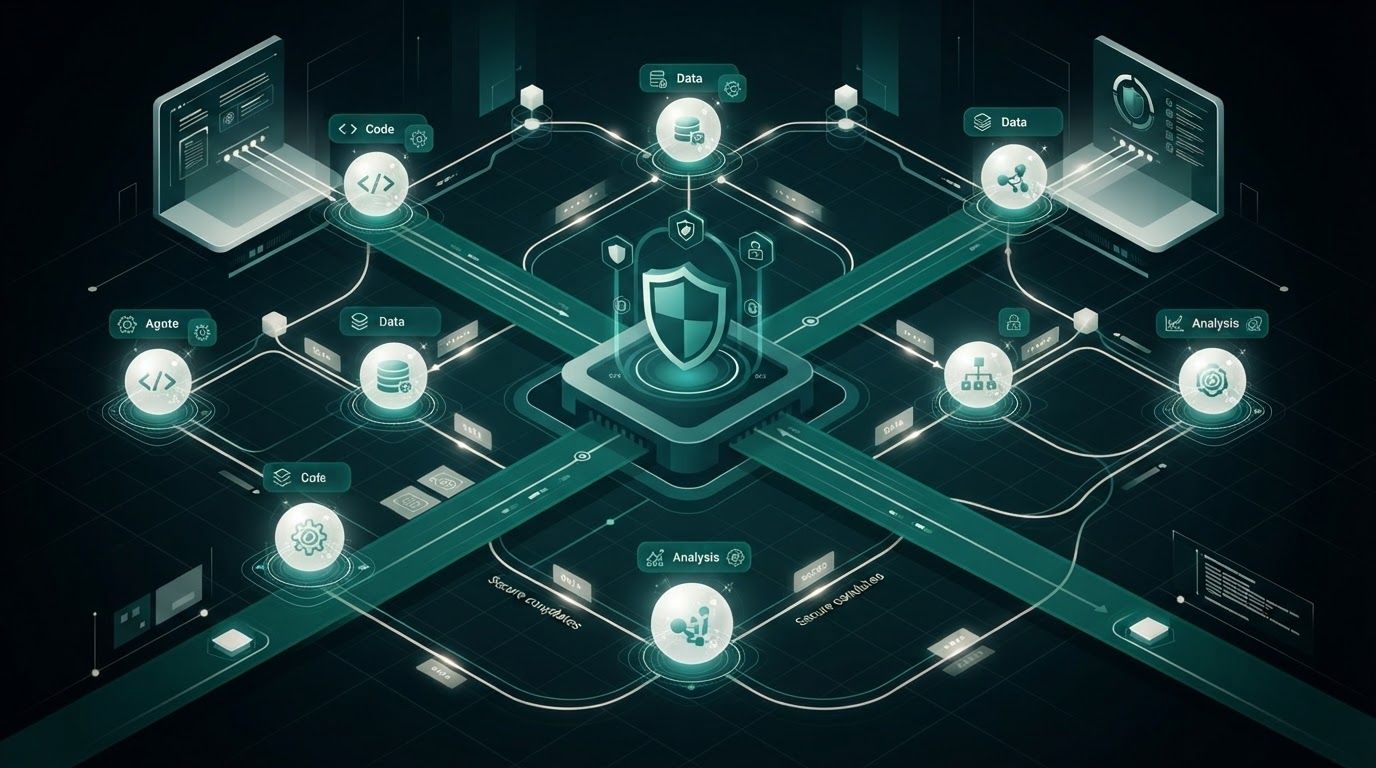
Secure, scalable model integrations are no longer mainly a question of choosing a model endpoint or writing another tool wrapper. The latest protocol direction makes secure model integrations an architectural discipline: use stateless HTTP where possible, give workloads strong short-lived identities, and keep private tools behind the network boundaries that already protect them.
For platform teams building agent workflows, this changes the operating model. MCP’s 2026-07-28 specification reduces dependence on stateful, bespoke connections, while OpenAI’s tunnel, workload identity, mTLS, and network-control updates provide concrete patterns for connecting models to enterprise systems without making those systems broadly reachable. The result is not automatic security or scale, but it is a clearer foundation for designing both deliberately.
What the latest protocol updates mean for secure model integrations
Direct answer: Build model-to-tool integrations around stateless MCP over standard HTTP, isolated private access paths, short-lived workload credentials, and explicit authorization controls. Treat long-running work as an extension-managed concern, not a reason to keep a custom stateful transport alive.
The most consequential MCP change is the move from a stateful bidirectional core to a stateless request/response model. The new core includes Multi Round-Trip Requests, er-based routing, cacheable list results, authorization hardening, and a formal extensions framework. MCP maintainers describe the practical outcome plainly: remote MCP servers can run like ordinary HTTP workloads on commodity infrastructure.
That matters because familiar HTTP operating practices already exist in most production environments. Teams know how to place HTTP services behind gateways, distribute them across infrastructure, observe them, apply policy, and evolve them. A model integration no longer has to carry a special connection-management burden simply because an agent needs tools.
Statelessness should not be confused with a promise that every workflow is simple. An agent may still perform several tool calls, ask for clarification, retrieve data, or initiate a long-running job. The design change is that the protocol core can remain simpler while higher-level capabilities are expressed without forcing every deployment to preserve a stateful transport lifecycle.
For platform engineering:
scale MCP services with the same load-balancing, routing, deployment, and observability patterns used for other HTTP APIs.
For security teams:
place authentication and authorization decisions at recognizable request boundaries, where identity and routing metadata can be inspected and governed.
For agent builders:
separate the agent’s orchestration state from the connection state required to reach a tool server.
For operations teams:
reduce the number of bespoke connection behaviors that must be diagnosed during incident response.
The strategic value is portability. A tool service that behaves as an ordinary HTTP workload is easier to host in an existing environment, subject to existing controls, and move across infrastructure choices. It also creates a stronger boundary between the protocol contract and the agent framework or model provider used above it.
Why stateless MCP over HTTP improves scalable agent architecture
Scalability is often discussed as raw capacity, but model integrations also fail to scale when their lifecycle rules are hard to reason about. Stateful bidirectional designs can require connection affinity, coordinated reconnect behavior, or special handling when an intermediary times out. Those concerns are not always wrong, but they expand the number of moving parts between an agent and a business system.
The MCP 2026-07-28 core instead emphasizes stateless request/response interaction. Header-based routing gives deployers a protocol-level mechanism that better fits common HTTP routing infrastructure. Cacheable list results offer a useful optimization point for discovery-style operations where repeatedly fetching the same list is unnecessary.
Separate control-plane context from tool-server transport
A robust multi-agent system should preserve task and user context in its orchestration layer, then send only the information required for each authorized tool operation. This is distinct from expecting a single persistent transport session to hold the context together.
In practice, an orchestration workspace can route a request to a specialist agent, hand over the relevant context, and invoke the appropriate MCP-connected tool service through a governed HTTP path. Each layer has a distinct responsibility: the orchestrator manages workflow state, the model selects or structures an action, and the MCP server performs the constrained external operation.
Receive a user or system-triggered task in the orchestration layer.
Determine which specialist agent and approved tool capabilities are relevant.
Construct a minimal, scoped invocation using the current authorization context.
Route the request to the correct MCP service using standard HTTP-aware infrastructure.
Record the action, result, and any task status in the operational system of record.
This decomposition is especially valuable when multiple agents participate in one workflow. Context handoffs can be intentional and auditable rather than implicitly tied to a connection. It also reduces the temptation to give every agent a broad, durable credential simply so a session can continue functioning.
Use cacheable list results carefully
Cacheable list results can lower repeated discovery work, but caching is a correctness decision as well as a performance decision. A list of available tools, resources, or capabilities may change after a deployment, a policy update, or an authorization change. Platform teams should define what can be cached, how it is invalidated, and whether the result is safe to reuse for the particular identity and tenant.
Do not let a cache become an authorization bypass. A previously valid capability listing is not proof that a current caller is permitted to use a capability. Keep capability discovery, permission evaluation, and execution authorization conceptually separate even when they occur close together.
Run long-lived work with the MCP Tasks extension, not transport coupling
Long-running actions are a common reason teams hold onto stateful integration patterns. Data exports, internal approval processes, batch operations, and workflows that wait on external systems do not fit neatly into a single immediate response. The latest MCP release addresses this without putting Tasks back into the protocol core.
Tasks now live in the official io.modelcontextprotocol/tasks extension. The extension provides poll-based tasks/get, tasks/update, and tasks/cancel operations. This gives long-running work an explicit protocol shape while preserving a stateless core.
The maintainers’ roadmap makes the compatibility objective important: implementers should be able to adopt future task revisions without rewriting their transport or lifecycle code. For an enterprise integration team, that reduces the blast radius of protocol evolution. A new task capability should not require replacing load balancers, redesigning connection affinity, or reworking the basic HTTP deployment model.
Design tasks as durable business operations
When an agent starts a task, the task should represent a real, durable operation with clear ownership and cancellation behavior. A task identifier is not a substitute for operational discipline. The owning service still needs to determine whether repeated requests are safe, what cancellation means after work has begun, and what result data may be returned to the initiating user or agent.
Make task status meaningful enough for an orchestrator to decide whether to wait, retry, escalate, or continue with another branch of work.
Define cancellation semantics for each operation. Canceling a queued export is different from canceling an already-submitted transaction.
Constrain task outputs to the caller’s authorized scope, especially if status includes operational details or links to generated artifacts.
Persist task state in an appropriate service-owned store rather than relying on a model conversation as the record of execution.
Polling has a trade-off: it may introduce repeated status requests, and teams must choose sensible polling behavior for their environment. Its benefit is operational clarity. The client can recover, scale independently, and check state through defined operations rather than depending on a long-lived connection remaining intact.
This is a useful boundary for agent reliability. The model can propose, initiate, and interpret a task, but the durable task system should remain responsible for the execution lifecycle. That separation makes it easier to audit what actually happened when a model response, a client process, or a network path changes.
Strengthen MCP authorization and workload identity end to end
Protocol simplification does not remove the need for identity; it makes identity placement more important. MCP’s latest release explicitly highlights authorization hardening, and its maintainers say Client ID Metadata Documents are becoming the standard to align better with OAuth and OpenID Connect deployments.
This direction favors integrations where clients are identifiable, redirect and metadata assumptions are explicit, and authorization can fit the identity systems enterprises already operate. Teams should plan for protocol upgrades by avoiding identity shortcuts that cannot be governed later, such as anonymous broad-scope internal clients or shared credentials used by unrelated services.
OpenAI’s API updates point in the same direction. Workload identity federation lets trusted workloads exchange externally issued identity tokens for short-lived OpenAI access tokens, reducing reliance on long-lived API keys. mTLS and X.509 workload identity federation are generally available for the OpenAI API, providing stronger service-to-service authentication patterns for regulated and enterprise deployments.
A practical identity chain for tool-enabled agents
A secure design should distinguish people, workloads, agents, and downstream services. A user may initiate a request, but an orchestration service may call the model, and a separate tool service may execute a permitted action. Collapsing all of these into one static secret destroys useful accountability.
Authenticate the human or upstream system that initiates work.
Authorize the orchestration workload to call the model service using a short-lived, federated identity where appropriate.
Identify the MCP client and enforce the applicable authorization policy before tool invocation.
Authorize the target tool operation against the user, workload, tenant, and requested scope.
Log the decision path without storing unnecessary sensitive prompts, tokens, or tool output.
mTLS and X.509 federation can strengthen the service-to-service portions of this chain, but they do not decide what an agent should be allowed to do. Authentication proves or supports proof of workload identity; authorization still needs policies for tool selection, data access, action scope, and approval requirements.
Likewise, short-lived tokens reduce the exposure associated with long-lived API keys, but they do not eliminate risk from an overprivileged workload. Issue the smallest practical permissions, separate production workloads from development workloads, and make credential rotation and revocation part of the normal platform operating model.
Keep private MCP servers private with Secure MCP Tunnel
Many of the highest-value tools for an agent are intentionally not public services: internal databases, operations systems, proprietary applications, and on-premises platforms. Making these systems publicly reachable just to support model access expands the attack surface and can conflict with established network controls.
OpenAI supports Secure MCP Tunnel for private and on-premises servers without exposing them to the public internet. The pattern uses a customer-hosted tunnel-client that establishes an outbound HTTPS connection while the MCP server remains behind existing network controls. According to OpenAI’s API changelog, Secure MCP Tunnel is available across ChatGPT web, Codex, the Responses API, and AgentKit.
This is significant because it turns private connectivity into a deliberate architecture choice rather than a workaround. The model-facing product can reach an approved MCP integration path, while the actual tool server remains within the customer-controlled environment. It is particularly relevant where direct inbound connectivity is prohibited or undesirable.
What a tunnel solves,and what it does not
A secure tunnel addresses network reachability and helps preserve perimeter security. It does not, by itself, decide whether an agent may query payroll data, modify a production record, or retrieve a confidential document. Those decisions remain the responsibility of authorization policy, tool design, and the systems that own the data.
Use the tunnel for:
private connectivity to specifically approved MCP servers, including on-premises services that should not accept public inbound traffic.
Keep authorization at the server:
validate caller identity and scope at the tool boundary, not only at the orchestration layer.
Limit reachable services:
expose narrowly scoped tool interfaces rather than treating the tunnel as general network access.
Operate it as production infrastructure:
monitor the tunnel client, define ownership, and test failure and recovery behavior.
The appropriate alternative depends on where the tool already runs and what network controls are acceptable. A public HTTP MCP server may be suitable for a service designed for internet exposure and protected with strong authentication. A private tunnel pattern is better aligned with systems that must remain behind internal controls. In either case, a narrowly designed MCP server is safer to operate than a broad adapter that exposes an entire enterprise API surface to model-directed calls.
Layer network restrictions around model and tool access
Identity is necessary, but network controls remain valuable defense in depth. OpenAI now supports multiple IP allowlists at the project or organization scope. This gives organizations an additional means to restrict production model access and segment it more cleanly across teams, applications, or environments.
IP allowlists are not a replacement for workload identity or authorization. They are most useful as one control in a layered design: a workload has a verifiable identity, receives a short-lived credential, originates from an expected network location, and can invoke only approved capabilities. If one layer is misconfigured, another may still reduce exposure.
A pragmatic segmentation model is to separate environments and workloads based on their risk. For example, development experiments should not automatically share the same model project, network allowance, tool server, or credentials as a production workflow that can access internal records. Likewise, a retrieval-only agent should not need the same downstream permissions as an agent that can initiate an operational change.
Apply least privilege to the tool surface, not only the API account
Teams often focus their permissions work on the model provider account and overlook the tool layer. Yet a permissive tool can undo careful model-side controls. If one MCP service exposes broad database access or a generic administrative API, an agent that reaches it may have more practical power than its intended use case requires.
Prefer task-oriented tools with clear inputs and bounded outputs. A tool named for retrieving an approved account summary, for instance, is easier to authorize and audit than a general query interface. This does not mean every integration must be tiny; it means the interface should express business constraints that the underlying system can enforce.
OpenAI’s update on broad access through consistent standards also matters for governance planning. The company emphasizes unified policy treatment across direct, partner-hosted, and reseller-hosted access. Organizations using more than one procurement or hosting route should therefore avoid assuming that a different access channel removes the need for a consistent internal control model.
Match model capabilities to governed orchestration, not unrestricted autonomy
Model capabilities are becoming more directly aligned with enterprise agent patterns. OpenAI says GPT-5.5 supports MCP, structured outputs, function calling, prompt caching, and 1M-token context windows. Together, these capabilities support tool use, long-context workflows, and retrieval-heavy patterns, but they should be paired with controls that make behavior inspectable.
Structured outputs and function calling are useful because they provide a more disciplined boundary between natural-language reasoning and executable tool requests. Rather than parsing a free-form answer into an action, an orchestrator can validate a requested function and its arguments against an expected schema before it reaches a tool service.
Long context can help an agent work across extensive policy, knowledge, or workflow material. It also increases the importance of deciding which context belongs in the request. More context is not automatically safer or more accurate. Sensitive data should be minimized, retrieval should be scoped, and the orchestration layer should be explicit about what context is passed from one agent or tool stage to another.
OpenAI’s October 29, 2026 Model Spec update emphasizes context-aware behavior and clearer developer/user boundaries. For integration design, that reinforces a practical rule: treat instructions, user input, memory, retrieved content, and tool results as different categories of context. Do not allow untrusted retrieved text or tool output to silently override developer-defined tool policy.
Build approval points for consequential actions
Not every tool call needs a human checkpoint. Read-only retrieval, low-risk classification, and preparation of a draft may be appropriate for automation when properly scoped. Actions that create commitments, change records, transfer sensitive data, or trigger external effects often require additional controls.
Validate structured tool arguments before execution.
Require an explicit approval step for defined high-impact operations.
Show the actor, target system, intended action, and key parameters in audit records.
Return bounded tool results to the model and avoid exposing credentials or unrestricted raw system responses.
This is where an agent orchestration control plane adds operational value. It can route work to specialist agents, carry only the context needed for a handoff, enforce which tools are available at each stage, and provide a consistent record across a multi-agent workflow. The protocol makes integration more standard; the orchestration layer makes the overall behavior manageable.
Adopt the new integration pattern without a disruptive rewrite
MCP maintainers frame the stateless core and extensions framework as a long-lived foundation. The roadmap specifically positions capabilities such as Tasks and MCP Apps to evolve independently without breaking transport or lifecycle code. That does not mean every existing integration should be replaced immediately. It means teams can create an incremental migration plan centered on the interfaces with the greatest operational risk or scale pressure.
The reported ecosystem scale also supports treating MCP as an increasingly mature integration substrate. The MCP maintainers state that Tier 1 SDKs are seeing close to half a billion downloads per month and that the TypeScript and Python SDKs have each crossed 1 billion total downloads. Adoption does not prove that a particular server is secure, but it does increase the value of investing in standard interfaces, skills, and governance patterns rather than one-off adapters.
Start with an architecture review
Inventory tool connections.
Identify which integrations are stateful, which are exposed publicly, which use long-lived secrets, and which can perform consequential actions.
Prioritize private systems.
For internal or on-premises tools, evaluate Secure MCP Tunnel where keeping the server behind existing network controls is required.
Modernize service identity.
Replace reliance on broadly shared, long-lived API keys with workload identity federation, mTLS, or X.509 federation where the deployment supports them.
Separate durable work.
Move long-running operations toward explicit task handling with the official Tasks extension rather than connection-bound lifecycle logic.
Enforce tool contracts.
Define schemas, authorization scopes, validation, and audit requirements for each tool operation.
Segment access.
Use project or organization controls, including multiple IP allowlists where appropriate, to keep environments and workloads distinct.
Test the negative paths, not just the successful demonstration. Confirm what happens when a token expires, a tunnel connection is unavailable, a task is canceled, a user loses access while work is in progress, or an agent proposes an unavailable tool. These cases reveal whether the design truly separates identity, authorization, transport, and execution state.
The practical goal is not to make agents autonomous everywhere. It is to make approved automation repeatable: the same request should encounter the same routing rules, identity requirements, tool constraints, and logging expectations regardless of whether it originates in a chat interface, API-driven workflow, or specialist agent handoff.
The latest updates point to a durable operating model for secure model integrations: stateless MCP and ordinary HTTP infrastructure for scale, extension-managed tasks for long-running reliability, strong federated identity for service access, and tunnel-based connectivity for private tools. Each component solves a different problem, so the strongest architecture combines them rather than treating any one feature as a complete security solution.
Platform teams should use this moment to simplify transports, narrow tool surfaces, and make identity and authorization visible at every meaningful boundary. Done well, model integrations can become easier to scale across agents and teams while remaining easier to isolate, audit, and evolve.