
Home/Blog/When to offload tasks to specialist endpoints: design patterns for stateless handoffs
When to offload tasks to specialist endpoints: design patterns for stateless handoffs
September 22, 2026
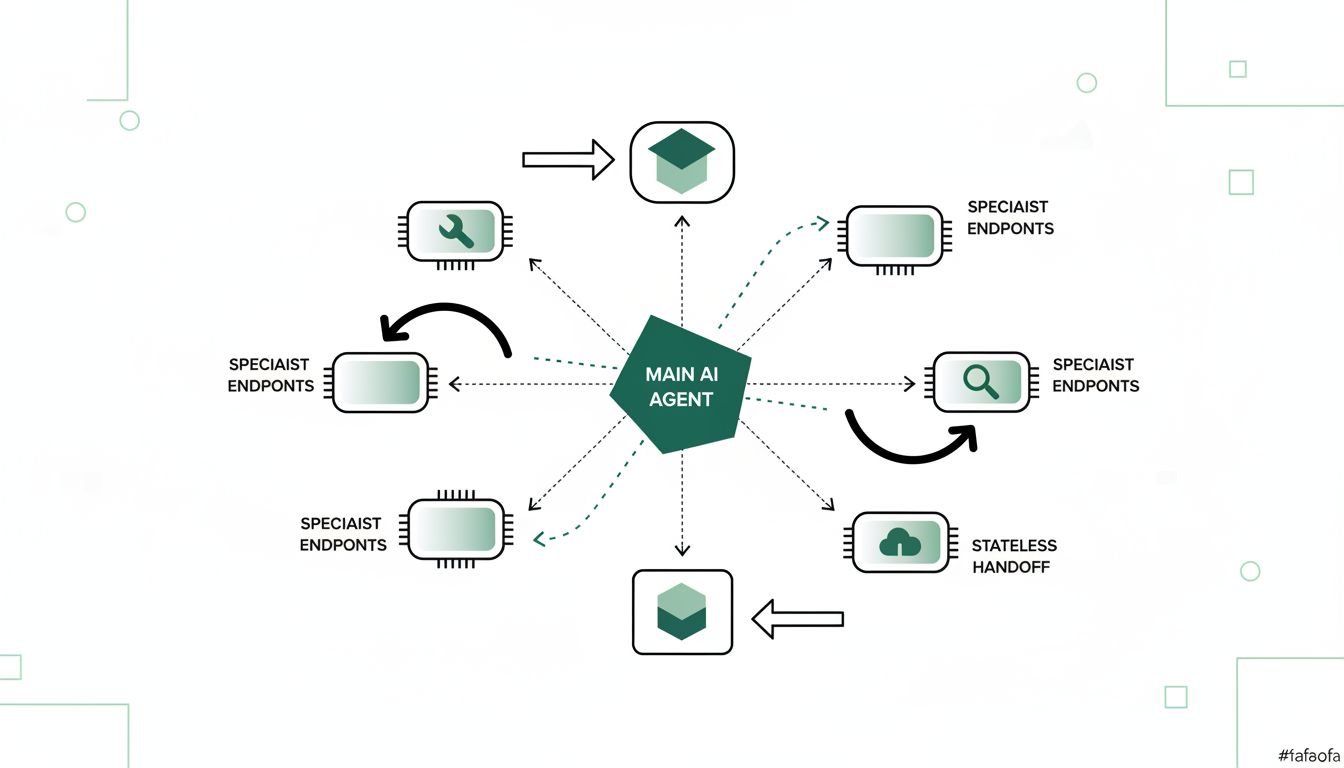
Teams should use stateless handoffs when a subtask has a clear contract, a bounded purpose, and a better owner than the agent currently speaking to the user. Instead of stretching one general agent across planning, retrieval, transformation, approvals, backend writes, and long-running work, route each well-defined unit to a specialist endpoint that can accept the necessary input, produce an explicit result, and retain no hidden conversational state.
The decision is not simply whether to add another agent. It is whether the new boundary makes the workflow easier to operate: easier to retry, scale, secure, observe, and evolve. For platform engineers building MCP-connected systems, the most reliable pattern is usually to keep coordination and session context in a control plane or edge service, while moving constrained execution into tool-backed specialist services.
When to use stateless handoffs: the direct answer
Offload work to a specialist endpoint when the task is single-purpose, bounded, reusable, and can be completed from an explicit request contract rather than private conversation history. Keep planning, user-session state, and cross-task coordination with the orchestrator; send execution, transformation, validation, or durable-work requests to specialists.
This boundary is useful because it turns an ambiguous prompt continuation into an operational unit of work. The orchestrator can decide what needs to happen next, while the specialist can focus on doing one thing under a defined interface.
Current agent guidance distinguishes between a manager pattern, where a central LLM invokes tools, and a decentralized pattern, where specialized agents hand work to one another. Neither is automatically superior. The key design choice is whether a task needs a different domain capability, workflow owner, execution environment, or lifecycle from the agent currently handling the interaction.
Use a specialist endpoint
when the input and expected output can be represented explicitly, often as structured arguments and a structured response.
Use an asynchronous handoff
when the task may run for an extended period, includes multiple downstream steps, or should not hold an interactive request open.
Use parallel specialists
when independent checks, retrievals, transformations, or evaluations do not need to wait for one another.
Keep work local to the orchestrator
when the action is tiny, highly conversational, and gains no reliability or ownership benefit from crossing a service boundary.
Examples of naturally bounded work include a refund evaluation, document research, structured data extraction, policy validation, content generation, and a downstream system update. These are not merely different prompts. They commonly have different tools, permissions, observability needs, and retry semantics.
Identify a real offload boundary, not just another prompt
A useful handoff begins with a boundary that the system can describe without relying on unstated context. “Help the customer” is not a boundary. “Extract the requested fields from this document and return a validated JSON object” is one. “Determine whether this refund request meets policy and return the supporting policy references” is another.
Specialists work best when their remit is narrow enough that an engineering team can state what the endpoint owns, what it does not own, and how callers know it has succeeded. Guidance for agent building emphasizes single-purpose, bounded, reusable agents because they are simpler to route to and reason about than a universal endpoint that tries to absorb every responsibility.
Ask five boundary questions before creating an endpoint
Is the task independently nameable?
If the team cannot give the task a concise operational name, it may still be an unseparated part of planning rather than an executable unit.
Can the specialist receive all required context as input?
Statelessness requires the request to carry the relevant task data, identifiers, authorization context, and constraints, or to provide controlled references from which they can be retrieved.
Does the task produce a meaningful artifact or decision?
A specialist should return a result that the orchestrator can consume: extracted fields, a recommendation, a validation result, a job identifier, a document reference, or an action receipt.
Does it have a different capability or owner?
A boundary is valuable when a different service, agent, team, permission set, model configuration, or toolchain should own the work.
Can failures be represented explicitly?
The caller needs more than a natural-language apology. It needs machine-actionable outcomes such as completed, needs-input, retryable failure, rejected, or pending.
Planning and execution are often the most productive split. A central agent can interpret intent, choose a route, and assemble a task request. A specialist then executes against its tools and returns a result to the next planning step. This follows the tight execution-loop approach in which a model proposes an action, the platform performs it, and the outcome feeds subsequent reasoning.
That split also prevents a common architecture failure: asking one general agent to remember every intermediate fact while simultaneously managing credentials, external calls, status tracking, and side effects. The orchestration layer still has important work, but it no longer needs to impersonate every domain service.
Keep session state at the edge and pass task context deliberately
Stateless does not mean context-free. It means the specialist does not depend on hidden, mutable, per-conversation memory to complete the current request. The orchestrator or session edge remains responsible for determining which context matters and passing it through in a controlled form.
This pattern is especially important in real-time applications. OpenAI’s voice architecture separates the service that owns full WebRTC session state from internal services for inference, transcription, speech generation, tool use, and orchestration. The architectural lesson extends beyond voice: one edge component can own the live session while internal specialists receive simpler task-oriented requests.
Build a handoff envelope
A practical handoff envelope gives specialists enough information to work without recreating the full chat session. It should be designed as an API contract, not as a copied transcript.
Task identity:
a task ID, correlation ID, and, where relevant, a parent workflow ID.
Request intent:
the operation to perform, desired outcome, and constraints that apply to this step.
Minimal working context:
normalized user inputs, relevant prior decisions, document references, or retrieved facts needed for execution.
Authorization scope:
the caller or tenant identity, permitted actions, and references to credentials managed outside the model prompt.
Output contract:
expected schema, completion state, and whether the endpoint can return pending work rather than a final result.
Trace context:
identifiers that connect logs and spans from routing through downstream execution.
Sending all conversation history to every worker can undermine the point of the boundary. It increases payload size, exposes irrelevant information, and lets a specialist start depending on narrative context that is difficult to version or test. A better design creates task-specific context snapshots: enough information to execute correctly, but no more.
For example, an extraction specialist may need a document URI, a target schema, tenant scope, and validation rules. It probably does not need the user’s complete conversation, the routing agent’s internal chain of decisions, or unrelated system messages. The orchestrator can retain those elements if they are necessary for later interaction.
This placement of state also helps future routing changes. If a session-owning edge can hand off work through stable contracts, a team can replace a specialist, add a human-review path, or direct requests to a new execution environment without making every worker session-aware.
Use structured contracts for reliable specialist endpoint routing
A handoff should not rely on a specialist inferring its job from prose alone. Tool and function calling provide a natural contract: the orchestrator selects an operation and sends structured arguments that satisfy the endpoint’s schema. On compatible paths, JSON constraints are automatically applied to function-call arguments, which is useful when an agent must produce predictable inputs for downstream services.
Structured contracts reduce ambiguity at the moment it matters most: where model-directed reasoning becomes external execution. They also make endpoint behavior easier to test independently of a particular prompt or model run.
Design the request around the business operation
Prefer an operation that represents an actual unit of work over a generic endpoint such as run_agent. A contract called extract_invoice_fields, evaluate_refund_eligibility, or create_salesforce_document states intent, limits scope, and offers a clear location for policy and access controls.
Data extraction is a particularly clean example. A workflow can fetch raw text, hand it to a structured extraction operation, validate the resulting fields, and then ask a durable system to save them. Each step has different concerns: retrieval may handle source access, extraction handles normalization, validation handles quality checks, and persistence owns the database write.
{ "task_id": "task_...", "operation": "extract_contract_metadata", "input": { "document_ref": "document_...", "target_schema": "contract_metadata_v2", "required_fields": ["counterparty", "effective_date", "term"] }, "constraints": { "tenant_id": "tenant_...", "return_confidence_notes": true }, "trace": { "workflow_id": "workflow_..." }}
The exact fields will vary, but the principles should remain stable. Include identifiers instead of duplicating large objects when a specialist can retrieve an authorized reference. Version schemas. Define fields that are required, optional, and nullable. Make completion states explicit. Avoid mixing a request to reason about the task with an unrestricted invitation to execute any available tool.
Return outcomes that the orchestrator can route
A specialist response should support a next decision. For synchronous work, that may be a final result plus evidence or validation details. For longer work, it may be an accepted job ID and status URL. For blocked work, it may identify missing input or an approval requirement.
Natural-language summaries can still be valuable for human visibility, but they should supplement rather than replace operational fields. A routing layer should be able to determine whether to continue, retry, ask the user a question, queue a follow-up, or escalate without parsing an apology paragraph.
Choose synchronous, asynchronous, or parallel handoffs by workflow shape
The transport pattern should match the task’s duration and dependencies. A stateless request-response call works well when a specialist can complete promptly and the caller needs the result to take the next step. It is the wrong default for every workload, particularly work that waits on downstream systems or has multiple processing stages.
Synchronous handoffs for short, decision-critical steps
Use a direct call when the orchestration loop cannot advance without the result. A policy checker that returns eligibility, a classifier that selects a route, or an extractor that produces fields needed for the next tool call can all be synchronous specialist operations.
Cloud Run guidance positions services as a fit for stateless, request-driven agents that autoscale and can scale to zero. This aligns well with a focused HTTP endpoint that accepts a task, runs a bounded capability, and returns a response without storing conversation state.
Asynchronous request-reply for slow or multi-step work
When work can be queued, separate acceptance from completion. Azure’s asynchronous request-reply pattern uses a client request, a queued worker, and a status endpoint; the initiating service can return HTTP 202 (Accepted) while another component processes the task.
The orchestrator validates the task request and creates or forwards a work item.
The caller receives an accepted response with a task identifier and a location for status or result retrieval.
A specialist worker consumes the queued task and performs the work.
The worker records or emits a final state that the orchestrator, client, or downstream system can retrieve.
This pattern prevents an interactive agent turn from being held hostage by a long-running specialist. It also decouples the rate at which work arrives from the rate at which the worker can safely process it. The trade-off is that workflow design must account for pending states, status retrieval, cancellation rules, and duplicate delivery.
Parallel handoffs for independent subproblems
Parallelization is another strong reason to offload. Agentic workflow guidance recommends parallel processing and dynamic tool use for sub-tasks. If a request requires independent work such as retrieving account facts, checking a policy, transforming a document, and evaluating a compliance rule, the orchestrator can dispatch those tasks concurrently and join the results.
Do not parallelize merely because endpoints exist. Parallel work needs clear independence. If one specialist’s output determines the valid input for another, preserve the dependency rather than creating a race that produces unusable results. A join step should also define how to handle partial success: whether one failure blocks the overall task, triggers a retry, or produces a result with an explicit limitation.
Separate orchestration from durable side effects
A stateless specialist should not become an accidental system of record. It can compute, validate, enrich, or prepare an action, while a designated durable system owns persistence and the authoritative business update.
The Palo Alto Networks example illustrates this separation. A webserver batches questions for an Agent Engine endpoint, then completed work is handed off asynchronously through Pub/Sub to Salesforce. The webserver and agent execution layer do not need to become the durable owner of the final document; the downstream business system handles that responsibility.
This is a useful blueprint for enterprise workflows because it distinguishes three responsibilities that are often incorrectly combined:
Orchestration:
interpret the request, select specialists, track workflow progress, and determine next actions.
Specialist execution:
perform a bounded transformation, analysis, retrieval, or action preparation.
Durable ownership:
write records, manage business state, and enforce the lifecycle of authoritative data in systems such as a CRM, database, ticketing platform, or ERP.
Keeping these responsibilities separate does not eliminate the need for transactional thinking. It makes that thinking more precise. A specialist that proposes a record update should return a well-defined mutation request or result. The persistence owner should apply its own validation, authorization, and deduplication before treating the change as committed.
This design is particularly helpful where a workflow may be resumed after a delay. The orchestrator can inspect durable workflow status, reissue a safe task where appropriate, or ask a user for missing information. It does not need an individual specialist’s in-memory chat history to reconstruct what happened.
Design retries, idempotency, and failure paths before production traffic
Stateless requests make retries easier to reason about, but they do not make repeated side effects harmless by default. Network timeouts, queue redelivery, client retries, and worker restarts can all cause an endpoint to see the same task more than once. The endpoint contract must say what repeated delivery means.
Azure API guidance connects request handling with idempotent-consumer thinking and stateless requests. In practical terms, an offloaded task is a better endpoint candidate when it can safely recognize or deduplicate a repeat invocation without consulting hidden conversation state.
Give every side-effecting handoff an idempotency strategy
For a task that only computes a result, retry behavior may be straightforward. For a task that creates a ticket, issues a refund, sends a message, or writes a record, use a stable idempotency key associated with the intended business action. Persist the outcome with the system that owns the side effect, then return the prior outcome when the same key is seen again.
Idempotency is not the same as blindly ignoring duplicates. The key must represent the same requested operation, under the same relevant scope. A system should reject a key reused for a materially different payload rather than accidentally treating two separate actions as one.
Classify failures in a way that supports recovery
Validation failure:
the input is incomplete or does not satisfy the specialist contract. Return actionable field-level details where possible.
Authorization or policy rejection:
the operation is not permitted. Do not turn this into a generic retry.
Retryable execution failure:
a dependency is temporarily unavailable or a worker could not complete a noncommitted operation.
Pending or deferred:
the work was accepted but is not complete, perhaps because it is queued, awaiting an external system, or needs a later event.
Needs review:
the workflow requires a human decision, an approval, or a clarification that cannot safely be inferred.
Planning and task decomposition can reduce cognitive load and help prevent hallucinations in complex workflows. The same discipline applies to failure handling: do not ask one general agent to infer recovery behavior from a vague error. Return typed outcomes, let the orchestrator apply known policies, and preserve the information needed to audit the decision.
Compensation also deserves an explicit design. Some failed workflows cannot be rolled back automatically. In those cases, the specialist should report exactly which stage completed and which did not, so a durable workflow owner or human operator can choose the next action.
Make each specialist handoff observable and secure
More endpoints create more operational boundaries. That is beneficial only when those boundaries are visible. Structured logs and traces across an agentic workflow allow teams to follow a request from intent interpretation through tool invocation, queue delivery, specialist execution, and final persistence.
At minimum, propagate a workflow ID and task ID through every handoff. Log the selected operation, endpoint version, model or tool configuration where relevant, timing, result state, and safe error classification. Avoid placing unnecessary sensitive inputs or full conversation transcripts into logs merely for convenience.
Use the boundary as a security control point
A specialist endpoint can be an inspectable boundary between a model and a backend system. Remote MCP servers expose HTTP endpoints to AI applications, and MCP-oriented infrastructure can apply controls around requests and responses. Google Cloud documentation, for example, describes Model Armor sanitizing MCP requests and responses.
That does not mean a handoff automatically makes a system safe. It gives teams a concrete place to apply controls that are difficult to guarantee inside an open-ended prompt:
Validate schemas, required fields, sizes, and allowed operations before execution.
Apply tenant-aware authorization at the endpoint, not only in the routing prompt.
Use narrowly scoped credentials for the specialist’s specific backend access.
Inspect or sanitize requests and responses when the integration warrants it.
Record audit events for sensitive actions and privileged tool calls.
Restrict outbound network and data access according to the specialist’s defined role.
MCP’s move toward stateless communication patterns also reinforces this approach. As remote servers are consumed through lighter-weight, handoff-friendly integrations, stable HTTP and tool contracts become central places to enforce access, validate inputs, and measure behavior.
Observability and security should serve the same architecture, not compete with it. If a task cannot be traced across routing, execution, and durable completion, the system will be difficult to operate. If a task cannot be authorized and constrained at its execution boundary, the abstraction is too permissive.
Know when not to offload tasks to specialist endpoints
Specialization has costs. Each handoff introduces a contract, a deployment unit, an availability dependency, routing logic, trace propagation, and versioning work. Creating endpoints for every minor reasoning step can turn a coherent workflow into a distributed chain that is slower to understand and harder to change.
Keep a task in the orchestrator when it is genuinely small, requires no distinct capability or permission boundary, and does not benefit from independent scaling, retry behavior, or observability. For example, choosing between two already-available response templates may not justify a remote specialist. A lightweight internal function or tool call can be enough.
Also avoid offloading a task whose true input cannot be stated safely or whose correctness depends on tacit, fast-changing conversational nuance that the endpoint cannot access through a deliberate context envelope. In that situation, first improve context modeling or keep the work near the session owner. Statelessness should remove hidden dependency, not conceal it.
Use a simple-versus-complex decomposition test
Benchmark candidate boundaries with representative tasks. Run simple tasks through the current path and compare them with a decomposed version. Then do the same for complex tasks that involve more tools, policy constraints, or multi-step reasoning. The purpose is not to prove that more agents are always better; it is to identify where decomposition reduces reasoning burden and improves reliability enough to justify the operational cost.
Look for signals such as repeated prompt growth, muddled ownership, unreliable tool arguments, difficult failure diagnosis, or a task that naturally maps to a queue consumer. Cloud Run guidance identifies worker pools as a fit for background distributed agent fleets consuming tasks from queues such as Kafka or Pub/Sub. When a task looks more like queued work than a chat turn, it is often ready for a specialist worker.
Finally, preserve escape hatches. A clean handoff boundary can later route to human review, a different implementation, or a revised policy service. This is valuable even when automation is the current goal, because high-impact workflows eventually encounter exceptions that should not be forced through the original path.
Stateless handoffs work best as deliberate contracts between an orchestrator and focused capabilities. Keep session ownership near the edge, send minimum sufficient task context, use structured function or tool contracts, and choose synchronous, asynchronous, or parallel execution based on the workflow’s actual shape.
For an agent orchestration workspace, start by mapping one end-to-end workflow and identifying the first subtask that is bounded, reusable, and independently observable. Make its contract explicit, define its idempotency and status behavior, then connect it through a traceable MCP or HTTP handoff. That first well-designed boundary provides a durable pattern for the next specialist without turning the platform into a collection of opaque agents.