
Home/Blog/Why brokered handoffs are becoming the default for edge-to-cloud model dispatch
Why brokered handoffs are becoming the default for edge-to-cloud model dispatch
October 20, 2026
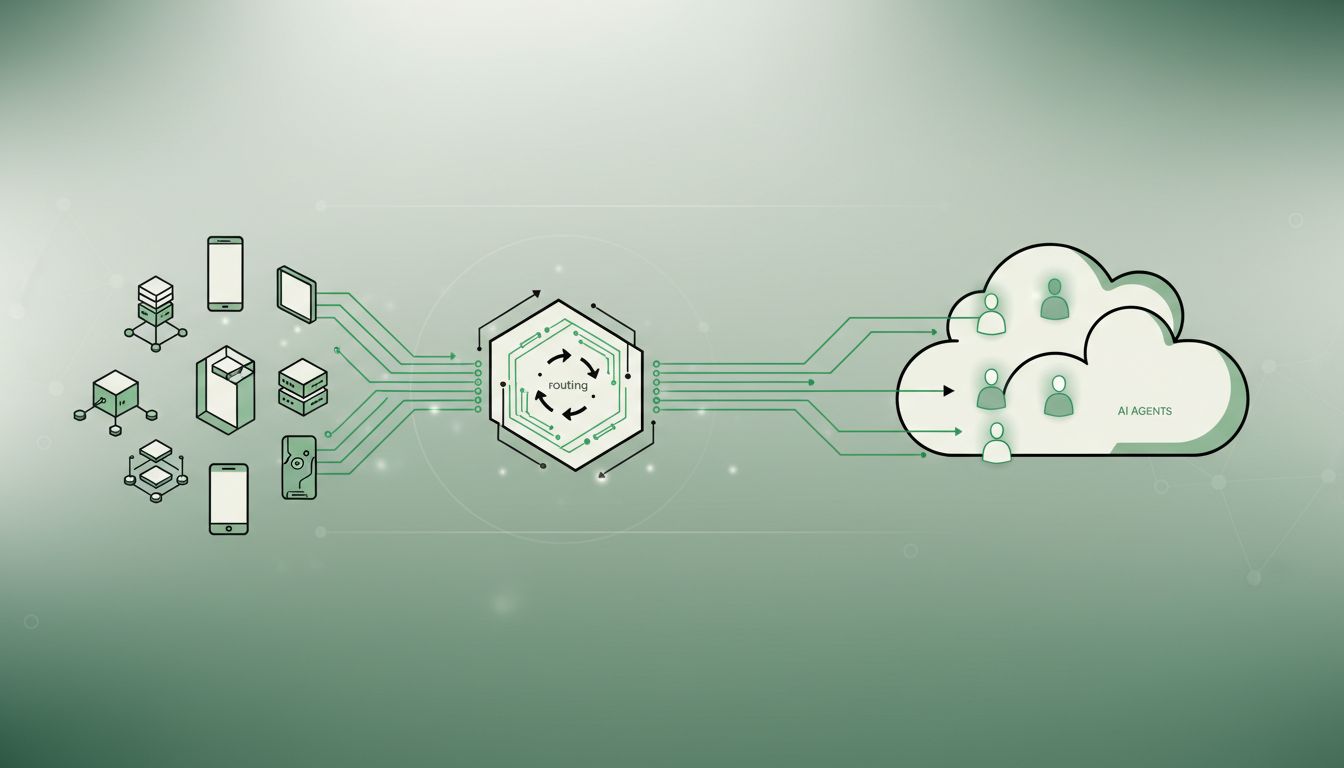
Directly binding an application, device, or agent to one model endpoint creates a fragile path: every provider change, capacity issue, regional constraint, cost decision, and safety requirement leaks into application code. Brokered handoffs are becoming the default answer because they put dispatch decisions in a managed control layer that can select, observe, retry, and fail over inference requests across edge and cloud resources.
For platform teams, this is not simply a new proxy pattern. It is a practical operating model for agentic workflows, hybrid inference, and multi-provider AI delivery: keep the request contract stable, then let policy determine where each model call should run and which model should handle it.
Why brokered handoffs are replacing direct model dispatch
Direct answer: Brokered handoffs are becoming the default for edge-to-cloud model dispatch because one intermediary control plane can route requests among models and locations, enforce policy, collect telemetry, cache results, retry failures, and apply provider fallback without hard-coding those decisions into every application or device.
A direct integration is attractive at first. An application calls a provider SDK or endpoint, sends a prompt, and receives a response. That path can be adequate for a contained workload with one model, one region, and limited operational requirements.
Production conditions are rarely that static. Providers expose different models and APIs, model availability changes, workloads cross regions, and teams need consistent logging, authentication, rate limiting, cost controls, and guardrails. In a physical or edge environment, the execution decision also involves network conditions, device power, local compute capacity, and latency.
A dispatch broker separates those changing concerns from the caller. The client sends a request to a stable gateway or proxy, while the broker applies routing policy and hands the request to an eligible edge, cloud, or provider target. The result is a cleaner boundary between product logic and inference operations.
Callers
express the task, model requirements, and relevant request constraints.
The broker
evaluates eligibility, policy, quotas, routing rules, and failover order.
Inference targets
run at an edge location, a cloud GPU environment, an external model provider, or a specialized internal endpoint.
Operators
use centralized telemetry to understand decisions, performance, cache behavior, failures, and spend.
This arrangement is increasingly concrete rather than theoretical. Cloudflare positions AI Gateway as a single layer for observing requests, applying routing policies, and managing cost controls across supported model providers. Its Dynamic Routing guidance describes composing a small flow that evaluates conditions, enforces quotas, chooses models, and defines fallbacks.
The important change is not that every request must be moved to the cloud. It is that placement and provider choice are no longer assumed to be permanent properties of the application. They become controlled decisions made per request or per workflow stage.
Edge-to-cloud model dispatch needs policy, not a fixed endpoint
Edge-to-cloud architecture is often described as a placement question: should inference run on the device, near the user, or in a central cloud region? In practice, it is a policy question because no single placement is optimal across all workloads.
Microsoft Research’s work on robotics and physical AI makes the trade-off clear. Inference only on onboard GPUs can constrain performance, battery life, and scalability. Offloading work to edge or cloud GPUs can provide significant advantages, but the correct choice still depends on workload performance, latency, bandwidth, power consumption, and cost.
That combination of variables is why a broker is useful. A device should not need embedded logic for every possible capacity condition or infrastructure path. Instead, it can communicate with a dispatch layer that has current information about allowed targets and can apply a defined policy.
What the broker can decide
The exact policy will differ by system, but mature edge-to-cloud dispatch commonly needs to account for several kinds of decisions:
Eligibility:
Is the requested model available on this target, and is the target authorized for this workload?
Placement:
Should work remain local, move to a nearby edge resource, or use cloud capacity?
Provider selection:
Which external or internal model endpoint meets the task requirements?
Fallback:
What should happen when the preferred target is unhealthy, unavailable, invalid for the request, or constrained by policy?
Budget and quota:
Is the request within the applicable spend, rate, or usage limits?
Response handling:
Can a cached answer be used, should output stream back, and how should the request be observed?
Microsoft reports that distributed inference across robot, edge, and cloud resources improved task success rates, enabled larger models, and extended robot operating time. It also notes that this can be orchestrated through Kubernetes-based distributed inference tooling. The lesson for platform engineering is that offloading is not an exception path; it can be an operationally managed part of the inference fabric.
The same principle applies beyond robotics. A user-facing application may run close to users while reaching remote providers through a managed proxy. Cloudflare describes this setup as keeping the model layer behind a managed proxy while the application runs on its network, with the gateway handling functions such as logging, analytics, rate limiting, caching, retries, dynamic routing, provider fallback, token authentication, DLP, and guardrails.
Provider-agnostic model routing makes handoffs operational
Multi-provider AI was once largely an architectural aspiration. It is now embodied in managed products and routing interfaces. Cloudflare documents native AI Gateway support for providers including OpenAI, Anthropic, Azure OpenAI, Google Vertex AI, Mistral, xAI, and others, and states that its Agents SDK routes vendor models through AI Gateway.
That productization matters because a provider-agnostic layer gives teams a place to standardize operational behavior. A team can preserve a unified calling pattern while routing to different providers according to policy, rather than maintaining provider-specific behavior throughout each agent, service, and edge client.
Unified access is useful, but it is not the entire design
Cloudflare’s 2026 changelog describes unified API access across multiple model vendors as normal operational practice: teams can call models from OpenAI, Anthropic, Google, or Workers AI through one unified API. The same guidance distinguishes more complex cross-provider failover as a Dynamic Routing concern.
That distinction is useful. A common API reduces integration friction, but it does not by itself define the decision logic for production dispatch. Teams still need to specify which requests are eligible for which models, when a fallback is acceptable, what quality boundaries apply, and what conditions should stop a retry loop.
Cloudflare’s Auto Router illustrates the progression from fixed model selection to first-class routing behavior. Users can send requests to cloudflare/auto rather than naming a specific provider model, and the gateway can select a fallback model when a routed choice is invalid. This makes the dispatch path an explicit platform capability rather than a collection of application-side conditionals.
Custom-provider support extends the same pattern to heterogeneous estates. Cloudflare says AI Gateway can mediate internal models, regional providers, specialized models, and custom endpoints through a single proxy layer. That is especially relevant for enterprises that cannot treat public-provider endpoints as their only inference option.
The broker does not eliminate provider differences. Model capabilities, input formats, tool-use behavior, limits, and safety characteristics still matter. Instead, it gives teams one control point for deciding where differences should be normalized and where they should remain explicit in the workflow.
Agentic workflows make brokered handoffs more valuable
A single-model application can sometimes tolerate a fixed endpoint. An agentic workflow is more likely to need different models and tools at different stages, which multiplies the cost of direct integrations.
Cloudflare gives a practical example: a support agent may use a fast model to classify a message, a larger reasoning model to plan actions, and a lightweight model to execute tasks. Each stage has a different performance and capability profile, so treating every call as a request to one default model is often an operational compromise rather than a design principle.
NVIDIA’s NeMo Switchyard messaging similarly frames agents as beneficiaries of routing across specialized and frontier models instead of relying on one model for every step. It identifies staged and escalation routing as a way to reduce costs substantially while preserving performance.
Route by the job each step must do
A robust orchestration layer should let teams express task-oriented policy. For example, a workflow might use a lower-latency option for classification, reserve a stronger reasoning model for escalation, and direct tool-backed execution to a model that is appropriate for structured actions.
Use a stable workflow-level request contract instead of embedding provider assumptions in every agent.
Attach routing metadata that describes the task class, latency sensitivity, risk level, and allowed model tier.
Define escalation rules before production traffic reaches the system.
Record which route was selected and why, so quality, cost, and failure behavior can be reviewed.
Keep tool authorization and model routing related but separate: a model choice should not silently expand a tool’s permissions.
This is where an AI agent orchestration workspace can provide more than endpoint abstraction. When specialist MCP-connected agents hand off context and invoke tools from a shared control plane, the dispatch broker can be aligned with workflow state, policy, and observability. The handoff then becomes a governed transition between specialists, not merely a network hop.
Cost-aware routing is one clear example. Cloudflare’s guidance says Dynamic Routing is the practical choice when requests must move between providers while spend remains visible and controlled. The core benefit is policy-driven movement: the gateway directs requests according to defined rules instead of leaving cost behavior implicit in model names scattered through code.
Reliable brokered dispatch requires eligibility, failover, and observability
Centralizing dispatch does not automatically make it reliable. A broker needs accurate information about targets and disciplined failure behavior. Otherwise, it can centralize confusion just as effectively as it centralizes routing.
NVIDIA’s Personal AI Router architecture makes a useful operational model explicit. One request is sent to one node, responses stream back through the same path, and the proxy owns per-request node selection. Rather than choosing one fixed winner, the proxy generates an ordered failover list of eligible nodes and walks that list.
This ordered approach is materially different from a simplistic round-robin strategy. It means selection can be based on eligibility first, then preference and failover order. A target may be healthy but still unsuitable for a particular request.
Make model availability a hard gate
NVIDIA states that its proxy retains only nodes whose engine inventory advertises the requested model before routing model-bearing inference requests. This is a fundamental control: model-specific traffic should not reach a target that cannot serve the requested model.
Teams should treat eligibility as a first-class data problem. The broker needs trustworthy target metadata covering model inventory, location, health, capacity signals, policy boundaries, and relevant request compatibility. A routing system cannot make defensible decisions from a target list that is stale or incomplete.
Observe the routing decision, not only the final response
NVIDIA’s reference architecture maps inference-service concerns to queueing, placement, startup ordering, routing, and autoscaling. It also says operators should require telemetry showing routing decisions and cache behavior before making cache-aware routing a production default.
That guidance identifies an important limit. Caching and intelligent routing can improve efficiency, but they should not be accepted on faith. Operators need evidence of which request was routed where, whether a cache was considered or used, which fallback occurred, how long stages took, and what outcome the requester experienced.
At minimum, a production dispatch record should preserve request correlation, selected target, fallback sequence when used, model or model class, relevant policy version, timing, error classification, and cache outcome. The exact retention and privacy treatment must fit the organization’s controls, but without decision-level visibility, debugging hybrid inference becomes guesswork.
Model distribution and scaling are part of the handoff path
Dispatch does not end once a broker selects a node. For self-managed or distributed inference, the selected destination must have the right model available and be able to start or scale replicas quickly enough to meet the workload’s needs.
NVIDIA’s ModelExpress addresses this operational layer by describing direct GPU-to-GPU transfer of model weights through NIXL. It bypasses object storage, disk, and host memory to speed replica startup and scaling. That optimization supports the broader brokered model: placement decisions are more useful when the platform can efficiently make suitable capacity ready.
For engineering teams, the implication is to connect routing design with lifecycle design. A policy that chooses an edge or cloud target is incomplete if model inventory, warm capacity, startup ordering, and autoscaling are managed separately with no shared signals.
Publish model inventory and target capabilities to the routing layer.
Define which models require warm replicas and which can tolerate startup delay.
Link autoscaling signals to actual queueing and dispatch behavior.
Validate that a fallback target can serve the workload, not merely accept a connection.
Review startup, scale-out, and recovery behavior as end-to-end handoff scenarios.
The edge-to-cloud continuum literature has long described interconnected edge and cloud systems as a computing continuum, with performance optimization, heterogeneous deployment, and efficient AI workflows as central challenges. Current routing and model-distribution architectures are operationalizing that continuum through brokers, inventory-aware selection, and managed handoffs.
Where direct dispatch still fits and where brokered handoffs add over
Brokered dispatch is not a mandate to place a proxy in front of every experiment. For a narrow prototype, a single approved provider, or a tightly bounded internal service, direct model access may be simpler to build and reason about.
It can also be appropriate to keep a local inference path for workloads that cannot tolerate a network dependency, provided the system clearly defines what runs locally and what is allowed to offload. The point is not to force remote dispatch; it is to avoid hard-coding a universal placement assumption where the workload does not support one.
A broker introduces its own responsibilities. It becomes a control-plane dependency, needs careful authentication and authorization design, and must avoid becoming an opaque source of latency or unexpected behavior. Routing policies can also become overly complex when teams encode exceptions without ownership, test coverage, or clear quality criteria.
Use a broker when variability is real
Brokered handoffs are most compelling when one or more of these conditions apply:
Multiple model providers, internal endpoints, or regional deployment targets must be supported.
Agent workflows require specialized, fast, reasoning, or lightweight models at different steps.
Applications run at the edge while inference may use edge, cloud, or external-provider resources.
Provider fallback, quota enforcement, cost visibility, caching, or centralized guardrails are operational requirements.
Teams need a consistent audit trail of routing decisions and request outcomes.
Model availability and capacity vary across a distributed fleet.
Conversely, do not introduce dynamic routing merely because it is available. A fixed route can be the right policy for sensitive workloads, evaluated deployments, or tasks where model variation is not acceptable. The broker should be able to enforce a fixed policy as cleanly as it supports adaptive selection.
The broader infrastructure pattern supports this direction. Cloudflare’s 2026 Security Signals Report describes trust-by-proxy as the default operating model, reflecting an architectural preference for mediated handoffs and centralized policy enforcement. In AI dispatch, the same preference helps teams manage a growing number of models, locations, agents, and operational controls.
How to adopt brokered handoffs without losing control
Start with the dispatch decisions that are already happening informally. Most teams already have fallback code, provider-specific clients, budget conversations, ad hoc retries, regional exceptions, or agent prompts that assume a particular model. The goal is to move those decisions into an explicit, reviewable policy layer.
Map the current request paths.
Identify every direct model call, internal endpoint, edge deployment, and tool-backed agent step. Record the model assumption and the fallback behavior, including cases where no fallback exists.
Define a minimal stable request contract.
Standardize what callers send to the broker, while retaining task metadata needed for policy. Avoid pretending all models are identical when a workflow requires a specific capability.
Build eligibility before optimization.
Ensure the broker knows what each target can serve. Model-aware filtering should precede load balancing, cost optimization, or cache-aware decisions.
Introduce explicit fallback policies.
Specify the ordered alternatives, retry boundaries, and failure conditions for each workload class. Test the behavior when a preferred provider or node is unavailable.
Instrument decision-level telemetry.
Capture selection, fallback, latency, cache behavior, and outcomes. Use this data to validate policies before expanding automation.
Expand by workflow class.
Begin with a clear use case such as classification, support triage, or a noncritical agent stage. Add more adaptive policies after quality and operations teams can evaluate the results.
Cloudflare’s combination of Workers AI at the edge and AI Gateway for external providers demonstrates why this incremental approach is practical. Edge inference, unified analytics, caching, rate limiting, and fallback controls can coexist in one control plane, allowing teams to choose the appropriate execution path instead of treating edge and external inference as separate architectural worlds.
The durable design principle is simple: applications and agents should describe the work they need done, while a policy-aware platform decides the eligible route and makes that decision visible. As models, providers, and deployment locations continue to diversify, that separation is what keeps edge-to-cloud AI systems manageable.
Brokered handoffs are becoming the default because they convert model dispatch from embedded integration code into an observable operational capability. They support hybrid placement, provider-agnostic routing, model-aware eligibility, controlled fallback, and the specialized model choices that agentic workflows increasingly require.
For platform teams, the practical next step is to centralize one meaningful dispatch decision, measure it end to end, and expand only where the broker produces clearer policy, better resilience, or more workable operations. A stable control plane is not a replacement for engineering judgment; it is the place where that judgment can be implemented consistently.