
Home/Blog/Why model dispatchers matter for cost, compliance and uptime
Why model dispatchers matter for cost, compliance and uptime
November 3, 2026
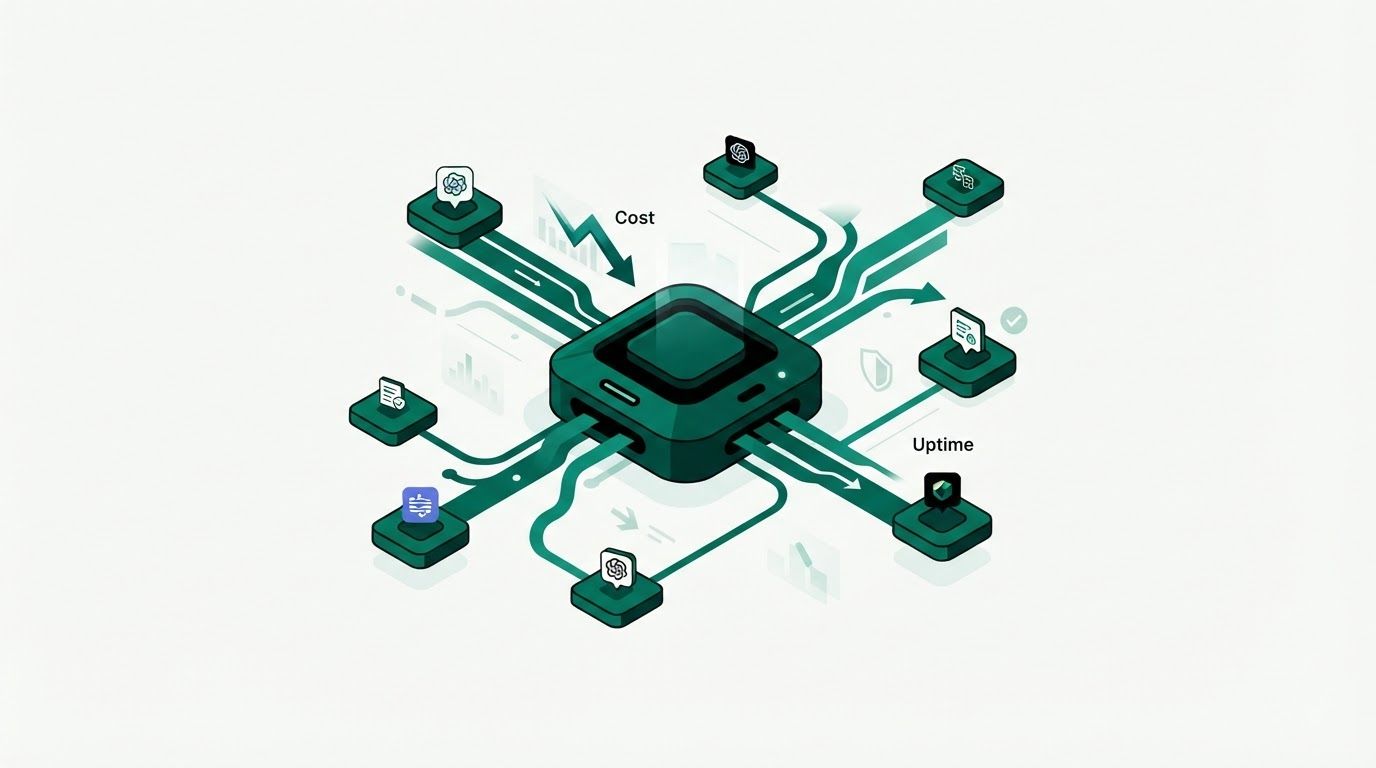
Model dispatchers matter because a single default model route is rarely the best route for every production task. For platform teams operating agent workflows, the dispatch layer is where cost, compliance, quality, latency, and availability can be evaluated together rather than treated as separate after-the-fact problems.
The practical goal is not to send every request to the cheapest or most capable model. It is to send each workload to an approved path that can complete the task at an acceptable quality, within its latency target, under the right data and access controls, and with a tested recovery path when a model, provider, or routing service becomes unavailable.
Why model dispatchers are essential in production AI systems
A model dispatcher is the decision layer that selects a model, provider, workflow, or fallback route for an incoming request. In an agent orchestration environment, that decision can account for the user’s task, the tools an agent needs, policy constraints, current capacity, expected latency, and the quality level required to finish the work safely.
It is tempting to view routing as a narrow performance feature: choose a faster model for simple prompts and a stronger one for difficult prompts. That is useful, but it is incomplete. Production dispatching also determines whether sensitive data can leave a defined boundary, whether an escalation uses an approved provider, and whether an agent can continue operating when its primary route is rate-limited.
Direct answer: Model dispatchers matter because they route each workload to an approved model and workflow based on quality, cost, latency, compliance, and availability requirements. They make those trade-offs explicit, measurable, and recoverable when the primary route fails.
OpenAI’s failover guidance makes the operational case directly: planned routing may split traffic across providers, and those patterns need tests of their own. This is an important distinction. A team can test a model in isolation and still fail to test the real system behavior created by routing rules, capacity limits, retries, fallbacks, and handoffs between models or providers.
For an AI agent platform, the dispatcher is also a context-preserving control point. It can pass a task to a specialist agent, retain the reason for a routing choice, apply a model-specific configuration, and record the outcome. That makes routing decisions inspectable instead of burying them in scattered application code, prompt branches, or individual business-unit integrations.
Cost control means measuring cost per successful task
Raw token prices are necessary inputs to cost management, but they are not enough to decide where a workload should run. A route that looks inexpensive per token can become costly if it produces weak outputs, retries, unnecessary tool calls, incorrect actions, or escalations to another workflow. Conversely, a higher-cost route can be economically preferable when it reliably completes a task that would otherwise fail or require human intervention.
OpenAI’s deployment checklist recommends evaluating task success, latency, input tokens, output tokens, reasoning tokens, cache-write tokens, and cost per successful task. That last measure is especially useful for model dispatchers because it joins the technical routing decision to a business-relevant outcome.
What to measure before changing routing rules
Task success:
Whether the workflow reached the required end state, not merely whether the model produced fluent text.
Action accuracy:
Whether an agent used the right tool, selected the correct record, applied the expected policy, or escalated appropriately.
End-to-end latency:
The time from request to usable outcome, including dispatch, model calls, tool calls, retries, and handoffs.
Token profile:
Input, output, reasoning, and cache-write tokens, assessed in the context of the completed task.
Cost per successful task:
Total cost divided by outcomes that meet the workflow’s defined success criteria.
Fallback frequency:
How often a route needs recovery, because frequent fallbacks can change both economics and user experience.
Consider a support workflow that classifies a request, retrieves account information, applies a policy, and drafts a response. Classification may be suitable for a smaller and faster model, while a policy-sensitive action may require a more capable model or an explicitly approved tool-backed agent. A dispatcher can separate those stages instead of funding the entire workflow at the highest capability level.
This is where model routing can produce meaningful improvements. Anthropic’s October 2026 Claude Haiku 5.5 release described more than a 30% latency reduction for task completions and up to 2.5x faster inference per agent turn. Those figures do not establish a universal result for every stack or workload. They do show why testing smaller or faster models for work they can safely handle belongs in an operational routing strategy.
Do not confuse prompt trimming with a routing strategy
Prompt optimization still has a place. Removing irrelevant context can reduce cost, improve clarity, and reduce the chance that a model follows misleading instructions. But it should not become the only answer to performance or spend pressure.
OpenAI’s latency guidance notes that cutting 50% of a prompt may improve latency by only 1.5%. For many workflows, the larger opportunity is choosing a better model-workflow combination, reducing needless agent loops, caching appropriate data, or routing a narrow task to a faster path. A dispatcher gives teams a place to make and test those choices systematically.
The trade-off is that more routing logic introduces more configuration, telemetry, and evaluation work. The answer is not uncontrolled complexity. Start with the task classes that have clear volume, cost, latency, or compliance differences, then expand only when evidence shows that another route improves the overall outcome.
Model dispatchers protect uptime with tested fallback routes
Availability failures are not limited to full provider outages. A production route can become unusable because a particular model is unavailable, a capacity constraint appears, a rate limit is reached, a dependency fails, or a routing decision service degrades. If every workflow depends on one provider-model path, each of these conditions can stop a business process even when another acceptable route exists.
A good dispatcher provides approved fallback routes. OpenAI’s guidance says that when a model-specific unavailability or capacity constraint occurs, the system should trigger an approved alternate route that still meets quality, feature, and latency requirements. “Approved” is doing important work here: a fallback is not simply whichever model endpoint responds first.
Design fallback around workload requirements
Define the primary route.
Specify the model, provider, tools, expected service characteristics, and policy conditions for the normal workflow.
Identify viable alternates.
Check that each fallback can support the required features, quality threshold, latency needs, tool interfaces, and data-handling rules.
Set failure triggers.
Decide what conditions cause a route change, such as a known unavailability, a capacity constraint, or a rate-limit response.
Define the degraded behavior.
A fallback may complete the task normally, limit certain actions, queue work, or require a human review depending on the workflow.
Test the complete recovery path.
Validate not only the alternate model call but also context transfer, authentication, tool behavior, logging, user messaging, and return to the preferred route.
Planned routing and recovery routing should be evaluated separately. Planned routing might send lower-risk, high-volume classification work to a fast model by design. Recovery routing exists for exceptional conditions and may use a different provider or a reduced-capability workflow. Treating them as the same rule can hide failure modes, especially when the fallback has different tool support, latency characteristics, or compliance eligibility.
OpenAI also says workflow owners should define behavior for the case in which a router or decision service is unavailable. This is a mature but often missed requirement. A dispatcher is itself part of the critical path; if it has no defined degraded mode, a resilient set of models can still be made unavailable by a single routing-layer dependency.
Uptime is a workflow property, not a model property
A model endpoint may be healthy while an agent workflow is unable to complete its job. The problem may be an unavailable tool, a missing permission, a slow retrieval service, or a policy check that cannot be evaluated. Dispatch design should therefore operate at the workflow level, not only at the request endpoint level.
An OpenAI status incident in 2026 showed that costs data in the Compliance API was delayed while API and ChatGPT usage continued unaffected. The event illustrates why teams should avoid assuming that all services move together. Decoupled services can have distinct failure modes, and continuity plans should identify what can proceed, what must wait, and what requires a controlled alternative.
A fallback is not automatically better than a temporary failure. If the alternate path cannot meet the task’s quality, feature, or policy requirements, routing to it could create a worse operational incident. For high-impact actions, the correct recovery behavior may be to pause, queue, or escalate rather than continue with an unsuitable model.
Compliance-aware routing makes eligibility a policy decision
Compliance cannot be added after dispatching if the route itself determines where data is processed, which tools receive it, and which records an agent can access. For regulated workloads, the dispatcher needs to know more than task complexity. It must enforce route eligibility based on data classification, user permissions, business unit, geography or regulatory boundary where applicable, workflow purpose, and the approvals attached to the available model and tool paths.
OpenAI’s failover design distinguishes between “approved, ready routes” and routes that are “eligible recovery only.” That model is useful because it prevents a common mistake: treating every technically available endpoint as equally permitted for all traffic. Technical connectivity does not establish policy approval.
Controls that belong in the dispatch layer
Data sensitivity classification:
Match the request and its retrieved context to routes permitted for that sensitivity level.
Access-aware agent selection:
Ensure a specialist agent receives only the records and tools allowed for the calling user and workflow.
Provider and model allowlists:
Limit production routing to reviewed routes instead of allowing ad hoc endpoint selection.
Purpose-based rules:
Separate uses such as drafting, summarization, case analysis, record updates, and external communications when they carry different risk.
Fallback restrictions:
Define which alternates are ready for normal use, which are recovery-only, and which are never eligible for a given class of traffic.
Audit-ready route records:
Capture the route selected, policy basis, relevant configuration, outcome, and any fallback event.
AWS warned in July 2026 that, without coordinated governance, agents operating across business units can create hidden cost aggregation and compliance violations when they cross regulatory boundaries without detection. That warning is directly relevant to decentralized AI adoption. When teams independently connect models, agents, and tools, each local implementation may appear reasonable while the organization loses visibility into aggregate spend, data movement, and route eligibility.
A centralized dispatcher does not mean every workflow needs identical models or identical policies. It means the organization has one enforceable mechanism for expressing which differences are allowed. Teams can still use specialist agents and fit-for-purpose models, but the decision occurs inside a governed framework rather than in unreviewed application logic.
Access control and auditability are operational requirements
AWS’s July 2026 public-sector example emphasizes that AI is useful only if it can access compliance records under the access controls and audit requirements of a federal environment. The broader lesson applies well beyond public sector deployments. An agent that is technically capable of retrieving information is not production-ready unless it does so under the permissions, logging, and controls appropriate to the environment.
For orchestration teams, this means context handoff needs the same care as model selection. A dispatcher should not casually forward full conversation history, retrieved documents, or tool outputs to every alternate route. It should pass the minimum context needed for the task and preserve enough evidence to explain how the route was chosen and what the agent did next.
Dispatch quality requires traces, evaluations, and failure testing
A polished final answer can conceal an inefficient or unsafe agent trajectory. The response may sound correct even when the agent called an unnecessary tool, looped through multiple model turns, chose an incorrect action, took too long, or routed work through the wrong policy path. This is why routing cannot be judged solely through subjective review of final text.
OpenAI’s 2026 customer support optimization example connects traces with cost, latency, action accuracy, policy compliance, and escalation behavior. Traces reveal unnecessary loops, incorrect actions, and routing failures that a final response can hide. For a dispatcher, this evidence is what turns a routing rule from a plausible hypothesis into an operationally defensible choice.
Build evaluations around real task classes
Begin by dividing traffic into meaningful workload categories, not vague labels such as “easy” and “hard.” Useful categories might include intent classification, retrieval-grounded answers, account-specific support, policy application, structured extraction, code generation, tool execution, and human escalation. The categories should reflect differences in required quality, tool use, data sensitivity, and acceptable latency.
For each category, define what success looks like. A support answer may need factual correctness, correct account context, compliant language, and an appropriate escalation decision. A tool-backed workflow may need the correct action, a complete audit record, and no unauthorized side effect. Measuring only response quality misses these requirements.
Collect representative tasks, including normal cases, edge cases, policy-sensitive cases, and expected failure conditions.
Run candidate primary and alternate routes against the same evaluation set.
Inspect end-to-end traces for model turns, tool calls, retrieval behavior, handoffs, retries, and escalation decisions.
Compare task success, latency, token categories, cost per successful task, and compliance-relevant outcomes.
Set route-specific acceptance criteria before rollout, then monitor production outcomes for drift.
OpenAI’s guidance on quality, latency, and cost trade-offs recommends preserving the current effective effort unless representative evaluations show that a quality gain justifies additional latency and cost. This is a useful discipline for dispatch decisions. A more expensive route should have a demonstrated reason to exist; a cheaper route should prove that it preserves the outcome required by the workflow.
Test the failure modes that routing creates
Routing adds scenarios that single-model evaluations will not expose. Test a rate-limited primary route, an unavailable provider, a slow decision service, an alternate route with different feature support, a tool that fails after dispatch, and a policy rule that makes the usual fallback ineligible. Also test what users and operators see when the workflow must queue, degrade, or escalate.
AWS’s May 2026 Resilience Hub update highlights structured resilience policies, failure-mode analysis, and reporting to demonstrate compliance across a portfolio. The important point is that resilience and compliance should be demonstrated through testing and organization-wide reporting, not assumed because a fallback exists in a configuration file.
Production telemetry should make route selection explainable. At minimum, teams need to identify the task class, selected route, route version, model and provider, fallback reason where relevant, policy decision, outcome, latency, relevant token measures, and cost attribution. The exact fields depend on the environment, but a route that cannot be reconstructed is difficult to improve or audit.
Where dispatching delivers the most value for agent workflows
Not every application needs a sophisticated multi-provider router on day one. A low-volume internal prototype with non-sensitive content and one well-understood task may reasonably begin with a single approved route. Dispatching becomes more valuable as task diversity, business impact, agent autonomy, model options, compliance obligations, or uptime expectations increase.
The highest-value opportunities tend to appear where one route is predictably overpowered, underpowered, too slow, too expensive, or not eligible for part of the traffic. Enterprise support operations are a clear example. AWS noted in September 2026 that scaling support means balancing strict SLAs, evolving compliance requirements, and documentation needs without proportional count growth. Those are precisely the constraints a dispatcher can manage at the workflow boundary.
Common workload patterns
High-volume intake:
Route classification, tagging, and basic extraction to a smaller or faster approved model when evaluations show it meets the task threshold.
Specialist handoffs:
Send requests needing domain tools, structured actions, or narrower expertise to MCP-connected specialist agents with the required permissions.
High-stakes decisions:
Use a route with stronger quality controls, appropriate human escalation, and a more restrictive set of eligible tools or providers.
Policy-sensitive support:
Separate general response drafting from account actions or policy interpretation, with different models and review conditions for each stage.
Resilient customer workflows:
Use tested alternate routes when the primary model is unavailable or capacity-constrained, while preserving the correct limits for the task.
Cross-business-unit platforms:
Apply central guardrails while allowing teams to use different specialist workflows within approved boundaries.
These patterns work best when dispatching is connected to orchestration rather than bolted on as a thin API proxy. The orchestrator understands the current workflow state, available tools, agent capabilities, user context, and handoff requirements. The dispatcher can use that information to make a more reliable decision than a router that sees only an isolated text prompt.
There is also a strategic reason to design for dispatching early. Anthropic’s 2026 State of AI Agents Report found that security and compliance concerns were cited by 40% overall and 44% of enterprises, while cost of implementation was cited by 43% overall and 40% of enterprises. Organizations do not need to wait for every concern to become an incident. An explicit dispatch layer gives teams a practical location to apply governance and optimize usage as adoption expands.
How to implement a practical model dispatch strategy
Effective dispatching begins with a small number of explicit decisions, not an attempt to build a perfect autonomous router. The first version should make approved routes visible, define the limited conditions under which they are selected, record outcomes, and provide a safe behavior when uncertainty or failure occurs.
1. Inventory workloads and constraints
List the workflows that call models or specialist agents. For each one, document the business objective, expected volume, latency expectation, required tools, sensitivity of the data and context, required audit evidence, quality threshold, and human escalation path. This creates the inputs for deciding which routes are both useful and eligible.
Do not classify tasks solely by prompt length or apparent complexity. A short request to modify a customer record can be more sensitive than a long request to summarize public documentation. The risk and required controls come from the intended action and the data involved, not from the number of tokens.
2. Define route contracts
A route contract should state what a route is allowed to handle and what it is expected to deliver. Include the model or provider, permitted data classes, supported features, tool access, quality criteria, latency expectations, cost assumptions, logging requirements, and fallback eligibility.
This contract makes it possible to distinguish a normal production route from an eligible recovery-only route. It also gives security, platform, product, and operations teams a shared artifact for reviewing changes rather than debating routing behavior through informal assumptions.
3. Use deterministic guardrails before probabilistic selection
Some decisions should be policy rules, not model judgments. For example, a route may be ineligible for a restricted data class, an agent may lack the access required to perform an action, or a workflow may require a specific audit trail. Apply these hard constraints first.
After that, the dispatcher can choose among eligible routes based on task classification, current capacity, expected cost, expected latency, or measured success rates. This sequence reduces the risk that an optimization decision accidentally overrides a compliance requirement.
4. Keep the initial routing policy understandable
Start with a rule set operators can explain: route task class A to route X; route task class B to route Y; if X has an approved capacity or availability failure, use Z; if no eligible route exists, queue or escalate. More sophisticated selection can be added after the baseline has sufficient evaluation and production evidence.
Opaque routing can make troubleshooting difficult. If an unexpected cost spike or policy event occurs, teams need to determine whether the issue came from classification, eligibility rules, capacity logic, fallback behavior, tool availability, or a change in the underlying workflow.
5. Treat routing configuration as production software
Version routing policies, review changes, test them against representative evaluations, and keep a rollback path. A seemingly minor adjustment can shift substantial traffic, change provider exposure, alter tool behavior, or move a workflow beyond its latency budget.
Use staged rollout where appropriate. Compare the new route against the current route using the same success and trace-based measures, then increase traffic only when the result meets the defined acceptance criteria. This supports evidence-based optimization without making the entire user population the first test group.
6. Plan for dispatch-layer failure
Specify what happens if the router, decision service, policy service, or telemetry dependency is unavailable. Depending on the workflow, a safe default could be a known approved route, a limited no-action experience, a queue, or human escalation. The correct choice depends on the risk of proceeding without the usual decision logic.
What matters is that this behavior is intentional and tested. A routing layer that silently fails open may undermine compliance; one that always fails closed may unnecessarily stop low-risk work. The workflow owner should decide based on the route contract and the consequences of error.
Limits and trade-offs of model dispatchers
Model dispatchers are not a substitute for sound agent design, reliable tools, clear authorization, or evaluation discipline. They cannot make an unsuitable model safe for a high-impact task, and they cannot fix a workflow whose success criteria are undefined. Routing is a control and optimization layer, not a guarantee of quality or compliance by itself.
More routes can also increase operational complexity. Each additional route may require evaluations, policy review, telemetry, fallback testing, cost attribution, and change management. Teams should avoid adding providers or models merely for theoretical optionality when they do not have a concrete workload, recovery, compliance, or performance reason to support them.
There is a real tension between resilience and consistency. A fallback model may have different behavior, tool-calling characteristics, or response style than the primary route. For tasks where behavioral consistency is essential, the route design may need stricter fallbacks, additional validation, or an escalation path rather than broad automatic failover.
There is also a tension between centralized governance and team autonomy. A centralized control plane should make approved specialist-agent workflows easier to ship, not force every team into one generic model. The practical balance is common policy enforcement and shared observability combined with workflow-level ownership of task definitions, evaluation sets, and quality thresholds.
The strongest dispatch programs remain deliberately narrow where they need to be. They route only when there is a measurable reason, use policy constraints before optimization logic, test failure behavior, and revisit decisions as workloads, models, provider capabilities, and regulatory expectations change.
Model dispatchers turn model selection from a static configuration choice into an operational capability. They help teams direct each task to a route that is approved for its data and action, appropriate for its quality target, economical when measured by successful outcomes, and resilient when the preferred path is unavailable.
For teams building multi-agent systems, the next practical step is to identify the workflows with the clearest cost, compliance, or uptime pressure; define their route contracts and success measures; then test primary, fallback, and dispatcher-failure behavior with traces. That foundation makes it possible to scale specialist agents and tool-backed workflows without losing control of the decisions between request and outcome.