
Home/Blog/Why stateless adapters and hardened auth are making ai integrations easier to secure
Why stateless adapters and hardened auth are making ai integrations easier to secure
October 23, 2026
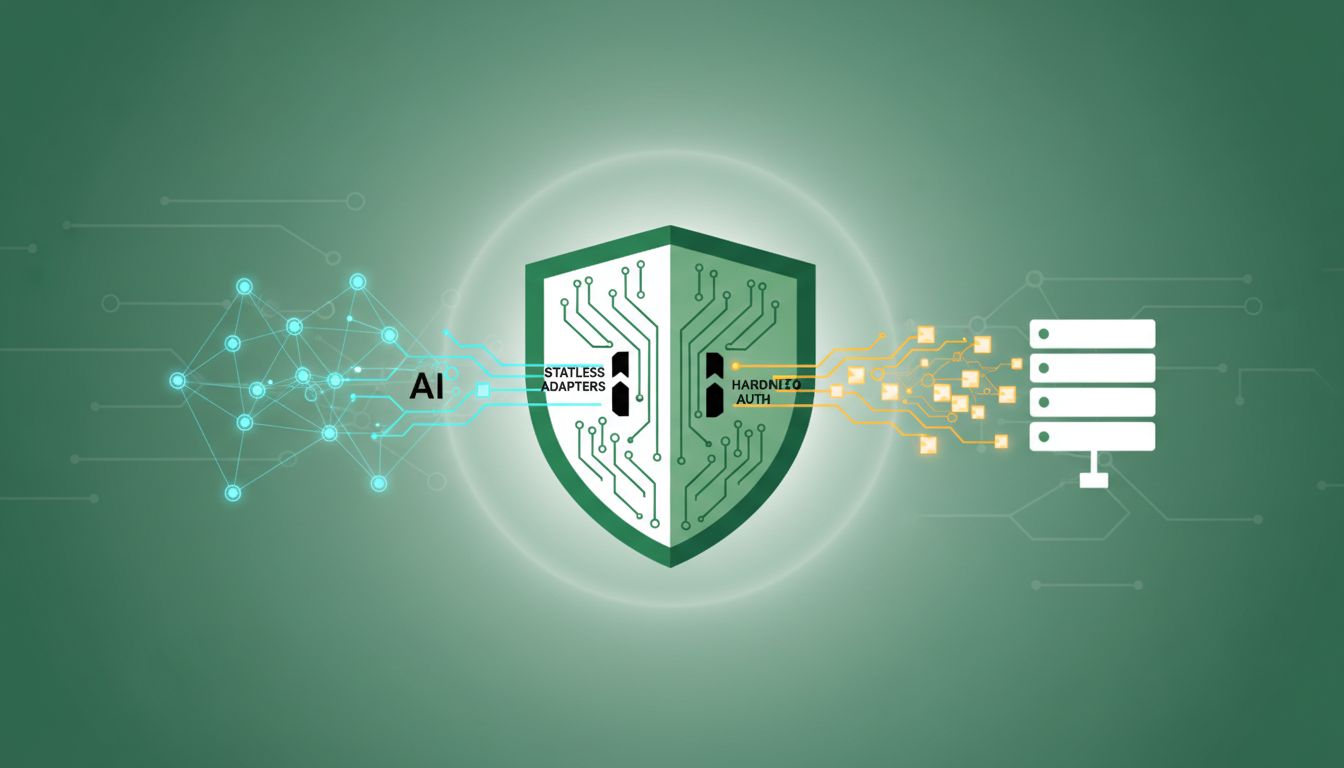
AI integrations become difficult to secure when every connector creates its own session, token cache, callback behavior, and permission model. Stateless adapters and hardened auth reduce that sprawl by making each request easier to authenticate, authorize, inspect, route, and revoke within a consistent control plane.
For teams building MCP-connected agents, the value is practical rather than theoretical: a thin adapter can focus on translating a tool call to an upstream system, while OAuth-based identity, consent, and policy enforcement live in well-defined layers. That does not make an agent trustworthy by default, but it gives platform engineers a much stronger foundation for securing multi-agent workflows.
How stateless adapters and hardened auth improve AI integration security
Direct answer: Stateless adapters make AI integrations easier to secure because they avoid hidden, long-lived server-side session state and carry the necessary protocol context with each request. Hardened authentication, particularly OAuth 2.1 with mechanisms such as PKCE, metadata discovery, and bearer-resource metadata, standardizes how identities, consent, and tokens are established and validated across those integrations.
In a stateful integration, a server often has to remember what happened earlier: which client connected, which protocol version it negotiated, what capabilities were selected, what authorization context applies, and whether a session remains valid. That state can be useful, but it also becomes security-sensitive infrastructure that must be stored, expired, synchronized, protected, and diagnosed.
With the MCP 2026-07-28 release candidate, MCP became stateless at the protocol layer. Protocol version and client capability information move into per-request metadata rather than depending on a persistent bidirectional session. Google Cloud describes the same model for MCP 2026-07-28: standard request ers and context are sent per request.
That shift does not remove all state from an AI platform. Authentication systems, user consent, OAuth refresh-token handling, server selection, audit records, and workflow state may still need durable storage. Cloudflare, for example, notes that its portal retains authentication, server selection, and upstream OAuth state. The important architectural distinction is that a tool-facing adapter need not retain opaque protocol session state merely to serve the next call.
Fewer hidden assumptions:
Every request can be evaluated against explicit ers, context, identity, and policy.
More uniform enforcement:
Gateways and policy layers can apply the same controls before a request reaches a specialized tool server.
Cleaner horizontal scaling:
An adapter is less dependent on a specific process or node remembering an earlier exchange.
More reliable investigation:
Request logs can associate a tool action with the applicable caller, audience, scopes, and policy decision.
The result is not simply “stateless is secure.” It is that statelessness removes one common source of integration-specific security behavior, making disciplined security controls easier to apply consistently.
Why session state complicates MCP and agent integrations
An agent workflow rarely calls only one system. It may route a request through an orchestrator, delegate to a specialist agent, select an MCP server, invoke several tools, and send the result to another service. If each hop creates its own durable session semantics, the team must answer difficult questions about session binding, timeout behavior, affinity, revocation, and context propagation.
Persistent sessions can also obscure where authority came from. A downstream server may see a valid session but lack a clear, request-level account of which end user, workload, client application, or agent is acting now. This ambiguity becomes especially important when one automated actor performs actions on behalf of many users or crosses several business domains.
Per-request context is easier to place behind controls
Request-based context handling gives an enforcement point a clearer unit of work. A gateway can validate the token, inspect its intended resource and scopes, evaluate the request route, apply rate or admission policy, and record the outcome before forwarding the request. It can do so without reconstructing an informal connector-specific session.
This is aligned with the direction described in MCP materials. Google Cloud’s overview identifies per-request ers and request-based context handling as elements of the stateless design. Cloudflare’s MCP portals explicitly support stateless MCP 2026-07-28 clients and servers, which indicates that stateless adapters are becoming a viable vendor deployment pattern rather than an isolated design preference.
Stateless does not mean context-free
A common mistake is to interpret a stateless protocol as one without identity or context. The opposite is closer to the truth: the relevant context must be provided, validated, and bounded for each request. That demands careful design of ers, tokens, audience restrictions, scopes, request routing, and log correlation.
It also means teams should distinguish three kinds of state:
Protocol state:
session negotiation and client capability details. MCP’s newer stateless direction minimizes dependence on this at the adapter layer.
Security state:
identities, consent records, key material, token lifecycle data, and authorization policy. This belongs in hardened identity and policy systems.
Business and workflow state:
task progress, approvals, handoffs, and artifacts. This belongs in explicit workflow and application stores, not accidental connector sessions.
Making these categories explicit helps teams keep a short-lived tool request from inheriting broad or stale authority merely because it is attached to a long-running connection.
Hardened OAuth 2.1 makes identity and consent more portable
Stateless transport only solves part of the problem. An adapter still needs to know who is calling, whether that caller can access the requested resource, and how credentials should be acquired and renewed. This is where hardened authentication and authorization standards reduce custom security work.
Cloudflare describes MCP authorization as using a subset of OAuth 2.1 and separates authentication from authorization for MCP servers. That separation matters. Authentication establishes the identity of a user, workload, or client. Authorization determines what that identity may do at a particular server or underlying service. Treating the two as separate concerns prevents a successful login from being mistaken for unrestricted permission.
Google’s account-linking guidance recommends OAuth 2.1 enforcement for stateless AI agents and multi-modal pipelines, while noting that the implicit flow is deprecated for new integrations. Keycloak’s MCP authorization guidance states that MCP authorization servers must support OAuth 2.1 requirements such as PKCE in newer MCP revisions. NetScaler’s MCP gateway guidance similarly says MCP clients, including VS Code, Claude Desktop, and Copilot, follow authorization specifications that mandate OAuth 2.1 along with RFC 9470 and RFC 9728 support.
What the hardening components contribute
OAuth 2.1:
Provides a standardized authorization framework instead of each AI connector inventing its own way to exchange credentials and consent.
PKCE:
Adds protection to authorization-code exchanges, which is particularly relevant for client applications that cannot safely keep a confidential secret.
Authorization-server metadata discovery:
Lets clients discover supported authorization endpoints and capabilities through a defined mechanism rather than static, ad hoc setup.
Bearer-resource metadata:
Helps a client identify the authorization details associated with a protected resource, improving the consistency of resource-specific token acquisition.
Audience and scope validation:
Helps ensure a token issued for one resource or permission set is not treated as universal authority across unrelated tool servers.
These mechanisms do not eliminate implementation decisions. Teams still decide which identity is delegated, what scopes exist, how consent is presented, and which actions require additional approval. But standards reduce the temptation to use a long-lived shared API key because a connector lacks an interoperable authorization path.
The OpenID Foundation has noted that AI-agent ecosystems commonly fall back to API keys when teams do not have time to implement proper OAuth flows. That operational reality is precisely why standardized hardened auth matters: it makes the secure path more repeatable across agents, tools, and platforms.
Use identity-based access instead of shared secrets
Shared secrets are convenient at the beginning of an integration because they appear simple: place a token in a configuration store and let the agent call the service. The simplicity often breaks down when several agents, users, environments, or services share that credential. Attribution becomes weak, permissions tend to become broad, and decommissioning one integration may affect others.
Google Cloud notes that remote MCP servers requiring authentication use Google credentials or identity for the AI application. This reflects a broader security direction: use identities that can be scoped, audited, rotated, and disabled rather than treating a secret as a permanent identity for an entire integration.
Choose the acting identity deliberately
For every tool call, identify the principal that should be represented. It might be an end user whose access is being delegated, an application workload acting within a narrow service role, or a dedicated integration account for a task that cannot be tied to an individual user. The choice should be explicit and visible in authorization policy and audit logs.
Use delegated user identity when the action should honor the user’s own entitlements.
Use a narrowly scoped workload identity when an automated workflow has an independent, repeatable responsibility.
Use dedicated accounts when broad access is genuinely required, rather than sharing a human account or a generic token.
Disable service accounts when an integration is decommissioned, as Cloud Security Alliance guidance recommends.
Dedicated accounts are not a license for unlimited access. They are an operational boundary that makes ownership, review, rotation, and shutdown more manageable. Pair them with least-privilege scopes, resource restrictions, and a clear owner responsible for recertifying the integration’s access.
Microsoft Foundry’s MCP authentication documentation notes that most MCP servers require authentication to access both the server and the underlying service. This is an important reminder that securing only the MCP endpoint is insufficient. The server may be a broker for databases, ticketing systems, SaaS applications, internal APIs, or other resources, each with its own consequences if authorization is overly broad.
Put a hardened gateway in front of many stateless adapters
As organizations add specialized agents and MCP servers, a centralized gateway or control plane can prevent each adapter from becoming its own security island. The adapter remains narrow: receive a validated request, translate it to an upstream API or tool, and return a constrained result. The central layer takes responsibility for common identity, policy, observability, and routing functions.
A 2026 enterprise MCP gateway paper describes a centralized gateway as a response to the “user vs. automated non-user” persona problem. This is a real architectural issue: an agent may need to act under delegated user authority in one step and under a service identity in another. A central enforcement layer makes those transitions more visible and governable.
A practical division of responsibilities
Client or agent runtime:
Requests access, presents the relevant identity context, and limits which tools it can select.
Authorization service:
Authenticates parties, manages consent, issues or validates tokens, and supports OAuth metadata and protected-resource discovery.
Gateway or portal:
Validates inbound requests, enforces routing and policy, selects approved servers, maintains security state where needed, and creates audit records.
Stateless adapter:
Converts MCP requests into upstream actions with minimal local state and no independent, improvised authorization model.
Upstream service:
Enforces its own resource-level permissions rather than assuming the adapter’s presence is sufficient authorization.
Cloudflare’s observation that its portal retains authentication, server selection, and upstream OAuth state illustrates this division. Centralizing that state can allow adapters to remain stateless without abandoning the stateful capabilities that secure operations require.
This pattern also aligns with recurring MCP architecture patterns identified in a 2026 paper: the Domain-Specific Adapter and the Proxy Aggregator. A domain adapter can encapsulate the peculiarities of one system, while an aggregator or gateway offers a controlled front door for discovery, routing, and shared policy. For an orchestration workspace, this supports context handoffs and specialist-agent routing without making every downstream tool server responsible for the full identity stack.
Stateless design improves inspection, scaling, and incident response
Security controls are only useful when teams can operate them under load and during failures. Per-request context makes it easier to build predictable checks at a stable boundary. A policy engine does not have to recover the meaning of an old connection before deciding whether the next request is allowed.
For scaling, a stateless adapter can be deployed behind ordinary load-balancing patterns with less dependence on session affinity. For observability, logs can record the request identifier, caller identity, target server, selected tool, token audience, scope or authorization outcome, and upstream result classification. The exact fields depend on an organization’s privacy and security requirements, but the principle is to preserve enough evidence to explain a sensitive tool call.
Operational controls to design alongside the protocol
The NSA’s 2026 MCP security guidance says the core MCP specification does not mandate lifecycle controls. That is a boundary of the protocol, not a reason to skip lifecycle engineering. Organizations still need to define how integrations are approved, changed, monitored, suspended, and retired.
Inventory servers and tools:
Maintain an approved catalog of MCP servers, their owners, their upstream dependencies, and the data or actions they expose.
Bind tokens to intended resources:
Validate issuer, audience, expiration, and scopes before forwarding a request.
Record policy decisions:
Capture allow, deny, step-up, and routing outcomes in a way that supports incident investigation.
Rotate and revoke:
Plan for token invalidation, credential rotation, server removal, and rapid shutdown of a compromised integration.
Review access on change:
Re-evaluate permissions when a tool gains new operations, an agent receives new autonomy, or an upstream system changes its data classification.
Statelessness helps because a revoked or changed policy can be applied to subsequent requests at the enforcement boundary. It does not guarantee immediate removal of every already-issued credential or every external upstream session. Teams must understand the lifetime and revocation behavior of their own identity providers and downstream services.
Hardened auth is necessary because agents can be adversarially steered
The central risk in agentic systems is not limited to stolen credentials. An LLM can be influenced by untrusted content, including content that attempts to redirect the model toward a privileged tool action. A 2026 paper on zero-trust authorization for enterprise MCP argues that LLM agents can be prompt-injected into privileged tool calls, so authorization must remain effective even under adversarial steering.
This changes how teams should evaluate an authorization design. It is not enough to ask whether the agent can obtain a valid token. Ask whether a malicious instruction inside an email, document, ticket, webpage, or tool result could cause a valid identity to invoke an action beyond the user’s intended purpose.
Apply authorization at the point of action
Use layered constraints rather than trusting the model’s tool-selection judgment alone. A valid request should still encounter resource-level authorization, tool allowlists, parameter validation, and policies tailored to the sensitivity of the action. For especially consequential actions, a workflow can require an explicit approval step or a constrained execution environment.
Limit each agent to the tools and servers needed for its defined task.
Limit each tool token to the relevant audience, resources, and scopes.
Separate read, write, administrative, and high-impact operations where the upstream system supports it.
Validate tool parameters against policy, not merely against syntactic schema.
Use human confirmation or a separate approval workflow for actions with irreversible business impact.
A separate 2026 paper on attested tool-server admission makes a related point: MCP standardizes message exchange, not trust. An organization therefore needs admission controls that bound which servers and tools an agent may use. Discovery should not automatically equal approval, and an advertised tool should not automatically receive access to enterprise identity or data.
These controls are compatible with stateless adapters. In fact, explicit request context and centralized enforcement make it easier to decide whether the current caller may reach the current server with the current tool and parameters.
Where stateless adapters are not enough on their own
Stateless adapters simplify an important layer, but they do not solve every AI security problem. They do not determine whether an upstream API has safe permissions, whether a model output is correct, whether sensitive data should be sent to a tool, or whether an organization’s approval process is adequate.
They also do not eliminate the need for stateful security services. OAuth authorization servers need to manage identities, consent, token lifecycles, and signing material. Gateways may retain server-selection and upstream OAuth state. Workflow engines may need durable records of task progress and approval decisions. The goal is to put state where it can be governed centrally, rather than scattering it through every adapter.
When a different pattern may fit
A long-running, interactive workflow can still require durable application state. For example, an approval chain or a complex job should persist its business state explicitly so that it can resume safely after failure. That is different from requiring a tool adapter to maintain an informal protocol session as the source of truth for identity and permissions.
Likewise, a simple internal prototype may begin with a tightly controlled service credential. The production path should not stop there. As soon as multiple users, environments, teams, or tools depend on the integration, identity-based access, least privilege, lifecycle controls, and centralized policy become operational necessities rather than optional refinements.
The MCP project’s 2025 transport roadmap said it was working to standardize what “stateless” means across official SDKs. Teams should therefore verify the behavior of the specific MCP revision, SDK, client, gateway, and server they deploy. “Stateless” is a useful architectural property only when request metadata, authorization behavior, logging, and failure handling are implemented consistently end to end.
The most secure AI integration architecture is not one that assumes the agent is always correct or that a protocol alone establishes trust. It is one that makes authority explicit on each request, uses hardened standards for identity and consent, limits agents to approved tools, and keeps operational security state in deliberate control points.
For teams orchestrating specialist agents, start by making adapters thin and stateless, move authentication and authorization to OAuth 2.1-aligned identity services, and enforce tool admission through a central gateway. That combination makes integrations easier to scale and audit while preserving the controls needed when an agent, a user, or an upstream tool should not be trusted by default.