
Home/Blog/Why the move to stateless tool protocols is rewriting control planes for model-driven workflows
Why the move to stateless tool protocols is rewriting control planes for model-driven workflows
October 19, 2026
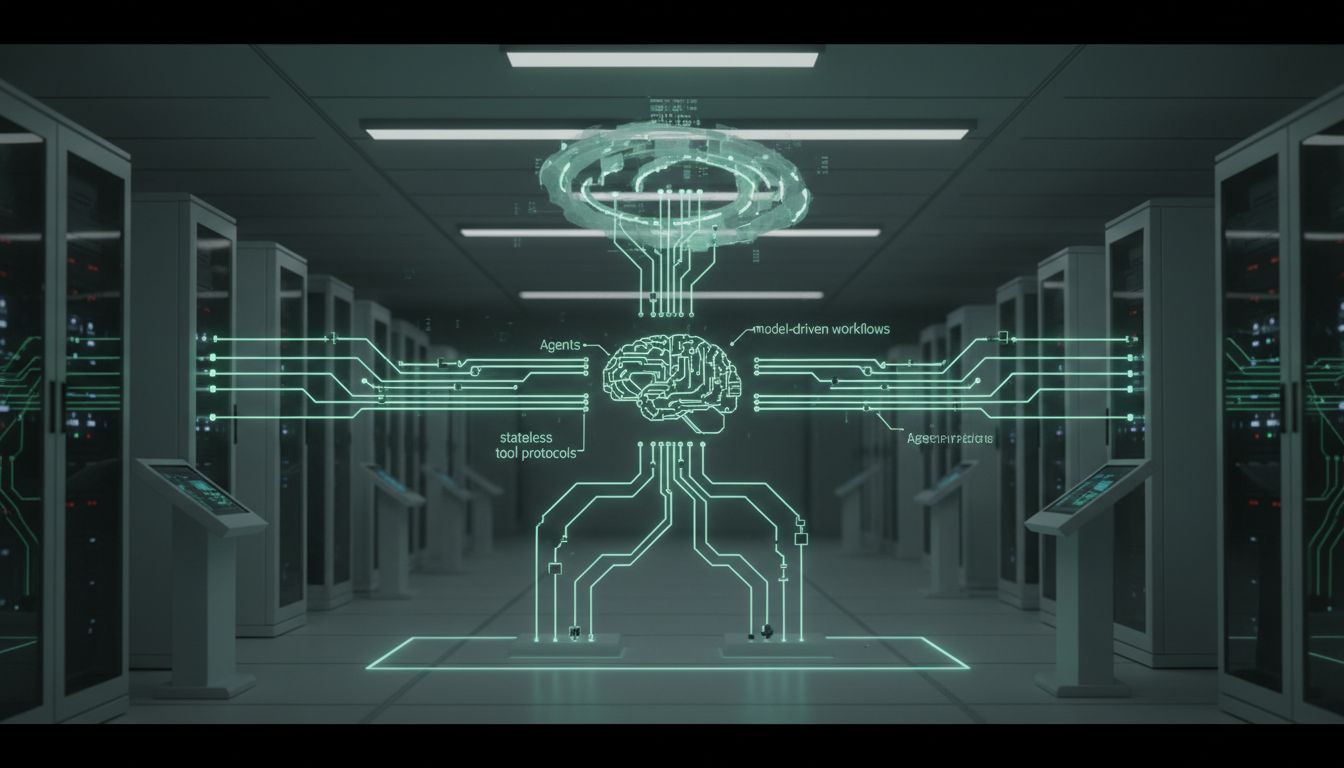
Control planes for AI workflows have traditionally absorbed the complexity that tool integrations exposed: persistent connections, session affinity, initialization handshakes, custom middleware, and application-owned tool loops. Stateless tool protocols change that division of labor by making each request carry the information required to route, validate, and execute work, while durable context is represented explicitly rather than hidden in a live connection.
This is not a claim that agent systems no longer need orchestration. It is a change in where orchestration belongs. As MCP adopts a stateless core and model platforms add tool discovery, hosted tools, and managed conversation state, the most durable control planes are becoming thinner policy-and-routing layers instead of bespoke session coordinators.
Why stateless tool protocols are rewriting the control plane
Direct answer: Stateless tool protocols rewrite control planes because they replace connection-bound session management with self-describing requests, explicit state handles, capability negotiation, and protocol-native tool execution. That lets a control plane focus on identity, authorization, policy, routing, observability, and cost controls rather than keeping sessions and custom tool loops alive.
The important distinction is between eliminating hidden state and eliminating state altogether. Model-driven workflows still require state: a conversation may need prior outputs, a tool may need a pending approval, and a long-running business process may need a durable work record. The new architecture makes that state visible as an object, handle, identifier, or request item that can be passed and governed deliberately.
That shift has direct consequences for platform teams. In a session-oriented design, control-plane behavior is often entangled with transport behavior. The system needs to know which process owns a connection, whether an initialization handshake completed, how to recover a dropped stream, and where server-side memory lives. Scaling, failover, and auditability all inherit that coupling.
In a stateless design, a request instead arrives with the protocol version, relevant capability information, tool arguments, and any explicit references needed to continue work. The control plane can evaluate that request at the edge or in a shared routing layer. It can then dispatch to an eligible tool provider without assuming the next request will land on the same worker or retain a particular connection.
The architectural direction is simple: make requests self-describing, make durable state explicit, and avoid treating a transport session as the source of workflow truth.
This does not automatically make every agent workflow simple. Distributed systems concerns remain, including authorization, idempotency, retries, data residency, and audit trails. But the protocol can now carry enough context for those concerns to be handled consistently across tools and runtimes rather than repeatedly rebuilt in application-specific middleware.
What MCP’s stateless core changes at the protocol level
The Model Context Protocol release dated 2026-07-28 explicitly moved its core to a stateless protocol model. Core request/response flows no longer require a held-open session, and the protocol adds explicit handles for information that truly must persist across calls. When a server needs to retain state, the specification’s direction is to mint a handle and require the model to pass that handle back as an argument.
That is a meaningful change from the familiar pattern of opening a session and relying on it as implicit shared memory. A persistent session can be convenient, but it can also conceal important operational assumptions: the session must be created, retained, recovered, associated with a connection, and eventually cleaned up. The state may also be difficult for a caller, policy engine, or auditor to identify independently of that connection.
From handshake state to request metadata
In the newer stateless model, requests are routed using protocol version and capability data carried in the request. The Go SDK documentation describes this model as having no initialize and notifications/initialized handshake. In practical terms, the receiving side has the information needed to interpret and handle a call without first reconstructing a long-lived protocol relationship.
This moves a portion of the control plane into standardized request processing. Rather than asking whether a session is initialized and what it negotiated earlier, an implementation can inspect the current request, determine the protocol version and supported capabilities, apply compatibility rules, and make a routing decision. That is more compatible with load-balanced, short-lived, and independently scalable infrastructure.
Explicit handles make state governable
Explicit handles are not just an API design preference. They create a stable boundary for governance. A platform can classify a handle, attach ownership and expiry rules, validate that a caller may use it, log its use, and reject it when it falls outside policy. Those controls are harder to express when the meaningful state is simply whatever a particular server process remembers about an open connection.
Conversation or work context:
represented as a durable, addressable reference rather than inferred from a socket.
Pending approval:
represented as a stateful object that can be resumed by an authorized caller.
Missing input:
represented in a retryable request flow instead of a connection-bound prompt exchange.
Tool-specific state:
exposed through a handle that the tool can validate on every relevant call.
The result is not necessarily less state. It is state that can be named, passed, checked, and observed. For enterprise control planes, that is the more important property.
How control-plane responsibilities move from sessions to policy and routing
In the session-centric era, an orchestration backend often became the place where every agent action was mediated. It stored model context, held tool connections, interpreted tool schemas, conducted retries, tracked approvals, and tried to maintain a coherent execution history. Some of those functions remain necessary, but stateless protocol design and model-native tooling reduce the need for one custom application layer to own all of them.
With per-request protocol metadata and explicit references, the control plane can be organized around a clearer set of responsibilities:
Authenticate the requesting principal.
Determine the user, workload, service, or agent identity making the call.
Interpret protocol and capability metadata.
Select compatible handling paths based on the request rather than prior connection setup.
Apply policy.
Check tool eligibility, data-access rules, approval requirements, tenancy boundaries, and allowed destinations.
Route the request.
Select an appropriate specialist agent, hosted tool, MCP server, or internal service endpoint.
Validate explicit state references.
Check handles, conversation objects, or prior outputs for integrity, authority, lifecycle, and scope.
Record execution signals.
Produce audit events, usage records, traces, and outcome data that do not depend on a session staying alive.
This is why the change is best understood as a control-plane rewrite rather than a transport optimization. The logic previously embedded in session coordination becomes a repeatable decision process around each request. It can be centralized, distributed, or applied at multiple enforcement points, but it no longer has to be attached to the lifecycle of a persistent connection.
A thinner control plane is not a weaker control plane
Thin does not mean passive. A mature routing layer may still enforce strict rules: which models can discover a sensitive tool, which arguments require human approval, whether a handle is valid in a tenant, whether a tool response can cross a data boundary, and whether a workflow has exceeded its budget. The difference is that these decisions can be made from declared protocol data and explicit state rather than from opaque application session memory.
This also improves composability. A specialist agent can hand off structured context to another specialist, and the receiving workflow can use that context according to its own policy. The control plane does not need to pretend that all work belongs to one monolithic backend session. For an agent orchestration workspace, this makes it more practical to route users and tasks to MCP-connected specialists while keeping enforcement consistent across the workflow.
Model-driven workflows are absorbing orchestration that apps once owned
The protocol change is reinforced by platform behavior. OpenAI’s Responses API documentation describes built-in tool search, deferred tool loading, hosted tools, and stateful conversations. These capabilities reduce glue code and orchestration that application backends previously had to implement themselves.
For example, tool search and deferred tool loading allow only the needed deferred tools to be loaded at runtime. OpenAI states that this preserves cache behavior while reducing context bloat and cost. A backend that previously injected every available tool definition into every model turn can hand more of the selection lifecycle to the platform and focus instead on defining which tools are permitted and under what conditions.
The Responses API is positioned as the main interface for agentic workflows. Its migration guidance says that the Assistants API was sunset on August 26, 2026 and directs new integrations to Responses, including tool calling, conversations, and hosted capabilities such as web search and MCP. That is a product-level signal that model interaction, tool use, and conversational continuity are becoming first-class platform concerns rather than purely app-specific mechanics.
Stateful interactions do not contradict stateless tool access
At first glance, managed conversation state and stateless tool protocols can appear to point in opposite directions. They do not. They address state at different layers. A model platform can maintain or reference conversation state, while the tool protocol avoids requiring a permanently open client-server session to execute a tool request.
OpenAI’s conversation-state guidance distinguishes stateless reasoning requests from conversation objects. It also notes that stateless reasoning requests should preserve every item in the output array. This is the same broad design principle seen in stateless MCP: if continuity matters, represent it explicitly in the information supplied or referenced by the next request. Do not assume that invisible transport memory is a reliable source of truth.
For workflow designers, this produces a useful separation:
Use a conversation object or prior model output when the model needs continuity.
Use a durable business record when a workflow needs enterprise lifecycle management.
Use an explicit MCP handle when a tool must continue server-owned state across calls.
Use the control plane to verify whether those references may be used in the current request.
That separation prevents a common design error: treating a model conversation, a tool transport session, and a business transaction as if they were the same object. They may relate to one another, but they have different owners, lifetimes, and governance requirements.
Multi-round-trip requests make stateless workflows practical
A common objection to stateless tool access is that real work is interactive. A tool may need missing parameters. A high-impact action may require a person to approve it. An agent may need to ask for clarification before a call can safely continue. Persistent streams have often been used to support these patterns because they keep a conversational channel open.
MCP’s 2026-07-28 specification introduces multi-round-trip requests, or MRTR, to address that need without relying on held-open streams. A server can ask for missing input or approval, and the client can retry the original call with the answers attached. The interaction becomes a sequence of self-contained requests rather than a dependency on a pinned, persistent transport.
What an approval flow can look like
A model selects a tool action that falls under an approval policy.
The tool server returns a request for approval or additional information.
The control plane records the pending action, associates it with the relevant identity and policy context, and presents it to the appropriate human or system approver.
The client retries the original operation with the required answer or approval information attached.
The tool server evaluates the retried request and proceeds only if the supplied information satisfies its rules.
The operational benefit is portability. The flow can survive changes in worker placement, connection loss, or runtime environment because the relevant information is carried forward in the retry rather than retained only in a live stream. A control plane can therefore support approvals and missing-parameter recovery across web applications, background jobs, queues, and other execution environments that may not maintain durable connections.
MRTR is not a substitute for carefully designed approval semantics. Teams still need to define who can approve, what exactly was approved, how long approval remains valid, whether arguments changed between the request and retry, and how the event is audited. Statelessness makes the transport simpler; it does not make governance decisions automatically safe.
Why cloud-native scaling favors explicit state and transport-agnostic routing
MCP describes the stateless core as enabling deployment on standard, scalable infrastructure without managing sessions or persistent connections. That is the infrastructure-level reason this protocol decision matters. Stateless request handling fits naturally with load balancing and horizontally scaled services because any eligible instance can process a request when the request includes the required metadata and explicit references.
Persistent connection designs can still be appropriate in some environments, especially where streaming interaction is fundamental or low-level connection semantics are part of the product. But they impose extra requirements: connection ownership, affinity, reconnect behavior, state replication or pinning, and failure handling tied to transport lifecycle. Those requirements can become disproportionate when the underlying task is ordinary request/response tool execution.
SDK behavior reflects the need to bridge both worlds. The C# and Go MCP SDK documentation describes automatic routing between stateless and stateful modes based on protocol version. That matters for platform engineers because it supports gradual adoption. A control plane does not need to assume that every server, client, or integration migrates at the same time.
What platform teams should design for
Version-aware gateways:
accept that routing behavior may vary by protocol version and capability declaration.
Handle lifecycle controls:
define issuance, scope, expiration, revocation, and validation for any explicit state handle.
Idempotent execution:
prepare for retried requests, especially in approval and recovery flows.
Structured observability:
correlate model activity, tool calls, handles, policies, and outcomes without depending on a connection identifier alone.
Mode coexistence:
support stateful and stateless interoperability during migration where the SDKs and protocol versions allow it.
Cloud ecosystem support provides additional evidence of the direction. The MCP blog says Amazon Bedrock AgentCore supports the new stateless core, while Cloudflare’s Agents SDK supports the specification from day one. These are not guarantees that all integration work disappears, but they show that cloud-native agent tooling is adapting to the same operating model.
The limits of stateless tool protocols and where state still belongs
The move toward stateless tool protocols should not be interpreted as an instruction to make every layer stateless. Durable state remains essential for many workflows. The question is whether the state is explicit, addressable, and governed independently of a transport connection.
A customer-support agent, for example, may need a conversation record. A procurement workflow may need a durable approval artifact. A deployment tool may need a job record with status, logs, ownership, and rollback information. These are legitimate stateful domain objects. The weakness is not their existence; it is hiding their lifecycle inside an incidental protocol session.
Trade-offs teams need to accept
Explicit state shifts responsibilities to interface and data design. Handles need meaningful scoping and expiration. Callers must retain or receive the references required for continuation. Tool servers must validate supplied references on every relevant call. Systems need to avoid assuming that a handle alone grants broad authority.
There is also a usability trade-off. A long-lived session can provide a straightforward mental model for a developer who wants to connect once and continue interacting. Stateless requests can expose more metadata and lifecycle details. Good SDKs, gateways, and orchestration products should hide incidental complexity while preserving the explicit control points that make the system safer and easier to operate.
Finally, model-native orchestration does not remove the need for application architecture. Hosted tools and managed conversations can reduce custom glue, but enterprises still need ownership boundaries, policy enforcement, business-level audit records, error handling, and human escalation. The strongest approach is to avoid duplicating platform capabilities while retaining control over the decisions that are unique to the organization.
A practical migration path for model workflow control planes
Most teams do not need a wholesale rewrite to benefit from this direction. Start by identifying where current orchestration depends on a live session rather than an explicit business requirement. The goal is not to remove every connection; it is to stop using connection memory as the default mechanism for workflow coordination.
Inventory session-coupled behavior.
Map initialization steps, in-memory context, connection affinity, tool loops, approval exchanges, and reconnect logic. Separate required product behavior from historical implementation convenience.
Classify state by owner and lifetime.
Decide whether each piece of state belongs to the model conversation, a tool server, a business workflow system, or the control plane. Give
durable state
an explicit representation.
Introduce request-level policy evaluation.
Use protocol version, capabilities, identity, tool name, arguments, and explicit references as inputs to authorization and routing decisions.
Adopt protocol-native continuation patterns.
Where applicable, use MRTR-style retries for missing information and approvals rather than building transport-bound interaction loops.
Use model platform features deliberately.
Evaluate hosted tools, tool search, deferred loading, and managed conversation state before rebuilding equivalent functions in application middleware.
Measure operational outcomes.
Track failed tool calls, retries, approval completion, routing decisions, policy denials, and the cost of tool context. The purpose is to validate that the new boundary reduces operational burden without weakening governance.
For a multi-agent environment, this migration also clarifies handoffs. A routing layer can select a specialist based on declared capabilities and policy. It can pass only the explicit context needed for the next task. The receiving specialist can use its tools through the same protocol controls, and the platform can retain an end-to-end record of the workflow without treating one application session as the sole coordinating mechanism.
That is the strategic value of a unified agent orchestration workspace: not recreating every protocol detail in proprietary middleware, but providing a consistent place to route work, connect specialists, enforce controls, and observe tool-backed execution across changing models and runtimes.
What to take forward
MCP’s stateless core, explicit handles, request-carried capability data, and multi-round-trip requests establish a protocol pattern built for scalable tool access without persistent session dependence. OpenAI’s Responses API follows a complementary platform pattern by bringing tool search, hosted capabilities, tool call loops, and conversation state closer to the model interaction itself. Together, these developments move routine coordination away from app-specific glue code.
Platform teams should respond by treating the control plane as a protocol-aware policy and routing system: validate explicit state, select permitted tools and specialists, support version-aware interoperability, and retain durable business records where they belong. The result is not a state-free architecture. It is a more portable, observable, and governable one in which the protocol,not an opaque backend session,governs tool execution.