
Home/Blog/Why unified connectors are making AI assistants more reliable and enterprise-ready
Why unified connectors are making AI assistants more reliable and enterprise-ready
August 5, 2026
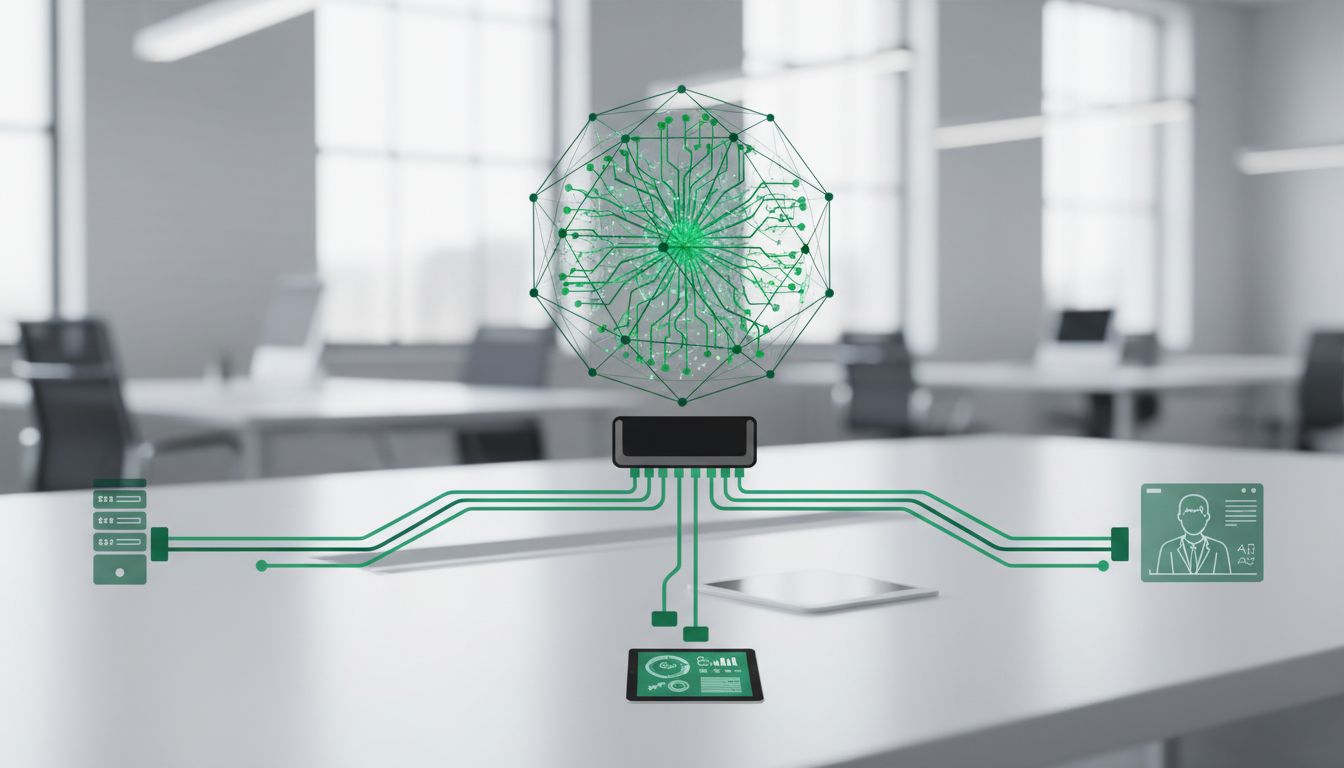
Enterprise AI teams are moving past the idea that a useful assistant is simply a better chat interface. In production environments, reliability depends on whether an assistant can consistently access the right business context, operate within approved permissions, and execute workflows without creating governance gaps. That is why unified connectors are becoming a core part of enterprise AI architecture rather than a convenience feature.
OpenAI’s recent shift from the term “connectors” to “apps” reflects this broader direction. The rename is designed to create a more unified connected experience in ChatGPT, while preserving existing functionality and prior setups. For platform engineers and operations teams, that continuity matters: changes in terminology are manageable, but broken integrations are not. The fact that existing connector configurations continue working signals a more stable path to enterprise adoption.
A unified integration layer improves operational reliability
One reason unified connectors matter is that they consolidate several enterprise use cases into a single integration model. OpenAI now describes apps as an umbrella for connected applications that can support file search, deep research across multiple sources with citations, and sync-based access to knowledge. Instead of treating each use case as a separate architectural pattern, teams can work from one connected layer.
That design reduces system fragmentation. In many enterprises, assistant reliability suffers when search, retrieval, and workflow execution are built through disconnected integrations with inconsistent authentication, incomplete metadata, or duplicated configuration. A unified connector model reduces those weak points by giving teams one standard way to connect tools and data into the assistant experience.
It also simplifies orchestration. In a workspace where users may be routed to specialist agents, handed off across tasks, and supported by tool-backed workflows, consistency in the connector layer becomes essential. When every agent depends on a common connected substrate, context transfer and tool invocation become easier to standardize, observe, and trust.
Better context leads to more dependable answers
Reliable AI assistants need more than model quality. They need dependable access to relevant enterprise information at the moment of use. OpenAI’s enterprise materials explicitly frame connectors as a path to secure access to company data inside core tools, enabling context-aware responses and automated actions. That framing is important because it shifts reliability from purely model behavior to the combined behavior of model plus context system.
Unified connectors help reduce the common failure mode where assistants answer confidently from incomplete or stale information. When connected applications can search and reference internal data directly, the assistant is more likely to ground its response in the organization’s actual documents, systems, and workflows. That creates more trustworthy outputs for operational, product, and support use cases.
OpenAI also links connected data to reduced context switching and better decision-making. In practice, that means users do not need to manually gather information from multiple systems before asking for help. The assistant can surface relevant internal information within the same interaction, which not only improves productivity but also lowers the chance of omission-driven errors.
Sync turns connectors into a performance and quality layer
Sync-based connectors are especially important for enterprise readiness because they pre-index selected knowledge sources in advance. OpenAI says apps with sync can bring relevant internal information into ChatGPT a of time, which helps speed up answers and improve response quality. For production systems, this is not a minor optimization; it directly affects latency, consistency, and user trust.
Without sync, many retrieval patterns rely heavily on live lookups at query time. That can work, but it also introduces more points of variability, including API latency, rate limits, and uneven source performance. Pre-indexing reduces some of that operational volatility by making high-value knowledge available through a more predictable retrieval path.
For enterprise teams building specialist agents, sync also helps create a cleaner separation between access control, indexing policy, and runtime orchestration. Teams can decide which knowledge should be synced, how often it should refresh, and which agents can rely on it. That makes assistant behavior easier to tune and govern across repeated workflows.
Centralized admin controls make assistants safer to deploy
Reliability in enterprise AI is inseparable from governance. OpenAI documents workspace-level app enablement, default-disabled behavior for Enterprise and Edu, and role-based access control for managing who can use which connected applications. These controls matter because a system that can technically access everything is rarely a system that should.
Centralized permissions reduce accidental overreach. Owners can assign app-specific roles through RBAC and control access at the workspace level, which helps organizations limit exposure and standardize usage patterns. For enterprises, that translates into better operational trust: teams know that an assistant’s capabilities are bounded by policy, not just by informal guidance.
From a platform perspective, a unified connector layer with centralized controls is easier to audit and maintain than a patchwork of custom integrations. Instead of reviewing access logic agent by agent or tool by tool, administrators can manage connected capabilities through a consistent control plane. That lowers administrative over while improving confidence in what is enabled, for whom, and under what conditions.
Security and compliance are built into the operating model
Enterprise AI deployments succeed only when security and compliance are part of the architecture from the start. OpenAI states that business, enterprise, and education customers can manage secure data flows and compliance needs through admin settings, with support for mechanisms such as OAuth and domain-wide delegation. This is a significant step beyond ad hoc tool hookups.
Unified connectors are more enterprise-ready because they make security repeatable. When authentication, delegated access, and app administration follow standardized patterns, teams avoid reinventing security design for every integration. That consistency reduces implementation risk and makes security reviews more straightforward.
OpenAI’s enterprise reporting also emphasizes that the hardest technical challenges for frontier intelligence appear in enterprise settings because they require reliability, safety, and security at scale. Unified connectors fit this reality. They provide the structured access layer that lets assistants work with sensitive business systems while remaining aligned with governance requirements.
Private testing and standard protocols reduce rollout risk
Another reason unified connectors are making AI assistants more reliable is that they support safer rollout practices. OpenAI now allows Enterprise and Edu admins, along with authorized developers, to upload and test MCP apps privately in developer mode before publishing them more broadly. That kind of staged deployment is essential for enterprise environments where mistakes can have operational impact.
Private testing allows teams to validate data access, action scopes, handoff behavior, and user permissions before exposing a connector to a wider audience. It also creates a controlled environment for evaluating how a new app behaves inside multi-agent workflows. For orchestration teams, this lowers the chance that a new integration will introduce regressions or unsafe actions into production.
The reference to full MCP connectors also signals where the ecosystem is ing: toward standardized connector infrastructure rather than bespoke one-off integrations. Standard protocols improve portability, reduce implementation ambiguity, and make it easier to build repeatable patterns across agents and tools. That is a major advantage for teams trying to operationalize assistants at scale.
Unified connectors support the shift from chat to delegated work
The strategic importance of unified connectors becomes clearer when viewed against broader enterprise AI adoption trends. OpenAI’s recent B2B research argues that the biggest gains come not from simple chat usage, but from richer and more complex AI use, including delegated workflows. Frontier firms reportedly use far more intelligence per worker, and their advantage is strongest in advanced, integrated tools.
That finding aligns with what platform teams are seeing in practice. A standalone assistant can answer questions, but an enterprise-ready system needs to route users to specialist agents, carry context across tasks, and trigger approved actions across business systems. Unified connectors are what make those interactions coherent. They turn the assistant from an isolated interface into a governed execution layer for work.
This is also why connected, governed workflows are becoming more important than isolated prompts. As enterprises push assistants into support operations, internal knowledge work, research, and execution-heavy processes, reliability depends on whether the assistant can connect context, permissions, and actions in a repeatable way. Unified connectors provide the structural foundation for that maturity.
In the near term, the terminology shift from connectors to apps may look cosmetic, but the underlying model is operationally meaningful. A unified integration layer that preserves previous setups, centralizes governance, supports sync, and aligns with standardized protocols is a practical improvement for enterprise teams. It reduces deployment friction while improving the consistency of how assistants access data and tools.
For organizations building multi-agent systems, this matters even more. The more workflows depend on specialist agents, context handoffs, and tool-backed execution, the more important the connector layer becomes. Unified connectors make AI assistants more reliable and enterprise-ready because they bring together context, controls, and workflow access in one governed system that enterprises can actually operate at scale.